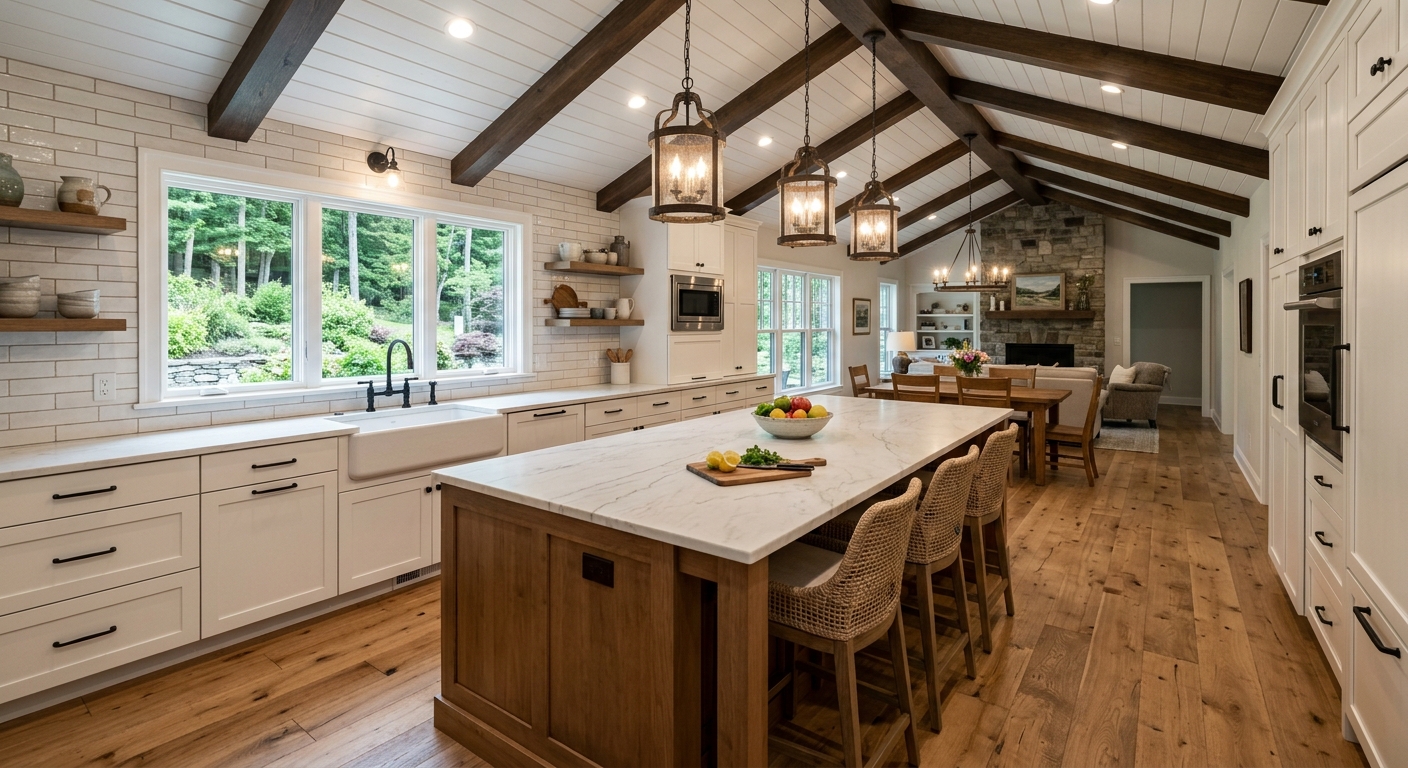
Kitchen renovation costs in West Deer — 2026
In West Deer, kitchen renovation costs sit squarely at the intersection of what homeowners need and what their homes demand. With a high homeownership rate of 85.1% and a median household income of $83,913 (U.S. Census Bureau, ACS 2024), investment in kitchen upgrades isn’t just common—it’s often about making the house work better for the family living in it. Many homes here date back several decades, so cramped or outdated layouts are frequently due for a wholesale rework, especially in houses from the substantial pre-1940 stock inherited from Pittsburgh’s development pattern. That’s why some West Deer projects are simple refreshes, while others turn into full gut jobs where walls move to open up the space.
Most kitchen budget overruns in West Deer aren’t due to luxury choices, but to homeowners pricing out a basic refresh and then deciding midway to move plumbing, knock down a wall, or change the footprint. Those shifts move you from the confines of a cosmetic “same layout” quote to a full gut remodel with layout changes—sometimes more than doubling your budget. Start by identifying what you really need the space to do, and compare costs in that scope before spending on style upgrades.
| Scope |
What's included |
Duration |
Price range |
| Full gut remodel, same layout |
cabinets, counters, appliances, flooring, lighting, fixtures |
6–10 weeks |
$30,500–$121,500 |
| Gut plus layout change |
all of the above plus moved plumbing, electrical, walls |
10–16 weeks |
$66,000–$121,500 |
| Cabinet replacement (stock to semi-custom) |
remove and install cabinets, hardware, patching |
1–3 weeks |
$7,100–$30,500 |
| Cabinet refacing |
new doors and drawer fronts, veneer, hardware |
3–6 days |
$7,100–$20,000 |
| Countertop replacement only |
template, fabricate, install, reconnect sink |
1–3 weeks |
$4,000–$16,000 |
| Kitchen flooring only |
remove existing, install new flooring |
3–6 days |
$5,100–$20,000 |
Estimates for a typical West Deer kitchen. Cabinet grade and whether the layout changes move these figures more than square footage.
Why appliance selection comes first
In kitchen remodeling, sequencing matters more than most homeowners realize—nowhere more so than with appliances. Every cabinet run is designed using exact appliance sizes as the starting point. In West Deer, I have seen perfectly good cabinets torn out because the fridge chosen at the end didn’t fit. Choose your appliances first, or risk an expensive redo.
Consider fridges: a standard-depth model will stick out past your cabinets and require extra filler on the sides, while a counter-depth fridge sits flush and needs precise cabinet installation. Slide-in ranges have finished sides and sit between the cabinets, while freestanding ranges may need a gap or filler. If you’re contemplating moving to induction or a commercial-style gas range, know that you might need a dedicated 240V circuit or upgraded gas service—both trigger code scrutiny and extra cost.
Panel-ready dishwashers deliver the integrated look people want but demand careful cabinet planning. The same goes for range hoods: ducting to the outside is best for air quality, but not always feasible without major wall or soffit work. Recirculating hoods are a compromise and rarely satisfy anyone who cooks regularly.
Finally, recognize that professional-grade appliances (the Sub-Zero, Wolf, and similar lines) deliver longevity and sometimes better cooking features, but the main premium is often finish and status. Many top-line “pro” ranges require custom hood solutions (and extra code steps).
Right now, some West Deer customers are waiting longer for appliances than for cabinets, so make selections early and ensure exact model specs are sent to your kitchen designer before any cabinets are ordered.
Practical survival during the work
A West Deer kitchen renovation isn’t just about new cabinets and countertops—it’s also about living without a functional kitchen for weeks or even months. Plan now for a temporary setup. The refrigerator often ends up in the dining room or basement. A microwave, a coffee maker or kettle, and a folding table with supplies can make day-to-day survival possible. Most homeowners use the laundry or bathroom sink for dishes and rely on paper plates for weeks. Your grocery budget will climb as you lean on takeout or prepared foods—eating out for eight weeks routinely adds up to more than $5,100–$20,000, which can rival what you spend on new flooring.
During the heaviest demolition and installation, dust will travel everywhere unless heavy plastic sheeting or zip walls are put up. That keeps construction grit out of your living space—and protects HVAC returns from filling up with debris. You’ll need to decide where to stage materials and the dumpster; in West Deer, driveways frequently double as work areas during renovation. Pay attention to pets if doors need to stay open—crews focus on the job, not on who might slip outside.
Some West Deer homeowners choose to move out for the demolition week, which can ease the hassle but is by no means required. If you plan ahead for where to cook, where to eat, and where the mess is headed, the renovation process is stressful but manageable.
What a kitchen quote should specify
The true test of a kitchen quote isn’t the total listed at the bottom. In West Deer and Allegheny County, homeowners get caught when one contractor puts in a realistic “allowance” (essentially a budget placeholder) while another enters a lowball number just to keep the total down. Two bids may look equal, but a tile allowance of $500 won’t buy even basic backsplash material, while a more honest line item at $2,000 tells the real story.
Allowances often cover appliances, tile, fixtures, and sometimes even countertops. Always compare those lines first before looking at the bottom number. Insist that the cabinet brand, line, and box construction are clearly written out—not just “quality cabinets.” Countertops should specify material, thickness (1.25" is standard for stone), edge style, and how seams are handled. Electrical lines should note how many new circuits, GFCI outlets, and lighting zones are included. Quotes must detail how unforeseen wall or floor issues are priced and the process for managing change orders—written homeowner approval before work continues is the standard here, not verbal agreements after the fact.
A payment schedule in West Deer should tie checks to milestones (like “after cabinet installation”), not calendar dates, and deposits shouldn’t be front-loaded with your cash at risk. Ask for lien waivers from every subcontractor with each payment. Remember, Pennsylvania law requires a written contract for any project over $500, and you have a 3-business-day right to cancel. That protects both sides.
| Line item |
What to look for |
Red flag if… |
| Allowances |
realistic amounts, itemized |
round numbers with no basis |
| Cabinetry |
brand, line, box construction |
'quality cabinets' |
| Countertops |
material, thickness, edge, seams |
material name only |
| Electrical |
circuits to be added, GFCI scope |
'as needed' |
| Unforeseen conditions |
how they are priced and approved |
not addressed |
| Change orders |
written approval before work |
verbal |
| Payment |
milestone-based, modest deposit |
front-loaded |
| Lien waivers |
from subs at each payment |
not offered |
Lead times, sequencing and why it takes longer
In West Deer and across Allegheny County, most frustration in a kitchen remodel comes from underestimated timelines. Between design, permits, material order, and build, an eight-week job can turn into twelve in the blink of an eye. Here’s the sequence most West Deer jobs follow: start with design and measurement (especially important in older homes with non-square walls common to the area), then place orders for cabinets as soon as dimensions are confirmed. Do not wait until demolition is underway—cabinet lead times are often 6 to 12 weeks. If you demolish before ordering, you risk having a gutted kitchen and empty space for months while waiting for delivery.
Demolition comes next, followed by rough-in for plumbing and electrical (and inspection if layout changes are involved), then drywall and floor prep. Once that is complete, cabinets are installed, but here’s the catch: countertops can’t be measured (“templated”) until the cabinets are in and leveled. Fabrication and install of stone or solid-surface tops usually takes another 1–2 weeks. During that gap, most other trades are stalled. Nobody tells you about this downtime, but it’s always there, even with the tightest schedules.
After countertops go in, the rest—backsplash tile, appliances, flooring, and trim—can finish up relatively quickly. Labor is in high demand in Allegheny County, and finish trades are often booked out months ahead. The key to making your job move: order all materials before demo starts, particularly cabinets and appliances, which dictate the entire timeline.
Cabinets: reface, stock, semi-custom or custom
What you choose for cabinets shapes both the look and the cost of your West Deer kitchen. There are four real options: painting, refacing, replacing with stock or semi-custom, or going entirely custom. Painting cabinets is the least expensive ($1,200–$3,500), but only makes sense when the cabinets and doors are structurally sound and you like the existing layout. Refacing—replacing doors, drawer fronts, and covering the boxes with new veneer—can deliver a dramatic update when the boxes themselves are square and solid, but won’t add storage or change the layout.
Stock cabinets come in set increments and work when your walls are straight and the dimensions fit standard sizes—this rarely happens in pre-1940 West Deer-area houses. In those cases, expect to need filler strips and to have fewer finish options. Semi-custom cabinets allow for size tweaks and broader style selections, which suits the quirky wall lines and room shapes in older homes common in Allegheny County. Custom cabinets fit anything (including odd angles or historic trim), but expect a major leap in cost and time.
Price doesn’t always predict durability. Look for plywood boxes over particleboard, dovetail drawer joints instead of staples, and full-extension, soft-close drawer hardware. Frameless (full-overlay) cabinets give a modern look and maximize storage, but may not suit some historic homes.
| Option |
Cost |
Best when |
Limitation |
| Painting existing cabinets |
$1,200–$3,500 |
boxes and doors sound, tight budget |
no layout or style change |
| Refacing |
$7,100–$20,000 |
boxes square and layout works |
storage unchanged |
| Stock cabinets |
$7,100–$30,500 |
standard dimensions fit |
filler strips, limited finishes |
| Semi-custom |
$20,000–$30,500 |
non-standard walls or finishes |
6–12 week lead time |
| Full custom |
$20,000–$30,500 |
unusual layout or high-end design |
longest lead, highest cost |
Code requirements for West Deer kitchens
In West Deer Township, Allegheny County, understanding local building code triggers can save major headaches at resale. For most cosmetic kitchen work—such as painting, cabinet refacing, or replacing countertops in place—a permit is generally not required. However, if your renovation moves electrical circuits, changes plumbing locations, removes or alters structural walls, or involves new mechanical ducting (like adding an exterior-vented range hood), you’ll need a permit. Permits are also typically required for any full remodels that reconfigure kitchen layout, since these changes usually bring plan review by the relevant municipal code office.
Electrical inspections in Pittsburgh are performed by the city, while some suburban municipalities use third-party inspection agencies approved for Allegheny County homeowners. Always clarify which system your municipality uses, as inspection can delay final approvals if not scheduled properly.
Contractors working on jobs over $500 must have Home Improvement Contractor registration with the Pennsylvania Office of Attorney General. You can verify this at hic.attorneygeneral.gov. If your project uses employees, contractors must also carry workers' compensation—check registration at the WCAIS portal (wcais.pa.gov). Not complying with these requirements risks fines and, more importantly, may complicate the sale of your house if unpermitted work is discovered.
Put simply: if you're planning anything beyond surface-level upgrades, factor in code compliance and permits, and get everything in writing before work starts.
Frequently asked questions — kitchen renovation in West Deer
What happens if previous work was unpermitted?
If unpermitted work is discovered during a new kitchen project in West Deer, you may have to open up finished walls or floors for inspection and bring everything up to the Pennsylvania Uniform Construction Code. This is especially common when homes from the pre-1980 era (56.4% of the local housing stock) have had casual updates over the decades. Inspections may require undoing part of the previous work, which adds both time and cost—sometimes as much as $5,100–$20,000 just to get back to code compliance. Worse, when it comes time to sell, unpermitted renovations can derail a real estate transaction because a buyer’s lender or home inspector will demand documentation. The safest route is to address any unpermitted work early, with a plan review and all needed inspections, rather than risk surprise costs and delays once a project is underway.
What does a full gut kitchen remodel cost in West Deer?
For a typical single-family home in West Deer, a full gut kitchen remodel (keeping the layout roughly the same) runs between $30,500–$121,500, with most jobs landing around $66,000. The lower end of that band usually means basic materials, no wall movement, and stock cabinetry. If you start moving plumbing, opening up walls, or specifying custom cabinets and professional-grade appliances, costs quickly approach the upper end. Remember, the age and layout of your home play a big role in where you fall on this spectrum. Even a modest kitchen budget will be stretched if existing walls are out-of-square or if asbestos, knob-and-tube wiring, or old plumbing surfaces during demo.
Can I renovate a kitchen in stages?
Staged renovations are possible and sometimes a good financial strategy in West Deer, especially when the kitchen needs more than the budget allows in one go. The common route is to do flooring and painting early, then move to cabinets and countertops next. However, staged work almost always costs a bit more overall, since crews have to return and protect previous new finishes with each phase. Important: don’t replace floors or paint walls until after major cabinet and countertop work is done to avoid damage. With costs for jobs like countertops in West Deer running $4,000–$16,000, spreading work over two years can make the outlay more manageable—as long as you plan the sequence with your contractor up front.
What are cabinet lead times in West Deer right now?
Cabinet lead times in West Deer vary by type. Stock cabinets from larger suppliers can sometimes arrive in as little as 2–3 weeks. Semi-custom orders, which are more common here due to older homes and the need for size tweaks, are averaging 6–12 weeks. Custom cabinets for unique layouts or finishes may exceed 12 weeks. Remember, the entire kitchen timeline pivots on cabinet arrival—waiting to demolish until cabinets are on order is critical to avoid living in a construction zone longer than needed. Plan accordingly, especially if you're making layout changes, as moving walls and utilities before cabinets have arrived risks unnecessary downtime and frustration.
How does West Deer's housing stock affect cabinet fit?
West Deer’s housing stock, like much of Allegheny County, contains a high percentage of homes built before 1980—more than half, according to the latest census data. This means walls are rarely square, room dimensions are non-standard, and corners often settle out of plumb. As a result, stock cabinets frequently require wide filler strips, wasted space, and rarely deliver a “built-in” look. That’s why semi-custom cabinets—priced at $20,000–$30,500 locally—are so common in West Deer, even when homeowners hope to use stock. The extra cost buys you cabinets that truly fit, more storage, and a better end result. Always double-check field measurements in older homes before signing off on a cabinet order.
What is an allowance in a renovation quote?
An “allowance” in a kitchen renovation quote is a budget placeholder for items you haven’t selected yet—appliances, backsplash tiles, or plumbing fixtures, for example. In West Deer, as in all of Pennsylvania, allowances are the main way two bids with the same total can be very different. A lowball countertop allowance (say, $4,000–$6,000 when you expect quartz) looks attractive until you choose a material and owe thousands more. Always ask for itemized allowances and realistic amounts—if a bid gives suspiciously round numbers or doesn’t allow enough for what you actually want, you’ll blow past your total in change orders once the job starts. Smart comparison starts with allowances, not with the total price.
How much more does moving the sink and range cost?
In West Deer, the cost to move your sink or range (and reroute the associated plumbing, gas, or electrical) adds a significant premium to your kitchen renovation. While cosmetic upgrades—like new counters or refacing—don't trigger these costs, changing locations pushes your project into “gut renovation” territory, which typically costs $66,000–$121,500 locally. That’s because opening floors and walls uncovers older plumbing and wiring (often non-compliant or deteriorated), and most municipalities will require both permits and inspections. Always budget extra for unforeseen issues if you plan on changing the footprint, and make sure your quote details these line items specifically so you avoid change-order shock mid-project.
What adds the most resale value in a kitchen?
In West Deer, kitchens sell homes—and the most value comes from layout improvements and quality mid-range finishes, not the most expensive cabinet line or appliances. Opening a cramped galley into a more usable space (see the frequent gut-renovations in Allegheny County's older stock) typically nets the highest return, even if you use stock or semi-custom cabinetry. Quartz or quality laminate countertops (budgeted at $9,100–$16,000) and full-extension drawer hardware are noticed by buyers. Avoid over-investing in professional appliances or exotic finishes unless your home already sits in the top value bracket for the area. A balanced upgrade almost always beats a luxury splurge for long-term value.
What flooring works best in a kitchen?
The best kitchen flooring for most West Deer homes is luxury vinyl plank or high-quality porcelain tile. Both stand up well to the heavy freeze-thaw cycles and clay subgrade common in southwestern Pennsylvania, meaning better resistance to expansion, contraction, and moisture. Wood looks great but can show gaps or finish issues in older homes with high humidity swings. Budget for flooring runs $5,100–$20,000 depending on material and area, with installation complexity in older homes pushing costs up. Tile remains king for durability, while luxury vinyl delivers warmth, comfort, and easy repair. Avoid cheap laminate—it just doesn’t hold up in the long run.