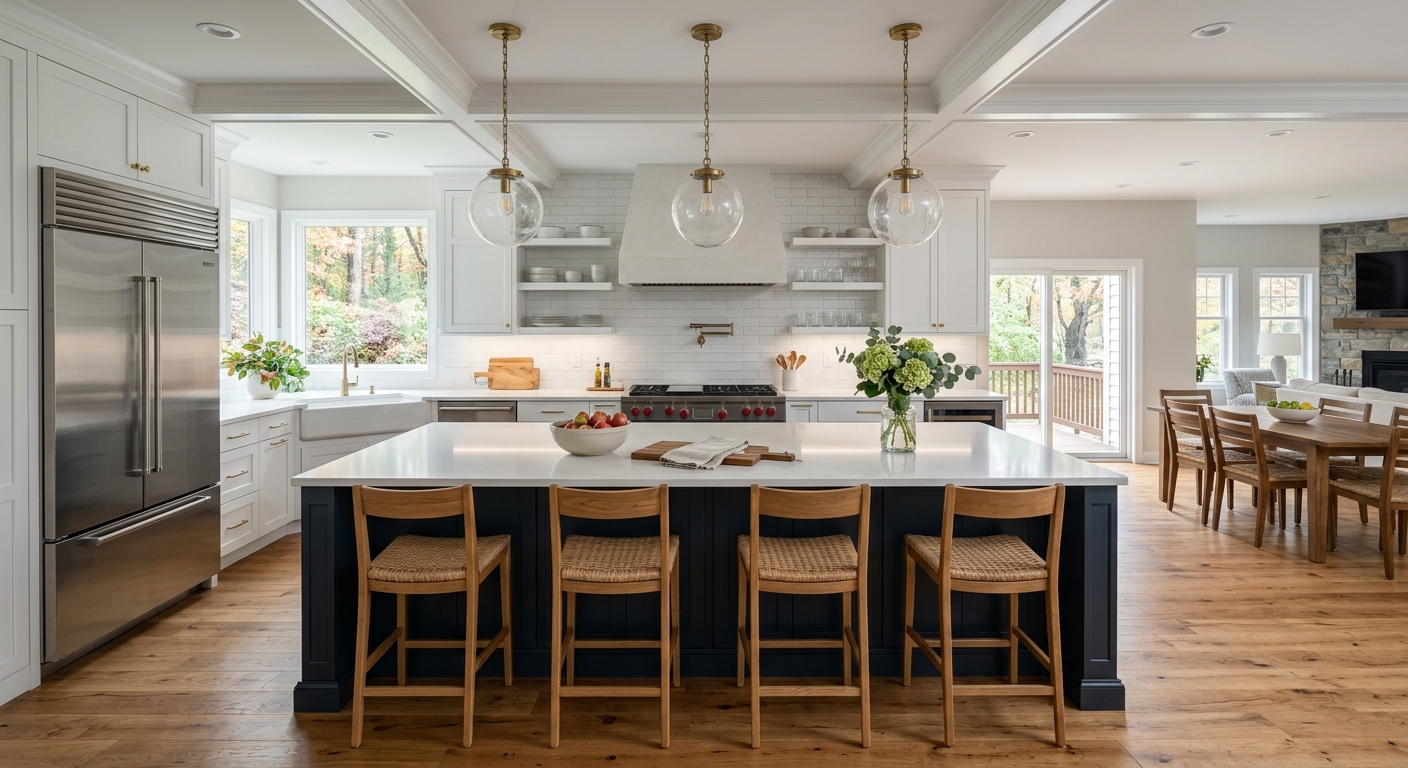
Hatboro kitchen renovation prices by scope — 2026
Hatboro’s kitchen renovation costs are shaped by homeownership patterns and what homeowners are willing to invest. With a homeownership rate of 56.3% and a strong median household income of $106,318 (U.S. Census Bureau, ACS 2024), many Hatboro owners plan kitchen projects to improve their living space rather than for quick resale. The region’s housing stock says a lot: many homes in the Hatboro-Abington stretch were built shortly after WWII—tract houses with compact, workhorse kitchens. These 1950s-1960s layouts often feel cramped today, which is why so many kitchen projects here balloon in scope and budget. If your house dates to the 1990s, you’re often looking at finish updates and appliance swaps; in older homes, owners routinely eye wall removal and expansion.
The single biggest source of blown renovation budgets in Montgomery County is homeowners pricing a simple “pull and replace” remodel, then shifting to plans that add wall removal or layout changes. These jump the project into a higher price and timeline band—sometimes doubling the budget. Know your scope beforehand, and budget for the tier you actually plan to build, not what seems “typical.”
| Scope |
What's included |
Duration |
Price range |
| Full gut remodel, same layout |
cabinets, counters, appliances, flooring, lighting, fixtures |
6–10 weeks |
$33,000–$131,000 |
| Gut plus layout change |
all of the above plus moved plumbing, electrical, walls |
10–16 weeks |
$71,000–$131,000 |
| Cabinet replacement (stock to semi-custom) |
remove and install cabinets, hardware, patching |
1–3 weeks |
$7,700–$33,000 |
| Cabinet refacing |
new doors and drawer fronts, veneer, hardware |
3–6 days |
$7,700–$22,000 |
| Countertop replacement only |
template, fabricate, install, reconnect sink |
1–3 weeks |
$4,400–$17,500 |
| Kitchen flooring only |
remove existing, install new flooring |
3–6 days |
$5,500–$22,000 |
Estimates for a typical Hatboro kitchen. Cabinet grade and whether the layout changes move these figures more than square footage.
When a Hatboro kitchen needs walls moved
Homeowners in Hatboro are often tempted to open up old, closed-in kitchens—especially in homes built before 1980, which is over 80% of the local stock (U.S. Census Bureau, ACS 2024). But shifting from a “same footprint” remodel to one that moves walls or reconfigures plumbing and electrical is the most dramatic price jump you’ll encounter. Keeping everything in place (the sink, stove, and major wiring) means your project sits firmly in the $33,000–$131,000 range. Move the plumbing or add new circuits, and you’re immediately looking at $71,000–$131,000—often without anything feeling twice as new.
Relocating sink or dishwasher lines isn’t just a matter of running pipe: drain lines need slope, so if your kitchen is above a finished basement or slab, building that slope without major demo is where money (and schedule) get consumed. Running new circuits can mean updating the electric panel—painful if you’re already close to its limit. Removing a wall is even trickier; someone has to determine if it’s load-bearing, and that means an engineer, a building permit, and often, more structure rebuilt elsewhere.
If you’re opening the floor plan, keep in mind that Lower Merion Township (which neighbors Hatboro) explicitly requires a building permit and plan review when you touch structural walls or change kitchen layouts. For most in Hatboro, the practical lesson is this: genuinely assess whether your kitchen’s footprint is dysfunctional, or just dated. Many homeowners spend more than $38,000 to move a sink three feet—and barely notice it day-to-day.
Planning appliances before cabinets
Kitchen renovations in Hatboro get into trouble fast when cabinets are specified before appliances. Cabinet shops build their layouts around your appliance choices—width, depth, and clearances—so if you buy a new fridge after your cabinet order, you’ll either live with a gap or have to reorder. Counter-depth refrigerators look built-in, but they need cabinet panels and a deeper overhead. Slide-in ranges sit flush and need precise counter cutouts, unlike freestanding models. Gas versus induction (or electric) isn’t just about taste: induction typically requires a high-amperage 240V circuit, which not all Montgomery County homes have in the kitchen, especially prior to 1980 builds. Panel-ready dishwashers disappear behind custom fronts, but they also need cabinet hardware planning. For range hoods, ducting to the outside is preferred—recirculating models are used only if outside venting isn’t practical, and local contractors will tell you it’s a last resort for real cooking performance.
Professional-grade appliances can deliver more robust burners or beefy hardware. But you’re paying heavily for design, name, and, in many cases, brand status rather than game-changing function. Unless you cook daily or entertain large groups, the incremental performance isn’t always worth the premium.
One last point: as of 2026, appliance lead times in the greater Montgomery County market can now exceed cabinet production on some models, especially specialty ranges and panel-ready refrigerators. Plan selections early, and don’t let the sequence trip up your timeline.
Countertop materials compared
In a Hatboro kitchen, countertop choice sets the tone for both look and long-term maintenance. Quartz—a factory-made, engineered stone—remains popular for its nonporous, easy-to-clean surface. You don’t have to seal it, but it doesn’t love heat: drop a hot pan on an unprotected surface and you risk damage. Granite, a natural stone, is more heat-tolerant and that appeals to many home cooks, but it needs a fresh seal every year or two. Laminate used to be the fallback, yet modern options are tough, easy to clean, and suit modest kitchens or rentals. Choosing laminate here isn’t a compromise—it’s a rational investment in plenty of Hatboro homes, especially those that won’t recoup more exotic stone at resale.
Butcher block brings inviting warmth, but demands discipline—standing water stains it, and regular oiling is non-negotiable. Solid surface materials (like Corian) offer invisible seams and can be sanded out if scratched or stained, making them a sleeper choice for durability. For all these options, price is affected less by square footage than by fabrication details: edge profiles, sink and cooktop cutouts, and whether installers can minimize visible seams.
Fabricators template your counters, then cut offsite—so make sure your sink and faucet choices are finalized before they show up to measure. Cabinet strength is also verified at this stage. For those watching investment closely, a mid-tier quartz or even the best new laminates can land in the $4,400–$17,500 range, with granite trending toward the upper bands for high-variation stones.
Permits and inspections for a Hatboro kitchen
If you’re renovating a kitchen in Hatboro or anywhere in Montgomery County, distinguishing what requires a permit is where many owners get tripped up—especially at resale, when unpermitted work may need to be redone. Cosmetic updates never trigger permits: painting, hardware swaps, and even replacing a counter in the same footprint is typically considered maintenance. But as soon as you move or add electrical circuits, relocate plumbing, bust out walls, or alter anything structural, you move into permit-required territory. For example, in Lower Merion Township (not far from Hatboro), removing a structural wall or changing a kitchen layout will require a building permit and official plan review, and a similar approach is found in many townships across the county.
Inspections for kitchen renovations depend on your municipality. In Norristown, municipal inspectors perform electrical work sign-offs. In many Hatboro-adjacent areas, however, third-party electrical inspection firms are the norm, which surprises many first-timers.
All contractors working on kitchen jobs valued at more than $500 in Pennsylvania must carry a Home Improvement Contractor (HIC) registration, which you can look up via the Pennsylvania Office of Attorney General. They’re also required to provide current workers’ compensation coverage for employees, verifiable through WCAIS. Skipping these protections can leave you exposed financially. Bottom line: Unpermitted or undocumented work may come back to haunt you during property sale, with buyers and their agents digging into permit histories during due diligence.
Defining your scope before you get quotes
Homeowners in Hatboro often start with “I want my kitchen updated” when what’s needed are hard lines: scope tiers. There’s a fivefold spread in price between tiers, so knowing which you want—and will actually stick to—is the only way to compare prices meaningfully. Here’s the breakdown:
- Cosmetic refresh: Paint, new hardware, refreshed backsplash, and swapped lighting—no layout or cabinet changes. Best for tight budgets or prepping for rent or sale.
- Pull and replace: Remove and install new cabinets and counters in the same footprint. Plumbing and electrical stay put. Fastest way to a “new” look without triggering major permits.
- Full gut, same layout: Tear everything down to studs, insulate, run new wires and pipes—but leave them in the same spots. Allows modern systems and better longevity without complex permitting.
- Layout change: Move walls, sink, stove, or structural elements. This is the major-league tier—expect reviews, engineering sign-offs, more inspections, and a much bigger spend.
The cliff is between option three and four. Moving a sink or range triggers not just permits, but also engineering and sometimes panel upgrades or extra trades. This is why many Hatboro kitchens jump from $33,000–$131,000 to $71,000–$131,000 with nothing flashy to show except less-obvious function.
If you want a quick, actionable start: decide your tier before calling anyone. No contractor can provide a meaningful quote until the scope is settled—otherwise you’re pricing apples and oranges.
Allowances, exclusions and change orders
Comparing kitchen bids in Hatboro will drive you nuts if you don’t understand the game of allowances. An “allowance” is a placeholder dollar for an item you haven’t selected yet—say tile, hardware, or lighting. You’ll see two quotes, both for $71,000, but one proposes an allowance for appliances of $6,000 (enough), while the other lists $2,000 (far short). This makes totals useless at face value—always compare the allowance lines before judging bottom lines. For every line item, you want brand, model, thickness for countertops, and specifics for electrical scope (like how many circuits are budgeted). If you see “as needed,” you’re being set up for cost increases.
How surprises are handled also matters: your contract should plainly state how pricing for unforeseen conditions and change orders works, and whether these must be signed before extra work proceeds. Payments should be tied to milestones (like “cabinets set” or “countertops installed”), not the calendar, and every payment to a general contractor should trigger a lien waiver from every subcontractor—so you don’t end up paying twice. State law in Pennsylvania enforces this: any contract over $500 must be written, and you get a three business-day right of cancellation (Home Improvement Consumer Protection Act). Waiving an insurance deductible is not legal and is a big red flag.
| Line item |
What to look for |
Red flag if… |
| Allowances |
realistic amounts, itemised |
round numbers with no basis |
| Cabinetry |
brand, line, box construction |
'quality cabinets' |
| Countertops |
material, thickness, edge, seams |
material name only |
| Electrical |
circuits to be added, GFCI scope |
'as needed' |
| Unforeseen conditions |
how they are priced and approved |
not addressed |
| Change orders |
written approval before work |
verbal |
| Payment |
milestone-based, modest deposit |
front-loaded |
| Lien waivers |
from subs at each payment |
not offered |
Frequently asked questions — kitchen renovation in Hatboro
Do older Hatboro homes need electrical upgrades for a kitchen?
Many Hatboro homes were built before 1980, and kitchen circuits from those eras are almost always underpowered for today’s appliances. Code now expects separate circuits for the dishwasher, disposal, and each countertop appliance zone—requirements most older kitchens don’t meet. If your house hasn’t seen a kitchen update in decades, plan for a panel assessment and possible rewiring. Hiring a contractor who knows local code and can coordinate with the right inspection authority (in Hatboro this could be a municipal or third-party inspector) is key. Factoring in upgrades can move a cabinet replacement from $7,700–$33,000 toward a full gut remodel budget if the panel or wiring needs attention. Don’t cut corners here—future homebuyers and insurance carriers will ask about the electrical work at resale or after any issue.
How much more does moving the sink and range cost?
The leap from a remodel where all plumbing and electrical stay put to one where you move the sink or range—even a few feet—is steep. Even a minor shift triggers more demolition (for slope and access), more trades, and typically a permit. In Hatboro, this shift jumps your budget from something like a $33,000–$131,000 “same layout” gut job to a $71,000–$131,000 full reconfiguration, often with little to show in visible upgrades. Think through whether the function truly demands it, or if you’re chasing a trend. Most postwar homes here don’t have clean runs for plumbing under floors, so that “simple” move means more structural and finish work than you’d expect.
What does a quartz countertop cost in Hatboro?
For a typical Hatboro kitchen, you’ll spend between $4,400–$17,500 for new quartz countertops, with most homeowners landing around $9,800 when using a reputable local shop. Price varies based on edge style, cutouts, and patterns. The cost reflects not just the material, but also fabrication quality and installation. Higher-end slabs (with premium colors or veining) and complex edges drive the price to the top end of the band. In modest kitchens, using a standard slab with a basic edge is a sound approach—quartz is easy to maintain and stays looking new for years, with no need for sealing like granite.
Should I renovate before selling or let the buyer do it?
In Hatboro, where homes range from pre-1980s to newer builds, the answer depends on your sale timeline and target buyers. If your kitchen is functional and clean but dated, sometimes cosmetic updates—like paint and hardware—are enough to show well and avoid the big spend. Full gut remodels at $33,000–$131,000 rarely return dollar-for-dollar at resale here, especially when most buyers want to put their own stamp on the space. If you do renovate for sale, stick to broadly appealing finishes and the “pull-and-replace” scope rather than bespoke upgrades. Ask your agent about buyer expectations in your neighborhood to avoid over-improving.
What flooring works best in a kitchen?
For Hatboro kitchens, the best option is usually luxury vinyl plank (LVP), quality tile, or good engineered hardwood. LVP handles spills and humidity, and modern products look convincingly like wood or stone. Tile is essentially bombproof if installed right, but can be hard underfoot and cold in winter—though Hatboro’s moderate climate means it’s less of an issue than in colder parts of the state. Engineered hardwood works in most kitchens, provided what’s under it is dry and flat. Budget for $5,500–$22,000 just for flooring if you’re hiring out removal and install. Skip sheet vinyl in higher-value homes—it can drag down perceived value at resale.
What is the cheapest way to update a Hatboro kitchen?
In Hatboro, where home values and owner budgets cover a broad range, the most cost-effective refresh is strictly cosmetic: painting cabinets, changing hardware, swapping the faucet, and updating lighting. These changes can usually be done for a fraction of the price of even the least expensive cabinet replacement, which starts at $7,700–$33,000. Modern laminate countertops are inexpensive and durable, making them an honest fit for homes not looking to set market records at resale. Avoid removing walls or moving services unless function truly demands—cosmetic upgrades deliver the best return per dollar in most local homes.
How do I set up a temporary kitchen?
During a Hatboro kitchen renovation, set up a makeshift kitchen in another room with a utility sink, plug-in induction or electric burner, microwave, and a toaster oven. Place a dorm fridge or your old fridge nearby for essentials. Use folding tables for prep space and store utensils in bins. If weather permits, grilling outside is an easy option. Plan ahead—it may be 6–10 weeks if you’re doing a full gut remodel (costing $33,000–$131,000), so stock up on disposable plates and keep things simple. Good contractors will work with you to relocate your appliances temporarily if needed, especially if it avoids project delays.
Who inspects kitchen electrical work in Hatboro?
In Hatboro and the surrounding Montgomery County municipalities, electrical inspections are handled either by a municipal inspector or an approved third-party inspection agency—never assume it’s always the township itself. For example, Norristown uses municipal inspectors, but many neighboring townships require a third-party signoff. Your contractor should schedule all inspections and provide proof of approval before closing up walls. This protects you at resale and ensures insurance coverage is not compromised. Upgrading electrical during a kitchen remodel—especially at the $33,000–$131,000 level—is also the time to make sure you’re up to Pennsylvania Uniform Construction Code standards.
Should I order cabinets before demolition?
No—never order cabinets before the kitchen is fully measured, with walls open if you’re doing a gut remodel. In too many Hatboro projects, old framing isn’t square, and drywall thickness changes can throw off cabinet fit by a half inch or more. Finish the demo, repair framing (including any surprises behind old walls), then have the kitchen measured for cabinetry—preferably by whoever is supplying or installing the cabinets. This avoids costly delays and rework, especially when you’re spending $7,700–$33,000 or more just on cabinets. Patience here saves money and headaches later.