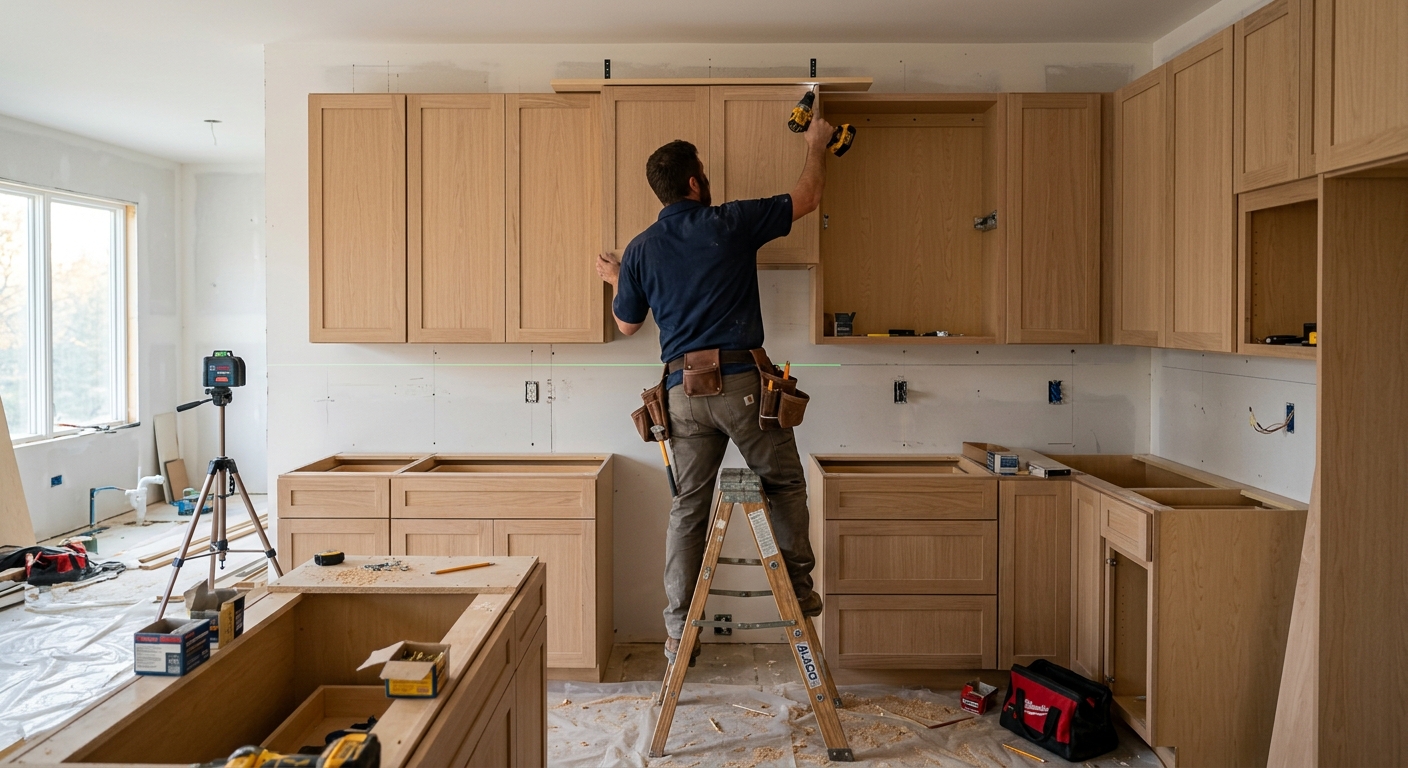
Kitchen renovation costs in Forest Hills — 2026
Forest Hills kitchen renovation costs tend to reflect the high owner-occupancy rate and the area’s median household income of $82,962 (U.S. Census Bureau, ACS 2024). Most local homes were built before 1980, so kitchens needing work here are often out-of-date, undersized, or have poor layouts carried over from a pre-1940 build. Remodeling a cramped, wall-bound 1950s kitchen usually means moving walls and completely updating systems, which costs more than refreshing a 1990s space with new finishes alone. Your total depends not just on square footage, but whether you’re staying close to the existing footprint or planning bigger structural changes.
One of the main reasons homeowners blow their kitchen budgets is by pricing a basic “replace what’s there” scope, then upsizing the plans midstream—moving plumbing, adding circuits, or choosing custom cabinets after all. Every major category below comes from local jobs delivered in Allegheny County’s tight contractor market:
| Scope |
What's included |
Duration |
Price range |
| Full gut remodel, same layout |
cabinets, counters, appliances, flooring, lighting, fixtures |
6–10 weeks |
$30,500–$121,000 |
| Gut plus layout change |
all of the above plus moved plumbing, electrical, walls |
10–16 weeks |
$65,500–$121,000 |
| Cabinet replacement (stock to semi-custom) |
remove and install cabinets, hardware, patching |
1–3 weeks |
$7,100–$30,500 |
| Cabinet refacing |
new doors and drawer fronts, veneer, hardware |
3–6 days |
$7,100–$20,000 |
| Countertop replacement only |
template, fabricate, install, reconnect sink |
1–3 weeks |
$4,000–$16,000 |
| Kitchen flooring only |
remove existing, install new flooring |
3–6 days |
$5,000–$20,000 |
Estimates for a typical Forest Hills kitchen. Cabinet grade and whether the layout changes move these figures more than square footage.
Code requirements for Forest Hills kitchens
In Forest Hills, code compliance is based on the Pennsylvania Uniform Construction Code (UCC), which most boroughs enforce themselves. Cosmetic upgrades—like painting, hardware swaps, refacing, or simply changing a countertop—are typically considered minor work and don’t require permits. But as soon as you relocate plumbing, electrical circuits, make structural wall changes, or substantially alter your kitchen’s layout, you trigger the requirement for a building permit and possibly plan review, especially for full remodels or new appliance venting. This applies whether you’re in Pittsburgh (where the Department of Permits, Licenses, and Inspections oversees reviews and permits) or another Allegheny County municipality with its own code office.
Electrical inspections for renovated kitchens in Forest Hills are either done by the municipality’s inspector or a third-party agency approved by the borough—Pittsburgh handles its own, while some suburbs delegate this authority. When you hire a contractor, confirm they hold a current Pennsylvania Home Improvement Contractor (HIC) registration—look it up at hic.attorneygeneral.gov. Any employer must also provide workers’ compensation insurance, which you can verify via WCAIS (wcais.pa.gov).
Unpermitted work in Forest Hills is not a minor issue—it will almost always get flagged at resale or refinancing, forcing costly retroactive repairs and inspections. Pennsylvania’s Home Improvement Consumer Protection Act requires a written contract for work over $500 and gives you three business days to cancel, so don’t waive your rights on paperwork or permits.
Eight weeks without a kitchen
Living without a functioning kitchen—even for the standard six to ten weeks of a Forest Hills gut renovation—requires some planning. Most homeowners set up a temporary kitchen in a dining room or basement: a folding table for the microwave, toaster oven, and coffee maker, and the fridge plugged into a nearby outlet. Prep and cleanup are another story—a laundry or bathroom sink often becomes the stand-in for dishwashing, but most families switch to disposable plates and cutlery for simplicity. Food costs spike, as the temptation and sometimes necessity of takeout dinners grows with each week. For a typical family, eating out over an eight-week stretch can rival the flooring budget in this region—count on it when planning.
Dust is relentless. Crews should install zip walls or taped plastic sheeting between work and living areas, but expect some seepage no matter what. You’ll need to clear paths for material deliveries and set aside space for jobsite dumpster or debris staging—driveways, lawns, or street parking may be taken for a while. Multiple trades will be coming and going, and pets should be kept away from open doors and the chaos of delivery days. If sensitive to noise or dust, or if layout changes involve major wall removal, consider moving out for at least the demolition and drywall week—sometimes, it’s the only way to keep your sanity and schedule.
Why the contingency exists
With 88.0% of Forest Hills homes built before 1980 (U.S. Census Bureau, ACS 2024), surprises inside walls and floors are the rule, not the exception. Older kitchens were built when standards were different—and when they get opened up for a renovation, these issues drive the need for healthy contingencies.
- Out-of-plumb walls and sagging subfloors: Common in houses from the pre-1940 build era, these demand shimming and leveling, adding $1,500–$4,500.
- Wiring: It’s not unusual to find two-prong, ungrounded wiring or a single circuit carrying all outlets and lights. Upgrading to today’s code, including new circuits, can add $4,000–$12,000 to your job.
- Plumbing: Galvanized steel supply lines or cast iron drains are likely. Replacing supply and drain lines—often necessary for layout changes—typically costs $2,500–$7,500.
- Insulation: Many exterior walls behind kitchen cabinets have none. Adding batt or foam insulation can add $900–$2,500 depending on wall length.
- Lead paint: Homes built before 1978 fall under the federal EPA Lead RRP Rule. Any disturbance requires trained crews, containment, and testing, which can add $800–$2,000 in abatement costs if found.
- Asbestos: Some 1950s–1970s tile and sheet flooring or old pipe wrap may contain asbestos—testing and remediating these is a separate line item and needs professional handling.
- Previous unpermitted work: Discovering hidden splices, illegal plumbing reroutes, or jerry-rigged venting can force unplanned corrections and reinspection, typically running from $1,000–$6,000 depending on severity.
These are why reputable contractors include a contingency—if you don’t, you’re not budgeting for the Forest Hills reality.
Comparing kitchen renovation bids in Forest Hills
When you request bids for your Forest Hills kitchen, the biggest trap isn’t spotting a low-ball estimate, it’s comparing quotes that aren’t actually apples-to-apples—thanks mostly to allowances. An allowance is a placeholder dollar figure for items you haven’t picked out yet (like tile, fixtures, or appliances). Two bids with the same bottom line can be thousands apart if one uses a realistic $40/sq.ft. tile budget and another assumes $3/sq.ft.—and until the real selections are priced in, you won’t see the gap. Always compare the allowance lines separately before looking at the total.
Look for bids that name cabinet brands and lines, specify the construction type (plywood vs. particleboard), and list countertop materials, thickness, and edges. Electrical lines should call out the number of new circuits and GFCI scope; “as needed” is an invitation for upcharges. All bids should specify what happens if unforeseen conditions (bad wiring, rot) arise, whether change orders need written approval, and how payments are scheduled—preferably tied to milestones (like cabinet delivery or countertop install), not just dates. Never pay most of the total upfront, and insist on lien waivers from subcontractors so you’re not at risk of paying twice if someone was left unpaid.
Pennsylvania’s Home Improvement Consumer Protection Act guarantees a written contract over $500 and a three-business day right to cancel after signing—these rules protect Forest Hills homeowners from bad actors.
| Line item |
What to look for |
Red flag if… |
| Allowances |
realistic amounts, itemised |
round numbers with no basis |
| Cabinetry |
brand, line, box construction |
'quality cabinets' |
| Countertops |
material, thickness, edge, seams |
material name only |
| Electrical |
circuits to be added, GFCI scope |
'as needed' |
| Unforeseen conditions |
how they are priced and approved |
not addressed |
| Change orders |
written approval before work |
verbal |
| Payment |
milestone-based, modest deposit |
front-loaded |
| Lien waivers |
from subs at each payment |
not offered |
Electrical work in an older Forest Hills kitchen
For most older Forest Hills homes, electrical upgrades are what catch people mid-project. Modern code calls for at least two dedicated small-appliance circuits (20-amp), GFCI outlets at all countertop locations, outlet spacing no more than 4 feet apart, and dedicated circuits for the dishwasher, garbage disposal, and built-in microwave. An electric range needs a 240-volt line. You’re also required to have AFCI protection on new circuits.
But take a look behind your existing walls—very often, especially in pre-1940s stock that’s common in Pittsburgh-adjacent suburbs, you’ll find two-wire, ungrounded electrical circuits, or a whole kitchen powered by a single 15-amp breaker. Many panels have no room for new circuits. Sometimes, older properties even have aluminum branch wiring—rare, but expensive to bring up to code. Once demolition starts and these conditions are visible, any inspector working under municipal authority in Allegheny County will expect them to be rectified. It’s not optional, and it’s rarely in the initial budget if your contractor hasn’t planned for it.
Bringing a kitchen’s electrical up to code in a local Forest Hills job most often falls between $4,000–$12,000, depending on how extensive the rewire and panel upgrade may be. If your home is newer (1990s), you might already have GFCI outlets, but it’s still common to find just two or three small circuits where a modern kitchen now expects five or more.
Who should run your Forest Hills renovation
The biggest decision isn’t what tile you pick, but who will manage the entire job. There are three structures local homeowners use in Forest Hills: design-build firms, general contractors, and owner-managed projects.
A design-build kitchen firm handles the design, cabinets, scheduling, permits, and all trades under one contract. This is usually the highest cost—sometimes near the top end of the $30,500–$121,000 band for a gut remodel—but you get the lowest stress. It’s ideal if you want a single point of contact and do not want to be hands-on with the day-to-day sequencing.
A general contractor model means you or a hired designer lay out the vision, and the GC brings in their own trade partners for each scope item. You deal directly with the GC, but may get more say (and sometimes cost savings) depending on finish choices. This route is mid-range for both price and homeowner effort, and works well for those who want some control but not all the headaches.
Owner-managed is the least expensive but most demanding option. You organize each trade, schedule inspections, and own the results. It works only if you have time, trade experience, and local contacts—Forest Hills’ tight finish-trade labor means DIYers may wait weeks for a good electrician or tile setter. If your job triggers a permit—anything beyond refacing or surfaces—and you have a full-time job, self-managing is seldom worth the stress or risk.
Frequently asked questions — kitchen renovation in Forest Hills
Do I need to change my kitchen layout?
In Forest Hills, most kitchens were designed before open plans became common, especially with the large number of pre-1940 and pre-1980 homes (U.S. Census Bureau, ACS 2024). If your existing layout is cramped, with minimal counter space or poor appliance placement, moving walls or fixtures can make the space much more functional. However, layout changes drive both the cost and the need for permits—shifting plumbing, new circuits, or structural changes move you into a higher price band, with gut-plus-layout-change projects running $65,500–$121,000. If your layout already works, sometimes just updating finishes is enough. The right choice comes down to your priorities and budget; changing the layout always adds months and cost, so unless it’s a daily frustration, you can often keep it as is and save substantially.
What does a quartz countertop cost in Forest Hills?
Quartz countertops are a popular upgrade in Forest Hills and across Allegheny County, especially for homeowners modernizing kitchens in older homes. The local cost for supply, fabrication, and installation currently runs $4,000–$16,000 depending on the size of your kitchen, the brand and thickness of the quartz, and how many seams or cutouts are required. Most mid-range kitchen jobs in this area end up around $9,100. More complex layouts or premium quartz will push toward the upper end. Always ask if templating, sink cutout, and edge finishing are included in the quoted price to avoid surprises. Be aware that lead-times can fluctuate, especially in the spring and early summer renovation rush.
What is the difference between stock and semi-custom cabinets?
Stock cabinets are mass-produced in standard sizes and finishes, which limits design flexibility but keeps costs at the lower end—Forest Hills homeowners can expect to pay as little as $7,100 for a full replacement in a smaller kitchen. Semi-custom cabinets are built to order with more size, finish, and storage options, allowing better fit and aesthetic upgrades for homes with odd wall measurements or out-of-plumb corners (common in our pre-1980 homes). Semi-custom prices in Forest Hills typically land around $20,000. For complicated rooms, semi-custom is often worth it to minimize filler strips and maximize storage, but for straightforward layouts with standard sizes, stock cabinets will function and look just fine.
Do older Forest Hills homes need electrical upgrades for a kitchen?
Yes, most kitchens in Forest Hills need electrical upgrades because of the high percentage of pre-1980 and especially pre-1940 homes here. Kitchens built before the 1970s often have only one or two old circuits—sometimes ungrounded and always without the GFCI protection current code demands. Remodeling a kitchen typically means the inspector will require new, dedicated circuits for appliances and countertop outlets. Electrical upgrades on a Forest Hills kitchen are usually in the $4,000–$12,000 range. Ignoring this isn’t an option if your work requires a permit, and trying to dodge upgrades just because “it worked before” could be a safety risk.
What adds the most resale value in a kitchen?
In Forest Hills, a renovated kitchen adds noticeable resale value, but not all upgrades are equal. Buyers consistently look for improved layouts, modern cabinet storage (like full-extension drawers), and high-utility surfaces like quartz. Appliances are less of a draw if they aren’t paired with an updated look and better workflow. In this area, a full gut remodel in the $30,500–$121,000 range is only justified if you’re solving a layout or utility problem found in older homes. Cabinet replacement or professional refacing can offer much of the visual and functional improvement at a lower price—sometimes $7,100–$30,500. Your best return comes from improvements that solve real functional problems, not just cosmetic changes.
How do I set up a temporary kitchen?
During a Forest Hills kitchen renovation, you’ll need a plan for daily living. Most homeowners move the refrigerator and a folding table with microwave, toaster oven, and coffee pot to a nearby room, like a dining or basement area. Dishes can be washed in a laundry or bathroom sink, but most families switch to paper goods to cut down on cleanup. Don’t forget to budget for eating out—over eight weeks, local families often spend the same as they would on a new floor ($5,000–$20,000). Plan ahead for pets and children so they stay out of work zones, and ask your contractor about setting up dust barriers. The more organized your temporary setup, the less stressful and costly the project will feel.
How long does a kitchen renovation take in Forest Hills?
Renovation timelines in Forest Hills are shaped by both the scope of work and how quickly trades can be scheduled—labor demand is higher here than surrounding counties. A straightforward cabinet replacement or countertop swap can take as little as one to three weeks, while a full gut remodel with layout changes often runs ten to sixteen weeks when inspections, plan reviews, and surprise repairs are accounted for. Most Forest Hills kitchens see work completed in 6–10 weeks for a full renovation of similar layout, provided you’ve made tile and appliance selections early. Allow extra time for older homes where electrical or structural upgrades are likely and for busy spring and summer seasons.
How much does a kitchen renovation cost in Forest Hills?
The typical Forest Hills kitchen renovation, when fully gutting and updating, lands between $30,500–$121,000, with a middle-of-the-road job running around $65,500. Simple cabinet replacements can be as little as $7,100–$30,500, and countertop-only projects start at $4,000. Your final price depends mostly on whether walls, plumbing, or electrical are moved, and what cabinet grade and finishes you select. Plan realistically—most cost overruns come from a mismatch between your initial “replace what’s there” budget and a final scope pushing into layout or systems upgrades.
Does replacing cabinets require a permit?
In most Forest Hills-area boroughs, simply replacing kitchen cabinets in the same location—what’s called a “like-for-like” or “swap out”—does not require a building permit. There’s an exception if electrical or plumbing are moved as part of the process, or if you’re also removing walls or changing the kitchen’s footprint; then, you will need a permit and inspections. This is different from some bigger metro areas, so double-check with your local code office. Cabinet-only projects fall into the $7,100–$30,500 price band locally. Always confirm permit requirements before signing a contract, especially if you plan to sell in the next few years and want a clean resale process.