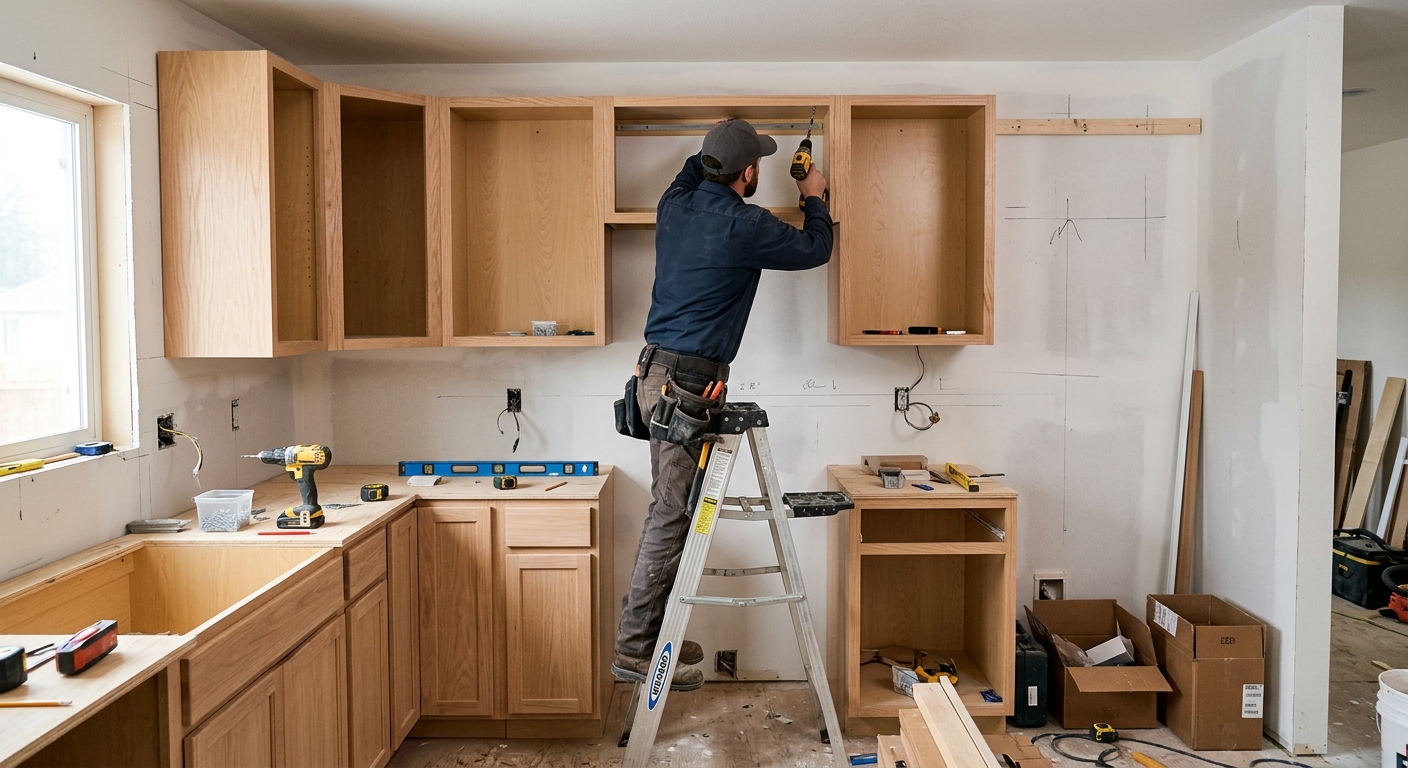
Emmaus kitchen renovation prices by scope — 2026
Emmaus homeowners considering a kitchen renovation should start with realistic numbers. With a median household income of $80,625 and a homeownership rate of 66.0% (U.S. Census Bureau, ACS 2024), remodeling budgets here closely track actual home values, and owners plan upgrades with long-term use and resale in mind. In the Emmaus market, many kitchens were built during the surge of post‑1960 suburban growth in Upper and Lower Macungie—meaning most kitchens are now reaching full replacement age. If you have a tract house from the 1970s or 1980s, it likely faces full re-cabinet or finishing; older layouts (galley kitchens, for example) may also require wall or plumbing moves to meet today’s needs.
Most kitchen budget overruns come from homeowners pricing a cosmetic or mid-range job, then picking finishes or features from a much higher tier. Minor finish updates, a straight cabinet swap, and a full gut-and-rebuild are all priced very differently. Here’s what to expect:
| Scope |
What's included |
Duration |
Price range |
| Full gut remodel, same layout |
cabinets, counters, appliances, flooring, lighting, fixtures |
6–10 weeks |
$30,000–$121,000 |
| Gut plus layout change |
all of the above plus moved plumbing, electrical, walls |
10–16 weeks |
$65,500–$121,000 |
| Cabinet replacement (stock to semi-custom) |
remove and install cabinets, hardware, patching |
1–3 weeks |
$7,000–$30,000 |
| Cabinet refacing |
new doors and drawer fronts, veneer, hardware |
3–6 days |
$7,000–$20,000 |
| Countertop replacement only |
template, fabricate, install, reconnect sink |
1–3 weeks |
$4,000–$16,000 |
| Kitchen flooring only |
remove existing, install new flooring |
3–6 days |
$5,000–$20,000 |
Estimates for a typical Emmaus kitchen. Cabinet grade and whether the layout changes move these figures more than square footage.
Allocating a kitchen budget
Seeing how a kitchen renovation budget actually breaks down often changes priorities. In Emmaus, the single biggest line is cabinetry, which can eat up $7,500–$42,350 (25–35% of a gut remodel), with labor close behind. On most jobs, counters, appliances, flooring, lighting, and plumbing end up as smaller but still significant shares. Two lines owners routinely underestimate: the contingency for what’s hidden behind walls (always needed in houses built before 1980), and the soft costs—permits, design, and disposal—which are real and inescapable.
Spending an extra thousand on upgraded cabinet boxes offers much more day-to-day value (and longevity) than dropping it on high-end hardware or gadget appliances. If you have to make a cut, start with features you can cheaply swap later—backsplash, smart lighting, organizational gadgets—rather than anything structural or built-in. Putting a luxury range in a kitchen with basic cabinets is a poor use of funds. Anchor your expectations around the local budget: In Emmaus, for a gut remodel at $65,500, you should see the bulk going to cabinetry, labor, and counters.
| Category |
Share of budget |
Notes |
| Cabinetry |
25–35% |
the largest line and the longest lead time |
| Labour and installation |
20–30% |
rises sharply if the layout changes |
| Countertops |
8–15% |
material choice drives the swing |
| Appliances |
10–20% |
widest range of any category |
| Flooring |
5–10% |
|
| Lighting and electrical |
5–10% |
higher in older homes needing circuits |
| Plumbing and fixtures |
4–8% |
|
| Permits, design, disposal |
3–6% |
usually forgotten in early budgets |
| Contingency |
10–15% |
not optional in a pre-1980 house |
Electrical work in an older Emmaus kitchen
In Emmaus, the biggest surprise budget item in a kitchen renovation comes from electrical upgrades—especially in homes built before 1980, which make up over three quarters of the local stock (U.S. Census Bureau, ACS 2024). Current code expects every kitchen to have two or more dedicated small-appliance circuits, GFCI protection at all counter outlets, carefully spaced receptacles (no more than four feet apart), separate circuits for the dishwasher, microwave, and disposal, and 240-volt service for an electric range. Few pre-1980 kitchens in town meet this standard.
What’s often behind your walls: ungrounded two-wire circuits, sometimes aluminum wiring from the late 1960s or early ’70s, and at least half the time, an overloaded or outdated panel with no expansion room. These issues instantly turn a “replace the cabinets” plan into a full-service upgrade, because inspectors require new work to bring the whole kitchen up to code—and this is never optional. And while post‑1960 tract homes from Upper and Lower Macungie are newer, even late-1990s kitchens typically fall short on required outlets and dedicated circuits. Expect permit and inspection as soon as you add new circuits or move outlets.
In terms of budget, bringing a kitchen’s wiring to current code is rarely less than $4,000 and often lands between $7,000–$14,000 when a panel upgrade or extensive rewiring is involved.
Resale value and kitchen spending
A kitchen renovation in Emmaus will almost always help a house sell faster, but rarely returns its full cost at resale. The most honest way to look at “return on investment” is that midrange projects—meaning careful choices in cabinetry and countertops, with no luxury splurges—tend to recoup the greatest percentage of spend. Over-the-top, luxury remodels fetch buyer attention but don’t deliver the same dollar-for-dollar return.
The bigger point: renovating to live in and renovating to sell are two entirely different projects. If you're renovating to sell in Emmaus, stick to neutral finishes, do not change the layout, and keep spend in the midrange. Going all-in on features or materials you personally love, but which are outside the neighborhood’s norm, will not pay you back. With Emmaus’s median income at $80,625 (U.S. Census Bureau, ACS 2024), a kitchen budget well above $65,500 is usually past what the local market will recognize at sale—buyers see value, but there's a ceiling to recoupment based on the local pool's willingness to pay.
If you're renovating to stay, focus purely on how you’ll use it: storage, workflow, and comfort. Ignore national statistics on resale returns—a finished, functional Emmaus kitchen will still move a home, but it’s not a guaranteed profit center.
Planning appliances before cabinets
The fastest way to back yourself into a kitchen design corner is to pick appliances after the cabinet order is in. In Emmaus, just like everywhere else, cabinets are built to appliance specs—and every model is a little different. Standard-depth fridges project past the cabinets; counter-depth models sit flush, but cost more and offer less storage. Slide-in ranges require a cutout and counter overlap—a mistake here makes for visible seams—whereas freestanding ranges can simply slide between bases, but with a slightly different countertop return. Decide if you want gas, electric, or induction: induction and newer high-wattage electric ranges usually mean running a new 240V line, adding to your electrical bill. Gas upgrades can trigger inspection and venting requirements.
If you’re thinking about a panel-ready dishwasher or fridge, remember these wrap with custom cabinet panels and demand very exact fit from day one. Range hood venting is a major performance issue: venting outside pulls grease and moisture out of the house, while recirculating hoods (with charcoal filters) are easier to install but only sort of work, especially in family kitchens.
Lead times for certain appliances—especially specialty sizes, induction, or panel-ready models—now sometimes exceed the wait for cabinets. For professional-grade ranges and appliances, know that the premium is mostly appearance and heft; real cooking precision comes from features and layout, not just the badge.
Cosmetic, replacement, gut, or layout change?
“Kitchen remodel” means four entirely different things in Emmaus, all with their own price band and disruption. Here’s a plain breakdown:
- Cosmetic refresh: Paint the cabinets, swap hardware, upgrade the lighting, and maybe add a tile backsplash. No cabinet, counter, or appliance moves. Cheapest and quickest—great for prepping to sell, or as a bridge to a later full remodel.
- Pull and replace: New cabinets and counters in the same layout—plumbing and electric stay put. Fastest full replacement, and no permit unless circuits or plumbing change. Works for most tract homes in Upper and Lower Macungie built from the 1960s onward.
- Gut, same layout: Strip to the studs, update all electric and plumbing, but reinstall in the same footprint. This is the safest way to get a reliable kitchen in Emmaus’s pre-1980 houses—the 79.3% that are due for wiring and piping updates.
- Layout change: Move the sink, range, or a wall. This is the cost cliff. It triggers engineering, multiple permits, possible township plan review, and the highest labor spend.
The price leap is between gutting in place and gutting with a new layout. Moving just one fixture, or opening up a wall, can double project time and cost. Figure out which of these four tiers you need before calling contractors: there’s no way for a pro to quote accurately without knowing if plumbing or walls are moving. Having this clarity up front saves time, avoids sticker shock, and targets the right crew for your Emmaus home.
Permits and inspections for a Emmaus kitchen
Permits are where many Emmaus projects go sideways—especially at resale. For most work that’s purely cosmetic (paint, hardware, even refacing or replacing a countertop in place), a permit is not typically required in Allentown and the surrounding townships. But as soon as you plan to move plumbing lines, add or relocate electrical circuits, or touch gas piping, you trigger a building permit. Layout changes involving structural work or any new appliance circuits (like adding a range hood ventilation line) also call for plan review before the permit is issued, particularly in Allentown.
Inspections for electrical upgrades are performed by the City of Allentown’s code office or, in many Lehigh Valley townships, by third-party inspection agencies. This difference catches a lot of Emmaus owners off guard, since outside inspectors are more likely to flag existing issues in older homes.
Only hire kitchen contractors with a valid Home Improvement Contractor (HIC) registration, as required by Pennsylvania’s Office of Attorney General for any contract over $500—verify at hic.attorneygeneral.gov. Contractors must also hold workers' compensation insurance, which you can confirm in the state’s WCAIS system. Unpermitted work doesn't just pose safety risks—it makes reselling harder, as municipal records and buyer inspections increasingly catch everything that was never documented.
Frequently asked questions — kitchen renovation in Emmaus
Who inspects kitchen electrical work in Emmaus?
In Emmaus, electrical inspections depend on where you live. Within the City of Allentown, the city’s own Bureau of Building Standards inspects all electrical work, including everything done as part of a kitchen remodel—so you’re working directly with the city. But in most surrounding Lehigh Valley townships, inspections are commonly handled by third-party inspection agencies that contract with the local code office. This surprises a lot of homeowners, since these outside inspectors can be stricter about older house wiring or bringing everything fully up to the current Pennsylvania Uniform Construction Code. Either way, expect that if you add circuits, relocate outlets, or update your panel during a kitchen project (often needed in houses built before 1980), you’ll need a permit and a formal inspection to close it out. Skipping this step can cause major headaches at resale or if the township asks for proof of approval later.
How much does a kitchen renovation cost in Emmaus?
In Emmaus, what you pay depends entirely on project scope. A full gut kitchen remodel—down to the studs, replacing everything but keeping the layout—typically runs $30,000–$121,000, with a local average near $65,500. Just replacing cabinets or counters lands closer to $7,000–$30,000 and $4,000–$16,000 respectively. If you’re thinking about moving walls or relocating plumbing and appliances, your project moves into the higher band real fast, often above $65,500. Most Emmaus kitchens are in post‑1960 houses now at the point of needing at least cabinet replacement or more. Don’t price out the lowest tier unless you’re sticking to pure cosmetic updates—paint, hardware, and lighting swaps—since full replacement costs are more reflective of what the local housing stock requires.
Should I reface or replace my kitchen cabinets?
In Emmaus, cabinet refacing is worth considering if your existing cabinet boxes are structurally sound, but you want to change the look for less than a full gut job. Refacing—new doors, drawer fronts, and surface veneer—takes just a few days and usually lands in the $7,000–$20,000 range, making it a strong middle ground. Full replacement, needed if boxes are warped, moldy, or built from particleboard, typically costs $7,000–$30,000 depending on whether you go with stock or semi-custom. With so many Emmaus homes built during the post‑1960 suburban boom, many original kitchens are now worn out enough to need full replacement rather than just a cosmetic lift. Bottom line: if your boxes are good and the layout works, refacing stretches your budget further; if you want a layout change or know you have water or structural damage, bite the bullet and replace.
What are cabinet lead times in Emmaus right now?
As of 2026, lead times for kitchen cabinets in Emmaus vary by brand and level of customization. Stock cabinets from big box stores can arrive in as little as two weeks, but most semi-custom orders (the most popular choice in Lehigh County) require a wait of 4 to 10 weeks from order to delivery. Custom cabinetry—especially with specialty finishes or built-in features—can run 12 weeks or more, and that’s if supply chain disruptions don’t get in the way. It’s important to note that appliance lead times for certain brands now sometimes exceed cabinet lead times. Plan ahead early, and don’t finalize your cabinet order until you’re absolutely sure on your appliance models and sizes—having the wrong fridge or range specs is the number one reason for delays and costly field modifications down the road.
What countertop material is best for a family kitchen?
For Emmaus families, quartz countertops have become the go-to for their durability, low maintenance, and resistance to stains—especially with kids or heavy cooking. Quartz is non-porous and doesn’t need sealing, unlike granite or marble. It’s a bit more forgiving against accidental chips than some stones, and comes in a wide range of colors that work well with both classic and modern Emmaus kitchen styles. The installed price for quartz countertops here usually falls in the $4,000–$16,000 range, depending on edge profiles and complexity. While butcher block and laminate are more affordable, they’re less durable in the long run. Quartz suits the practical, lived-in kitchens typical in Emmaus’s family homes, many of which were built in the late 20th century and are due for upgrades that will last another generation.
Should I renovate before selling or let the buyer do it?
If your Emmaus kitchen is truly outdated, renovating before sale almost always helps the home sell faster and for a higher price—buyers tend to overestimate what work will cost if the kitchen looks tired or original. But there’s a ceiling to your investment, dictated by Emmaus’s real estate market and the local median household income of $80,625 (U.S. Census Bureau, ACS 2024). Spending much above $30,000–$40,000 on a pre-sale project is rarely recouped. The smart move is a neutral, midrange “pull and replace”—new cabinets, counters, and possibly updated lighting—without moving layouts or splurging on luxury appliances. Cosmetic updates (paint, new hardware) can be enough if everything else is serviceable. Only tackle a full gut remodel if your kitchen is a genuine liability for the sale; otherwise, keep it sensible and leave the dream build to the next owner.
What does a quartz countertop cost in Emmaus?
Quartz countertops have become one of the most popular picks in Emmaus kitchens, especially in busy family homes. For a typical kitchen, you’ll pay between $4,000–$16,000 installed. The swing in price has more to do with color, edge profiles, and extras like integrated sinks than pure square footage. For most Emmaus houses—especially tract homes from the post‑1960 era now due for renovation—quartz works out as a smarter investment than granite or marble, since it’s more resistant to staining and chipping. Installation includes template, fabrication, and professional mounting, and the cleaner install compared to tile or laminate appeals to buyers when resale time comes. If you want premium colors or unusual slabs, budget for the upper end of the range, as custom slabs sometimes come with longer lead times as well.
Can I live in the house during a kitchen renovation?
Yes, you can usually live in your Emmaus home during a kitchen renovation, but expect some serious disruption—especially in a full gut remodel, which usually runs six to ten weeks. Most families set up a makeshift kitchenette in the dining room or basement with a microwave, toaster, and fridge. If your kitchen is at the center of the house, dust and access may be issues, especially during demolition and when flooring is replaced. If major electrical or plumbing lines are being shifted (which is common in kitchens built before 1980), the water or power may be shut off for chunks of the day. If you have young kids or work from home, noise and logistics become trickier. Many Emmaus homeowners stay put, but a short-term rental or staying with family can ease the stress—especially during the crucial weeks when you have no countertops, running water, or stove.
How does Emmaus's housing stock affect cabinet fit?
Nearly 80% of Emmaus homes were built before 1980 (U.S. Census Bureau, ACS 2024), which means original kitchens often have odd dimensions, out-of-square walls, and custom soffits—especially in tract homes from the Upper and Lower Macungie boom. Off-the-shelf cabinets sometimes leave awkward gaps or force filler strips for a proper fit. Local kitchen contractors are used to templating on-site and scribing cabinets to accommodate these quirks, but it can add both cost and time to installation. Custom or semi-custom cabinets solve most fit problems, though with lead times of 4–10 weeks for mid-range lines. If you’re redoing a kitchen in Emmaus, expect to need careful measuring, some onsite adjustments, and occasionally, creative trim work to blend new cabinets into older construction—especially if you’re not doing a full gut remodel. Basic stock cabinets work best in newer subdivisions with standard dimensions and drywall.