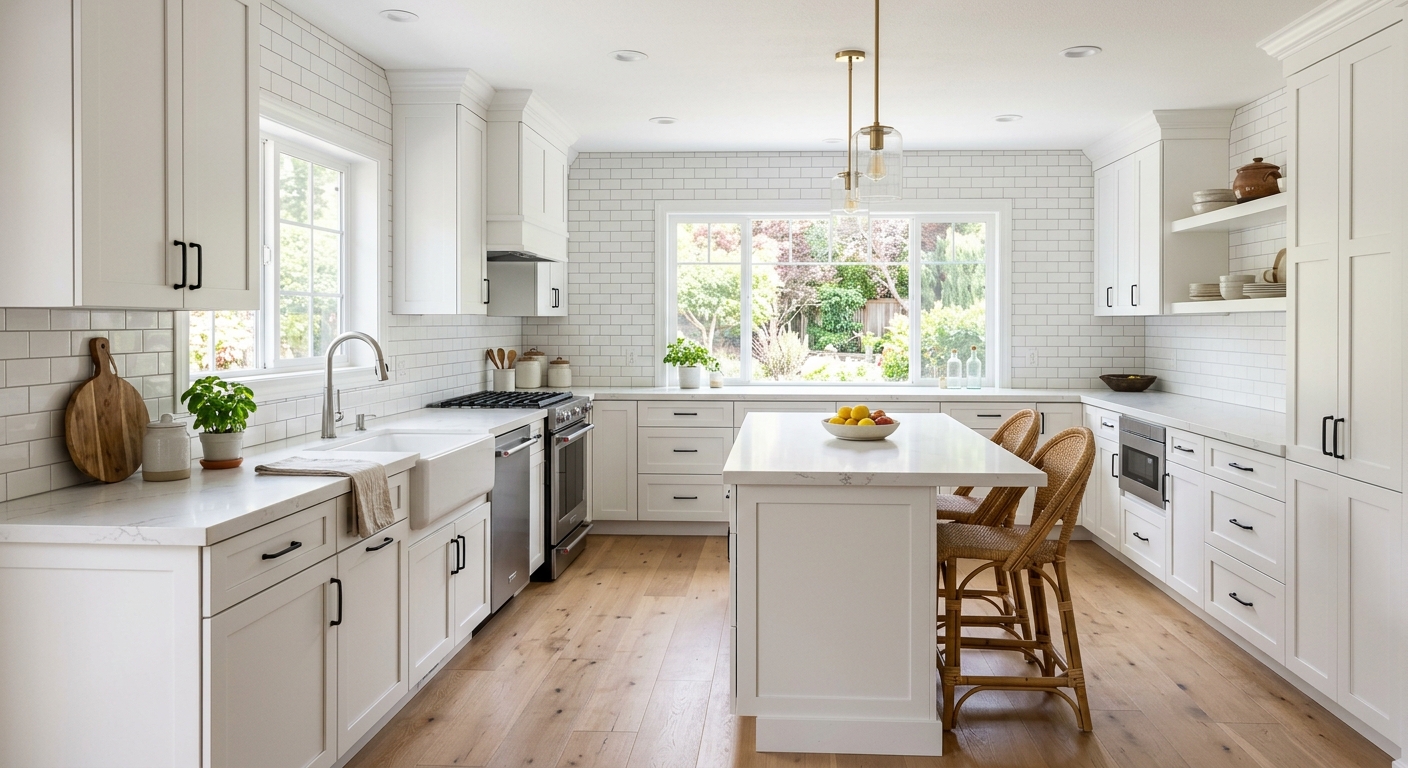
What a kitchen remodel costs in Moon
In Moon, with its homeownership rate of 78.1% and a median household income of $101,047 (U.S. Census Bureau, ACS 2024), most kitchen renovation budgets reflect real homeowners choosing long-lasting upgrades. Many Moon homes draw on Pittsburgh’s broader housing stock, which includes a large portion built before 1940 and another large group from the suburban building boom through the 1980s. Older layouts often mean smaller kitchens from past eras—a 1950s galley or compartmentalized room—whereas post-1990 kitchens have more open space and flexible layouts, affecting renovation costs.
The main way Moon homeowners overspend on a kitchen project is by pricing a modest refresh but specifying a gut-level scope: keeping plumbing in place and refreshing cabinet fronts costs nowhere near as much as moving walls, relocating gas lines, and fully gutting a space. Even within the same square footage, changes to the plumbing or electrical quickly push a project from one cost band to another.
Here’s what Moon homeowners can expect for typical kitchen renovation scopes:
| Scope |
What's included |
Duration |
Price range |
| Full gut remodel, same layout |
cabinets, counters, appliances, flooring, lighting, fixtures |
6–10 weeks |
$32,000–$128,500 |
| Gut plus layout change |
all of the above plus moved plumbing, electrical, walls |
10–16 weeks |
$69,500–$128,500 |
| Cabinet replacement (stock to semi-custom) |
remove and install cabinets, hardware, patching |
1–3 weeks |
$7,500–$32,000 |
| Cabinet refacing |
new doors and drawer fronts, veneer, hardware |
3–6 days |
$7,500–$21,500 |
| Countertop replacement only |
template, fabricate, install, reconnect sink |
1–3 weeks |
$4,300–$17,000 |
| Kitchen flooring only |
remove existing, install new flooring |
3–6 days |
$5,400–$21,500 |
Estimates for a typical Moon kitchen. Cabinet grade and whether the layout changes move these figures more than square footage.
What requires a permit in a kitchen renovation
In most of Moon and the surrounding Allegheny County boroughs, kitchen work that is strictly cosmetic—like painting, refacing, swapping out cabinet hardware, or replacing a countertop in place—does not usually require a building permit. The permit line is crossed when a project involves moving or adding electrical circuits, relocating plumbing lines, structural changes (like removing or opening a wall), or adding mechanical ventilation. In Pittsburgh proper, any shift to plumbing, electrical, or structural components nearly always requires a formal building permit, and major kitchen layouts that alter floorplans undergo plan review by the Department of Permits, Licenses, and Inspections.
Inspections for electrical work are handled by the city’s authority in Pittsburgh, while some suburbs use third-party inspection agencies approved by the code office. This split in inspection authority can catch homeowners off guard, especially when projects cross municipal borders within Allegheny County.
Any contract for work over $500 requires the contractor to hold valid Home Improvement Contractor (HIC) registration, which is issued by the Pennsylvania Office of Attorney General—check this at hic.attorneygeneral.gov. All employers must have current workers’ compensation, verifiable through WCAIS (wcais.pa.gov). These requirements exist to protect Moon homeowners legally and financially.
Unpermitted work can present major headaches at resale. Real estate transactions often unravel over kitchen remodels completed without the proper inspections and paperwork, which are required under Pennsylvania’s Uniform Construction Code (UCC).
What moving the sink really costs
Moving a sink, gas line, or major appliance in a Moon kitchen is where renovation costs jump sharply. So long as you keep existing plumbing and electrical in the same locations, you stay in the lower scope: demolition, cabinetry, finishes, and quick installations. But even a short move—say, shifting a sink to center under a new window—triggers a higher price tier, not because of the distance but due to what’s involved behind the walls and below the floor.
Relocating a drain requires maintaining proper slope for wastewater. In a house on a slab or over a finished lower level (like many split-levels typical in the Pittsburgh area), achieving that slope often means cutting into or rebuilding walls, floors, or ceilings. New circuits mean ensuring your panel has enough capacity, and running those circuits typically involves opening up more ceilings and walls.
Removing or altering a wall to achieve an open-plan kitchen can mean dealing with a load-bearing structure—which then calls for an engineer, structural permitting, and often a plan review in larger municipalities like Pittsburgh. Adding or relocating a range hood? You now need a new exterior vent, which requires cutting through siding or brick.
It’s worth pausing to ask if the existing layout is truly holding you back or just dated—because the price leap from a basic gut remodel ($32,000–$128,500) to a layout change ($69,500–$128,500) is substantial. That four-foot move can cost as much as a luxury appliance upgrade, with little impact on daily function for most families.
Why the electrical line grew
The single most common budget “surprise” in older Moon homes is kitchen rewiring. Modern electrical code expects kitchen remodels to provide multiple new circuits: dedicated lines for small appliances, GFCI outlets every four feet at countertops, separate breakers for microwave, disposal, dishwasher, and—in electric kitchens—240-volt service for a range or cooktop. Receptacles must be placed to avoid people relying on extension cords, and all outlets serving countertop surfaces need ground-fault protection.
But pre-1980 homes, which make up 56.4% of Moon residences (U.S. Census Bureau, ACS 2024), rarely have enough capacity. Many kitchens still have two-wire ungrounded outlets, just a handful of circuits feeding the entire space, or breaker boxes that have no spare slots for new circuits. Some houses, especially from earlier eras described in Pittsburgh's housing stock, even have aluminum wiring or original panels that need replacing. Once demolition exposes old wiring, inspectors require upgrades to current standards—this is mandatory under the Pennsylvania Uniform Construction Code.
The price for bringing a Moon kitchen’s wiring up to code frequently tacks on $5,400–$21,500 to the project total, depending on kitchen size, number of new circuits, and the state of the existing panel.
Comparing kitchen renovation bids in Moon
When you collect bids for kitchen work in Moon, focus first on the allowances. An allowance is just a budget placeholder—a guess for an item you haven’t chosen yet, like tile or light fixtures. Two contractors can both show totals of $32,000, but if one carries $2,500 for appliances and the other uses $7,500, you’re not seeing an apples-to-apples proposal. Always compare the details under the allowance column first.
Beyond allowances, read the specifications: credible bids name the cabinet brand and construction, list countertop material and thickness, and spell out how unforseen site conditions are handled. Change orders—any additional work or scope changes—should require written approval before proceeding, and payment schedules should be tied to clear project milestones, not arbitrary dates. Lien waivers protect you by ensuring subcontractors are paid as you pay the general contractor.
For any home improvement work in Pennsylvania over $500, contractors must provide a written contract under the Home Improvement Consumer Protection Act. You are guaranteed a three-business-day right of cancellation—useful if you spot missing or unclear terms.
| Line item |
What to look for |
Red flag if… |
| Allowances |
realistic amounts, itemised |
round numbers with no basis |
| Cabinetry |
brand, line, box construction |
'quality cabinets' |
| Countertops |
material, thickness, edge, seams |
material name only |
| Electrical |
circuits to be added, GFCI scope |
'as needed' |
| Unforeseen conditions |
how they are priced and approved |
not addressed |
| Change orders |
written approval before work |
verbal |
| Payment |
milestone-based, modest deposit |
front-loaded |
| Lien waivers |
from subs at each payment |
not offered |
Quartz, granite, laminate or butcher block
Moon homeowners have a full range of countertop options, each with strengths beyond just visual style. Quartz is engineered from natural stone and resin, making it highly stain-resistant and non-porous, but it can discolor or crack if hot pans are placed directly on it. Granite is entirely natural—each slab unique—and can withstand high temperatures, but it must be resealed periodically to keep out stains.
Laminate, often dismissed due to its reputation from decades-old kitchens, has improved dramatically; modern products come in countless patterns, resist staining, and are easy to wipe down, though they can still be scratched or scorched by abuse. For a rental or budget-conscious kitchen, choosing laminate is fiscally sound and not a downgrade if done with a good pattern and edge detail.
Butcher block brings a warm, functional look—great for prep work but demanding routine oiling and vulnerable to water or heat damage. Solid surface materials (like Corian) are seamless, non-porous, and easily repairable, but less heat tolerant than stone.
Fabrication costs depend on the number of cutouts (sink, cooktop), edge profile, thickness, and seam placement—a complex L-shaped kitchen will cost more than straightforward galley runs. Professional installers will visit to template, not just measure, ensuring an exact fit that accommodates the quirks of older walls and floors common in Moon homes.
Surprises in an older Moon home
With more than half of Moon’s homes built before 1980 (U.S. Census Bureau, ACS 2024), kitchen renovations often uncover issues that weren’t on anyone’s radar at bidding time. Walls and floors out of plumb or level mean every cabinet requires shimming—adding days of labor. Built-in wiring from the 1960s or earlier is usually ungrounded, undersized, or simply not up to the demands of today’s appliances, driving electrical cost increases. Galvanized supply lines are susceptible to corrosion and low flow; cast iron drains may be cracked or restricted. It’s not uncommon to find no insulation on exterior walls behind kitchen cabinets, and many homes have previous “remuddling”—unpermitted work that wasn’t performed to code.
For houses predating 1978, the federal EPA Lead Renovation, Repair and Painting Rule applies, requiring certified contractors: surfaces must be tested before disturbance, which can increase project duration and complexity. Asbestos is frequently encountered in resilient floor tiles or old adhesives; safe removal or encapsulation adds to cost and planning.
In newer Moon developments, surprises tend toward builder-grade shortcuts: cabinets with stapled particleboard boxes, insufficient circuit counts (barely meeting minimums of the time), or laminate counters that have reached the end of their service life en masse.
Frequently asked questions — kitchen renovation in Moon
Does a kitchen renovation increase home value in Moon?
In Moon, where the homeownership rate is 78.1% and most homes are single family, kitchen renovations can increase market value—especially when older layouts are updated to meet modern expectations. However, not all kitchen updates yield dollar-for-dollar returns. Projects at the typical local cost ($69,500 for a full gut remodel) often recoup a major portion in resale value, particularly if the previous kitchen was outdated, cramped, or showed wear in a mid-range neighborhood. That said, over-customizing with ultra-premium finishes can price your home above local comparables. Stick with well-crafted mid-range upgrades, functional layouts, and timeless materials for the best resale boost in Moon’s market.
Should I choose plywood or particleboard cabinet boxes?
In Moon, the choice between plywood and particleboard cabinet construction isn't as simple as “wood is always better.” Plywood is more resistant to moisture and holds fasteners better—worth considering if your kitchen is prone to leaks (e.g., under a window or next to plumbing lines). However, high-quality particleboard, especially in well-made semi-custom cabinets, can work fine in most conditions and costs less. For a typical cabinet replacement budget of $21,500, you can get robust performance from either, provided you avoid bottom-tier units. In higher-humidity basements or at the sink base, prioritize plywood if your budget permits. For wall cabinets, well-laminated particleboard is unlikely to fail prematurely, especially in the generally dry indoor environments typical of Moon homes.
How far ahead should I book a contractor in Moon?
The Pittsburgh metro area—including Moon—has a steady demand for skilled trades, which means finish carpenters and kitchen contractors book out months in advance. For a significant kitchen remodel (like a gut and layout change, costing $69,500–$128,500), plan to book three to six months ahead, especially if you hope to start during the summer or fall high season. For smaller updates—cabinet refacing or countertop swaps—lead times are often shorter, around four to twelve weeks. If you’re flexible or willing to start in winter, there can be a slight dip in wait times. Don’t rush: reputable contractors rarely have immediate availability in Moon.
What does a quartz countertop cost in Moon?
In Moon, quartz countertop replacement typically runs in the $4,300–$17,000 range, with most homeowners spending around $9,600. This includes templating, fabrication, removing the old top, installation, and reconnecting the sink. The final price depends on total square footage, thickness (3cm is standard), number of cutouts, and which line of quartz you select. Patterns with visible movement, thicker edges, and high-end manufacturers land at the top end. In most Moon kitchens, expect the bulk of your cost to be driven not by material, but by fabrication labor—complex L- or U-shaped layouts cost more than straight runs.
Do older Moon homes need electrical upgrades for a kitchen?
Yes—a majority of Moon homes were built before modern kitchen circuit requirements were standard. If your home is part of the 56.4% built before 1980, you likely have limited circuits, two-prong outlets, or older panels with no spare capacity. Any substantial kitchen remodel (over $32,000) will almost certainly trigger inspection and a requirement to bring all kitchen circuits up to the Pennsylvania UCC code—meaning GFCI protection, spaced receptacles, dedicated lines for appliances, and potentially a new service panel. Skipping this or trying to “work around” it is not code compliant or safe, and will catch up at resale or during a future claim.
What happens if previous work was unpermitted?
If work in your Moon kitchen was previously done without the necessary permit—like moving plumbing or adding circuits—problems usually arise at resale or refinancing. Home inspectors and buyers’ agents are on the lookout for nonstandard wiring, mismatched finishes, and missing paperwork. In Pennsylvania, the Home Improvement Consumer Protection Act gives buyers grounds to demand disclosure, and municipalities can require upgrades or even partial teardown to bring the work up to UCC standards. If found early, you’re better off voluntarily applying for inspection and any needed corrections; otherwise, you risk larger costs down the line, especially if a hidden issue is uncovered during a project in the $7,500–$32,000 range or higher.
Can I renovate a kitchen in stages?
Staged renovation is common and practical in Moon, particularly where budgets or daily life make it hard to tackle a full gut remodel (that’s $32,000–$128,500) all at once. The key is sequencing: do essential infrastructure first (electrical, plumbing upgrades), then cabinets and layout, then finishes like counters and flooring. If the kitchen is older, prioritize “behind the wall” upgrades in phase one—you can’t economically do these after new cabinets go in. Staging works best if you have a master plan and don’t change the design mid-stream, which risks rework. Remember, each phase may need its own permitting and inspection cycle, especially for mechanical or electrical stages.
What does a full gut kitchen remodel cost in Moon?
For a full gut kitchen remodel—stripping the space to studs and reconstructing with new cabinets, counters, appliances, flooring, lighting, and fixtures—the cost in Moon ranges from $32,000–$128,500. The wide range covers everything from small, basic layouts using stock cabinets with laminate counters up to large, premium kitchens with semi-custom cabinetry, quartz or granite counters, and top-notch appliances. The typical spend for most Moon homeowners is about $69,500, although moving walls or altering plumbing or electrical will quickly move you into the upper price tier.
What is a change order and how should it work?
A change order is a formal document specifying any additional work or changes to the original contract scope—say, discovering rotted subflooring or choosing a fancier backsplash tile after work has begun. In Moon, as in the rest of Pennsylvania, the Home Improvement Consumer Protection Act requires contracts to state how changes are handled. A proper process means you receive a written description, with pricing, that you review and approve before any extra charges apply. Verbal changes or ambiguous “we’ll figure it out as we go” setups are red flags. In a typical kitchen remodel costing $32,000–$128,500, clear change order procedures spare you surprise bills and disputes, especially when unexpected conditions arise in older homes.