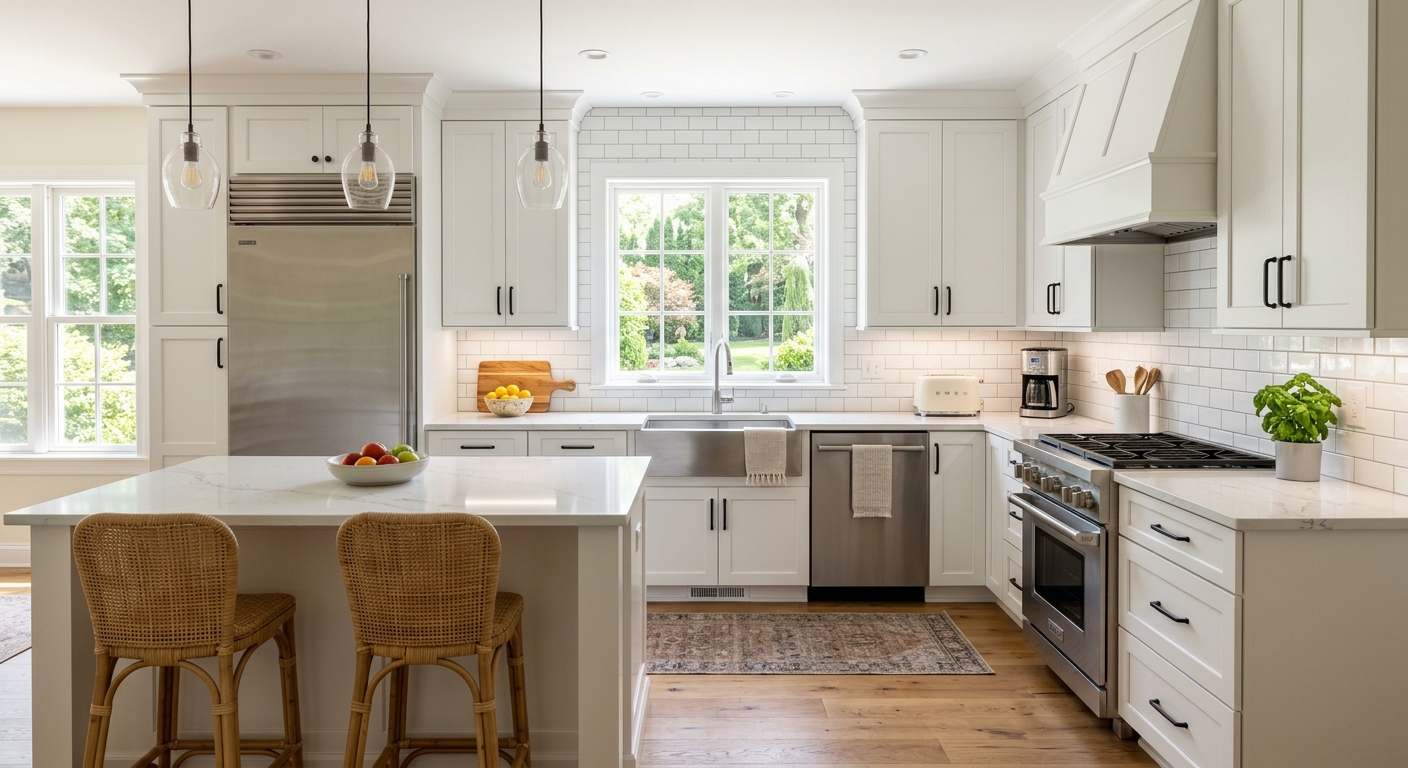
Kitchen renovation costs in Norwood — 2026
Norwood’s kitchen renovation costs in 2026 reflect the realities of Delaware County: a market where 67.7% of homes are owner-occupied and the median household income is $83,104 (U.S. Census Bureau, ACS 2024). Budgets here don’t float free of those numbers, and most projects run in homes built well before 1980, when small galley kitchens were the rule. If your Norwood kitchen still follows a 1950s footprint, expect some money to go to rethinking the walls and work triangle, not just the finishes. If you’re working on a later-era home where the layout is already functional, the investment needed is often far lower — unless you start to shift plumbing, knock out walls, or upgrade every appliance at once.
The number one reason budgets jump is homeowners pricing for a cosmetic replacement but then asking for a “while you’re here” change — like moving the sink or opening the kitchen to the dining room. That shift pushes the project into the next tier, where costs are not proportional to the square footage but to the complexity and code requirements.
| Scope |
What's included |
Duration |
Price range |
| Full gut remodel, same layout |
cabinets, counters, appliances, flooring, lighting, fixtures |
6–10 weeks |
$30,500–$121,500 |
| Gut plus layout change |
all of the above plus moved plumbing, electrical, walls |
10–16 weeks |
$65,500–$121,500 |
| Cabinet replacement (stock to semi-custom) |
remove and install cabinets, hardware, patching |
1–3 weeks |
$7,100–$30,500 |
| Cabinet refacing |
new doors and drawer fronts, veneer, hardware |
3–6 days |
$7,100–$20,000 |
| Countertop replacement only |
template, fabricate, install, reconnect sink |
1–3 weeks |
$4,000–$16,000 |
| Kitchen flooring only |
remove existing, install new flooring |
3–6 days |
$5,100–$20,000 |
Estimates for a typical Norwood kitchen. Cabinet grade and whether the layout changes move these figures more than square footage.
What moving the sink really costs
Keeping most elements in place is the single sharpest way to control costs in a Norwood kitchen. The moment you move a sink, range, or a wall, the entire project typically leaps in complexity and price category. Moving a sink means relocating both supply and drain lines. Drains need a precise slope, and in Delaware County, most homes are on a basement or crawlspace. If your kitchen is above finished space, running new plumbing can involve opening up ceilings below, not just the kitchen floor. Even moving a sink four feet can add weeks and thousands to your project. The code trigger isn’t subtle: In Haverford Township and neighboring areas, a permit is required the moment you move plumbing or create new electrical circuits.
Similarly, relocating or adding circuits demands not only new wiring, but the capacity to add them at your main panel. When a wall comes out, you can’t guess at whether it’s load bearing — Pennsylvania Uniform Construction Code means a structural change requires plan review, permit, and engineer sign-off. Even venting a hood to the exterior from a new location adds both cost and code oversight, because it’s an exterior wall penetration. The simple truth: the price jump for a “gut plus layout change” is steep — from $30,500–$121,500 for a same-layout gut to $65,500–$121,500 when walls or major rough-ins move. That’s not about square footage, but about complexity and layers of inspection.
Before you commit, spend time in the kitchen and work through whether the layout is truly dysfunctional or just dated — in Norwood, this single judgment will save or spend tens of thousands.
Who should run your Norwood renovation
The structure of your project delivery makes more difference to your bottom line and sanity than any material selection. In Norwood, where the labor market is shaped by proximity to Philadelphia — with more contractor choice in places like Upper Darby, but tighter finish-trade availability as you move west — your approach to hiring is essential.
- Design-build firm: This is one contract for design, cabinetry, installation, everything. You’ll pay more, but the process is smoother and you have a single company to manage issues. It’s the best fit for anyone short on time or not interested in heavy involvement.
- General contractor (GC): You hire a GC, who organizes trades and coordinates inspections. You may bring a designer or make finishes selections yourself. The GC manages most of the moving parts. It’s a balance — fewer headaches than managing yourself, less costly than a full design-build.
- Owner-managed: You directly hire each trade, schedule visits, manage materials, and handle sequencing. It’s the cheapest approach upfront, but the most demanding. Delays, unavailable subcontractors, or inspection failures are your headache to solve. If you work full time, or if your Norwood project requires plumbing or electrical changes (which trigger permits and inspections), this route is a heavy lift.
Choose a delivery method that matches not just your budget but your available energy. In Norwood’s market, where project timelines extend if a plaster finisher or electrician goes missing for a week, the premium for a firm with in-house trades might save you more than it costs.
What requires a permit in a kitchen renovation
In Norwood and across Delaware County, most purely cosmetic kitchen updates — like painting, changing cabinet doors, new hardware, or swapping in a new countertop without touching the plumbing or wiring — do not trigger a building permit. The moment a renovation involves new or moved electrical circuits, any change to plumbing, or the removal/movement of structural walls, a building permit is needed. A further line is drawn if your renovation includes changing the kitchen’s layout, especially if you are moving a sink, range, or adding circuits for new appliances. At that point, most municipalities in Delaware County require a plan review before a permit is granted.
When permits are pulled, many townships contract out electrical inspections to third-party agencies registered with the township rather than handling them directly. This can mean an unfamiliar inspector on-site and sometimes a few extra days to schedule visits, especially once walls are open and timelines get tight.
For work over $500, any contractor must be registered as a Home Improvement Contractor with the Pennsylvania Office of Attorney General. You have the right to verify registration at hic.attorneygeneral.gov. All employers must carry valid workers’ compensation insurance, verifiable through the WCAIS system (wcais.pa.gov).
Failing to permit work that requires it often comes back to haunt at resale — a buyer’s agent or township will flag unpermitted electrical or structural work and can complicate or delay closing.
Countertop materials compared
In daily use, what matters about a kitchen countertop isn’t just how it looks, but how it handles heat, resists stains and scratches, and how much work it takes to keep up. Quartz countertops are engineered, non-porous, excellent against stains, tough against scratches, and need next to no maintenance — but they don’t love heat. Place a hot pan on quartz, and you risk a permanent discoloration. Granite is a natural stone, beautiful and unique, but needs periodic resealing to protect against stains, especially in a household that cooks often. Granite has good heat resistance but can chip at edges and corners.
Laminate has outlasted its reputation: modern laminates come in near-invisible seams with a huge range of looks, and are perfectly solid for modest kitchens, rentals, or if you’d rather put your money elsewhere. They can burn and scratch, but are easily replaced at a low cost. Butcher block gives warmth and a forgiving work surface, but it demands oiling and isn’t for anyone who’s likely to leave water standing around the sink. Solid surface (like Corian) is matte, seamless, and can be repaired if scored or burned — and seamless sinks are possible, which is a real-world maintenance win.
The complexity of fabrication drives price up or down. More complex edge profiles, sink cutouts, and demanding seam placements mean higher templating and installation costs. A professional template (not just measurements) is essential for anything beyond laminate or butcher block.
If you’re fitting out a rental or budget kitchen in Norwood, laminate is not a compromise — it’s a practical, value-driven decision.
Allocating a kitchen budget
Most Norwood kitchen budgets are misallocated before the first dollar is spent: homeowners prioritize counters or appliances when, in reality, cabinetry is nearly always the largest single cost — often 25–35% of your total. The next biggest is labor and installation, which rises sharply if the layout changes, sometimes eclipsing their share if walls or plumbing are moved. From there, counters, appliances, flooring, lighting, and fixtures follow. Surprisingly, soft costs (permits, design, disposal) and contingency for what’s found behind drywall are neglected, even though in a pre-1980 house you should plan on 10–15% for contingencies.
Here’s the hard guidance: your money goes farthest on cabinetry and lighting (poor storage or bad lighting ruins daily function), and least on ultra-premium appliances in a kitchen with stock cabinets. If you have $1,000 extra, use it to upgrade cabinet hardware or lighting, not a microwave with Bluetooth.
Below is a typical budget breakdown — in a Norwood gut remodel targeting the $30,500–$121,500 range.
| Category |
Share of budget |
Notes |
| Cabinetry |
25–35% |
the largest line and the longest lead time |
| Labour and installation |
20–30% |
rises sharply if the layout changes |
| Countertops |
8–15% |
material choice drives the swing |
| Appliances |
10–20% |
widest range of any category |
| Flooring |
5–10% |
|
| Lighting and electrical |
5–10% |
higher in older homes needing circuits |
| Plumbing and fixtures |
4–8% |
|
| Permits, design, disposal |
3–6% |
usually forgotten in early budgets |
| Contingency |
10–15% |
not optional in a pre-1980 house |
Electrical work in an older Norwood kitchen
The single most common reason a Norwood kitchen budget climbs mid-project is electrical. In the typical Norwood home — built before 1980, with a huge portion dating to between 1920 and 1960 — you’re likely looking at a kitchen originally wired with two-wire, ungrounded circuits, often with outlets and lighting on the same run. Today’s code for kitchen renovations expects at least two 20-amp small appliance circuits, GFCI protection at every counter receptacle, outlets every four feet, and dedicated circuits for dishwasher, disposal, and microwave. If you have an electric range, that’s a 240-volt circuit with proper amperage.
Panels in older homes often have limited spare capacity, and sometimes the wiring is aluminum or the ground paths are missing. When walls are open, the code requires everything in the kitchen to be brought up to current safety standards — you can’t just do what’s visible and skip the rest. If your home was built in the 1990s, you may still find yourself short of circuits for today’s appliances, though you’re less likely to have major grounding issues. For most older Norwood kitchens, expect to invest an extra $7,100–$30,500 for a proper electrical upgrade as part of a full gut remodel, and this figure rises if your panel needs replacing or foundations make running new lines difficult.
Frequently asked questions — kitchen renovation in Norwood
Does a kitchen renovation increase home value in Norwood?
Most Norwood buyers expect a functional and updated kitchen, especially since so much of the local housing stock was built before 1980 and often features small galley layouts. An updated kitchen typically helps your house sell faster and for more — but you are unlikely to recover 100% of a high-end renovation’s cost at resale. If your kitchen is dated or functionally obsolete, a smartly scoped project can make a clear difference, especially given Norwood’s relatively high homeownership rate. Staying within the $30,500–$121,500 range for a full gut remodel ensures you don’t overbuild for this market. In short, yes — kitchen renovations are among the soundest upgrades for Norwood homeowners, if they’re planned with the area’s home values in mind.
What should I expect in a pre-1980 Norwood kitchen?
Nearly 89% of Norwood’s homes were built before 1980 (U.S. Census Bureau, ACS 2024), so odds are you’re looking at a space that’s small, with a galley footprint, and wiring or plumbing that’s outdated. Expect to find limited circuits, potentially ungrounded outlets, old supply plumbing, and minimal ventilation. Walls are often plaster, so demo is a bigger job than just pulling drywall. Modifying the layout typically uncovers surprises — sometimes asbestos or lead paint (federal rules apply in pre-1978 homes). If you’re thinking about a gut remodel, recognize that budgets trend toward $30,500–$121,500 for this scale, largely because so much foundational work is needed to bring old kitchens up to current code and comfort standards.
What countertop material is best for a family kitchen?
The "best" countertop is the one that matches your daily wear and cleaning habits. In Norwood family kitchens, engineered quartz is non-porous, stain and scratch resistant, and needs almost zero upkeep — but don’t put a hot pan directly on it. Granite is tough and handles heat, but requires regular sealing to stay stain-resistant. Laminate is budget-friendly and easily replaced, more than enough for a busy household or a rental. Butcher block looks great and gives a natural feel, but needs frequent care and can swell with water. For most families, quartz or a well-sealed granite offer the best tradeoff of resilience and looks. Quartz projects fall in the $4,000–$16,000 band, making them very accessible in Norwood.
How do I set up a temporary kitchen?
During a full kitchen renovation in Norwood, most families move a microwave, coffee maker, and slow cooker to the dining or family room. Set up a folding table as a prep station, use disposable plates, and wash dishes in a bathroom sink or utility tub if your kitchen plumbing is disconnected for any length of time. If your freezer space is limited, consider meal prepping or leaning on local takeout for a bit — Norwood isn’t short on food options. If possible, keep your refrigerator plugged in somewhere with easy access. Projects involving a gut remodel (budget: $30,500–$121,500) generally keep the kitchen offline for six to ten weeks, so a temporary setup is non-negotiable.
Can I cancel a renovation contract in Pennsylvania?
Yes. Under Pennsylvania’s Home Improvement Consumer Protection Act, when you sign a kitchen renovation contract in Norwood — or anywhere in the state — you have the right to cancel for any reason within three business days. This written contract is required for all jobs over $500, and reputable contractors spell out this cancellation right clearly. If your contractor hasn’t given you this right, or the notice isn’t spelled out, that’s a warning sign. If you cancel, you’re not responsible for any payments beyond work that’s already been completed, if any. For context, most kitchen cabinet replacement contracts in Norwood start at $7,100–$30,500, so nearly every project falls under these consumer protection rules.
How much do new kitchen cabinets cost in Norwood?
For a full cabinet replacement with stock or semi-custom cabinets in Norwood, expect to spend in the $7,100–$30,500 range, with a typical project running about $20,000. Factors affecting price include the cabinet line, door style, and whether you’re upgrading storage features or finishes. Small galley kitchens, common in Norwood’s pre-1980 homes, can be fully redone for less than a large open-concept layout, but custom details and high-end finishes will drive your number up. If your boxes are in good shape, you might consider refacing (typically less, $7,100–$20,000), but don’t over-improve for what the house and neighborhood can support.
Can I renovate a kitchen in stages?
You can, and sometimes it makes sense in Norwood when time or budget won’t stretch for a full project at once. Many homeowners start with cabinet replacement or countertop installation, then tackle flooring or appliances later. Just keep in mind that certain stages make more sense together — for instance, changing cabinets and counters at the same time avoids extra labor, and moving plumbing or electrical is best done all at once when walls are open. For a countertop-only refresh, plan on $4,000–$16,000; adding cabinets can be phased in, but keep the overall plan in mind to avoid doubling up on labor costs.
How much does a kitchen renovation cost in Norwood?
A full gut renovation in Norwood falls in the $30,500–$121,500 range, with the majority of mid-range projects at about $65,500. Cabinet replacement only is typically $7,100–$30,500, and countertop-only updates run $4,000–$16,000. Layout changes (like moving sinks or ranges, or removing a wall) land you in the higher cost bracket. Realistically, budgets track the scope: keeping your layout means staying on the low side; changing everything, especially in an older galley kitchen, pushes you quickly toward the upper bands. Always allocate at least 10–15% for hidden work in pre-1980 homes in Norwood.
How far ahead should I book a contractor in Norwood?
Norwood is in a contractor-dense county, but demand runs high, and finish-trade labor (cabinet installers, tile setters) can be tight especially in the outer townships. Book your contractor three to six months before you want work to begin. For a gut remodel (in the $30,500–$121,500 band), start conversations as soon as your budget is clear — cabinetry and countertop lead times can push project starts back by weeks or months. Don’t rush into the first opening you hear; choose a team with a clear track record, Pennsylvania HIC registration, and insurance. Planning ahead lets you get permits in order and you’ll have better pick of trades.