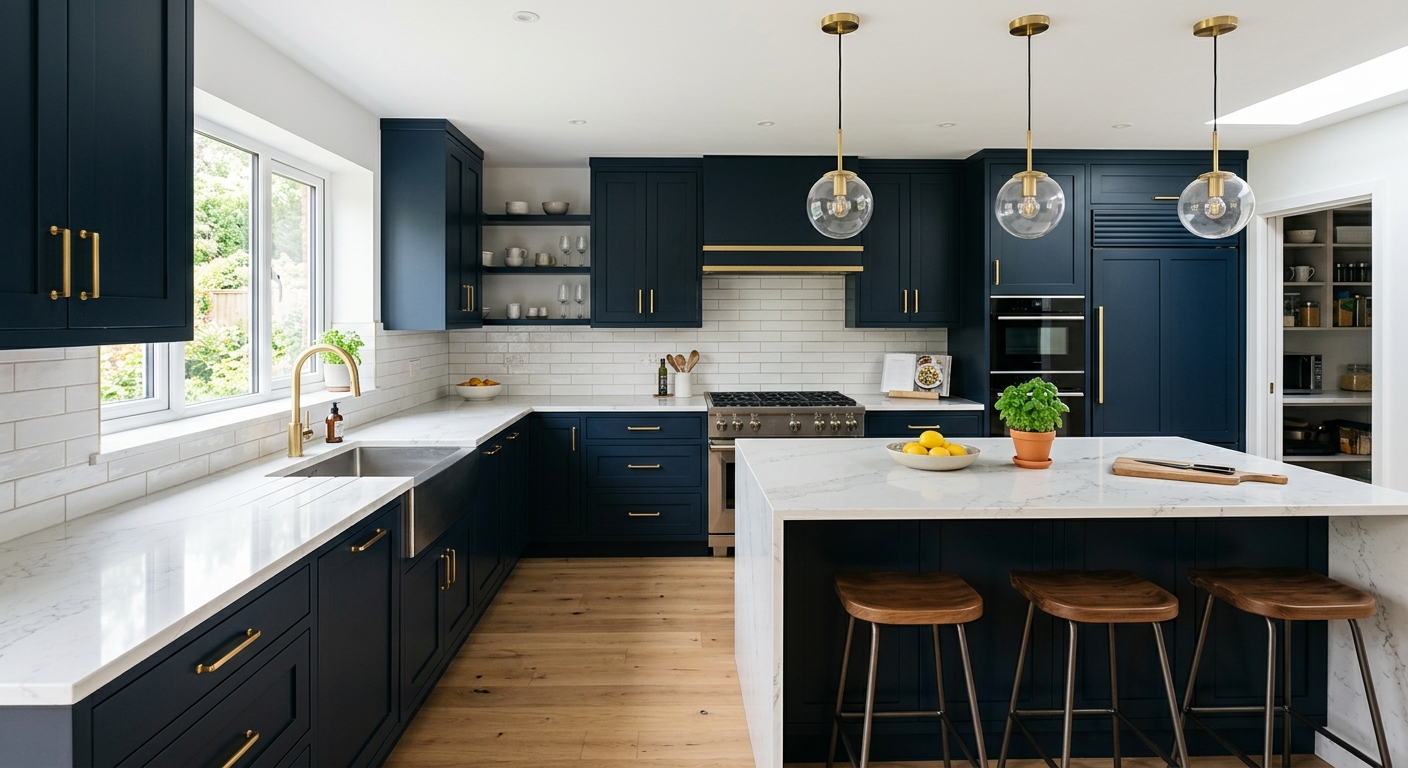
What a kitchen remodel costs in Sewickley
In Sewickley, most kitchen renovations reflect its high homeownership rate and solid median income — with 88.8% of homes owner-occupied and a typical household earning $70,655 (U.S. Census Bureau, ACS 2024), residents here invest with an eye toward long-term value. Renovation costs are shaped by the heavy presence of 1960s–1980s homes in Westmoreland County, which often translates to reworking outdated kitchen layouts and meeting modern electrical demands. Homeowners encounter older 8’x10’ or 12’x14’ kitchens that rarely support today’s open-plan preferences, meaning projects often escalate from straightforward replacements to full gut jobs with wall moves and service upgrades. For post-1980 homes, finishes and aesthetics may be the main concern — but for the majority, layout and code bring complexity.
The most common cause of blown budgets in Sewickley isn’t unexpected price hikes, but underestimating the scale of the work before material decisions are made. Many owners price for a finish upgrade, only to discover hidden costs after plans change from "pull and replace" to "moving walls and services." Knowing your scope – and its cost tier – up front is the surest way to avoid surprise overruns.
| Scope |
What's included |
Duration |
Price range |
| Full gut remodel, same layout |
cabinets, counters, appliances, flooring, lighting, fixtures |
6–10 weeks |
$29,000–$116,000 |
| Gut plus layout change |
all of the above plus moved plumbing, electrical, walls |
10–16 weeks |
$63,000–$116,000 |
| Cabinet replacement (stock to semi-custom) |
remove and install cabinets, hardware, patching |
1–3 weeks |
$6,800–$29,000 |
| Cabinet refacing |
new doors and drawer fronts, veneer, hardware |
3–6 days |
$6,800–$19,500 |
| Countertop replacement only |
template, fabricate, install, reconnect sink |
1–3 weeks |
$3,900–$15,500 |
| Kitchen flooring only |
remove existing, install new flooring |
3–6 days |
$4,800–$19,500 |
Estimates for a typical Sewickley kitchen. Cabinet grade and whether the layout changes move these figures more than square footage.
Four kinds of kitchen project, four budgets
Before requesting bids for a Sewickley kitchen remodel, it pays to define your project tier clearly, because "kitchen remodel" covers a huge range in cost and scope. There are four reliable buckets:
- Cosmetic refresh: Paint, lighting, new hardware, perhaps a backsplash. No cabinets or layout change. It’s the quickest upgrade — little risk or interruption.
- Pull and replace: Replacing cabinets, counters, and maybe appliances, but everything goes back in the existing spot. Plumbing and wiring stay where they are. This is common in Westmoreland County’s later homes, especially the 1980s–90s stock.
- Gut, same layout: Down to the studs. Insulation, wiring, and plumbing replaced, but the layout — sink, appliances, walls — stays essentially the same. This is what many older Sewickley kitchens really need given their age.
- Layout change: Walls or soffits come down, plumbing rerouted, appliances moved — often to open up a galley kitchen or add an island. This triggers a full permit and often requires mechanical or engineering input.
The biggest cost cliff is between gutting and changing the layout. Moving a sink or the range requires new plumbing, electrical, sometimes structural work — all inspected. That gap can be tens of thousands: a gut with the same layout might fall at $29,000–$116,000, but as soon as even one wall or drain moves, it jumps to $63,000–$116,000.
Deciding which tier you’re in, before you even call a contractor, saves you time and money. No reputable contractor can give a serious quote until you pick a scope — not just because work is more or less complicated, but because code and permit paths change too.
What a kitchen quote should specify
A well-written kitchen quote isn’t just a total price — it’s a control document. In Sewickley, the most common source of 'apples and oranges' kitchen bids is the use of allowances. An allowance is a set dollar amount for something not yet selected, like “backsplash: $1,500.” The problem: some contractors plug in real amounts, others lowball, making one quote appear lower while the actual project will run higher. Always check the allowance lines; it’s where identical quotes turn out thousands apart once you actually pick materials.
Your quote should list cabinets by brand and line, not just “quality cabinets.” Countertops should specify material, thickness, and edge style. Be sure it spells out what happens if rot, unsafe wiring, or hidden problems emerge — and exactly how change orders are handled. Good practice is requiring written approvals for all changes.
Payments should be tied to project milestones, not upfront dates, and each check should release a lien waiver from major subcontractors (protecting you from claims). Finally, Pennsylvania’s Home Improvement Consumer Protection Act (HICPA) requires written contracts for work over $500, plus a 3 business-day right to cancel. No contractor should ever ask or offer to skip this.
| Line item |
What to look for |
Red flag if… |
| Allowances |
realistic amounts, itemised |
round numbers with no basis |
| Cabinetry |
brand, line, box construction |
'quality cabinets' |
| Countertops |
material, thickness, edge, seams |
material name only |
| Electrical |
circuits to be added, GFCI scope |
'as needed' |
| Unforeseen conditions |
how they are priced and approved |
not addressed |
| Change orders |
written approval before work |
verbal |
| Payment |
milestone-based, modest deposit |
front-loaded |
| Lien waivers |
from subs at each payment |
not offered |
Electrical work in an older Sewickley kitchen
One of the most predictable budget surprises in Sewickley’s kitchen remodels is electrical. Current code requires dedicated 20-amp circuits for small appliances, ground-fault (GFCI) protection at each countertop outlet, proper outlet spacing, and separate circuits for dishwasher, disposal, and often microwave. An electric range needs a 240-volt circuit — a common upgrade when switching from gas.
But 72.2% of homes here were built before 1980 (U.S. Census Bureau, ACS 2024), so the reality can be: ungrounded two-wire circuits, a single branch powering the whole kitchen, no GFCIs, or a main panel that’s out of spaces or even aluminium wiring in some late-60s builds. Once walls are open, inspectors expect the new work to meet all code — and you cannot legally patch in to old, unsafe wiring. This isn’t optional, and it’s rarely in the “budget” phase. Even for 1990s homes here, you may still need new circuits to satisfy today’s code expectations.
For a typical kitchen in Sewickley, bringing the electrical system to code during a gut renovation often costs $4,500–$9,500, rising fast if the panel must be upgraded or unexpected conditions appear. Don’t skip this; both safety and code compliance ride on doing it right the first time.
Permits and inspections for a Sewickley kitchen
In Sewickley, permits are usually not needed for basic updates such as painting, installing new cabinet doors, replacing cabinet boxes without shifting appliances, or swapping out countertops in the exact same layout. However, as soon as you’re moving electrical circuits, plumbing lines, walls, or making structural changes, you will trigger a building permit under the Pennsylvania Uniform Construction Code (UCC). Moving the sink, adding recessed lights, or opening up a wall can all move your project from “no permit” to formal plan review, especially if you are in Greensburg or a township with active code enforcement.
Electrical inspections in both Greensburg and nearby Hempfield are commonly handled by certified third-party agencies like Code.sys, which sometimes surprises homeowners who expect a municipal inspector. Plumbing and mechanical inspections generally follow if the work requires permit-level changes.
Your contractor is legally required to carry a Pennsylvania Home Improvement Contractor (HIC) registration for any job over $500. You should verify this at hic.attorneygeneral.gov. If their company employs workers, they must also have valid workers’ compensation coverage — you can check via the WCAIS system. Skipping permits, or hiring someone unregistered, doesn’t just risk dangerous or noncompliant work; it can also cause legal trouble at resale, as an unpermitted remodel will be flagged by the next buyer’s title company or inspector.
Cabinets: reface, stock, semi-custom or custom
Choosing the right cabinet path is the single biggest decision in a Sewickley kitchen renovation. Refacing — keeping the existing boxes but swapping the doors, drawer fronts, and exterior finish — is a budget-friendly option if your boxes are solid, square, and you like the current layout. It can look fantastic and extend life for a fraction of the cost, but you cannot change cabinet configuration or add storage.
Stock cabinets come in fixed sizes and finishes, working well when your kitchen walls happen to match modern standards — but that’s rare in Westmoreland County. The 1960s–1980s homes here often have layouts and wall dimensions that do not play nicely with off-the-shelf options. Semi-custom allows for adjusted widths, depths, and an expanded finish palette. It’s the most common choice for older Sewickley homes where you want a modern look without doing full custom. Full custom cabinets are made to order for any shape, size, or design you want — highest price, but the only way to guarantee an exact fit in a uniquely sized space.
Construction quality matters at all price points: plywood boxes hold up better than particleboard, dovetailed wood drawers run smooth and last, and full-extension, soft-close hardware quickly becomes non-negotiable once you’ve had it. Face-frame styles are traditional and hide out-of-square walls better; frameless offers a modern look and more interior space, but less forgiveness in an old house.
| Option |
Cost |
Best when |
Limitation |
| Painting existing cabinets |
$1,200–$3,500 |
boxes and doors sound, tight budget |
no layout or style change |
| Refacing |
$6,800–$19,500 |
boxes square and layout works |
storage unchanged |
| Stock cabinets |
$6,800–$29,000 |
standard dimensions fit |
filler strips, limited finishes |
| Semi-custom |
$19,500–$29,000 |
non-standard walls or finishes |
6–12 week lead time |
| Full custom |
$19,500–$29,000 |
unusual layout or high-end design |
longest lead, highest cost |
Allocating a kitchen budget
Most Sewickley homeowners are surprised to see where the money actually goes when planning a kitchen renovation. Cabinetry is by far the largest slice, followed by labor/installation. Stone or solid-surface countertops are next, then appliances, flooring, lighting/electrical, and plumbing fixtures.
What’s easily overlooked (and shouldn’t be): set aside a contingency fund, especially for older pre-1980 houses. It’s common to find water damage, out-of-code wiring, or framing repairs once old cabinets are out. Another often-forgotten category is soft costs — permits, design help, delivery, and demolition/disposal fees.
If you find yourself with extra budget, it usually pays off in drawers and hardware upgrades before splurging on appliance brands. Conversely, putting a $7,000 range into a kitchen with entry-level particleboard cabinets is backwards — reallocate for function and longevity first.
For Sewickley’s midrange gut remodel of $63,000, the breakdown below gives a practical sense of where to put your dollars:
| Category |
Share of budget |
Notes |
| Cabinetry |
25–35% |
the largest line and the longest lead time |
| Labour and installation |
20–30% |
rises sharply if the layout changes |
| Countertops |
8–15% |
material choice drives the swing |
| Appliances |
10–20% |
widest range of any category |
| Flooring |
5–10% |
|
| Lighting and electrical |
5–10% |
higher in older homes needing circuits |
| Plumbing and fixtures |
4–8% |
|
| Permits, design, disposal |
3–6% |
usually forgotten in early budgets |
| Contingency |
10–15% |
not optional in a pre-1980 house |
Frequently asked questions — kitchen renovation in Sewickley
How does Sewickley's housing stock affect cabinet fit?
Most Sewickley homes are from the 1960s–1980s, which means kitchen walls are often not perfectly straight or plumb. This makes fitting stock cabinets a challenge, as they are built for standard, modern spaces. It’s common for remodels here to require at least some semi-custom sizing to avoid large gaps or excessive use of filler strips. Even if you plan to use stock cabinets at a cost of $6,800–$29,000, you may still encounter extra carpentry or altered layouts to get a decent fit. In homes with out-of-square walls or non-standard dimensions—and Sewickley has plenty—planning for at least some customization usually results in a better-looking and more functional kitchen.
Can I live in the house during a kitchen renovation?
In Sewickley, most homeowners stay put while the kitchen is remodeled, especially for jobs with turnarounds under a month, like cabinet refacing or counter replacement. Full gut projects, however, mean weeks without cooking, running water, or easy meal prep. You’ll need to set up a temporary kitchen space with a microwave and fridge, and expect noise, dust, and people in and out for a while. For extensive projects in the $29,000–$116,000 range, with wall moves or major service upgrades, it’s sometimes easier (especially for families) to plan for takeout and work-arounds. If the floor plan allows clear separation from work zones, staying is feasible; if not, temporary relocation is sometimes worth the cost for sanity.
What does a full gut kitchen remodel cost in Sewickley?
For Sewickley, a full gut kitchen remodel (keeping the same layout) typically lands between $29,000–$116,000, with the median right around $63,000. This includes tearing everything down to the studs, replacing all cabinets, counters, appliances, lighting, and floors, plus making whatever upgrades are needed behind the walls—especially for older electrics and plumbing that 1960s–1980s Westmoreland County homes are known for. Moving walls or changing the layout pushes you into a higher band. Be sure to factor in not just visible finishes but also “must do” infrastructure if your home predates the 1980s.
How much more does moving the sink and range cost?
Changing the placement of a sink, range, or other key plumbing or electrical fixtures in a Sewickley kitchen is what takes a project from a mid-range pull-and-replace to a higher-cost gut-and-layout-change job. Even one major move means new plumbing runs, venting, and electrical—with the necessary permits and signoff from inspection agencies. The typical cost increase is steep: moving from a “gut, same layout” range of $29,000–$116,000 into the “layout change” tier at $63,000–$116,000. If the only move is minor (say, shifting a dishwasher a few feet), it may land close to the lower threshold, but major changes with wall removal will push right to the top of the band.
What flooring works best in a kitchen?
In Sewickley’s climate, with heavy freeze-thaw cycles and clay subgrades, kitchen flooring must be both moisture-resistant and able to handle small settlement movement. LVP (luxury vinyl plank), porcelain tile, or site-finished hardwood are the most common picks. LVP wins for resilience and comfort underfoot, especially for families or heavy cooks, and holds up against water from boots or winter slush. Porcelain tile lasts longest and resists standing water, but needs a flat subfloor, which isn’t always present in Westmoreland County’s older homes. Expect to budget $4,800–$19,500 for new kitchen flooring, depending on material. Avoid laminate and cheap tile—resale and durability just aren’t there long-term.
Do I need to change my kitchen layout?
Most Sewickley kitchens can function better without a layout change, especially if you already have enough storage and workspace. The 1960s–1980s homes here often have walls or soffits that close off the kitchen, but if you’re happy with basic function, a “pull and replace” can stretch your dollar farther—falling in the $6,800–$29,000 range. Layout changes make sense when entertaining or open sight lines are a big deal, or when you’re correcting a true bottleneck. Keep in mind: changing layout nearly doubles budget and extends the project by several weeks. Decide if better lighting and updated cabinets solve your biggest problems before knocking walls down.
How do I verify a kitchen contractor in Pennsylvania?
In Pennsylvania, and by extension Sewickley, every kitchen remodel over $500 requires a Home Improvement Contractor (HIC) registration, issued by the Pennsylvania Office of Attorney General. You can verify this yourself at hic.attorneygeneral.gov, confirming both registration and bonding. If the contractor employs anyone, they must also hold active workers’ compensation insurance, which you can check at the WCAIS system (wcais.pa.gov). Beyond legal paperwork, ask for referrals from prior Westmoreland County jobs and be wary of any company unwilling to provide proof. Quotes on a typical project from $6,800–$29,000 and up deserve thorough vetting for legal compliance before you sign.
How long does a kitchen renovation take in Sewickley?
Project timelines in Sewickley depend largely on scope. Cabinet refacing or flooring only takes about a week. Full gut remodels usually span 6–10 weeks, but can extend to 16 weeks if the layout changes or custom elements are ordered. Westmoreland County faces tighter finish-trade labor availability than Pittsburgh proper, so expect longer lead times for skilled trades and certain materials—especially semi-custom or custom cabinets, which can take 6–12 weeks to arrive. Plan for $29,000–$116,000 projects to need substantial lead time, particularly if permits and inspections are involved. Weather rarely causes major delay, but supplier schedules sometimes do.
Does a kitchen renovation increase home value in Sewickley?
Upgrading your kitchen almost always lifts resale prospects in Sewickley, where homeownership rates are high and buyers expect updated finishes. A full gut remodel at $29,000–$116,000 won’t return dollar-for-dollar in the first year, but in older homes, updated wiring, insulation, and modern function help both appraisals and buyer appeal. Cosmetic-only jobs (paint, hardware, light refreshes) often pay back near 100% if your kitchen was functional to start. For homes built before 1980, value also comes from resolving safety and code deficiencies. The best return in this market comes from midrange projects that balance fresh finishes with a functional work triangle—over-the-top luxury upgrades rarely recoup their extra cost in suburban Westmoreland County.