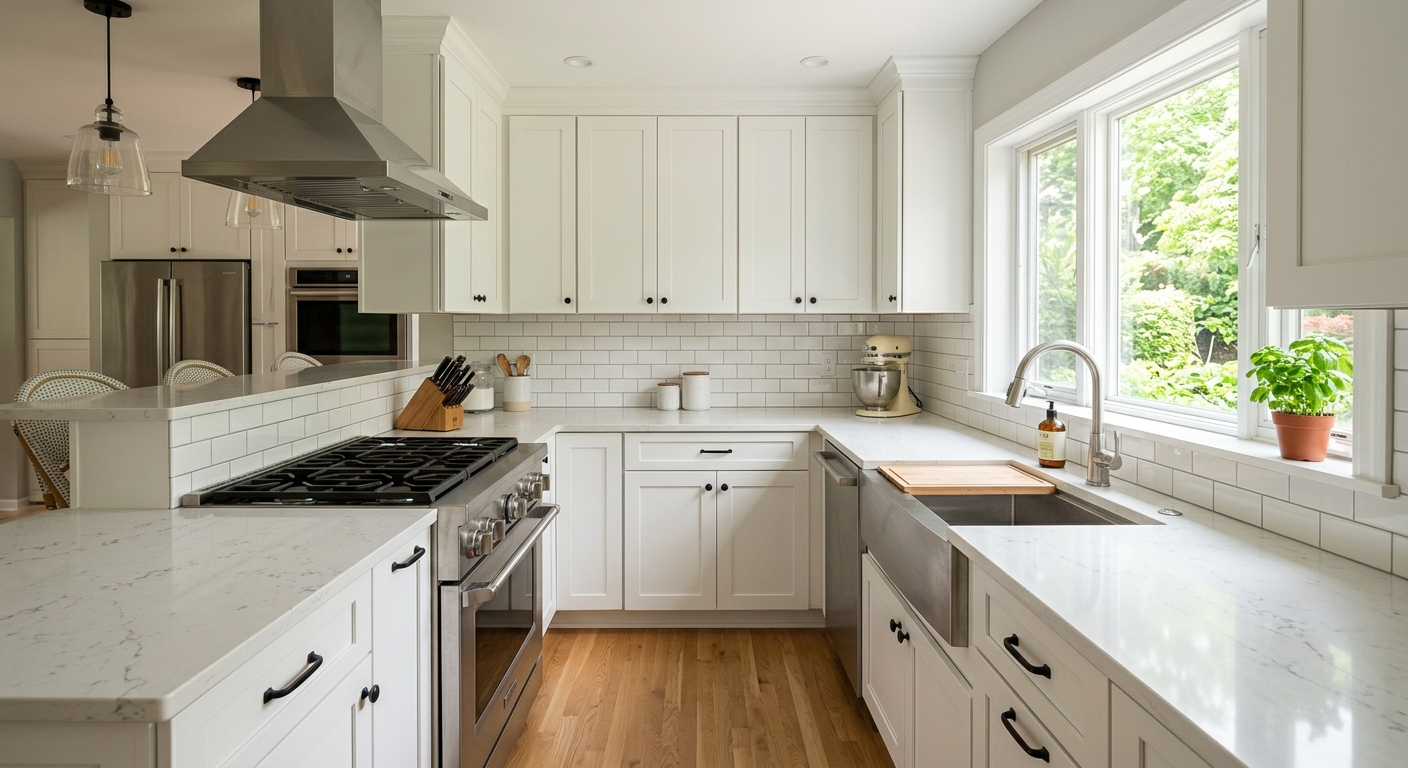
Easttown kitchen renovation prices by scope — 2026
Easttown kitchen projects land in a uniquely high-value bracket thanks to a median household income above $187,000 and a homeownership rate over 80% (U.S. Census Bureau, ACS 2024). Most owners are not flipping or patching rentals, but investing long-term in their own homes. Local housing stock is mostly single-family and built before 1980, so remodels tend to be substantial. Many West Chester and Phoenixville houses from the 1960s–1980s still have closed-off, dated layouts, which means many jobs go beyond a simple cabinet swap or countertop reface: walls get moved and new circuits run. If you expect to do just “finishes” and then decide to open everything up, the price jump is real.
The most common source of cost surprises here isn’t material upgrades—it’s homeowners not being clear on their true scope. Pricing for a cabinet-only replacement has nothing in common with a full remodel that moves appliances, plumbing, and demolishes a wall. If you’re budgeting for just cabinets but add a layout rework later, you can double or triple the estimate. Know your scope from the start and get a price band that matches it.
| Scope |
What's included |
Duration |
Price range |
| Full gut remodel, same layout |
cabinets, counters, appliances, flooring, lighting, fixtures |
6–10 weeks |
$38,500–$154,500 |
| Gut plus layout change |
all of the above plus moved plumbing, electrical, walls |
10–16 weeks |
$83,500–$154,500 |
| Cabinet replacement (stock to semi-custom) |
remove and install cabinets, hardware, patching |
1–3 weeks |
$9,000–$38,500 |
| Cabinet refacing |
new doors and drawer fronts, veneer, hardware |
3–6 days |
$9,000–$25,500 |
| Countertop replacement only |
template, fabricate, install, reconnect sink |
1–3 weeks |
$5,100–$20,500 |
| Kitchen flooring only |
remove existing, install new flooring |
3–6 days |
$6,400–$25,500 |
Estimates for a typical Easttown kitchen. Cabinet grade and whether the layout changes move these figures more than square footage.
Who should run your Easttown renovation
For Easttown homeowners, how you structure your kitchen project is almost as important as what you build. There are three options. The design-build kitchen firm handles everything — from design to cabinetry, install, and all coordination — under one contract. This runs at the top of the price range but takes the management and headaches off your shoulders entirely, with one accountable party. If you prefer handing off decisions, or want a finished product with the least risk, this is the low-stress route — and it fits the Main Line pattern, where professional households don’t have time to chase subcontractors.
A general contractor is the middle path. You or your designer do the product and finishes specification; the GC hires and manages all trades. This option can trim costs and let you have more say, but it still requires a good amount of homework and vigilance. Finish-trade labor here is more expensive and competitive than center-city Philadelphia, but you won’t have the empty calendar waits seen in Lancaster County. The broader labor pool can work for you, if you find the right GC.
If you have a day job, avoid owner-managing any project that triggers permits. Coordinating schedules, ordering materials, and handling surprises takes time and thick skin. Saving money this way only works if you can live with multi-week lags and being at the house for every trade’s access window. Full owner-management is mostly for experienced renovators or those with extremely flexible schedules. For nearly everyone else in Easttown, it’s a false economy.
Why the contingency exists
In Easttown, 64.9% of homes were built before 1980 (U.S. Census Bureau, ACS 2024), so most kitchen renovations touch older framing, wiring, and plumbing. That means opening up the walls is rarely a straight shot from demo to clean install. Expect to encounter walls that aren’t plumb, floors that aren’t level, or framing that needs shimming. Fixing these foundational issues can add $2,000–$6,000 right out of the gate.
Electrical surprises are common: kitchens from the 1960s–80s often have too few circuits, sometimes with ungrounded or undersized wires. Upgrading to today’s safer, code-compliant standards (including GFCIs) often adds $3,000–$7,500. Plumbing can surprise too — any galvanized supply pipes or cast iron drains found behind walls usually need replacement, which quickly runs $2,500–$8,000 extra. And both insulation and venting may be absent on outside walls, making rollback and patching necessary for comfort and long-term efficiency.
Homes from before 1978 may have lead paint risks, triggering requirements under the federal EPA Lead RRP Rule. In these cases, certified renovators will test and, if necessary, use safe work practices — this adds to cost and complexity but is non-negotiable for safety and law. Asbestos-containing flooring crops up in jobs from the 50s–70s; reputable contractors will sample and mitigate correctly. If your kitchen was last touched decades ago, be ready for the odd DIY wiring, hidden junction boxes, or unpermitted fixes. Expect a contingency — very few Easttown remodels go start-to-finish without a single hidden issue.
Eight weeks without a kitchen
Nobody tells you how disruptive a kitchen renovation gets in practice around Easttown — but it’s considerable. You’ll need a temporary setup: most people wedge the fridge into the dining room or garage, park a microwave and an electric kettle on a folding table, and default to paper plates and disposable cups. If you have a laundry or powder room sink nearby, that becomes your new dish-washing station. The food budget? It goes up fast. Eight weeks of takeout and restaurant meals will likely top the cost of new kitchen flooring ($6,400–$25,500), so plan for that as a real, not optional, expense.
Dust is the other uninvited guest. Plastic sheeting with zippered access — not just a tossed drop cloth — makes a big difference in keeping renovation dust out of the rest of your home. Crews need clear access to stage materials, run a dumpster, and move appliances in and out. That means parts of your driveway or lawn are off-limits and the door is often propped open, which is tough with pets and little kids. Demolition is by far the noisiest, dirtiest phase; if you can move out for that first week, you’ll return to a quieter, less messy job.
In short: build in a food budget, expect some daily disruption, and make sure pets and valuables are out of the way. The right planning upfront makes those eight weeks as bearable as possible.
What requires a permit in a kitchen renovation
In Chester County — and in towns like West Chester Borough or Tredyffrin — permits are not needed for straightforward cabinet door refacing, new paint, changing hardware, or swapping a countertop on existing cabinets, as long as you leave layout and utilities alone. But once you add, move, or change electrical circuits, rework any plumbing, move a wall, or re-route gas or ventilation, you cross into permit territory. Even removing one load-bearing wall to open up a 1960s galley triggers plans and approvals.
Plan review is required in West Chester Borough for any kitchen project that alters structural elements or changes mechanical, electrical, or plumbing systems. Electrical inspections in West Chester and West Goshen are usually performed by third-party agencies like United Inspection Agency, rather than by the municipal code office. That surprises many homeowners expecting a town inspector only.
Contractors working on projects over $500 in Pennsylvania must hold a Home Improvement Contractor registration, issued by the Office of Attorney General, and are required to provide a written contract. Their workers’ compensation insurance can be verified via WCAIS (wcais.pa.gov). Skipping the permit process may seem quicker, but unpermitted changes will absolutely come up at resale — causing delays, price reductions, or forced, expensive remediation before settlement. Getting the paperwork right is not red tape; it’s long-term protection.
Why appliance selection comes first
The fastest way to sabotage a kitchen project (and trigger delays or rework fees) is to order cabinets before finalizing your appliances. Appliance dimensions dictate cabinet cutouts and clearances; waiting until later nearly always means someone has to eat extra cost. For refrigerators, standard-depth units stick out past the cabinets, while counter-depth models sit flush — but they sacrifice interior capacity and are often pricier. Cabinet plans must reflect whatever you choose. Ranges also matter: slide-in styles require deeper countertops at the back, while freestanding models just slot into place.
If you switch from gas to induction cooking, know that induction needs a dedicated 240V, 40-amp circuit — and that’s rarely present in pre-1980 Easttown kitchens. This can add up to $2,500–$7,500 for a new circuit plus range. Panel-ready dishwashers offer a seamless cabinet look, but need exact panel specs up front. Range hood venting is a real decision: ducting to the outside removes smoke and moisture for good, while recirculating hoods are less messy to install but underperform, especially with heavy cooking.
As for professional-grade appliances? Their heating and cooling power is real and controls often last longer, but in residential kitchens, much of the premium is for stainless styling and the badge — not function. One last fact: appliance lead times can be much longer than cabinets these days, especially for sought-after brands. Select early to keep your schedule (and kitchen design) on track.
Comparing kitchen renovation bids in Easttown
Comparing kitchen quotes in Easttown is tougher than it should be, and the main culprit is allowances. An allowance is a placeholder amount set for an item not yet selected—like tile at $10/sf or “midrange” appliances at $7,500. Most bids look close until you see that one GC has realistic, market-based allowances and another just puts in lowball round numbers. That difference can swing your actual price by many thousands once real products are chosen. Don’t compare totals—compare the allowance lines, and challenge anybody who can’t explain theirs with market examples.
You also need to see the cabinet brand and line, not just “high quality cabinets.” Countertop material should specify thickness, edge and seam treatment — not just “quartz.” Electrical work needs to state how many new circuits, how GFCI protection will be handled, and whether panel upgrades are included. Watch for how unforeseen conditions are priced and what the change-order process is — these should require your written signoff before work starts. A fair payment schedule ties checks to milestones (like “cabinets delivered, 30% due”) with only a modest deposit up front. And ask for signed lien waivers from every subcontractor at each payment to keep your title clean for resale.
Pennsylvania’s Home Improvement Consumer Protection Act requires written contracts over $500, and gives you a 3-business-day right to cancel after signing. Don’t waive it, and check for contract language that matches. Here’s what the fine print should actually contain:
| Line item |
What to look for |
Red flag if… |
| Allowances |
realistic amounts, itemised |
round numbers with no basis |
| Cabinetry |
brand, line, box construction |
'quality cabinets' |
| Countertops |
material, thickness, edge, seams |
material name only |
| Electrical |
circuits to be added, GFCI scope |
'as needed' |
| Unforeseen conditions |
how they are priced and approved |
not addressed |
| Change orders |
written approval before work |
verbal |
| Payment |
milestone-based, modest deposit |
front-loaded |
| Lien waivers |
from subs at each payment |
not offered |
Frequently asked questions — kitchen renovation in Easttown
Do I need to change my kitchen layout?
Changing the layout in your Easttown kitchen isn’t always required, but it often makes sense if you have an older home — which is likely given that nearly two-thirds of area homes were built before 1980. If you’re living with a cramped 1960s galley or awkward corner cabinets, moving walls or shifting the kitchen triangle can be the difference between a dated space and one that’s open, efficient, and well-lit. On the other hand, if your existing kitchen has a good footprint and traffic flow, you might only need new cabinets or surfaces. Staying with the same general layout keeps costs lower, starting at $38,500–$154,500 for a gut remodel that doesn’t move plumbing or walls. Unless you’re desperate for more space or better flow, don’t tear down everything just for the sake of it — the biggest returns usually come from functional fixes, not just new trends.
How much more does moving the sink and range cost?
Moving a sink or range in Easttown adds real dollars to your project, mainly due to electrical and plumbing rerouting, along with possible changes to venting if you’re reworking a range hood. Relocating the sink means new supply and waste lines, plus repairs to surrounding flooring and cabinets. If you’re moving the range, especially from gas to electric or induction, you’ll need a dedicated 240V circuit most pre-1980 homes don’t have. These scope changes can quickly add $5,000–$18,000 to the base budget, especially if walls need to be opened and reclosed to make it all code-compliant. That’s a big jump from a “same layout” gut remodel, so only make these moves if they’ll pay off in daily use or value for the long term.
What does a quartz countertop cost in Easttown?
Quartz countertops are a popular choice here because they’re durable and low-maintenance, fitting for Easttown’s high homeownership rate and tendency toward long-term upgrades. For fabrication, edge detailing, installation, and reconnecting your sink, total project costs run from $5,100–$20,500, with most homeowners landing near the middle of the range for a standard kitchen. Pricing hits the upper band if you select a premium quartz brand or complex edge profile, or if the removal of old tops reveals hidden issues. One hint: find out whether your quote includes templating and sink cutouts — some shops break those costs out. If your kitchen is reasonably sized and not full of tricky angles, you won’t be surprised.
What is a change order and how should it work?
In Easttown (and across Pennsylvania), a change order is a written agreement that documents any additions, deletions, or modifications to the work after the contract is signed. If you decide mid-job to add a backsplash or move a light fixture, your contractor should give you a written change order — with the precise scope, cost, and any time changes — for your signature before the work proceeds. This protects both sides: you know exactly what you’re paying for, and your contractor is cleared to do the extra work without payment disputes. Change orders can add up, especially with older homes where surprises are common. For reference, adding a few electrical circuits or swapping appliance locations can mean an extra $3,000–$7,500. Never accept verbal-only changes; you’re legally entitled to clear documentation under the Home Improvement Consumer Protection Act.
Should I choose plywood or particleboard cabinet boxes?
It depends on your goals and budget for your Easttown kitchen. Plywood is stiffer, has better screw-holding strength, and resists moisture better than most particleboard. For high-traffic households or those likely to see dampness (like near a dishwasher or sink), plywood boxes are a safer bet — but they cost more. Particleboard (or MDF) boxes in today’s semi-custom lines are engineered well, and many last decades with routine use. If your budget tops out near $25,500 for all new cabinets, quality particleboard boxes may be your best intersection of price and function. If you plan to stay long-term and want maximum longevity or the ability to re-hinge doors without worry, step up to plywood.
Who inspects kitchen electrical work in Easttown?
Electrical inspections for kitchen renovations in Easttown’s nearby municipalities, like West Chester and West Goshen, are typically performed by third-party agencies such as United Inspection Agency rather than by the town’s own code office. This can be a surprise if you haven’t renovated locally before. The third-party inspector will check all new or relocated circuits, verify GFCI and AFCI protection, and ensure everything meets Pennsylvania’s Uniform Construction Code before walls are closed. Permit-triggered inspections are non-negotiable for resale — skipping this step can cost much more than the inspection fee if you’re flagged during a future sale, especially on projects over $38,500.
What should I expect in a pre-1980 Easttown kitchen?
With nearly 65% of homes built before 1980 in Easttown, you’re likely to encounter quirks once demolition begins. It’s routine to find out-of-level floors and walls with old plaster or drywall that make fitting modern cabinets a shimming project. Old wiring — sometimes ungrounded or on undersized circuits — usually isn’t ready for today’s kitchen loads, so electrical upgrades are often required. Galvanized pipes or cast iron drains typically crop up and add unplanned costs. And if your house is pre-1978, the federal EPA Lead RRP Rule applies: contractors must test and, if lead paint is present, use certified safe practices. Plan for a contingency: unexpected surprises can easily add $3,000–$7,500 or more once the walls open up. The upside is, once you’re through, modern systems should last a generation.
How long does a kitchen renovation take in Easttown?
Timelines for kitchen renovations in Easttown depend mainly on scope. For a full gut remodel, especially if you’re changing the layout, plan on 6–16 weeks from demo to final punch list, factoring in design finalization, permitting, inspections, and the inevitable material lead times. If you’re only doing cabinet replacement or simple finishes, the timeline is shorter—often 1–3 weeks, as long as materials aren’t backordered. Crew schedules are tight in the Chester County contractor market, so even a small delay with one trade can ripple through the whole project. Always ask your contractor for a realistic schedule based on your materials and scope at contract signing—and expect minor curveballs due to inspections or material lag.
What adds the most resale value in a kitchen?
In Easttown’s higher-end market, resale value comes from thoughtful updates, not just tossing in expensive surfaces. The biggest gains come when a kitchen’s layout fits how people actually use homes today — open flow, ample counter space, and great lighting. Updating from a closed-off 1960s galley to an open plan, even if it costs $83,500–$154,500, is what drives strong buyer interest here. Appliance and cabinet upgrades matter, but so do backsplash and hardware choices that feel current yet not overly trendy. Countertop material (quartz or stone) and well-coordinated flooring also push value up, but don’t overspend on professional-grade appliances unless you’re sure buyers will pay for the look. Clean, timeless, and functional always trump bells and whistles for Easttown buyers.