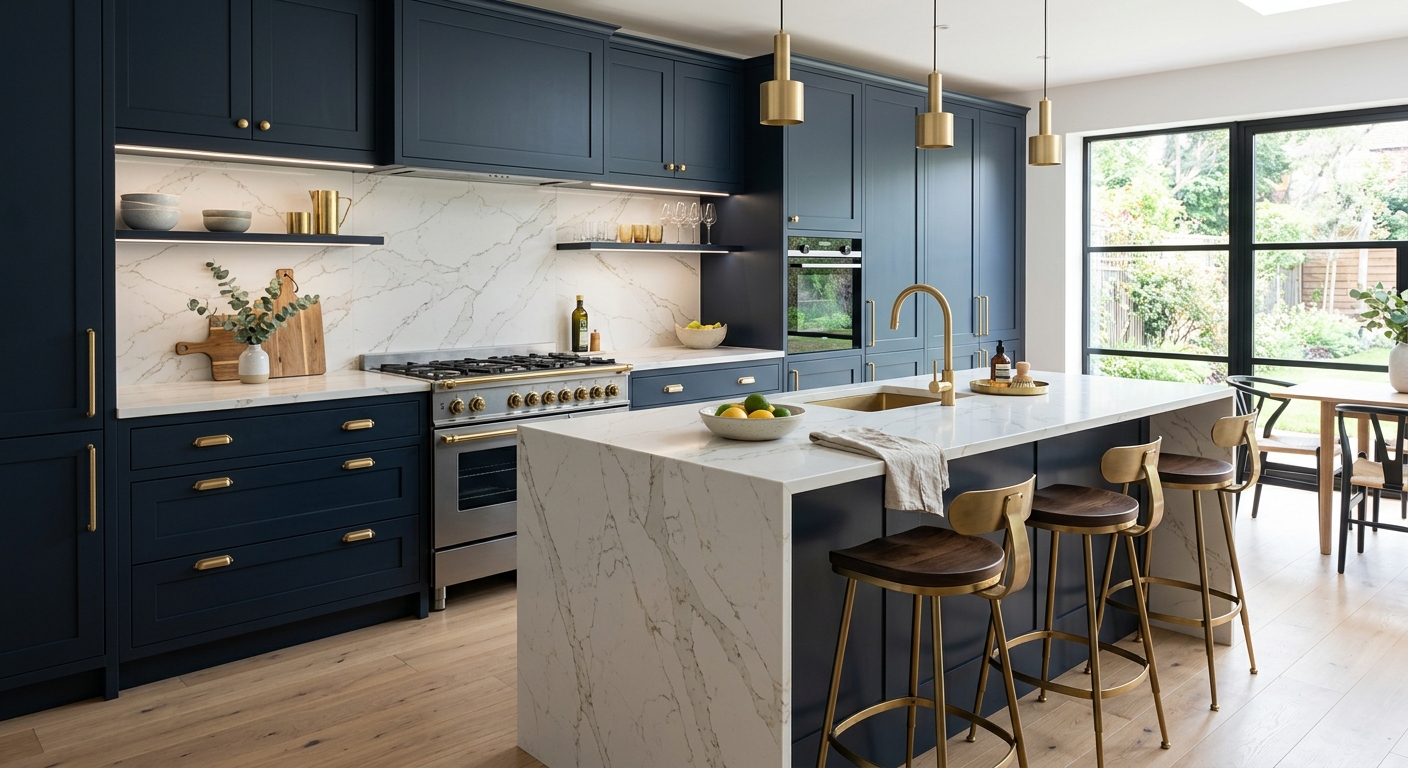
What a kitchen remodel costs in Hopewell
Hopewell’s kitchens track the shape of its housing stock and who owns it. With a homeownership rate around 79.9% and a median household income of $74,269 (U.S. Census Bureau, ACS 2024), most renovations here are planned and funded by the people living in the homes, not investors or short-term landlords. The result is kitchens renovated for decades of use, but on budgets that reflect real middle-income priorities.
One key detail: across Beaver County, many houses in nearby Beaver Falls and Aliquippa were built from 1940–1960, so it’s common to open up a 1950s galley kitchen or strip a worn layout to the studs. In those cases, a full gut remodel is often needed to deal with old wiring, insufficient storage, and cramped spaces. By contrast, in a newer Hopewell split-level from the 1990s, a refresh may be enough.
The biggest risk to your budget is pricing out a straight replacement and then falling in love with a scope that involves moving walls or plumbing: this will more than double not only your costs, but your timeline. Getting sharp about scope is critical before you collect bids or browse showroom samples.
| Scope |
What's included |
Duration |
Price range |
| Full gut remodel, same layout |
cabinets, counters, appliances, flooring, lighting, fixtures |
6–10 weeks |
$29,500–$117,500 |
| Gut plus layout change |
all of the above plus moved plumbing, electrical, walls |
10–16 weeks |
$64,000–$117,500 |
| Cabinet replacement (stock to semi-custom) |
remove and install cabinets, hardware, patching |
1–3 weeks |
$6,900–$29,500 |
| Cabinet refacing |
new doors and drawer fronts, veneer, hardware |
3–6 days |
$6,900–$19,500 |
| Countertop replacement only |
template, fabricate, install, reconnect sink |
1–3 weeks |
$3,900–$15,500 |
| Kitchen flooring only |
remove existing, install new flooring |
3–6 days |
$4,900–$19,500 |
Estimates for a typical Hopewell kitchen. Cabinet grade and whether the layout changes move these figures more than square footage.
Choosing a countertop for a Hopewell kitchen
Countertop selection in Hopewell comes down to how much daily use, maintenance, and repair tolerance you want to sign up for—not just what looks good under the showroom lights. Quartz is now the default pick in many houses: it’s engineered, non-porous, resists stains, and shrugs off most scratches. Its flaw is heat: set a hot pot down and you risk a burn mark that can’t be buffed out. Granite is a step up for heat tolerance and looks, but being natural, it requires sealing every year and can still chip on the edges. Laminate—often dismissed—is, in reality, a perfectly practical, updated product today. It won’t survive a careless knife, but in a Hopewell rental or a modest remodel, modern laminate is not the “cheap” option people remember.
Butcher block warms up a kitchen and is repairable with sanding, but stains, dents, and maintenance are part of the deal. Solid surface (like Corian) is repairable too: scratches and nicks can be sanded out, and seams are almost invisible if the fabrication is good.
On the fabrication side, price climbs quickly with complicated edge profiles, extra cutouts for under-mount sinks, and where seams are unavoidable. Most fabricators will require a template—an exact site visit with the new cabinets in place—rather than working from a drawing, which adds time. That extra site visit makes sure your new top actually fits, but also builds in at least a week’s delay for measurement, then fabrication, then install.
Don’t let anyone talk you out of laminate if it fits the budget or the application. In many Hopewell kitchens, it's the practical, correct call.
Why the contingency exists
With nearly 74% of Hopewell’s homes built before 1980 (U.S. Census Bureau, ACS 2024), kitchen remodels often discover more than intended. Once demolition starts, expect a list of surprises: out-of-plumb walls and out-of-level floors—common in the older Beaver County homes—mean every new cabinet will need shimming and scribing, adding solid labor hours. Undersized or ungrounded wiring appears regularly in kitchens of the 1940–1960 vintage and correcting this to current code can run anywhere from a few hundred to a couple thousand dollars per major circuit change.
Old supply lines made of galvanized pipe or cast iron drains will likely need replacing, not patching. That’s typically a $1,200–$3,500 cost line, not counting when work snowballs. No insulation on exterior walls is common for this era, and can drive up heating bills—so you’ll want to address it while walls are open. Hidden hazards like lead paint must be handled under the federal EPA Lead RRP Rule for any home built before 1978. That means testing before disturbance, and specialized containment and cleanup by certified contractors if lead is detected.
With so many older homes in Hopewell, skipping contingency—usually 10–15% of the budget—isn’t just risky, it’s asking for a nasty surprise. Sometimes you uncover previous unpermitted work or creative duct-taping. This section of the budget gives you breathing room.
Cabinets are the critical path
If there’s one part of a Hopewell kitchen remodel that nearly always sets the tempo, it’s the cabinets. Finish and electrical labor is spread thin across Beaver County compared to Pittsburgh, so the lead time for cabinets is even more of a pinch if you want decent craft.
The way the sequence works: first, you finalize your kitchen design and exact measurements—existing walls, window openings, appliance locations. Then, and only then, can cabinets be ordered. This typically takes several weeks, with semi-custom running even longer. That’s why demolition should only start after the order, not before; nothing drags out the job like waiting for delayed cabinets with an open kitchen.
Once cabinets arrive, demo happens, rough electrical and plumbing are run and inspected, then cabinets are installed. $6,900–$29,500 just for cabinets means they’re the 800-pound gorilla in the room. After that, the measuring for countertops can begin. This step is not optional—a countertop can’t be templated from a plan, only from installed cabinets. There’s no getting around a week or two “dead” period: installation waits for fabrication, and nothing finishes until counters go on.
Counsel: don’t let anyone demolish your kitchen before the cabinet order is confirmed and ship dates locked in. In Hopewell, that’s the best way to avoid a month without a working kitchen.
Allocating a kitchen budget
Break out your Hopewell kitchen budget into real-world shares and you’ll see why cabinetry rules the math. Typically, cabinetry—at 25–35%—is the single biggest check, followed by labor and installation, then the cost of countertops, appliances, flooring, and lighting. If you’re working within the typical full gut budget of $64,000, that means $16,000–$22,000 devoted just to cabinets is common. Labor (including trades, finish, rough-ins, and coordination) sets you back another $13,000–$19,000.
Counters come in at 8–15%, but picking marble or composite can swing thousands. Appliances have wide swings, from a modest to a luxury set, but spending $6,000–$13,000 is not unusual. Lighting is an underestimated budget hole in pre-1980 houses, where you often need new circuits or fixture locations.
Soft costs like permits, design, delivery, and debris haul-off run 3–6%. Contingency belongs in every Hopewell budget; with so many older homes, it’s not just for peace of mind, it’s practically guaranteed you’ll use some or all of it. The single worst allocation: buying a professional-grade range but running out of money for good cabinets or new electrical. Put your cash where you spend your hours, and where it costs you double to fix after the fact.
| Category |
Share of budget |
Notes |
| Cabinetry |
25–35% |
the largest line and the longest lead time |
| Labour and installation |
20–30% |
rises sharply if the layout changes |
| Countertops |
8–15% |
material choice drives the swing |
| Appliances |
10–20% |
widest range of any category |
| Flooring |
5–10% |
|
| Lighting and electrical |
5–10% |
higher in older homes needing circuits |
| Plumbing and fixtures |
4–8% |
|
| Permits, design, disposal |
3–6% |
usually forgotten in early budgets |
| Contingency |
10–15% |
not optional in a pre-1980 house |
Why appliance selection comes first
In a Hopewell kitchen, appliance choices dictate the layout—not the other way around. Every cabinet set is designed with precise appliance dimensions: height, width, depth, and required clearance. If you pick appliances after the cabinets are ordered, you create an expensive trap—a new refrigerator that protrudes, a range that won’t fit, or a dishwasher you can’t open fully.
For refrigerators, the difference between a standard-depth and counter-depth model is a full three inches—and it determines whether the fridge lines up with your cabinetry or towers over it. A slide-in range, which sits flush for a seamless look, requires a different cabinet cut than a freestanding model. Choosing gas or induction for your cooktop brings hard realities: induction may require a dedicated 240V line and, in older Hopewell homes, an upgraded main panel.
Panel-ready dishwashers can disappear behind a cabinet panel, but require coordination in the cabinet order. Range venting: ducted hoods vent melting bacon out of the house, which is always preferred, while recirculating hoods are a convenience compromise. Professional-grade appliances look sharp and can deliver higher output, but in real day-to-day Hopewell use, the extra money goes mostly to aesthetics and minor performance gains.
These days, certain appliances—especially induction or custom finishes—can take longer to arrive than the cabinets themselves. Make decisions early and order early, or you’ll find your kitchen waiting on a backordered oven.
Permits and inspections for a Hopewell kitchen
Most cosmetic kitchen updates in Hopewell—like painting, changing hardware, refacing cabinets, or swapping out a countertop—do not require building permits. But once your renovation crosses into new or relocated wiring, plumbing changes, layout changes, or structural wall removal, you need to pull a permit. For example, in nearby Aliquippa, removing or relocating a kitchen wall triggers a building permit and usually a formal plan review if you change layout or egress.
Electrical inspections in Aliquippa are handled by a third-party agency approved by the City of Aliquippa, which can add steps and waiting to your schedule. In other Beaver County boroughs and townships, code offices are typically separate and rules can vary, but expect oversight if rewiring, major plumbing adjustments, or mechanical work such as a range hood is involved.
Contractors must be registered for home improvement work over $500 through the Pennsylvania Office of Attorney General (check at hic.attorneygeneral.gov). Workers’ compensation is required by law for anyone with employees and can be verified through Pennsylvania’s WCAIS (wcais.pa.gov). You should have a written contract and know about your 3 business-day right of cancellation.
Cutting corners on permits is short-sighted: unpermitted work is the first thing flagged in a home sale and can cost more in the long run. Compliance is not optional if you want to protect your investment and resale value.
Frequently asked questions — kitchen renovation in Hopewell
What are cabinet lead times in Hopewell right now?
Lead times for kitchen cabinets in Hopewell are running a bit longer than what you’ll see in Allegheny County, due primarily to thinner finish-trade labor in Beaver County. For stock cabinets, expect 2–4 weeks if your selection is in distribution; for semi-custom options, 6–12 weeks from the time of confirm order to delivery is typical. Custom cabinets can stretch even further, especially around major holidays or during the spring and fall rush. If you plan a full gut kitchen remodel, cabinet delays can cascade—everything from countertop templating to flooring and even appliance installation often must wait until cabinets are in place. Within a total kitchen project that runs $29,500–$117,500, hard lead times can mean your kitchen is out of commission longer than you think, so always order cabinets before demolition.
What should I expect in a pre-1980 Hopewell kitchen?
Pre-1980 kitchens in Hopewell are the rule, not the exception, with nearly three-quarters of homes built before 1980 (U.S. Census Bureau, ACS 2024). You should prepare to run into out-of-level floors, walls that aren’t square, old electrical wiring (sometimes ungrounded or undersized), original plumbing, and potential lead paint hazards due to the age. Replacing galvanized water lines or cast iron drains is a frequent find—and resolving these can add $1,200–$3,500 to your project. Don’t be surprised if you also uncover unpermitted repairs or makeshift solutions behind the cabinets. An honest contractor in Hopewell will insist on a contingency budget and won’t sugarcoat how common these discoveries are. You’ll want a crew that has real experience with older homes, not just newer builds.
Can I over-improve for my Hopewell neighbourhood?
Yes—especially in Hopewell, where home values and household incomes (median $74,269, U.S. Census Bureau, ACS 2024) call for practical choices. Spending at the top of the price band—for example, a $117,500 full gut remodel—may not be recoverable at resale unless your kitchen is truly outmoded and the rest of your house matches the finish level. If you install high-end or custom everything in a modest neighborhood, you risk outpacing the value ceiling. The market rewards a well-planned upgrade with quality finishes, functional layouts, and good workmanship—not blown budgets or “luxury” brands nobody recognizes. A quality mid-range kitchen, with a careful allocation of $29,500–$64,000, will fit both neighborhood expectations and future buyers’ appraisal math.
What is a change order and how should it work?
In Pennsylvania, a change order is a written record of work not included in your original contract: maybe you want to add recessed lighting, shift a wall, or upgrade to a better countertop after the demo starts. In Hopewell, change orders are particularly common in pre-1980 homes when hidden defects or code issues surface. Every change order should clearly state the scope, the additional price, and any impact on your project schedule. The Home Improvement Consumer Protection Act requires written contracts and protects your right to understand every added cost. If you’re already at the typical remodel amount—say, $64,000—keep in mind change orders can tip a budget fast. Never rely on a handshake or verbal agreement; insist on everything in writing for both cost and liability reasons.
What does a full gut kitchen remodel cost in Hopewell?
For Hopewell, a full gut kitchen remodel—meaning all new cabinets, counters, flooring, lighting, appliances, and fresh finishes—is running from $29,500–$117,500, with a typical job landing near $64,000. This wide range reflects different scopes and choices: sticking to your original layout and picking good mid-range materials keeps the number in check, while moving walls, relocating plumbing, or selecting luxury appliances pushes you toward the upper end. With so much pre-1980 housing stock in Hopewell, always add a contingency budget for discoveries behind the walls. Kitchen size matters, but finish choices and whether the layout gets changed drive costs the most.
How do I verify a kitchen contractor in Pennsylvania?
In Pennsylvania, every contractor who performs home improvement work over $500 must be registered with the Pennsylvania Office of Attorney General. Before you sign a contract for your Hopewell kitchen, check their HIC (Home Improvement Contractor) registration at hic.attorneygeneral.gov. For jobs with employees on site, make sure the business holds valid workers’ compensation insurance; verification is available through the WCAIS system (wcais.pa.gov). Ask for a written contract, as required by the Home Improvement Consumer Protection Act. Never hire based solely on price—if you’re spending $6,900–$117,500 on work, a reputable, registered, and insured contractor is your best protection against problems both during and after the project.
What does a quartz countertop cost in Hopewell?
A quartz countertop replacement in Hopewell—including template, fabrication, and install—usually falls in the $3,900–$15,500 range, with most kitchens hitting near $8,800. The final price depends on your kitchen’s size, countertop thickness, edge selections, number of cutouts, and factory lead times. While quartz is low-maintenance, stain-resistant, and nearly impossible to scratch, it is sensitive to heat—do not set down hot pans directly. Quartz is more expensive than laminate or entry-level solid surface, but less costly than some rare stones or custom tops. If you're budgeting for a full kitchen remodel, countertop costs will typically be 8–15% of the total project.
Can I renovate a kitchen in stages?
Staged renovation is often the right call in Hopewell, especially where owners need to manage cost or avoid a fully unusable kitchen. For instance, you might first replace cabinets—at $6,900–$29,500—and live with the old floor for a year, or upgrade appliances without touching the rest. Just plan the sequence with a pro: new countertops can’t be removed and reused easily, so if you do cabinets first, you’ll need to budget for countertops soon afterwards to avoid extra labor costs. Electrical and plumbing upgrades are easier with walls open, so try to lump “behind the wall” work up front. In piecemeal jobs, expect a slightly higher total spend, as trades make more site visits and you’ll pay more for additional mobilization and adjustments.
What is the difference between stock and semi-custom cabinets?
Stock cabinets in Hopewell are mass-manufactured in set sizes and colors, ready for fast delivery and installation. They’re budget-friendly—falling in the lower end of $6,900–$29,500—but limited in sizing and features, which means more filler strips and less “seamless” fit in older, out-of-square kitchens. Semi-custom cabinets, on the other hand, are built to order with a wider choice of styles, sizes, finishes, and storage solutions. They cost more and take longer to arrive—sometimes up to 12 weeks as of 2026—but deliver a tailored fit and can work around Hopewell’s frequent bumps and odd corners found in pre-1980 houses. Think of semi-custom as the sweet spot for owners who want quality and flexibility without custom pricing.