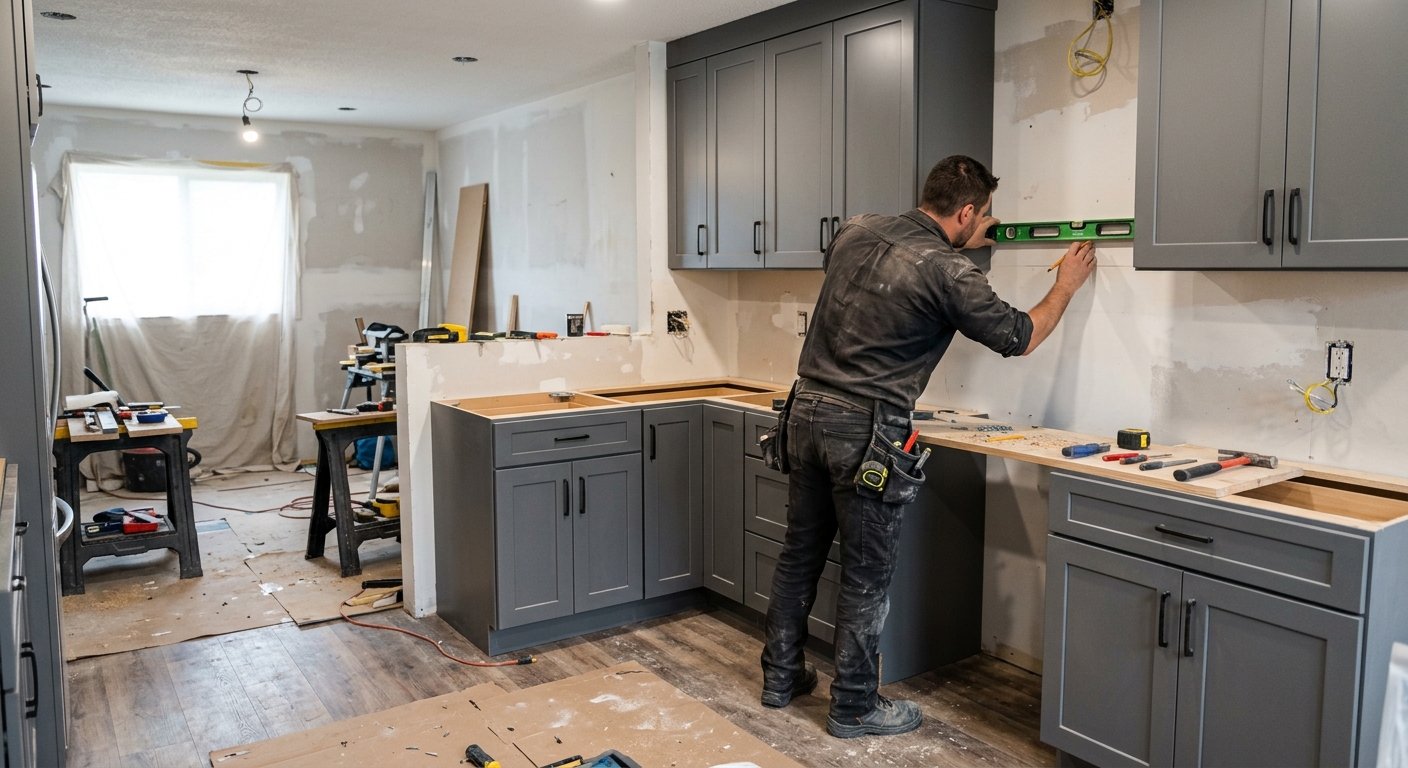
Swatara kitchen renovation prices by scope — 2026
In Swatara Township, where the median household income stands at $72,588 and homeownership is above 68% (U.S. Census Bureau, ACS 2024), most kitchen remodels are planned by homeowners for their own use, not for rental turnover. The houses that dominate this area — especially in postwar subdivisions built from 1945–1975 — often have small, galley-style kitchens that require more work to reconfigure than those found in new builds or larger, open-plan layouts. These age and design factors mean a renovation can quickly shift from a simple refresh to a complex project involving layout changes. The most common cause of big cost overruns is budgeting for "just new cabinets" but then deciding (or discovering a need) to move walls, rerun wiring, or update plumbing.
| Scope |
What's included |
Duration |
Price range |
| Full gut remodel, same layout |
cabinets, counters, appliances, flooring, lighting, fixtures |
6–10 weeks |
$29,000–$117,000 |
| Gut plus layout change |
all of the above plus moved plumbing, electrical, walls |
10–16 weeks |
$63,500–$117,000 |
| Cabinet replacement (stock to semi-custom) |
remove and install cabinets, hardware, patching |
1–3 weeks |
$6,800–$29,000 |
| Cabinet refacing |
new doors and drawer fronts, veneer, hardware |
3–6 days |
$6,800–$19,500 |
| Countertop replacement only |
template, fabricate, install, reconnect sink |
1–3 weeks |
$3,900–$15,500 |
| Kitchen flooring only |
remove existing, install new flooring |
3–6 days |
$4,900–$19,500 |
Estimates for a typical Swatara kitchen. Cabinet grade and whether the layout changes move these figures more than square footage.
What's behind the walls in a Swatara kitchen
More than 60% of homes in Swatara Township were built before 1980 (U.S. Census Bureau, ACS 2024), so it’s common to uncover a few surprises when gutting an older kitchen. Out-of-plumb walls and out-of-level floors mean the cabinet install starts with shimming and custom fitting, adding both time and labor cost. In these houses, wiring may be ungrounded, undersized, or run on only one or two circuits, which no inspector will sign off on today. Upgrading old circuits and panels can add between $3,000–$8,000 to your electrical scope, depending on the length and condition of runs.
Galvanized water supply lines, likely original to a 1950s build, need to be swapped out to avoid leaks and low pressure — and cast iron drains are often past their prime. Lack of insulation in exterior walls is another headache, especially for energy bills and code sign-off. It’s not unusual to find remnants of previous unpermitted DIY work, like 1970s ceiling tiles covering up knob-and-tube or cut joists under cabinet boxes.
Any home built before 1978 falls under the EPA Lead RRP Rule, so certified contractors must test for lead paint and, if present, follow special procedures during demolition. Asbestos sheet flooring or mastic also shows up in this era, requiring testing before removal. In newer houses, most surprises are due to builder-grade shortcuts: particleboard cabinets sagging, laminate counters swelling at seams, and minimal circuit counts for appliances added over the years.
Electrical work in an older Swatara kitchen
If your Swatara kitchen was last renovated before 1980, expect wiring upgrades to take a bigger share of your budget than you planned. Current code requires two or more dedicated 20-amp small appliance circuits with GFCI protection at all countertop outlets, receptacle spacing every four feet, and separate dedicated lines for dishwasher, disposal, and often the microwave. An electric range needs its own 240-volt circuit as well.
But pull off the panel cover in a 1955–1975 subdivision, and you'll often find two-wire ungrounded circuits, kitchen and lighting on the same breaker, and a fuse box or panel with no spare spaces. Aluminum branch wiring even shows up in a few late-1960s houses. Once demo begins, municipal inspectors expect all new kitchen wiring to meet current code — this is not negotiable. Some homeowners are caught off guard here, especially as the panel upgrade and rewiring is a big ticket item, often missed in the initial bid.
Expect a full electrical update, including panel, circuits, outlets, GFCI/AFCI, and hardwired appliances, to add $6,800–$19,500 to your project. Even in late-1990s kitchens, the number of circuits installed rarely meets today's code, so budget for extra runs to the panel if you’re adding high-draw appliances or changing the layout.
Resale value and kitchen spending
A newly renovated kitchen can speed up a sale in Swatara Township, but it’s rare for any remodel — even a sharp one — to return its full cost at closing. Buyer expectations lean toward clean, mid-range upgrades suitable for daily use, not luxury finishes or major layout reworks. In fact, homes that outspend the median for the area ($72,588 household income per U.S. Census Bureau, ACS 2024) rarely see a dollar-for-dollar return. Over-improvement for the neighborhood — for instance, dropping $117,000 on a full gut — turns into a loss when the house is eventually listed among smaller, mid-century neighbors.
The smarter approach if selling is to refresh surfaces with neutral colors, choose practical mid-grade cabinets and counters, and skip structural or major appliance upgrades. If you are renovating for your own long-term use, prioritize what you will use and enjoy every day — and accept that resale value may not enter into the equation. The value is in the function, not in future buyers’ preferences. For most Swatara homes, focus budget on visible finishes and up-to-date electrical, plumbing, and layout only if they are holding back daily use or code compliance.
Code requirements for Swatara kitchens
For Swatara homeowners, kitchen permits break down by project scope. No permit is generally needed for painting, changing hardware, or even refacing cabinets; similarly, countertop replacement on existing cabinets can often proceed without plan review. But the moment you touch electrical circuits (adding outlets, lighting, or new appliance feeds), move plumbing, or alter any wall structure, municipal code — based on the Pennsylvania Uniform Construction Code (UCC) — requires a permit and plan submittal. This plan typically needs to show the proposed kitchen layout, all new or moved electrical and plumbing, and any structural changes.
Inspections in Dauphin County, including Swatara and Lower Paxton, are generally handled by third-party electrical agencies rather than by a municipal inspector, which can catch homeowners off guard if they’re used to more hands-on township inspection. All contractors performing work over $500 must be registered with the Pennsylvania Office of Attorney General — verify their Home Improvement Contractor (HIC) registration at hic.attorneygeneral.gov. Employers must have workers' compensation coverage, verifiable through WCAIS.
Unpermitted work creates future title headaches: municipalities often require proof of permit and inspection sign-offs before issuing certificates of occupancy or approving resale. Doing it by the book is the only safe route when investing in a kitchen remodel in Swatara.
Choosing cabinetry
Cabinet decisions shape both budget and function in a Swatara kitchen renovation. Refacing is the lowest-disruption option: new doors, drawers, hardware, and a fresh veneer for existing sturdy cabinet boxes. This keeps costs and downtime down, but only makes sense if the original cabinets are solid and the layout fits your current needs — no new storage or configuration changes are possible.
Stock cabinets come in fixed sizes, so they often require filler strips where the room doesn't fall on a six-inch multiple, and the finish options are limited. Semi-custom cabinets allow for tailored widths, depths, and more finish choices, solving quirks that are common in Swatara’s postwar homes, where wall runs can be 105-3/4" and every corner is slightly out of square. Many homeowners start off thinking “stock is fine,” but these as-built wall quirks push them toward semi-custom by the time final measurements are taken.
Full custom cabinets suit truly unique needs, but cost and lead time climb fast — they are often unnecessary unless the kitchen footprint is genuinely unusual or you want features not available elsewhere.
For any option, pay attention to box construction: plywood boxes are tougher than particleboard in the long haul, dovetail drawers last longer than stapled boxes, and full-extension soft-close hardware isn’t just a minor upgrade. Frameless (European) cabinets give a cleaner look and more usable drawer space but need true walls for proper alignment, while face-frame cabinets are more forgiving in older homes that aren’t perfectly straight.
| Option |
Cost |
Best when |
Limitation |
| Painting existing cabinets |
$1,200–$3,500 |
boxes and doors sound, tight budget |
no layout or style change |
| Refacing |
$6,800–$19,500 |
boxes square and layout works |
storage unchanged |
| Stock cabinets |
$6,800–$29,000 |
standard dimensions fit |
filler strips, limited finishes |
| Semi-custom |
$19,500–$29,000 |
non-standard walls or finishes |
6–12 week lead time |
| Full custom |
$19,500–$29,000 |
unusual layout or high-end design |
longest lead, highest cost |
Choosing a countertop for a Swatara kitchen
Countertop choice in Swatara kitchens comes down to everyday maintenance, not just looks. Quartz is engineered, non-porous, and needs almost no care, but it’s heat-sensitive: a hot pan can leave a permanent mark. Granite is natural stone and handles heat better, but it needs to be sealed every 1–2 years or it will stain from wine, oil, or even water. Laminate, once dismissed as cheap, is durable and improved to resist scratches and stains — and in mid-range Swatara homes or rentals, it’s often the most sensible option.
Butcher block brings warmth and “country kitchen” charm, but requires frequent oiling and is easily damaged by water or knife slips. Solid surface materials (like Corian) are fully repairable: scratches sand out and seams almost vanish, making them a practical middle ground. Seam placement matters in all installs: in a small galley kitchen, one well-placed seam can be almost invisible or awkwardly prominent. Edge details, sink cutouts, and faucet holes all affect fabrication cost, as does whether a counter is measured directly or templated after cabinets go in.
For most Swatara kitchens, a carefully planned laminate, mid-range granite, or standard quartz counter is the right call — paying up for waterfall edges and exotic stone rarely pays off in daily life. If the kitchen goes into a rental or an affordable postwar family home, don’t ignore laminate: it’s durable, easily replaced, and cost-effective.
Frequently asked questions — kitchen renovation in Swatara
Can I live in the house during a kitchen renovation?
It’s possible to live in your Swatara home during a kitchen remodel, especially if you’re sticking to cabinet refacing or a countertop replacement, which can be done in under a week. For full gut renovations — typically $29,000–$117,000 and lasting several weeks — expect real disruption. Most contractors set up a temporary kitchen with a microwave and fridge in another room, but there will be noise, dust, and workers moving in and out. Plumbing and electrical will be shut off at times, so plan for simple meals and flexible daily routines. Consider your family’s schedule and tolerance for chaos; many Swatara homeowners arrange to stay nearby for the noisiest week if small kids or remote work are involved.
Can I cancel a renovation contract in Pennsylvania?
Yes — Pennsylvania’s Home Improvement Consumer Protection Act (HICPA) gives homeowners three business days to cancel a written home improvement contract over $500, which covers nearly any kitchen renovation in Swatara. You must notify the contractor in writing within that period for a refund of any deposit. This right must appear in the contract itself, so always check before you sign. After the three days pass, cancellation terms depend on what's in your contract; some firms keep fees for time and materials already spent. For a mid-range project, say cabinet replacement at $19,500, prompt communication is key if you change your mind.
What does a quartz countertop cost in Swatara?
In the Swatara and Lower Paxton market, quartz countertop pricing runs from $3,900–$15,500, with most jobs falling near the $8,800 mark for an average-sized kitchen. Price depends on the color chosen (some “natural” looks run higher), the complexity of the sink and faucet cutouts, edge profiles, and whether seams or L-shapes are required. Installation always includes basic removal and reinstallation of the sink, but exotic or oversize stone runs near the high end of the range. Costs may be slightly higher if you want to match backsplashes or include an integrated sink.
Do older Swatara homes need electrical upgrades for a kitchen?
Nearly always. Pre-1980 homes in Swatara — of which there are many — usually have outdated wiring: too few circuits, no GFCI outlets by the counters, and sometimes ungrounded or aluminum branch wiring. Any permitted kitchen renovation must bring these up to current code, which means adding new circuits and possibly upgrading your panel. Plan for electrical work in the $6,800–$19,500 range if you’re gutting and updating fully. Even a “like for like” remodel with new appliances usually uncovers enough deficiency to trigger at least some rewiring.
Is laminate countertop a bad choice?
Not at all. In many Swatara homes — especially rentals, budget remodels, or in keeping with a house’s original 1960s or 1970s era — laminate is practical and surprisingly tough. Modern laminates resist stains, scratches, and come in styles that mimic stone at a fraction of the cost ($3,900–$15,500 for most kitchens). If your kitchen doesn’t need a “statement piece” and you prefer easy cleaning, laminate may make sense. Seams and edging are more visible than in stone, but replacement is fast and costs remain low.
Should I reface or replace my kitchen cabinets?
Refacing costs less ($6,800–$19,500), gives a dramatic style update, and can be finished in under a week — but only works if your cabinet boxes are sturdy, square, and in a workable layout. If the storage is lacking, the boxes are particleboard and sagging, or you're planning to move appliances or walls (common in postwar Swatara kitchens), replacement is the better route. Replacement allows you to reconfigure for modern appliances and add storage, but takes more budget and time. In most Swatara homes, owners end up replacing if the kitchen is original and never modernized.
Can I over-improve for my Swatara neighbourhood?
Absolutely — and it’s easy to do. The median household income here is around $72,588, and home values reflect that. Spending on the high end — full custom cabinets, top appliances, layout moves, luxury finishes — may create a stunning kitchen but won’t return the extra investment when you sell. In a neighborhood of mostly 1950s–1970s homes, a practical, attractive new kitchen will help your house sell fast, but over-investment rarely pays back dollar-for-dollar.
How far ahead should I book a contractor in Swatara?
For a full kitchen gut — $29,000–$117,000 range — booking ahead by 4–6 months is smart in Swatara. Finish trade labor is tight, especially as larger contractors draw skilled crews from outside the area, and lead times for cabinets (especially semi-custom) stretch 6–12 weeks. For smaller projects like refacing or counters, 2–3 months might be enough, but the earlier you start lining up your contractor, making material decisions, and pulling permits, the better your timeline will hold.
How much more does moving the sink and range cost?
Moving sinks and ranges isn’t just about relocating an appliance — it means rerouting plumbing (supply and drain), running new electrical or gas lines, patching and refinishing floors, and often extensive wall work. For a typical Swatara kitchen, moving these can increase your project by $10,000–$30,000, depending on the runs and what’s uncovered during demo. It often triggers permit and code upgrades too. Unless the existing layout is truly unworkable, keeping these locations steady is the safer way to protect your budget.