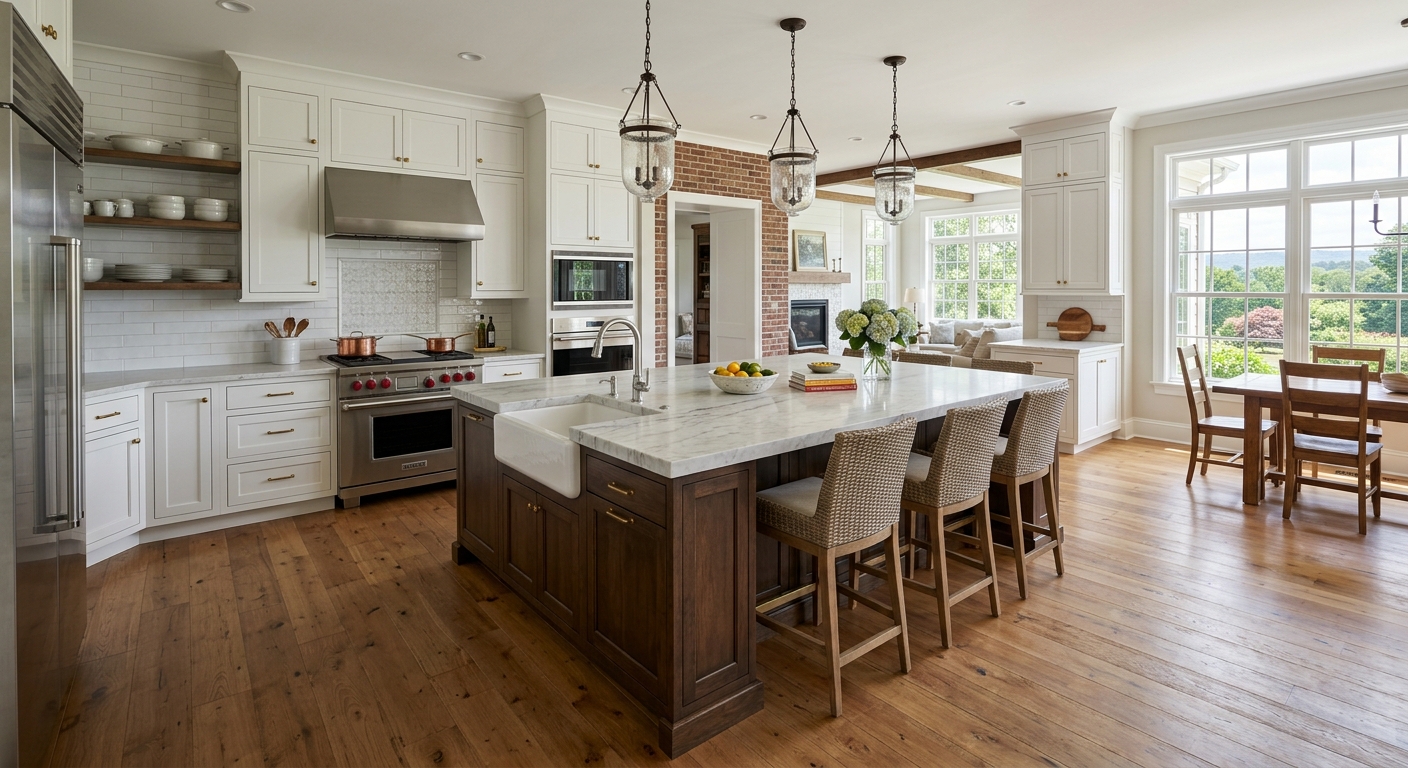
Warren kitchen renovation prices by scope — 2026
In Warren, kitchen renovation pricing sits at the intersection of older home layouts and what local homeowners are prepared to spend. With a 58.2% homeownership rate and median household income at $49,609 (U.S. Census Bureau, ACS 2024), most projects are planned by people who expect to live with the results for years, not landlords flipping rentals. Warren city homes are predominantly from 1900–1940, which means your “simple” kitchen update can turn into a major project the moment you touch a wall or discover outdated wiring or structure awkwardly spliced from earlier renovations.
The single biggest driver of blown budgets is underestimating your scope. If you price out a “gut remodel, same layout” and, along the way, move two walls and add circuits, you’ve crossed into a higher price band — but many first-time renovators don’t realize this until the change orders arrive.
| Scope |
What's included |
Duration |
Price range |
| Full gut remodel, same layout |
cabinets, counters, appliances, flooring, lighting, fixtures |
6–10 weeks |
$27,000–$107,000 |
| Gut plus layout change |
all of the above plus moved plumbing, electrical, walls |
10–16 weeks |
$58,000–$107,000 |
| Cabinet replacement (stock to semi-custom) |
remove and install cabinets, hardware, patching |
1–3 weeks |
$6,300–$27,000 |
| Cabinet refacing |
new doors and drawer fronts, veneer, hardware |
3–6 days |
$6,300–$18,000 |
| Countertop replacement only |
template, fabricate, install, reconnect sink |
1–3 weeks |
$3,600–$14,500 |
| Kitchen flooring only |
remove existing, install new flooring |
3–6 days |
$4,500–$18,000 |
Estimates for a typical Warren kitchen. Cabinet grade and whether the layout changes move these figures more than square footage.
Who should run your Warren renovation
Your construction delivery model will affect cost, scheduling, and headaches more than whether you choose quartz or granite. The three options in Warren are design-build, general contractor, and owner-managed.
A design-build kitchen firm brings the designer, the cabinetry, and the trades under a single contract. This is the highest up-front cost and the least hassle: the firm owns the timeline, the warranty, and the outcome. Single point of accountability matters if you can’t be on site every day.
A general contractor will coordinate the cabinet installer, the countertop crew, plumbers, electricians, and flooring trades, but you or your designer will specify every finish and appliance. You’ll pay less than design-build, but gain some homework and lose some control over each sub’s schedule. For most Warren homeowners, this is the happy medium: expertise you don’t have to direct daily.
Owner-management — hiring each trade individually and scheduling them yourself — will save money if you know construction sequencing and have abundant time. In Warren County, where finish-trade labor is tight compared to Erie, every missed element blows your timeline out by weeks. If you have a day job and will need a permit (for example, if your kitchen project moves plumbing or electrical), you should not self-manage. Inspectors and approval cycles do not work around your work travel or vacation plans.
The less time you have to chase contractors, the more worthwhile it is to pay for competent project management.
Allowances, exclusions and change orders
The price you get on a Warren kitchen bid isn’t always what you end up paying, and allowances are the main reason. An allowance is a placeholder sum in your contract for an item not yet selected — often tile, lighting, or appliances. Compare two bids that both total $58,000: one might allow $4,000 for appliances and the other just $1,000. You’ll pay the difference at the end, with markup.
Review all allowances before comparing contractor totals — not doing this leads to overruns and nasty surprises. Every bid should also name the cabinet brand and line (not just “quality cabinets”), specify countertops by both material and thickness, and explain what happens if old wiring, rot, or non-standard framing are found. Written change orders should be required before work continues, and payment schedules should be tied to milestones, not dates. Lien waivers from subcontractors protect you if a sub isn’t paid — insist on them at each payment.
For all Warren projects over $500, state law requires a written contract with your 3 business-day right of cancellation. Never trust a contractor who asks to skip this paperwork.
| Line item |
What to look for |
Red flag if… |
| Allowances |
realistic amounts, itemised |
round numbers with no basis |
| Cabinetry |
brand, line, box construction |
'quality cabinets' |
| Countertops |
material, thickness, edge, seams |
material name only |
| Electrical |
circuits to be added, GFCI scope |
'as needed' |
| Unforeseen conditions |
how they are priced and approved |
not addressed |
| Change orders |
written approval before work |
verbal |
| Payment |
milestone-based, modest deposit |
front-loaded |
| Lien waivers |
from subs at each payment |
not offered |
Code requirements for Warren kitchens
For Warren homeowners, understanding when you need a permit comes down to what’s changing. Cosmetic work like painting, swapping door hardware, or a straight countertop replacement usually does not trigger a permit either in the City of Warren or the surrounding townships. If your renovation will move plumbing, add or move electrical circuits, or remove a wall, you almost always need a building permit within the city. Plan review applies if you’re taking out a wall or changing major systems, while electrical inspections in the City of Warren are handled by a third-party certified UCC electrical inspection agency — not city inspectors directly.
If you live outside the city, most townships allow cabinet refacing and countertop replacement without a permit, but the minute your project touches electrical or plumbing, municipal code offices expect you to pull one. For anything over $500, Pennsylvania requires your contractor to be registered with the HIC registry and carry written contracts, with mandatory 3 business-day cancellation rights. Employers must also have active workers’ comp insurance; you can verify registration online at the named state portals.
If you sell your Warren home and a home inspector discovers unpermitted structural, electrical, or plumbing work, you may be forced to pay for costly after-the-fact inspections or even rip out noncompliant work before the sale closes.
Planning appliances before cabinets
The most common sequencing mistake in a Warren kitchen renovation is ordering cabinets before you’ve committed to your appliances. Appliances drive cabinet layout — not the other way around. A common blunder is guessing at appliance sizes, only to find the refrigerator won’t clear a passage or the range opening is off by an inch.
Standard-depth refrigerators stick out past base cabinets, while counter-depth models align flush, but cost more and compromise on cubic footage. Choose before cabinets are ordered, not after. Slide-in ranges need specific opening widths, a finished counter behind, and no raised back, whereas freestanding models are more forgiving. Shifting from a gas to induction range adds to the electrical scope, possibly requiring upgraded circuits. Going “panel-ready” with a dishwasher delivers an uninterrupted cabinet look, but the dishwasher depth must be called out at cabinet design time.
As for hood venting, ducted to the outside truly removes heat and odors; recirculating hoods are a compromise that recirculate air and capture grease, but won’t fully tackle smoke or moisture — a recurring issue in tightly built old Warren kitchens.
A word on professional-grade appliances: you pay a premium for styling and a reputation more than real-world performance. For most Warren kitchens, additional electrical and install cost often outweigh the functional gains. Appliance lead times regularly exceed cabinet lead times on high-demand and specialty models, so finalize your list early.
How a Warren kitchen budget breaks down
Most first-time renovators are surprised when they see the proportional breakdown of a full kitchen gut remodel in Warren. Cabinets alone commonly eat up 25–35% of the total, followed closely by labor and installation, which sets in even steeper on 1900–1940-era homes where walls aren’t plumb or systems are out of date. Counters, appliances, flooring, lighting, and fixtures collectively account for another third.
The two budget lines that routinely get skipped — and shouldn’t — are contingency (for what is discovered behind old plaster or tile) and the so-called soft costs: permits, delivery fees, disposal and design services. In Warren, where cabinetry alone can run $6,300–$27,000 and a full gut remodel spans $27,000–$107,000, a 10–15% contingency is not padding, but survival for anyone working in a pre-1980 home.
Where does another thousand dollars make a real impact? Expect the best return from quality full-extension hardware or improved lighting, not from a fancier stove. Spending more on cabinets buys utility and resale value — springing for a boutique fridge in a basic, out-of-square kitchen rarely pays back.
| Category |
Share of budget |
Notes |
| Cabinetry |
25–35% |
the largest line and the longest lead time |
| Labour and installation |
20–30% |
rises sharply if the layout changes |
| Countertops |
8–15% |
material choice drives the swing |
| Appliances |
10–20% |
widest range of any category |
| Flooring |
5–10% |
|
| Lighting and electrical |
5–10% |
higher in older homes needing circuits |
| Plumbing and fixtures |
4–8% |
|
| Permits, design, disposal |
3–6% |
usually forgotten in early budgets |
| Contingency |
10–15% |
not optional in a pre-1980 house |
The biggest line item in your Warren kitchen
The cabinetry decision determines whether your Warren kitchen will consume half your annual income or land within reach. There are four real options. Refacing is the least invasive: new doors, drawer fronts, and cabinet veneer. It works — and is well worth considering — when your box frames are solid, square, and already arranged as you want them. It won’t fix a bad layout or add storage.
Stock cabinets come in standard widths and heights. In older Warren homes, where wall dimensions are rarely square or standard, they require filler strips and you’re limited on finishes. Semi-custom cabinets offer more options: widths, depths, heights, and finishes, making them a common choice in the 1900–1940 stock so prevalent in Warren. Full custom means anything goes — made to measure for every crooked nook — but at the highest cost and with lead times that regularly run to three months or more.
Don’t be fooled by price alone — mid-tier cabinets can outperform expensive ones if they use plywood box construction, dovetail drawers, and soft-close hardware. Frameless (European) construction gives more interior space but requires more accurate installation, a challenge in older homes where nothing is plumb or level.
| Option |
Cost |
Best when |
Limitation |
| Painting existing cabinets |
$1,200–$3,500 |
boxes and doors sound, tight budget |
no layout or style change |
| Refacing |
$6,300–$18,000 |
boxes square and layout works |
storage unchanged |
| Stock cabinets |
$6,300–$27,000 |
standard dimensions fit |
filler strips, limited finishes |
| Semi-custom |
$18,000–$27,000 |
non-standard walls or finishes |
6–12 week lead time |
| Full custom |
$18,000–$27,000 |
unusual layout or high-end design |
longest lead, highest cost |
Frequently asked questions — kitchen renovation in Warren
What is an allowance in a renovation quote?
An allowance is a budget placeholder your Warren kitchen contractor uses for items not selected at contract signing — typically tile, appliances, or lighting. For example, if your contract includes a $4,000 counter allowance but you later pick a slab worth $6,000, you will pay the extra $2,000 at the end, often plus markup. It’s crucial to check what each allowance realistically covers, as two contractors can show similar totals while one quietly expects you’ll upgrade far above what’s budgeted. In Pennsylvania, written contracts are mandatory over $500, so everything should be itemized. Before you compare grand totals, scan each allowance line and check if it reflects prices at local suppliers.
Why is there a gap after cabinets are installed?
In Warren’s older homes, especially those built between 1900 and 1940, it’s common for walls to be out of square or for rooms to run just a bit wider than standard cabinet sizes. Stock cabinets come in fixed widths, so installers must use filler strips to bridge those small gaps. This is not sloppy work — it’s a necessity in houses with non-standard dimensions. Gaps can also appear because the installer intentionally left room for future appliance installation or because your floors slope more than you realize. If you want a tight, seamless cabinet wall, semi-custom or custom options (ranging from $18,000–$27,000) can be built to fit exactly, but at higher cost and longer lead times.
What is a realistic contingency for a Warren kitchen?
For Warren, where 92.5% of homes were built before 1980, you should set aside a 10–15% contingency on top of your target kitchen renovation budget. For a typical full gut remodel outlining $27,000–$107,000, this means an extra $2,700–$16,000 reserved for the unexpected — think deteriorated framing, outdated wiring, hidden plumbing issues, or asbestos in old flooring. Skipping the contingency is how projects stall or cheapen finishes at the end. Unlike newer builds, old Warren kitchens almost always reveal a surprise once demolition starts, so leaving this “padding” is wise, not wasteful.
Which upgrades are not worth the money?
In Warren kitchen projects, “luxury” features rarely recoup their investment unless the rest of the renovation is already high-end. Professional-grade appliances cost thousands more but function the same in daily use as reliable mid-range models. Panel-ready appliances add cost and complexity, especially if your cabinets aren’t already semi-custom or custom (a jump from $6,300–$18,000 for refacing to $18,000–$27,000 for custom). Soft-close hardware is worthwhile for daily convenience, but integrated touchscreens, interior lighting, and built-in organizers have limited resale and utility for most families. Invest instead in solid cabinets, proper lighting, and durable countertops before splurging on gadget-heavy appliances.
What flooring works best in a kitchen?
The best kitchen flooring in Warren must handle moisture, heavy traffic, and — thanks to our climate’s freeze/thaw cycles — possible subfloor movement. Luxury vinyl plank (LVP) is the most forgiving in older homes, offering water resistance, warmth underfoot, and a price band of $4,500–$18,000 installed for most kitchens. Porcelain tile is more durable but feels cold in winter unless you add radiant heat. Hardwood looks good but is prone to water damage from leaks or spills, a risk with homes built before dishwashers were common. Choose flooring that balances slip resistance, ease of cleaning, and matches the age and construction of your Warren home.
Are Warren kitchens typically small galley layouts?
In the City of Warren, most homes were built 1900–1940, a period when galley or corridor kitchens were the norm. These spaces often have limited natural light and cramped walking space. Older layouts mean full gut remodels (starting at $27,000–$107,000) typically involve layout changes, structural work, or opening up to adjacent rooms. If you’re planning to keep a small layout, smart cabinet and appliance choices can improve function without major expense. But if your dream is a wide-open, modern kitchen, expect to spend beyond cosmetic upgrades — most older Warren kitchens need both layout adjustment and significant system updates.
Do I need a permit for a kitchen renovation in Warren?
If you’re in the City of Warren, you’ll need a permit for any kitchen renovation that moves plumbing, electrical circuits, or touches structural elements. Cosmetic projects — like refacing cabinets or replacing a countertop in place — typically do not need one, unless you alter systems. In Warren County’s townships, rule of thumb is similar, and most towns don’t require permits for surface-only updates. However, always verify with your municipal code office before starting. Getting caught with unpermitted work can stop a sale or even force you to tear out finished renovations. Contractors in Pennsylvania must have valid HIC registration and insurance for jobs over $500, so always check these if a permit is in play.
Do I need to change my kitchen layout?
Most Warren homeowners want to open up galley kitchens common in 1900–1940 houses. If your layout genuinely works, sticking with it can save tens of thousands — gut remodels without layout changes start at $27,000–$107,000, while moving walls and systems runs $58,000–$107,000. The case for a layout change is strong when traffic flow is blocked, appliance doors collide, or you’re adding direct access to another room. But if your kitchen’s bones help you cook efficiently, surface upgrades and storage tweaks often deliver better value. Let your needs — not trends — dictate whether to re-imagine the space.
What does a quartz countertop cost in Warren?
A quartz countertop installation for an average-sized Warren kitchen falls in the $3,600–$14,500 range. The exact number depends on color, edge profile, seam locations, and if your layout has unusual corners. Quartz remains the go-to for those wanting low maintenance, consistent patterns, and modern appeal without the hassles of granite or marble upkeep. Keep in mind that cutout details for sinks, stoves, or unique shapes can push pricing toward the upper end. If your budget is tight, shopping basic color lines or having a smaller L-shaped counter installed will usually land you closer to the lower bracket.