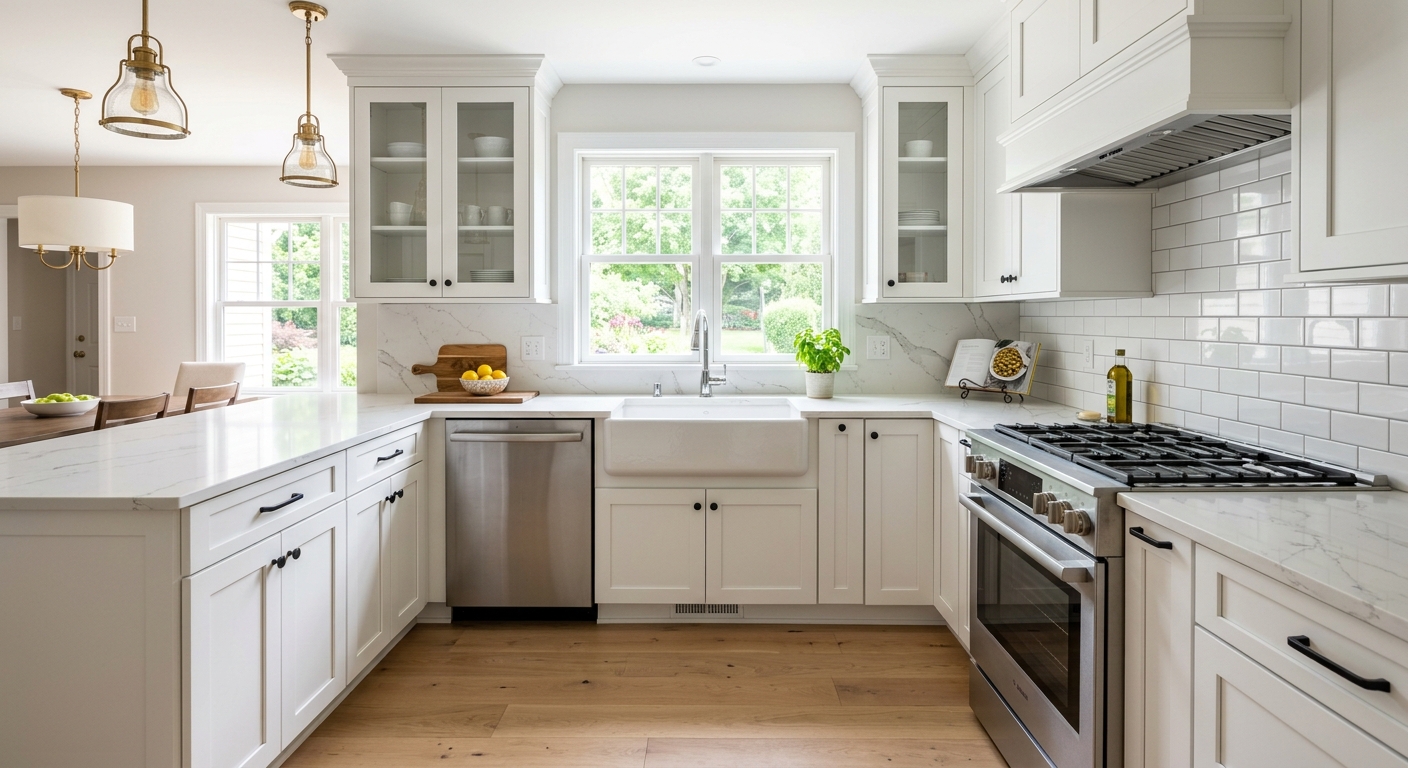
Kitchen renovation costs in Collier — 2026
In Collier—with a high homeownership rate and a median household income of $98,021 (U.S. Census Bureau, ACS 2024)—most kitchen renovations are value-driven decisions. Owners here plan for kitchens that fit their daily lives and reflect local home values, not just surface upgrades. The local remodeling market is shaped not just by money but by the era of the housing stock. In older parts of the Pittsburgh area, many homes pre-date 1940, so full gut renovations often mean reconfiguring tight, compartmentalized kitchens. More recent construction, especially from the 1990s onward, is likely to call for cosmetic improvements or targeted upgrades—think new cabinets or counters, not wall moves.
The big pitfall: mistaking your project’s scope. Many budget for “just cabinets” and then expand into wall changes, plumbing, and layout shifts—driving the job up into a far higher price tier. Here’s where most homeowners overspend, so make sure your design goals match your actual budget and scope.
| Scope |
What's included |
Duration |
Price range |
| Full gut remodel, same layout |
cabinets, counters, appliances, flooring, lighting, fixtures |
6–10 weeks |
$32,000–$127,500 |
| Gut plus layout change |
all of the above plus moved plumbing, electrical, walls |
10–16 weeks |
$69,000–$127,500 |
| Cabinet replacement (stock to semi-custom) |
remove and install cabinets, hardware, patching |
1–3 weeks |
$7,400–$32,000 |
| Cabinet refacing |
new doors and drawer fronts, veneer, hardware |
3–6 days |
$7,400–$21,000 |
| Countertop replacement only |
template, fabricate, install, reconnect sink |
1–3 weeks |
$4,200–$17,000 |
| Kitchen flooring only |
remove existing, install new flooring |
3–6 days |
$5,300–$21,000 |
Estimates for a typical Collier kitchen. Cabinet grade and whether the layout changes move these figures more than square footage.
Renovating to live in versus renovating to sell
It’s straightforward: renovating to enjoy your Collier kitchen is simply not the same as renovating for a future sale. A kitchen remodel will absolutely help a home sell faster here—but very rarely returns its full cost. Most mid-range kitchen projects recoup a higher percentage of their cost than luxury ones. Spending at the high end of the local range—anything approaching $127,500—often means you’re upgrading beyond what most of the neighborhood can justify.
Collier’s typical homeowner income is around $98,021 (U.S. Census Bureau, ACS 2024), so spending on a kitchen should reflect what homes actually sell for in your part of Allegheny County. If your goal is resale, keep your finishes neutral, your spending moderate, and avoid moving walls. Buyers want clean, fresh, and functional—anything more customized can narrow your pool.
On the other hand, if you’re staying, tailor the kitchen to how you live. That might mean splurging on appliances, the layout you want, or the cabinets that make sense for your family—even if resale isn’t your first concern. In either scenario, don’t expect a dollar-for-dollar return and don’t over-improve for your area. If you care primarily about resale, mid-range spend and broad appeal are usually safest.
Countertop materials compared
Selecting countertops in Collier is as much about practicality as it is about appearance. Here’s what matters: maintenance, stain-resistance, heat-tolerance, seams, repairability, and how it fits your daily routine.
Quartz is engineered stone—non-porous and low-maintenance, but can scorch from hot pans. If you cook a lot with cast iron or baking sheets, you’ll need to be vigilant. Granite is natural, unique in pattern, and takes heat—but requires periodic sealing to protect from stains. Laminate’s reputation is worse than its actual performance: today’s products resist scratching and stains remarkably well for the price, and for rentals or modest kitchens, there is no shame in choosing it.
Butcher block looks warm and inviting, trends up and down, but is demanding—susceptible to stains and requires regular oiling. On the plus side, it can be sanded and refinished. Solid surface (like Corian) offers invisible seams and is fully repairable if you gouge or scratch it. However, it can burn and looks less “natural” than stone.
Fabrication choices drive cost as much as the material: more complex edge profiles, sink cutouts, and custom measurements add up. Countertop pros will template onsite for a precise fit—don’t confuse this with rough measurements. Placement of seams matters too: in stone, they can be visible.
A well-chosen laminate or solid surface, professionally installed, can hold its own in many Collier kitchens—saving you thousands against stone with almost no penalty in daily use.
Planning appliances before cabinets
Get this order wrong, and you can blow months and thousands. Appliances drive your cabinet layout, not the other way around. If you design cabinets first and choose appliances last, you risk a fridge that sticks out or a range that doesn’t fit the opening.
Counter-depth refrigerators sit roughly flush with the cabinets, but regular models are deeper and will protrude several inches—this affects your cabinet plan. Slide-in ranges require finished sides on the adjacent cabinets and a slightly different countertop edge. Freestanding ranges are more forgiving but lack that built-in look.
Choosing between gas and induction? Induction cooking demands a dedicated 240-volt circuit and nearly always a panel upgrade in older homes. Gas ovens need to coordinate with both venting and appliance dimensions. For dishwashers—if you want a wood panel to match your cabinets, you need to specify a panel-ready model before your cabinet order.
Range hoods: ducted to the outside is best. Recirculating (filter-only) models are a compromise—acceptable in condos or where exterior venting isn’t feasible, but less effective at removing smells and moisture.
Lastly, premium “pro” appliances offer style and resale prestige but rarely outperform mid-grade models at everyday tasks. Lead times can stretch to months, so always choose and order appliances first.
Code requirements for Collier kitchens
In Collier, cosmetic kitchen projects—paint, new hardware, or countertop swaps where everything stays put—typically do not require permits. As soon as you move or add plumbing or electrical lines, change a structural wall, or perform significant mechanical work (like adding a vented range hood), most boroughs will require a permit for the kitchen remodel. Pittsburgh and similar townships also require plan review for full kitchen remodels that change layout or structure.
Electrical inspections are handled either by the municipality or by third-party inspection agencies authorized for a given borough—this is often surprising to homeowners coming from areas with one central building office.
Contractors in Pennsylvania must have a Home Improvement Contractor (HIC) registration for jobs over $500; always verify registration at hic.attorneygeneral.gov. Employers must carry workers’ compensation, which you can confirm via WCAIS (wcais.pa.gov).
The resale risk is this: work done without the right permits will surface at sale, especially if the buyer’s lender requires a municipal resale inspection. This can force a costly and disruptive “after-the-fact” permit process—sometimes including opening finished walls.
Electrical work in an older Collier kitchen
Older Collier homes tend to catch homeowners off guard during a kitchen remodel. Current code expects every kitchen to have multiple dedicated small-appliance circuits, GFCI protection at all countertop outlets, spacing rules for receptacles, and dedicated lines for dishwashers, disposals, microwaves, and (if electric) ranges including the required 240-volt service.
Many homes built before 1980—about 30% of Collier’s housing—have two-wire, ungrounded circuits, sometimes a single shared breaker for the entire kitchen, or even aluminium branch wiring in rare cases. Once your contractor opens the walls, code requires all new wiring to meet modern standards—no exceptions for "just a quick update." Even homes from the 1990s often lack the number of circuits now mandated.
Panel upgrades are another stumbling block. If your electrical panel is full, adding the circuits needed for today’s kitchens may require a new subpanel or a full replacement.
Upgrading an older kitchen’s electrical system to current code during a full renovation typically adds $4,200–$17,000 to your budget, depending on the panel, house access, and how much demo is needed.
What moving the sink really costs
When you move plumbing or electrical in a Collier kitchen, you step off a cost cliff. Keeping the sink, range, and outlets in place keeps your project in the lower price class; moving them pushes you into full gut remodel territory, with an added range of $37,000–$58,500 over a cosmetic-only approach.
Drains require slope—not just location. If your kitchen is over a finished basement ceiling or on a slab, moving a sink often means opening floors or ceilings, not just “moving a pipe.” For electric, new circuits may not fit in your existing panel. That means electricians evaluate for a subpanel or a service upgrade—costly steps, not simple ones.
Want to knock out a wall? In Allegheny County, you’ll need to determine if it’s load-bearing, hire an engineer, and apply for permits. Add range hood venting to an outside wall, and you’ll need a new exterior opening—again, not an afterthought.
For most Collier homeowners, the hard question is: is the current layout actually unworkable, or just dated? If you can live with the “wrong” sink location, you’ll avoid crossing from a $21,000 cabinet job into a much larger scope. Always clarify your priorities up front: every move adds more than its share to your final bill.
Frequently asked questions — kitchen renovation in Collier
Should I renovate before selling or let the buyer do it?
If you’re selling in Collier, a mid-range kitchen renovation helps a home sell faster, but rarely pays you back fully in dollars. Local homebuyers often prioritize move-in-ready kitchens, but if your cabinets are serviceable and the space is clean, you may only need to paint and update hardware—sometimes within the range of $7,400–$21,000 for basic refacing. Buyers recognize a fresh kitchen, but they don’t want to pay top dollar for one that’s overbuilt for the local market when the median income is around $98,000. If your kitchen is severely outdated or dysfunctional, an update can attract more offers, but keep the finishes neutral and avoid over-customizing. Unless your kitchen is a real deal-breaker, you can often price your home accordingly and let the next owner perform a full gut remodel to suit their tastes.
Can I cancel a renovation contract in Pennsylvania?
Yes—under the Home Improvement Consumer Protection Act (HICPA), contracts for work over $500 in Pennsylvania (including Collier) must be in writing and include a three business-day right of cancellation. This cooling-off period applies to most home improvement contracts, regardless of whether work has started. Make sure your contractor uses a written agreement, as required. After the three days, cancelling can involve fees, especially if special-order items—such as cabinetry, which may cost $7,400–$32,000—have already been ordered. Read your contract carefully before you sign, and never be pressured out of your legal right to cancel. If you don’t receive a contract, or if the contractor offers to waive your insurance deductible, consider this a warning sign.
Why are kitchen quotes in Collier so far apart?
Kitchen remodel quotes in Collier often span a broad range—from basic cabinet swaps at $7,400 up to major gut remodels well over $100,000. Here’s why: Collier’s homes vary widely in age and layout, so one kitchen might only need surface updates while another requires full rewiring, plumbing, insulation, and wall changes. Labor rates here are also higher than in outlying counties, reflecting continuous demand. If your quote is much higher, check what’s included—some contractors price bare-bones with upgrade options, while others include all contingencies. Always clarify the exact scope, and never compare prices unless the work is truly apples-to-apples.
What flooring works best in a kitchen?
In Collier, the best kitchen flooring balances durability, water resistance, and comfort. Options like luxury vinyl plank and porcelain tile are top contenders—they withstand the frequent freeze-thaw and handle dropped pans or messes from daily life. Real hardwood looks great but demands more maintenance, especially over clay or damp subgrade common in Allegheny County. High-quality vinyl flooring (in the $5,300–$21,000 range) has become almost standard for smart remodels here. If you’re on a budget, sheet goods or resilient tile can also hold up well, but always focus most on a level, stable subfloor—your finish floor is only as good as what’s underneath.
Should I hire a general contractor or a kitchen firm?
In Collier, both options are common. A general contractor can coordinate all trades (plumber, electrician, flooring, etc.) and is a good choice for expansions or gut remodels, especially if your project involves moving walls or changing layout (often starting at $32,000). A kitchen design-build firm may use their own carpenters and subs, offering a seamless process with less coordination for you—ideal if you prefer a single point of contact. In either case, insist on HIC registration, written contracts, and documented workers’ compensation. For small jobs (cabinet refacing, countertop replacement), a specialty firm can be cost-effective, but for complex jobs, general contractors offer more flexibility and oversight.
How far ahead should I book a contractor in Collier?
Demand for kitchen renovation in Collier is strong and steady, so reputable contractors often book out several months in advance—sometimes a full season for large jobs costing $69,000 or more. Appliance and cabinetry lead times remain long for many models, occasionally exceeding 10–12 weeks themselves. For summer or fall projects, start talking to contractors in winter or early spring to avoid disappointment. Small projects—simple flooring or countertop installs—may get scheduled sooner, but complex jobs involving layout changes are rarely available on short notice. Don’t wait until after you finalize design or product choices; book early so you’re not boxed in by others’ timelines.
What is the cheapest way to update a Collier kitchen?
The most budget-friendly updates are surface-level: repainting cabinets, installing new faucets and lighting, and swapping countertops can completely refresh a Collier kitchen starting at around $4,200 for a basic laminate counter replacement. Cabinet refacing, at $7,400–$21,000, can modernize the room without the sticker shock of full replacement. Avoid moving plumbing, re-routing electric, or removing walls—those changes move you into a very different, more expensive category. Focus your dollars where you’ll notice them in daily life, and don’t be afraid to leave the footprint alone. Most buyers and appraisers value clean, functional, and updated kitchens over flashy materials.
Do older Collier homes need electrical upgrades for a kitchen?
Yes—often more than you’d expect. With about 30% of Collier homes built before 1980, many kitchens here still run on undersized or ungrounded circuits, which are no longer up to code. Once walls are opened for work, inspectors expect all new wiring to meet modern safety standards: GFCI outlets, dedicated lines for appliances, and enough breakers for small appliance circuits. This upgrade adds both safety and peace of mind, but the cost—ranging from $4,200–$17,000—is commonly unbudgeted in planning. Plan for it up front if your home is older or if you know your electrical panel is at capacity.
What does a quartz countertop cost in Collier?
Quartz countertops are a premium choice in Collier, mainly for their durability and low maintenance. Expect to pay between $4,200–$17,000 for fabrication and installation, depending on your kitchen’s size, the edge profiles, and cutouts needed for sinks or cooktops. Quartz offers a non-porous, stain-resistant surface but is sensitive to heat, so always use trivets or pads. Some of the cost comes from precise templating and custom fabrication. For most owners here, quartz falls squarely into the upper-midrange—more than laminate or some solid surfaces, but it delivers value through daily usability and easy cleaning. If you’re planning a full renovation, always select your countertops in concert with cabinets and appliances, as lead times can stretch with specialty colors or finishes.