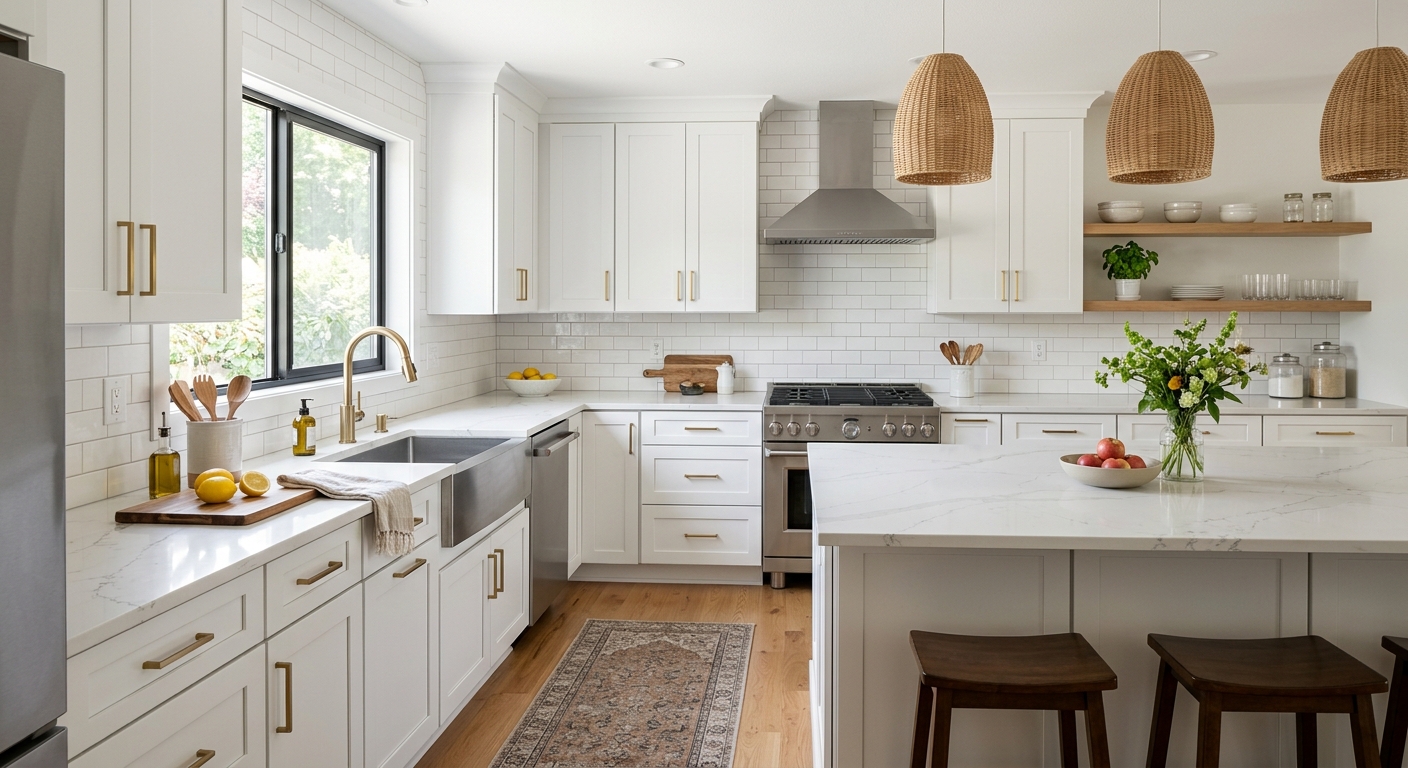
Kitchen renovation costs in Clearfield — 2026
Clearfield homeowners face a wide range of costs when planning a kitchen renovation, and those costs are shaped by the county’s older housing stock and the fact that over half of homes are owner-occupied (homeownership rate: 51.6%) on a median household income of $50,485 (U.S. Census Bureau, ACS 2024). Most houses here were built between 1940 and 1970, which means outdated layouts and systems are common—if your kitchen hasn’t been substantially updated, odds are good the electrical, plumbing, and even the walls themselves will need work when you renovate.
The biggest reason kitchen budgets in Clearfield get blown is when homeowners start out pricing a basic “replace in place” remodel, but end up adding layout changes that require moving plumbing, gas, or electrical—these costs add up fast and are rarely proportional to how far things move. Most of the cost comes from the work behind the walls, not the square footage or the beauty finishes everyone sees.
Below is what typical Clearfield homeowners can expect to pay for different scopes of kitchen work in 2026. Keep in mind that cabinet grade (stock, semi-custom, full custom) and whether the layout changes will move your project up or down the range much more than the sheer size of the room.
| Scope |
What's included |
Duration |
Price range |
| Full gut remodel, same layout |
cabinets, counters, appliances, flooring, lighting, fixtures |
6–10 weeks |
$26,500–$107,000 |
| Gut plus layout change |
all of the above plus moved plumbing, electrical, walls |
10–16 weeks |
$58,000–$107,000 |
| Cabinet replacement (stock to semi-custom) |
remove and install cabinets, hardware, patching |
1–3 weeks |
$6,200–$26,500 |
| Cabinet refacing |
new doors and drawer fronts, veneer, hardware |
3–6 days |
$6,200–$18,000 |
| Countertop replacement only |
template, fabricate, install, reconnect sink |
1–3 weeks |
$3,600–$14,500 |
| Kitchen flooring only |
remove existing, install new flooring |
3–6 days |
$4,500–$18,000 |
Estimates for a typical Clearfield kitchen. Cabinet grade and whether the layout changes move these figures more than square footage.
When a Clearfield kitchen needs walls moved
Changing your kitchen’s layout—like moving a sink, stove, or knocking out a wall for an open concept—pushes a Clearfield remodel into a new cost bracket. Keeping all plumbing, gas, and electrical where they are means you’re paying mainly for finishes, but as soon as you start moving those systems, things get expensive fast and rarely in a straight line.
Relocating a sink or dishwasher means new drain lines, which require proper slope. In older Clearfield homes over a finished basement ceiling or on a slab, this demands creative (and often costly) solutions. Moving a stove—especially switching from gas to induction or changing where the vent hood goes—can require a new 240V line or an exterior vent with a wall penetration, which always needs to be flashed for snow and the long local heating season. Electrical circuits are another choke point: pre-1970 homes here commonly have undersized panels, so adding new dedicated appliance circuits may mean a panel upgrade or even a new service—a far bigger cost than just running one more wire.
If you’re thinking about removing a wall, you have to know if it’s load-bearing. In Clearfield County, this means bringing in an engineer and pulling a permit. Don’t underestimate this cost. A full gut remodel with no layout change can be done for as little as $26,500, but once you move walls, plumbing, or electrical, you’re realistically starting in the $58,000 range. The jump is not split evenly no matter how modest the move—it’s all or nothing for trades and inspections.
Unless your existing layout is truly unworkable—say, your fridge blocks an entry or there’s no place for a dishwasher—think long and hard before moving key kitchen infrastructure. Many dated Clearfield kitchens can feel new with new cabinets, better lighting, and flooring, saving tens of thousands by keeping the “bones” right where they are.
What a kitchen quote should specify
A detailed and transparent quote is how you can compare bids and avoid unwelcome surprises. In Clearfield County, the #1 way kitchen quotes end up apples-to-oranges is through allowance lines. An allowance is a placeholder amount for something you haven’t picked yet—say, $1,500 for tile, or $6,000 for appliances. If one contractor uses an artificially low allowance to keep the total down, your “low bid” can balloon by thousands once you pick actual finishes. Always compare what’s allowed for appliances, tile, and lighting before comparing totals.
Push for specific cabinet brands, lines, and box construction in writing. Countertops should state the exact material, thickness, and edging. For old Clearfield homes, ensure the quote says how discoveries behind the walls (old wiring, bad floors) will be handled—priced, approved, and how quickly you’ll be notified. Change-orders should require written approval from you before moving forward, never just a quick chat.
Payments should be tied to actual milestones (demo done, cabinets delivered), not just calendar dates. And for your protection, make sure you’re getting lien waivers from subcontractors as you pay progress payments.
In Pennsylvania, you’re covered by the Home Improvement Consumer Protection Act—meaning a signed contract is mandatory for jobs over $500, and you have a three-business-day right to cancel. Don’t sign anything that doesn’t spell these out clearly.
| Line item |
What to look for |
Red flag if… |
| Allowances |
realistic amounts, itemised |
round numbers with no basis |
| Cabinetry |
brand, line, box construction |
'quality cabinets' |
| Countertops |
material, thickness, edge, seams |
material name only |
| Electrical |
circuits to be added, GFCI scope |
'as needed' |
| Unforeseen conditions |
how they are priced and approved |
not addressed |
| Change orders |
written approval before work |
verbal |
| Payment |
milestone-based, modest deposit |
front-loaded |
| Lien waivers |
from subs at each payment |
not offered |
Why appliance selection comes first
The biggest sequencing mistake in Clearfield kitchen projects is ordering cabinets before appliances are chosen. Cabinets are built to fit your appliances—not the other way around—so locking in appliance models is step one. A standard-depth fridge sticks out past cabinets, while a counter-depth model sits flush; slide-in ranges need a finished countertop edge and a precise opening, while freestanding types are more forgiving. A desire for gas or induction changes your wiring or even gas supply scope—major cost drivers in a 1940s or 1950s house here.
Panel-ready dishwashers need the cabinet company to prep a panel to match. If you plan a strong range hood, venting to the outside is a must—recirculating hoods don’t remove humidity or cooking odors effectively, and in Clearfield’s long heating season, keeping that airflow controlled is important. Relocating hoods means an exterior wall cut that must be properly flashed here, where snow is a factor most winters.
Professional-grade appliances in Clearfield County offer power and a premium look, but in most kitchens, they’re an aesthetic/longevity upgrade with diminishing returns on function alone. Unless you really cook hard, you’re often better off putting money elsewhere, especially in more modest homes.
Appliance lead times now often outstrip cabinet production, so for a smooth job, pick appliances and get your orders rolling before finalizing cabinet measurements or layouts.
Surprises in an older Clearfield home
With nearly 9 in 10 Clearfield County homes built before 1980, most kitchen renovations here uncover a few expected—and a few unwelcome—surprises once demolition begins (U.S. Census Bureau, ACS 2024). The floors might not be level and the walls likely aren’t plumb, which can mean two days of shimming at $1,000–$2,500. Undersized or ungrounded wiring is typical in 1950s and 1960s kitchens, making a full rewire add $3,500–$7,500, especially if the panel needs upgrading. Galvanized water lines or cast iron soil stacks often need to be replaced for reliability and insurance reasons—budget an extra $1,800–$6,000.
It’s also common to find no insulation in exterior kitchen walls. Opening the walls is your opportunity to add R-13 or better, but it will add a day or two and about $900–$2,000 for materials and labor. Previous “handyman specials” or unpermitted work can slow things down and force compliance with today’s Pennsylvania Uniform Construction Code. In Clearfield’s aging homes, you may encounter lead paint—for pre-1978 properties, the federal EPA Lead Renovation, Repair and Painting (RRP) Rule applies, meaning work must be tested and, if positive, performed by EPA-certified crews with proper containment and cleaning. Asbestos is possible in floor tile or old sheet goods from the era; if suspected, testing is done before any disturbance.
A Clearfield kitchen with all of the above lurking behind the walls will cost more upfront but leaves you with a safer, more insurable, and far more comfortable space for the coming decades.
Allocating a kitchen budget
Many Clearfield homeowners are surprised by what eats up a kitchen budget. Cabinetry is by far the largest slice, easily one-quarter to a third of the total ($6,600–$21,000 on a $26,500 project). Labor and installation are another hefty chunk, rising quickly if walls or utilities move. Choosing countertop material makes a noticeable difference, but it rarely doubles your cost. Appliances can swing wildly—from mass-market essentials to “statement” pro sets. Flooring and lighting should be specified for durability in Clearfield’s long winters and busy family use.
Where most forget to plan is for what’s behind the walls (contingency) and the so-called “soft costs”: permit fees, design support, delivery, and post-job disposal. Those items add up to real money, especially if you run into ungrounded wiring, insulation gaps, or code upgrades.
If you want your dollars to go farther, consider putting any extra funds into cabinets and electrical. Spending a thousand on longer-lasting cabinetry or adding more circuits gives you function every day, while a matching high-end fridge in a kitchen full of particleboard boxes is a poor use of your renovation budget in a county with a $50,485 median income.
| Category |
Share of budget |
Notes |
| Cabinetry |
25–35% |
the largest line and the longest lead time |
| Labour and installation |
20–30% |
rises sharply if the layout changes |
| Countertops |
8–15% |
material choice drives the swing |
| Appliances |
10–20% |
widest range of any category |
| Flooring |
5–10% |
|
| Lighting and electrical |
5–10% |
higher in older homes needing circuits |
| Plumbing and fixtures |
4–8% |
|
| Permits, design, disposal |
3–6% |
usually forgotten in early budgets |
| Contingency |
10–15% |
not optional in a pre-1980 house |
Permits and inspections for a Clearfield kitchen
In most of Clearfield County, you don’t need a permit to swap out cabinet doors, paint, or replace a countertop if you’re not altering the layout. But if your kitchen project involves moving or adding electrical circuits, plumbing, taking down or moving a wall, or adding mechanical ventilation for a new range hood, a permit is required under the Pennsylvania Uniform Construction Code—which is based on the International Residential Code and enforced here by either the City of DuBois Code Enforcement Office or the relevant township, depending on where you live.
Inspections for electrical work in DuBois are handled by the City’s code office, but in many rural Clearfield townships, you’ll be dealing with a third-party inspector—which often comes as a surprise, especially for those who’ve renovated elsewhere. The contractor you choose must be registered as a Home Improvement Contractor (HIC) through the Pennsylvania Office of Attorney General for any contract over $500, and employers must have active workers’ compensation insurance—both can be verified online at the systems noted in your contract paperwork.
Skipping permits may save time upfront, but it’s a headache at resale. When you sell, unpermitted work can hold up closings, drop your home’s value, or force you to undo and redo pieces of the renovation. Always ask your contractor how permits and inspections will be handled for your address before signing.
Frequently asked questions — kitchen renovation in Clearfield
Is lead paint a concern in Clearfield kitchen renovations?
Homes built before 1978 in Clearfield County often have lead paint somewhere in the structure, especially in original kitchens or trim. If your house predates 1978 (which is likely—over 89% of local homes are from that era), federal law requires testing before any painted surface is disturbed during a renovation. The EPA Lead RRP Rule applies and renovators must be EPA-certified if lead is present. For a full gut kitchen remodel ($26,500–$107,000), testing and safe lead containment are non-negotiable costs here. If lead is found, extra steps for dust control, plastic barriers, and special cleanup add both time and money but dramatically reduce health risks for your family. Don’t hire anyone unwilling to show EPA credentials for lead work in Clearfield.
How far ahead should I book a contractor in Clearfield?
Clearfield County is a thin rural market for renovations, and many reputable kitchen contractors either book heavily in the spring or travel from the Altoona–State College corridor. It’s wise to start interviewing contractors at least 3–6 months in advance of when you hope to begin. For major kitchen gut remodels (in the $26,500–$107,000 range), the lead time may be even longer if you want specific brands of cabinetry or appliances, both of which have extended backorders right now. Planning ahead also lets you secure your preferred start time and keeps you from getting stuck with the last team available. In off-seasons (late fall), you may get in sooner, but labor availability in Clearfield just isn’t the same as in larger towns.
What is a change order and how should it work?
A change order is a written agreement amending your original kitchen contract when you decide to add, subtract, or alter something after work begins. In Clearfield, this comes up often in older homes—say, you want to move a wall after seeing demo, or rotten floor joists need replacing. Your contract should clearly spell out that all changes require written approval and a new price (or credit) before the contractor moves ahead. Verbal agreements lead to bill shock. For a kitchen remodel of $26,500–$107,000, it’s not unusual to see a few change orders, but they should be closely tracked. Pennsylvania’s Home Improvement Consumer Protection Act (HICPA) favors written documentation, and with so much pre-1980 housing in Clearfield, you’ll want every new finding and cost in writing.
What is a realistic contingency for a Clearfield kitchen?
In Clearfield’s pre-1980 housing stock, including much of DuBois and the townships, a contingency of 10–15% is not just reasonable but necessary on kitchen remodels. That covers things like concealed knob-and-tube wiring, bad subfloors, or hidden plumbing runs you only find after demolishing cabinets. If your target budget for a gut kitchen is $58,000, hold back at least $5,800–$8,700 in contingency reserve. On newer kitchens or straightforward cabinet replacements ($6,200–$26,500), you may aim for 5–7%, but even then, unplanned conditions pop up. The older the house, the more critical a solid cushion becomes.
What does a quartz countertop cost in Clearfield?
Quartz countertops remain a popular, durable choice in Clearfield kitchens, prized for their low maintenance and consistent look. In 2026, replacing a kitchen countertop with a typical mid-range quartz (measured, fabricated, installed, plus reconnecting the sink) will run you between $3,600–$14,500. The range depends on the brand, color, edge profile, and any custom cutouts. More basic colors and thinner slabs fall at the lower end, while premium colorways and full backsplashes push things up. Labor costs are steady (since fabrication is usually done out of town), but always check that the quote includes removal/disposal of the old top and all reconnects so you aren’t charged add-on fees by your installer.
How do I verify a kitchen contractor in Pennsylvania?
For any kitchen renovation over $500 in Clearfield, Pennsylvania law requires contractors to register as Home Improvement Contractors (HIC) with the Office of Attorney General. You can verify this at hic.attorneygeneral.gov with their business name or HIC number. For those with employees, they must carry current workers’ compensation insurance, which you can verify at wcais.pa.gov. Ask for these numbers before signing anything—reputable Clearfield contractors expect the question. There are no trade licenses for kitchen work at the state level here, so the HIC registration is your main consumer safeguard. For a major full kitchen gut in the $26,500–$107,000 range, always check for clear HIC registration and get their insurance certificate before cutting any check.
What is the cheapest way to update a Clearfield kitchen?
For homeowners who want to refresh a kitchen without a full gut, the least costly way is typically cabinet refacing, which replaces just the doors, drawers, and surfaces while keeping the cabinet boxes. In Clearfield, this usually runs $6,200–$18,000 and takes less than a week. Replacing worn flooring ($4,500–$18,000) or swapping in a new countertop ($3,600–$14,500) also goes a long way visually without a full remodel. Painting cabinets, updating hardware, and installing new lighting can be done for even less, as these rarely require permits or major mess. Just be cautious—if your cabinets or wiring are at the end of their life, patch updates only buy so much time, especially in Clearfield’s older homes.
Should I renovate before selling or let the buyer do it?
In Clearfield County, with its modest median income and older housing, kitchens sell homes—but over-capitalizing in a small market rarely pays back in full. A tidy, functional kitchen is a must for securing buyers at a good price, but you’re unlikely to get dollar-for-dollar return on a high-end gut ($58,000–$107,000). Light updates—paint, new counters ($3,600–$14,500), and refacing cabinets ($6,200–$18,000)—almost always make sense before listing. Leave complex layouts and expensive infrastructure changes to buyers who may want something different anyway. Focus on clean, functional, and bright—you’ll spend less and may sell faster in Clearfield’s practical market.
What countertop material is best for a family kitchen?
For active families in Clearfield, quartz countertops strike the best balance of durability, ease of care, and appearance for the money. They resist stains, don’t need sealers, and stand up to spilled juice and hot pans better than most natural stones. While you’ll pay $3,600–$14,500 depending on kitchen size and color, quartz’s longevity makes it a strong value in homes with kids or heavy use. Laminate is less expensive but doesn’t hold up as well to wear and moisture. Granite is sturdy, but must be resealed and the look is less consistent. In most pre-1980 Clearfield homes, adding a practical, no-fuss surface like quartz makes day-to-day life easier and boosts appeal at resale without overspending.