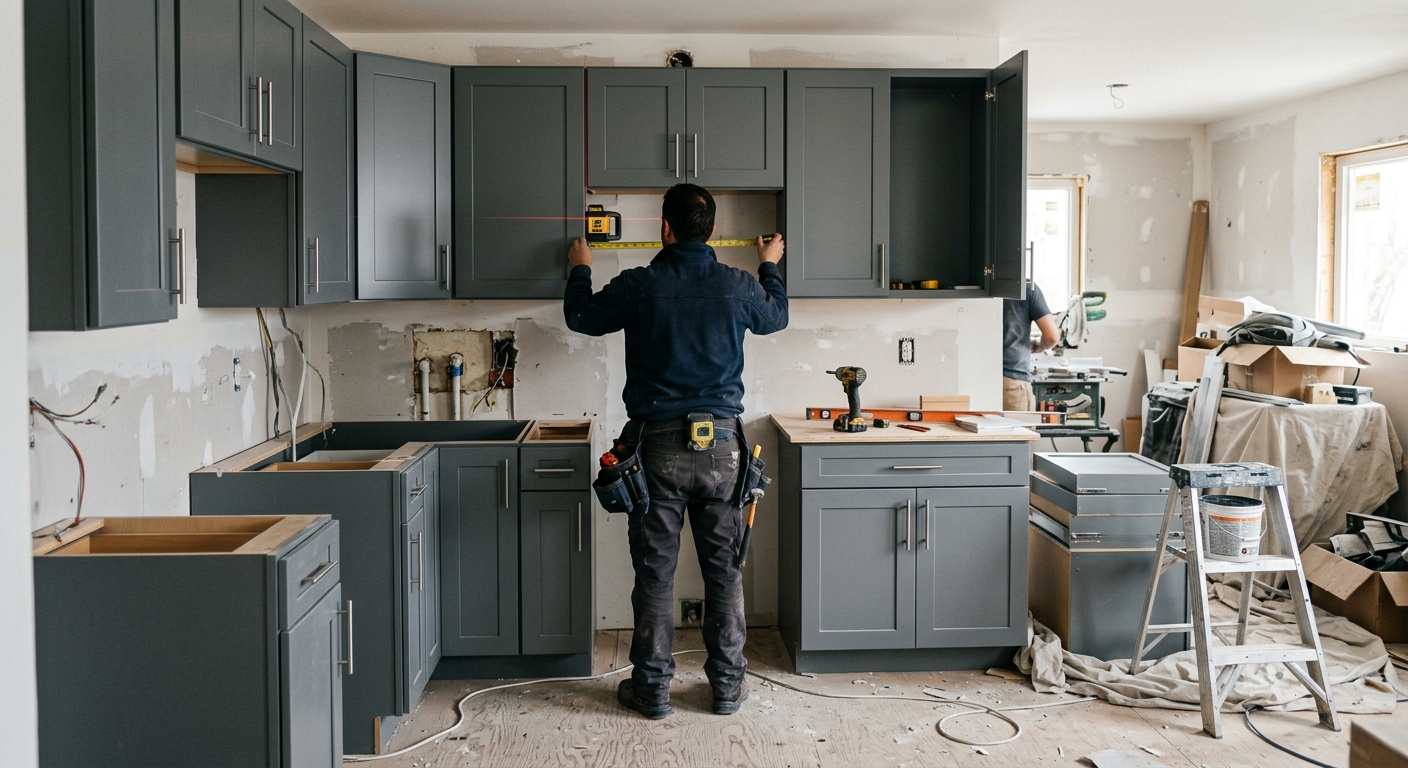
Kitchen renovation costs in West Hempfield — 2026
West Hempfield’s kitchen renovation budgets typically reflect its high homeownership rate and above-average median income (U.S. Census Bureau, ACS 2024). With 86.1% of homes owner-occupied and typical household incomes of $95,759, most renovation dollars here focus on long-term livability and quality, rather than landlord-driven quick fixes. However, the era of your house makes a dramatic difference: much of the housing stock in the area—spurred by post-World War II tract development around Lancaster and Manheim Township—features original mid-century layouts where a kitchen remodel can mean anything from cosmetic upgrades to major structural changes.
The most common mistake is pricing out a “surface-level” kitchen makeover and gradually specifying high-end finishes, structural changes, or layout shifts that belong in a different budget class. Most blown kitchen budgets can be traced to this issue—planning at one price tier, then building at a higher one without a buffer.
| Scope |
What's included |
Duration |
Price range |
| Full gut remodel, same layout |
cabinets, counters, appliances, flooring, lighting, fixtures |
6–10 weeks |
$31,500–$126,000 |
| Gut plus layout change |
all of the above plus moved plumbing, electrical, walls |
10–16 weeks |
$68,500–$126,000 |
| Cabinet replacement (stock to semi-custom) |
remove and install cabinets, hardware, patching |
1–3 weeks |
$7,400–$31,500 |
| Cabinet refacing |
new doors and drawer fronts, veneer, hardware |
3–6 days |
$7,400–$21,000 |
| Countertop replacement only |
template, fabricate, install, reconnect sink |
1–3 weeks |
$4,200–$17,000 |
| Kitchen flooring only |
remove existing, install new flooring |
3–6 days |
$5,300–$21,000 |
Estimates for a typical West Hempfield kitchen. Cabinet grade and whether the layout changes move these figures more than square footage.
The real timeline for a West Hempfield kitchen
In West Hempfield, homeowners are often surprised by how long a kitchen remodel truly takes, especially when juggling busy family routines. The schedule is shaped less by the actual construction and more by manufacturer lead times and mandatory sequencing. The steps go in this order: design consultation, precise on-site measurement, and product selection; then, ordering cabinets. Only once cabinets are on order and their delivery date is set does demolition begin. After demo, trades rough-in electrical and plumbing (if needed), followed by required inspections. Once cleared, cabinet installation happens—everything else hinges on this step.
Countertop templating can only start after the cabinets are installed. This is a non-negotiable pause; fabricators will not template from drawings, only from finished, secured cabinetry. In the Lancaster County market where finish-trade labor is tight and many cabinet lines have extended production times, this results in a week (sometimes more) of “nothing happening.” Homeowners often mistakenly expect countertops and cabinets to install back to back, but this gap is built into every timeline.
After countertops are installed, plumbers, electricians, and tile setters return for backsplashes, flooring, and final fixture hookup. Trying to shortcut the sequence usually backfires—results suffer, and costs rise. That's why ordering your cabinets before demolition is critical: it keeps your overall downtime (and the period your kitchen is unusable) as short as possible, even in a moderate suburban market like West Hempfield.
Renovating to live in versus renovating to sell
If your aim is to sell in West Hempfield soon, renovating for your own comfort and taste is a different exercise than prepping for resale. A kitchen renovation absolutely helps a house sell faster, but very few projects here fully recoup their cost at closing—especially at the top end of the price scale. In practice, mid-range remodels in the $31,500–$68,500 range help a home stand out to buyers without exceeding what the neighborhood supports.
Think of it this way: with a median household income around $95,759 (U.S. Census Bureau, ACS 2024), a six-figure kitchen will rarely yield a dollar-for-dollar return, no matter how stunning. Most West Hempfield buyers favor neutral finishes and practical layouts, so projects that stay close to the existing floor plan and use classic materials let new owners imagine their own upgrades over time. For a pure resale play, expensive changes—like moving walls or relocating plumbing—are not usually money well spent.
If you expect to stay for at least five years, make the kitchen yours. Spend where you cook and gather every day, and don’t obsess about recovery. If you’re moving soon, focus on broad appeal, mid-range cabinetry, and durable countertops. Renovating to live in and renovating to sell are not just different budgets—they are different designs entirely.
Permits and inspections for a West Hempfield kitchen
Permitting in West Hempfield is straightforward if you know where the line falls. Cosmetic updates—paint, hardware swaps, door and drawer front replacements, even new countertops in the same spot—typically do not require a permit in most Lancaster County townships. However, the moment your renovation includes new or moved electrical circuits, plumbing changes, wall removals, or structural modifications, you move into permit-required territory.
If you’re in Lancaster city, any kitchen renovation with layout changes or new utility work requires a building permit, and formal plan review is common when systems move. Electrical inspections here, and in many surrounding townships, are often performed not by the municipal code office but by certified third-party agencies such as Middle Department Inspection Agency. That can be a practical surprise for homeowners expecting a township inspector.
Your contractor must have current Home Improvement Contractor (HIC) registration from the Pennsylvania Office of Attorney General for any job over $500; this is easy to verify online. Workers’ compensation coverage is mandatory for all employers and can be checked using the WCAIS system. Every job over $500 must have a written contract, and you always have a three-business-day right to cancel. Skipping permits may save time but can become a resale deal-breaker, as title companies and buyers’ agents in Lancaster County now routinely check permit history during sales.
What moving the sink really costs
Keeping your plumbing—and your main outlets—where they are keeps your kitchen remodel budget in check in West Hempfield. The moment you decide to move a sink across the room or knock out a wall, you move up a cost class entirely. This is not a linear increase: even moving a sink four feet means opening walls or floors, running new drain lines (which require precise slope over distance), assessing whether you have a finished basement or a slab below, and potentially moving vent stacks. Relocating a gas line or range hood means new penetrations to the exterior. Every new circuit may reveal an undersized panel needing an expensive upgrade.
If you remove or modify a wall, you need to determine if it’s load-bearing. That means bringing in an engineer and pulling a permit, triggering inspections you would not face in a simple “replace in place” project. In Lancaster city and much of the county, moved plumbing or electrical reliably shifts you into permit-required territory with extra costs for both labor and compliance.
The hard reality: a same-layout gut renovation is in the $31,500–$126,000 range, but shifting your layout with utility moves starts at $68,500 and can easily rise from there. Most homeowners who go this route underestimate the true incremental cost. Work through whether the current kitchen is genuinely unworkable, or whether the real problem can be solved with better lighting, a wider doorway, or updated finishes. It is easy to spend $10,000 or $20,000 just to shift plumbing and electrical—money that rarely adds value at resale.
Electrical work in an older West Hempfield kitchen
One major surprise for West Hempfield homeowners—especially in postwar and mid-century homes—is the scope of electrical upgrades required by current code when you open the walls. The Pennsylvania Uniform Construction Code, which governs local remodels, requires every kitchen to have a dedicated set of small-appliance circuits, GFCI-protected receptacles at all countertop locations, outlets spaced no more than four feet apart, and dedicated circuits for dishwasher, disposal, microwave, and (if electric) the range. Even homes built as recently as the late 1990s often have fewer circuits than the current standard demands.
The typical mid-century kitchen here may have a single, ungrounded circuit or two-wire cable with no easy way to add grounding. Some older homes still have aluminum wiring or panels at full capacity. Once the walls are open, any permitted work must bring the space up to current code—this is not optional, and every inspector expects to see it. Many homeowners under-budget for this scope, thinking “the outlets are fine.” Once updated, expect costs for new circuits, upgraded breakers, and GFCI/AFCI protection to total between $5,300–$21,000, especially if panel upgrades are involved. If demolition uncovers something unexpected, bring it into compliance now; you may not get the option at sale, and safety is non-negotiable.
Surprises in an older West Hempfield home
In West Hempfield, a third of homes were built before 1980, meaning kitchen renovations here frequently uncover surprises from earlier eras. Common issues include walls that are out of plumb, which complicates cabinet hanging and often demands skilled shimming, and floors that slope or flex, requiring leveling before new flooring or cabinetry goes in. Electrical systems may use ungrounded or undersized wiring, and old galvanized steel supply lines or cast iron drains can be found once walls are opened—both of which are expensive to replace but often non-negotiable for long-term reliability.
Insulation can be completely absent from exterior kitchen walls in these houses, raising comfort and efficiency issues. If the home pre-dates 1978, renovation work triggers the federal Lead Renovation, Repair and Painting (RRP) Rule; safe work practices and proper documentation become mandatory, and testing happens before any paint disturbance. Asbestos-containing flooring in the underlayment or old sheet vinyl may also be present, and identification comes before removal. Past unpermitted renovations sometimes surface, adding risk and cost if present-day inspections find code violations.
In homes built during the 1980-2000 suburbia wave, problems shift: expect builder-grade cabinets at end of life, laminate counters and flooring reaching replacement age together, and a minimum of circuits barely meeting yesterday’s code. These kitchens are prime for upgrades, but “quick fixes” from decades ago may not line up with modern expectations when you pull things apart.
Frequently asked questions — kitchen renovation in West Hempfield
What does a full gut kitchen remodel cost in West Hempfield?
A full gut kitchen remodel in West Hempfield—removing everything down to the studs, replacing all cabinets, counters, flooring, fixtures, appliances, and lighting—falls in the $31,500–$126,000 range. Most projects that simply update finishes and keep the same layout land around the middle of that range. Costs swing higher if you select premium finishes or add layout changes that involve plumbing and electrical moves. Your final budget will lean on both the size of your space and choices like cabinet grade and appliance brands. For a typical mid-century home here, plan on at least eight weeks, start to finish. If you’re comparing contractors, be sure not to compare a finish-only price to a full gut price, as the differences in scope are major and can double the investment.
How does West Hempfield's housing stock affect cabinet fit?
West Hempfield’s housing is a mix of post-WWII tract homes and 1980s–2000s suburban development. In older homes, walls are rarely perfectly plumb or square. Cabinet installers often have to custom-shim, fur out, or modify end panels to ensure level, tight installs—especially with semi-custom or stock lines. Installing cabinets into a house with crooked walls can add days of careful adjustment and trim work. In newer builds, you typically see easier installs, but you’ll also find basic builder-grade boxes which may make the leap to heavier, better-built cabinets more noticeable during replacement. If your home was built before 1980 (34.1% were in West Hempfield), anticipate extra prep and fit labor built into any cabinet budget in the $7,400–$31,500 range.
What is the cheapest way to update a West Hempfield kitchen?
The least expensive way to upgrade your West Hempfield kitchen is to focus on cosmetic changes that skip layout or system work. Cabinet refacing—replacing just the doors, drawer fronts, and hardware—combined with new paint and possibly a fresh backsplash, can modernize the space dramatically for $7,400–$21,000. Countertop-only replacement is another impactful option, often in the $4,200–$17,000 range, depending on the material. These solutions avoid the pitfalls of hidden wiring or plumbing issues and generally don’t require permits in Lancaster County townships. Always price out the long-term benefit: if the cabinets are structurally sound, don’t rip them out needlessly. If the boxes are sagging or falling apart, even a modest replacement may make more sense.
How far ahead should I book a contractor in West Hempfield?
For a major kitchen renovation, it’s smart to book a contractor at least three to six months in advance in West Hempfield. The finish-trade labor market here is tighter compared to areas like Harrisburg, so reliable contractors book up faster—especially in spring and summer. Custom or semi-custom cabinet orders stretch lead times out by another six to twelve weeks, adding to your project window. It’s always safer to get on a contractor’s schedule well before demolition, especially if you want cabinetry from specific lines or if your kitchen needs lots of lead time for planning and permitting. For simple countertop or flooring replacements, the wait is shorter, but planning ahead always leads to a smoother experience and better results.
How should renovation payments be scheduled?
In West Hempfield and across Pennsylvania, a written contract is required for any home improvement project over $500. Expect a payment schedule that corresponds to milestones—for example, a deposit (often 10–20%), a progress payment when materials like cabinets arrive, and a final installment after completion and punch-list sign-off. Beware of contractors requiring huge up-front deposits; Pennsylvania law tightly regulates advance payments and sets maximums for deposits. Your project isn’t just a handshake: the contract should detail exactly when and for what each payment is due. If your gut renovation costs $68,500, staggered payments help ensure progress, accountability, and compliance with state law.
Can I over-improve for my West Hempfield neighbourhood?
Yes—over-improvement is a real risk in West Hempfield. With a median household income of $95,759, buyers here typically expect kitchens to reflect what other homes in the area offer. Pouring six figures into a luxury kitchen—say, spending $126,000 on a remodel in a neighborhood of $350,000–$450,000 homes—rarely pays back dollar-for-dollar at resale. If you plan to stay long-term, spend on features that improve daily life, even if you never recover every dollar. If you may list the house soon, keep the renovation budget and finishes in line with the broader market so you don’t lose money through “overbuilding.”
What does a quartz countertop cost in West Hempfield?
Quartz countertops are a popular choice in West Hempfield for their durability and low upkeep. Installed costs for quartz run from $4,200–$17,000, with most average kitchens falling closer to the $9,500 mark. Price depends on the complexity of the layout, edge profile, and the specific quartz brand you select. Quartz avoids the sealing and maintenance hassle of natural stone, which appeals to busy homeowners in the area. Some higher-end slabs and unique colors do push the price to the top of the range, but even entry-level quartz gives a major facelift and adds resale appeal in Lancaster County.
What happens if previous work was unpermitted?
If you discover—or suspect—prior unpermitted work in your West Hempfield kitchen, don’t panic but do take it seriously. Unpermitted wiring, plumbing, or structural changes can delay or derail a new renovation. Lancaster County inspectors may require you to open up finished walls for inspection and demand that any substandard work be brought up to current code, which may push your budget toward the upper end of the $31,500–$68,500 range. At resale, missing permits can stall buyer financing or lower your sale price, as agents and title officers in Lancaster County increasingly check for complete permit histories. Always ask your contractor to document everything and pull required permits from the start—it protects your investment and future home value.
Should I choose plywood or particleboard cabinet boxes?
In West Hempfield, the choice between plywood and particleboard for cabinet boxes largely comes down to budget and moisture exposure. Plywood boxes are more robust and handle minor water leaks or installation shimming better, making them a safer bet in older homes with less-than-perfect walls and floors—common here, given 34.1% of homes were built before 1980. However, they add several thousand dollars to a typical $7,400–$31,500 cabinet replacement. Particleboard works fine for dry, well-ventilated kitchens and is common in builder-grade or budget-friendly installs. For most families, upgrading to plywood is an investment in durability, but not strictly necessary unless your kitchen has a history of water issues or you plan to stay for decades.