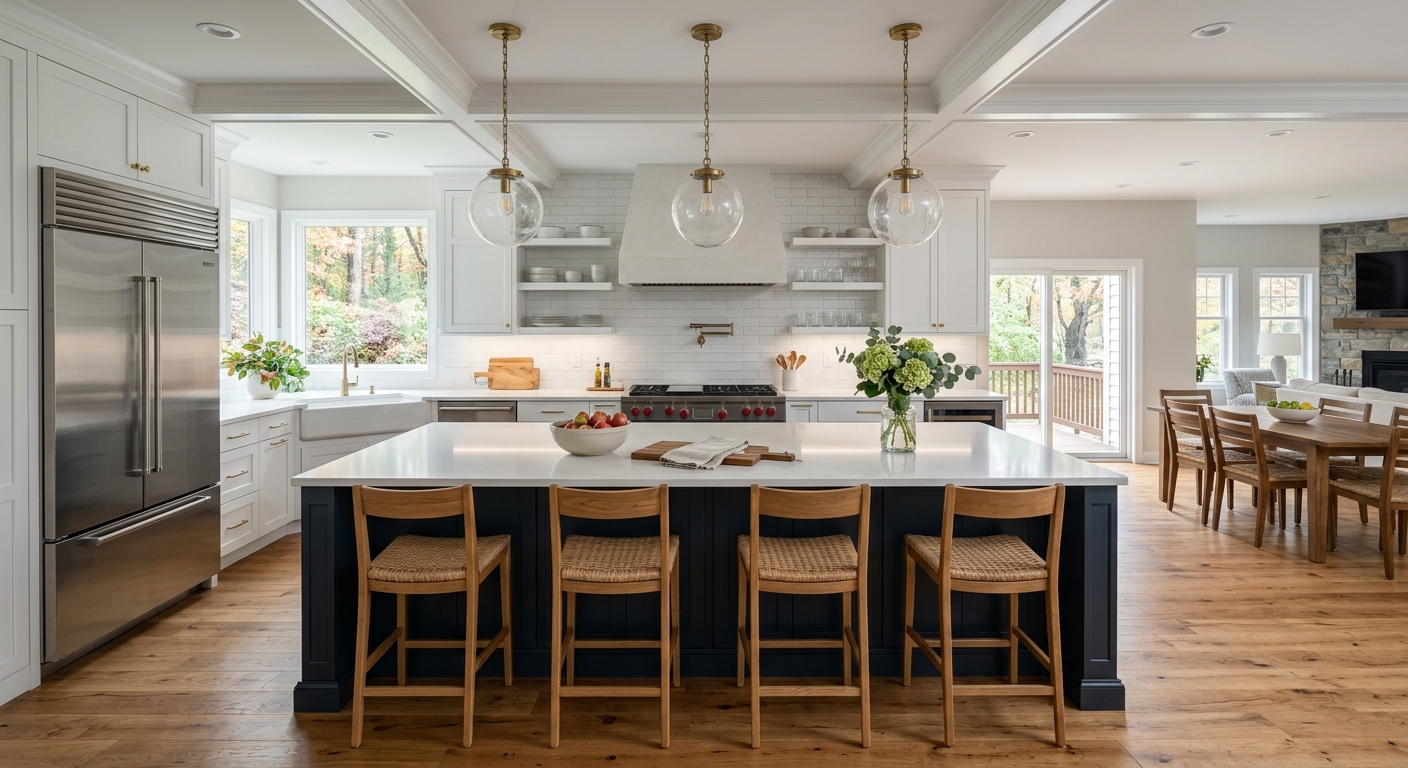
What a kitchen remodel costs in Pittsburgh
Pittsburgh homeowners face a wide price range when it comes to kitchen renovations, and the city’s older housing—over 84% of homes were built before 1980 (U.S. Census Bureau, ACS 2024)—pushes gut remodels to the top of renovation wish lists. Many kitchens in classic Pittsburgh neighborhoods are 1930s or 1950s layouts: small, boxed-in, and ready for a full rework, not just new countertops. These jobs run higher than simple cosmetic updates.
The profile of Pittsburgh’s owner households—homeownership sits at 47.4%, with a median household income of $60,187—means kitchen projects need to fit a tighter budget than in some zip codes elsewhere, and it’s easy to over-improve past the local resale ceiling. Most blown kitchen budgets in Allegheny County happen when a job starts at the “replace cabinets” cost tier and ends up including all-new electrical, moved plumbing, and high-end finishes, tacking on five figures.
Get clear early which project you’re actually planning. “Replace what’s there” is one price. “Open up the space, fix the wiring, and add a window” is another. The table below covers the full range you’ll see in this market.
| Scope |
What's included |
Duration |
Price range |
| Full gut remodel, same layout |
cabinets, counters, appliances, flooring, lighting, fixtures |
6–10 weeks |
$28,000–$113,000 |
| Gut plus layout change |
all of the above plus moved plumbing, electrical, walls |
10–16 weeks |
$61,000–$113,000 |
| Cabinet replacement (stock to semi-custom) |
remove and install cabinets, hardware, patching |
1–3 weeks |
$6,600–$28,000 |
| Cabinet refacing |
new doors and drawer fronts, veneer, hardware |
3–6 days |
$6,600–$19,000 |
| Countertop replacement only |
template, fabricate, install, reconnect sink |
1–3 weeks |
$3,800–$15,000 |
| Kitchen flooring only |
remove existing, install new flooring |
3–6 days |
$4,700–$19,000 |
Estimates for a typical Pittsburgh kitchen. Cabinet grade and whether the layout changes move these figures more than square footage.
Resale value and kitchen spending
Kitchens absolutely help a house move faster on the Pittsburgh market, but rarely return every dollar spent—especially on high-end upgrades. The best return on investment tends to come from mid-range jobs: replace cabinets, add stone counters, new appliances, and clean up the lighting. If you’re getting ready to sell, resist the urge to splurge on custom work or a full layout change; buyers notice fresh and functional much more than range brands or cabinet interiors.
Renovating to live in is a different conversation. If you plan to stay, spend on what you value every day—a mudroom cabinet, a paneled dishwasher, or taller uppers—rather than picking finishes only for broad resale appeal. But keep an eye on the local numbers: with Pittsburgh’s median income at $60,187, and many homes at or below that value, kitchens at the highest end of the $113,000 range will not return the excess at resale—no matter how nice the tile.
Over-improving is the most common financial miss here. When the kitchen cost rises well above what most local buyers can borrow or would spend, the “investment” is really for your own use. In neighborhoods with mostly pre-1980 homes and a homeownership rate under 50%, buyers tend to see ultra-high-end upgrades as out of place.
Cabinets: reface, stock, semi-custom or custom
Your choice of cabinets is the biggest decision you’ll make on a Pittsburgh kitchen—not just for budget, but how much you can change. Refacing replaces just the doors, drawer fronts, and veneer on your existing boxes. If those boxes are solid, square, and the layout works (not common in the city’s pre-war houses), refacing will get you the look of new cabinets for much less.
Stock cabinets come in set widths and heights, so they’re best suited for homes with standard, straight walls. In Pittsburgh’s older housing—a large share built before 1940—those walls are rarely dead square and alcoves frequently don’t match modern cabinet increments. This is where semi-custom becomes a practical necessity: you get tailored sizes and more finishes, though at higher cost and longer waits. Full custom is for when nothing else fits: odd angles, historical details, or high-end designs that can’t be matched with catalog choices.
Finish is only one part of the story. The boxes themselves can be plywood (strong, best for longevity), or particleboard (more common at the low end). Drawer construction matters: dovetail joints are best, while stapled joints wear faster. Full-extension, soft-close slides and hidden hinges are worth the extra cost. Frameless cabinets offer more storage and a sleek look, but require dead-plumb walls—rare in early 20th-century Pittsburgh homes. Face-frame cabinets forgive more wall irregularity and are common in both stock and semi-custom lines here.
| Option |
Cost |
Best when |
Limitation |
| Painting existing cabinets |
$1,200–$3,500 |
boxes and doors sound, tight budget |
no layout or style change |
| Refacing |
$6,600–$19,000 |
boxes square and layout works |
storage unchanged |
| Stock cabinets |
$6,600–$28,000 |
standard dimensions fit |
filler strips, limited finishes |
| Semi-custom |
$19,000–$28,000 |
non-standard walls or finishes |
6–12 week lead time |
| Full custom |
$19,000–$28,000 |
unusual layout or high-end design |
longest lead, highest cost |
Where the money actually goes
Most Pittsburgh kitchen budgets go sideways not from wild spending, but from not knowing what eats up the money. Cabinetry is the standout—it usually takes the largest single slice and determines your lead time. Labor and installation is next; if your project involves changing the layout or addressing issues behind walls (common in pre-1940s homes), expect this share to jump. Countertops, appliances, and flooring round out the big ticket lines, with lighting, electrical, plumbing, and fixtures adding up fast, especially if the wiring or pipes need upgrading.
Overlooked in nearly every first draft budget: soft costs like permits, design, delivery, and disposal. In Pittsburgh, permit fees and design can break four figures when structural or layout changes are on the table. Contingency exists for a reason—opening up knob-and-tube wiring, clay plumbing, or layers of old flooring always brings surprises.
If you have an extra thousand dollars, put it where it gets used every day—upgraded drawers or better lighting—rather than blowing it on a fridge with six functions you’ll never need. On a typical gut remodel at $61,000, here’s how the spending shakes out:
| Category |
Share of budget |
Notes |
| Cabinetry |
25–35% |
the largest line and the longest lead time |
| Labour and installation |
20–30% |
rises sharply if the layout changes |
| Countertops |
8–15% |
material choice drives the swing |
| Appliances |
10–20% |
widest range of any category |
| Flooring |
5–10% |
|
| Lighting and electrical |
5–10% |
higher in older homes needing circuits |
| Plumbing and fixtures |
4–8% |
|
| Permits, design, disposal |
3–6% |
usually forgotten in early budgets |
| Contingency |
10–15% |
not optional in a pre-1980 house |
Appliance choices and the decisions they force
The order you pick appliances matters—a lot. Cabinets are sized and built around appliance measurements, so deciding on a fridge or range after the cabinetry order is set is how Pittsburgh homeowners end up with kitchen layouts that don’t actually fit. Always lock down appliance specs first.
Standard-depth refrigerators stick out past the counters, while counter-depth models give you a cleaner line but cut a few cubic feet. Slide-in ranges need to be surrounded by cabinetry, while freestanding ones can stand alone. Gas is still popular in Pittsburgh—check for an existing gas line. Switching from gas to induction almost always requires an electrical upgrade, especially in older wiring. Panel-ready appliances can blend in, but they add cost and complexity.
Range hood venting is often skipped in the initial plan. Ducted to the outside is far better; recirculating hoods recapture only some smells and moisture. If you cook often—or just want less humidity—ducted venting to outside is worth planning for, but can mean permit triggers if drywall or structure is disturbed.
Professional-grade appliances deliver build quality and style, but the step up from reliable to “pro look” is mostly visual and may not match the rest of a middle-range kitchen. Appliance lead times—especially for popular ranges or custom finishes—can now run longer than the cabinets, so order early or risk holding up everything.
Code requirements for Pittsburgh kitchens
In Pittsburgh and Allegheny County, kitchen renovations follow the Pennsylvania Uniform Construction Code (UCC), which is enforced by the City of Pittsburgh Department of Permits, Licenses, and Inspections or by the local borough or township’s own code office. Cosmetic-only jobs—painting, cabinet refacing, countertop replacements without layout changes—don’t usually require permits. But as soon as you move a wall, relocate electrical or plumbing lines, or make structural changes, a building permit is required in Pittsburgh. Adding or altering a range hood vent to the outside can also trigger mechanical permits and review.
Full kitchen remodels that change the layout typically undergo plan review by the Department of Permits, Licenses, and Inspections. For inspections, Pittsburgh handles its own electrical reviews, but several suburbs use third-party inspection agencies; it’s worth asking up front which authority will inspect your project, as missing an inspection is a common source of headaches on resale.
All contractors for jobs over $500 must be registered with the Pennsylvania Office of Attorney General as Home Improvement Contractors, and you can verify them at hic.attorneygeneral.gov. Workers’ compensation is mandatory for all employers—check your contractor’s compliance at WCAIS (wcais.pa.gov).
If you skip permits where required, you risk trouble at resale—uncaught work can slow or kill a closing if the city or buyer’s agent spots work that didn’t pass inspection.
Eight weeks without a kitchen
Few people realize how much kitchen chaos affects daily life in a Pittsburgh renovation. Unless you’re moving out, you’ll need a “camp kitchen” somewhere in the house—a folding table for the microwave and kettle, your fridge tucked in a hallway or dining room, and either a laundry sink or bathroom sink to stand in for dishes. Paper plates, disposable cups, and an honest look at your increased take-out spending are all part of the process.
Dust will be everywhere without real barriers, so watch for plastic sheeting and zip walls—especially important in older Pittsburgh homes with plaster or lead paint risk. Crews will need space for a dumpster and staging materials; alleys or tight driveways in city neighborhoods make planning material drops and trash pickup especially important.
Pets are escape risks with doors propped open and workers in and out. If you have small children or anxious pets, consider housing for the demolition week. Eight weeks of eating out gets expensive fast—expect this line to run higher than your new flooring ($4,700–$19,000). Realistically, plan for the food budget to jump during a major gut. If you’re staying, patience and humor matter as much as planning.
Frequently asked questions — kitchen renovation in Pittsburgh
What does a full gut kitchen remodel cost in Pittsburgh?
For a full gut job in Pittsburgh—stripping the kitchen to the studs, new cabinets, counters, appliances, flooring, lighting, and fixtures—you’re typically looking at a range of $28,000–$113,000. Most jobs in the city land around $61,000, especially for an average-sized kitchen with quality but not luxury finishes. Pittsburgh’s large share of pre-1940 homes means hidden issues are common, sometimes pushing costs near the top end of this spectrum if the structure, wiring, or plumbing need major upgrades. Always build in a contingency for surprises behind the walls—most older houses here have them.
What is a change order and how should it work?
A change order is a written agreement for additional work after the original kitchen contract is signed. In Pittsburgh and throughout Pennsylvania, any contract over $500 must be in writing under the Home Improvement Consumer Protection Act (HICPA), and changes can’t just be verbal or left to “good faith.” A legitimate change order documents the additional work, time, and cost—let’s say you open a wall and find old plumbing that must be replaced, costing another $3,800–$15,000. The change order protects both parties: you know what's being added and at what price, and the contractor has your written approval to proceed. Always check the itemized change order before signing, and keep copies with your contract folder.
Is induction worth it over gas?
Induction cooking is increasingly popular in Pittsburgh, especially in homes that may not have an existing gas line. The main advantages: induction is faster to heat, more energy efficient, and safer, with no open flames or combustion byproducts in the kitchen. Drawbacks are the need for compatible cookware and a likely electrical circuit upgrade if your house has older wiring—common in the city’s pre-1980 stock. While new induction ranges can run similar in price to gas ($3,800–$15,000 for the appliance, depending on model), you need to factor installation and possible panel upgrades. If you enjoy precise control, dislike cleaning burner grates, or have air quality concerns, induction is a good choice. For some, especially daily bakers or wok cooks, gas still wins. Choose based on your cooking style and budget.
Can I renovate a kitchen in stages?
Staging a kitchen renovation is totally possible in Pittsburgh, especially if budget or calendar demands it. Homeowners often spread projects over months—replacing the countertop now ($3,800–$15,000), then cabinets or flooring later. The catch is efficiency: trades may charge more for multiple mobilizations, and you risk color or finish matches shifting between phases. If the kitchen is older and you want to avoid a full gut at once, prioritize the safety-related updates first—like electrical and plumbing—before cosmetic improvements. Some permits may also be triggered for each separate stage, depending on whether structural or system changes are involved. Good planning and clear scope for each sub-project make staged renovations work much better in tight Allegheny County housing.
How do I verify a kitchen contractor in Pennsylvania?
In Pennsylvania, any home improvement contractor working on jobs over $500 must have Home Improvement Contractor (HIC) registration from the Office of Attorney General. You can check your contractor’s registration status and any enforcement history at hic.attorneygeneral.gov (official state site). For projects in Pittsburgh, always confirm the company’s workers’ compensation insurance using the statewide WCAIS database—this is mandatory for all employers. If your renovation involves plumbing or electrical changes, make sure the trades are licensed by the City of Pittsburgh if required. Taking five minutes to double-check a contractor’s registration and insurance avoids the most common post-renovation disputes and protects you as a homeowner. On a job costing $28,000–$113,000, don’t skip this step.
Should I renovate before selling or let the buyer do it?
For most Pittsburgh homes, a light renovation—think new cabinet doors, fresh counters, and modern lighting—pays off more than gutting a kitchen just to sell. Repairs or updates under $19,000 often help the house show better without risking money you won’t recover. Buyers in the city’s established neighborhoods (with many homes built before 1940) often prefer to choose their layout and finishes. Over-renovating to your taste may not match the market. If the current kitchen is functional but tired, stick to visible, neutral upgrades. But if the kitchen has serious layout flaws or non-functional utilities, a more substantial renovation may be justified to attract buyers who want move-in ready. It depends on your timeline and appetite for disruption.
How much do new kitchen cabinets cost in Pittsburgh?
In Pittsburgh, new kitchen cabinets range from $6,600–$28,000, depending on whether you choose stock, semi-custom, or custom. Most city kitchens that replace all cabinets land near $19,000 for mid-range semi-custom. Stock cabinets suit newer, standard-sized spaces, but pre-1940 homes (which make up much of Pittsburgh’s housing) with odd alcoves or sloping walls often need semi-custom sizing—driving costs higher. Refacing, if your boxes are strong and well-laid-out, can update appearance for less ($6,600–$19,000). Full custom usually isn’t needed unless you have a rare layout or want specialty finishes. Always factor the lead time: custom and semi-custom can stretch to two or even three months.
What are cabinet lead times in Pittsburgh right now?
Cabinet lead times in Pittsburgh fluctuate with demand, but as of 2026, you should expect 6–12 weeks for semi-custom or custom. Stock cabinets are faster, typically 2–4 weeks from order to delivery. Because so many city homes need odd sizes—not uncommon with over 84% built before 1980—semi-custom lead times have become the norm rather than the exception. Delays from the manufacturer or the installer’s schedule are common, especially in the busy Allegheny County market, where finish-trade labor is tight. When budgeting, remember that extended cabinet lead times can push other trades back, increasing overall project duration—and prolonging your period without a usable kitchen. Every week of delay adds costs, especially if you’re budgeting for meals out ($4,700–$19,000).
Is lead paint a concern in Pittsburgh kitchen renovations?
Yes—lead paint is a real concern in pre-1978 homes, and with Pittsburgh’s large pre-1940 housing stock, you should assume lead is present unless proven otherwise. Federal EPA Lead Renovation, Repair and Painting (RRP) rule applies to all contractors working on homes built before 1978. Any demolition, sanding, or window replacement potentially disturbs lead-based paint, so your contractor must be EPA Certified (you can verify at certifiedrenovatorsearch.epa.gov). Proper dust containment isn’t just legal—it protects your family from fine lead dust that settles throughout the house when not controlled. Lead-safe compliance can add to your project cost, sometimes pushing a “small” job into the $6,600–$19,000 band. Always ask your contractor how they’ll safely manage lead in a Pittsburgh renovation.