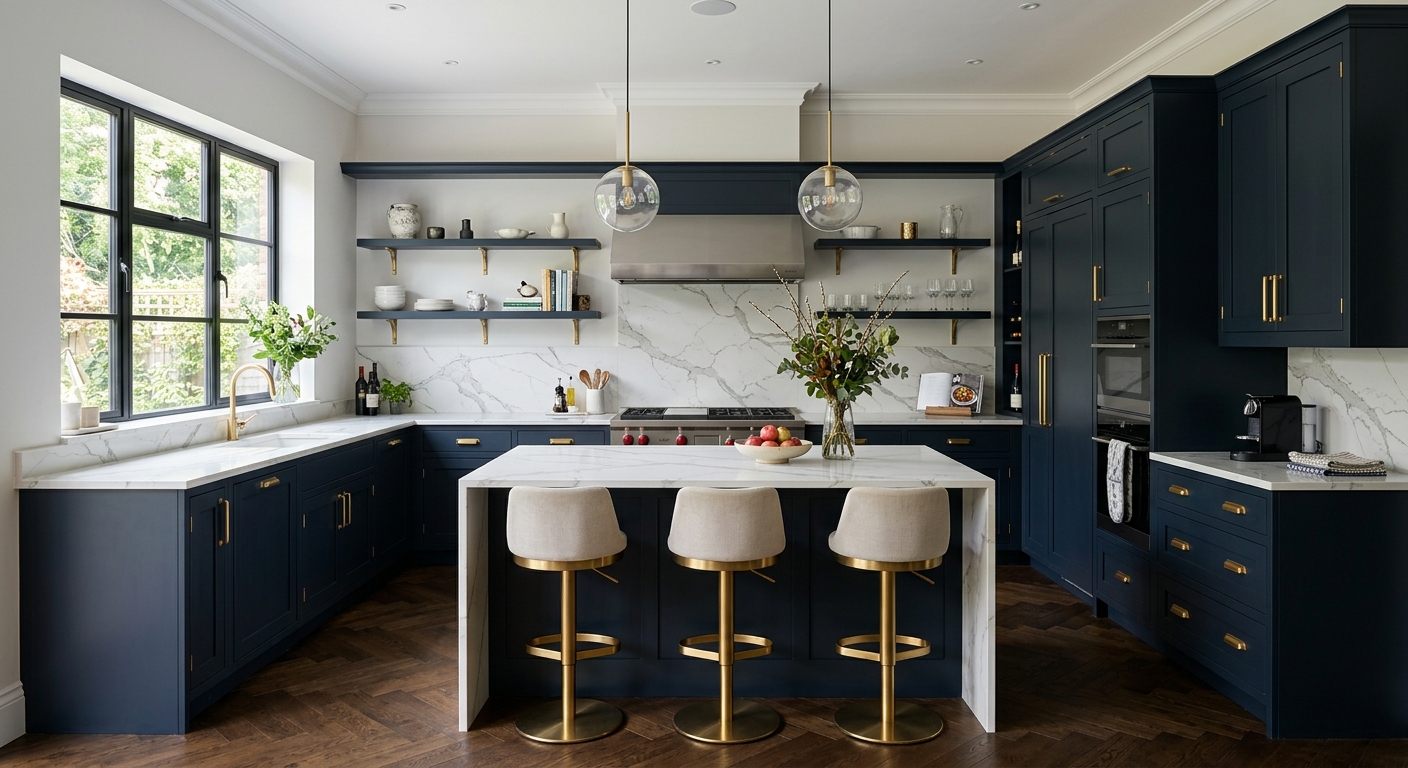
What a kitchen remodel costs in Economy
Economy’s kitchen remodel budgets track higher than many neighboring areas, simply because the town’s homeownership rate is about 93.0% and the median household income reaches $86,983 (U.S. Census Bureau, ACS 2024). Most residents are planning upgrades to use and enjoy long-term, not just to attract tenants or quick resale. Still, not all houses are starting from the same point: while you’ll see some 1990s layouts that only need new finishes, Beaver Falls and Aliquippa have large concentrations of 1940–1960 housing stock, driving frequent full-gut kitchen modernizations. Older layouts often require rethinking the whole design, not just swapping out cabinets.
The easiest way to blow your budget is to price a simple “replace the cabinets and floors” package, then start specifying layout changes (moving the sink, adding outlets, changing appliance sizes). Each upgrade doesn’t just add materials—it requires more skilled trades, permits, inspection, and time. Below is what you can expect to spend by scope, based on recent projects in Economy and the 2026 price bands for Beaver County.
| Scope |
What's included |
Duration |
Price range |
| Full gut remodel, same layout |
cabinets, counters, appliances, flooring, lighting, fixtures |
6–10 weeks |
$31,000–$123,500 |
| Gut plus layout change |
all of the above plus moved plumbing, electrical, walls |
10–16 weeks |
$67,000–$123,500 |
| Cabinet replacement (stock to semi-custom) |
remove and install cabinets, hardware, patching |
1–3 weeks |
$7,200–$31,000 |
| Cabinet refacing |
new doors and drawer fronts, veneer, hardware |
3–6 days |
$7,200–$20,500 |
| Countertop replacement only |
template, fabricate, install, reconnect sink |
1–3 weeks |
$4,100–$16,500 |
| Kitchen flooring only |
remove existing, install new flooring |
3–6 days |
$5,200–$20,500 |
Estimates for a typical Economy kitchen. Cabinet grade and whether the layout changes move these figures more than square footage.
Why the electrical line grew
In older Economy homes, the most common reason for a kitchen remodel going over budget is needing more electrical work than planned. Today’s codes expect every kitchen to have dedicated circuits for your coffee maker and toaster (small-appliance circuits), GFCI outlets at every countertop spot, dedicated runs for dishwasher, disposal, and microwave, and a 240-volt circuit for an electric range. These requirements are non-negotiable—inspectors must enforce them once the walls are open.
But in a house built in the 1940–1960 window, which is typical for most of Beaver County, it’s common to find just a two-wire, ungrounded circuit feeding all the original kitchen outlets, maybe shared with the fridge, and a breaker panel with no open slots at all. Sometimes you’ll see aluminum wiring, which carries risks and complicates modern upgrades. Even homes built before 1980 (67.4%) can have undersized electrical service. While a kitchen from the 1990s may offer a few more modern features, it’s rare that it already meets the high circuit count and GFCI standards required today.
When an inspector sees those open walls, the wiring in the kitchen must meet current code, and this upgrade is often the largest unplanned addition. Most Economy remodels that find old or limited wiring should expect an extra $5,200–$20,500 to rewire the kitchen, upgrade the panel, and bring everything to code.
What requires a permit in a kitchen renovation
For Economy homeowners, permits generally aren’t required when you’re staying with cosmetic changes—painting, changing hardware, refacing cabinets, or swapping out a countertop (as long as the sink and appliances stay put). You move into permit territory as soon as you run new electrical circuits, move plumbing, tear out walls, or install a new vented range hood.
In Aliquippa, structural wall removal or relocation in a kitchen remodel triggers a building permit, and nearby boroughs and townships in Beaver County operate their own code offices. For any work that involves moving structural elements or changing exits or egress, expect a formal plan review. In Beaver Falls, if you’re just replacing kitchen cabinet fronts and not changing the layout, many jobs proceed without a permit. However, it’s always wise to check with your specific municipality.
Electrical inspections in Aliquippa are performed by a third-party agency approved by the city, not by a municipal inspector—which catches many homeowners off guard. If your contractor is working on any part of your kitchen valued at over $500, they must be registered with the Home Improvement Contractor registry run by the Pennsylvania Office of Attorney General. You can verify at hic.attorneygeneral.gov, and employers must have workers’ compensation insurance, which you can check through WCAIS (wcais.pa.gov).
Skipping permits can make resale difficult. Unpermitted work gets flagged during future sales or insurance reviews, and correcting it later nearly always costs more.
Why appliance selection comes first
Most homeowners in Economy don’t realize that appliances drive cabinet choices, not the other way around. If you commit to cabinets first and then fall in love with a 36” range or extra-deep fridge, you’re looking at costly redesigns or products that simply won’t fit.
Standard-depth refrigerators stick out beyond base cabinets, but counter-depth models sit more flush—at a higher price, and cabinet panels must be designed around them. Slide-in ranges need countertop and cabinet lips to overlap the sides, while freestanding ranges allow simpler install but don’t look as seamless. Choosing gas versus induction (or electric) affects whether you need a new gas line or a heavy-duty electrical circuit. Panel-ready dishwashers disappear behind cabinetry but must be ordered early and matched to the cabinet layout.
Range hoods are another fork in the road: ducted hoods vent cooking fumes outside—by far the better choice—but require an exterior wall or ceiling run. Recirculating hoods are only a compromise when venting isn’t an option.
While professional-style appliances promise higher durability and luxe looks, their main benefit for most households is aesthetic. Most Economy homeowners will only realize their price premium in long-term satisfaction, not raw function. Appliance backorders can easily run longer than cabinet lead times, so always select and order appliances before finalizing your cabinet design.
What's behind the walls in a Economy kitchen
Two-thirds of Economy homes were built before 1980, and many share the same underlying challenges as older housing stock in Beaver Falls and Aliquippa. Once demolition starts, what’s behind the plaster and under the floors can have a real impact on your budget and schedule.
- Out-of-plumb walls and out-of-level floors: Installing new cabinets or countertops inevitably turns into a shimming game. Plan on $1,200–$3,500 extra if major re-framing is needed.
- Undersized or ungrounded wiring: Replacement to meet code costs $5,200–$20,500.
- Galvanized supply lines or cast iron drains: Replacement can add $2,000–$7,000, depending on how much is accessible.
- No insulation on exterior walls: Common pre-1970, adding batt or foam will typically add $800–$2,200.
- Signs of prior unpermitted work: Correcting shortcuts or dangerous splices can halt progress until resolved.
- Lead paint or asbestos flooring: In pre-1978 homes, federal EPA Lead RRP Rule applies, and specialized testing or lead-safe practices are required by certified renovators.
For homes built more recently, "builder-grade" shortcuts crop up: particleboard cabinet boxes at end of life, basic laminate counters, and barely enough electricity for modern appliances. Even then, if multiple homes in your Economy neighborhood were built in a short window, expect to replace flooring, counters, and cabinetry around the same time.
Layout changes and the cost cliff
Many Economy homeowners are surprised by how dramatically costs rise once layout changes enter the conversation. Keeping the plumbing and electrical in their original locations keeps your remodel closer to the lower band; the moment you move the sink, range, or add new circuits, you’re on the higher side—not proportionally, but with a dramatic jump.
Moving drain lines is not just about distance: they require continuous slope to function correctly. On a slab or above a finished ceiling, this often means major disruption and patchwork. Adding new circuits to power an island or wall oven requires checking if your panel can support them—many older Economy homes, especially those with mid-century origins, don’t have extra space. Removing a wall? The first question is whether it’s load-bearing; if so, you’ll need an engineer’s involvement, a permit, and potentially structural upgrades. Relocating a range hood to a new outside wall means cutting a new hole and re-running ductwork.
Always weigh whether the current kitchen “doesn’t work” or just isn’t attractive. Spending to shift a sink a few feet rarely pays off unless it’s really holding back the kitchen’s usability. In Aliquippa, structural wall changes trigger a building permit, and the price jump to move from a standard remodel to a layout change can be the difference between $31,000–$67,000—a cost cliff too many only see after demolition is underway.
The biggest line item in your Economy kitchen
Cabinets are the largest item in your kitchen budget, and your choice wields more influence over the final tally than any other decision. Refacing is the most affordable way to transform a kitchen if the boxes are square, solid, and laid out as you want. You get new doors, drawer fronts, and veneer—no ability to change layout or improve storage, but a significant visual upgrade. If your cabinets are particleboard, water-damaged, or were never quite right, this isn’t the way to recoup value.
Stock cabinets come in fixed sizes, so if your walls are not standard—even a little out-of-square (common in Beaver County’s mid-century housing stock)—you’ll chew up space with filler strips. Semi-custom cabinets allow dimension tweaks and a wider range of finishes, which becomes indispensable in older homes with wavy walls. Full custom meets any design regardless of room shape, at a much higher price and the longest wait.
Quality matters as much as upgrade tier: plywood boxes outlast particleboard, dovetail-jointed drawers are sturdier than stapled, full-extension soft-close slides make a difference every day, and frameless cabinets offer better access but require more precise installation. In Economy, thanks to the prevalence of older homes with non-standard dimensions, semi-custom is the most common reality—even if the original plan started with stock.
| Option |
Cost |
Best when |
Limitation |
| Painting existing cabinets |
$1,200–$3,500 |
boxes and doors sound, tight budget |
no layout or style change |
| Refacing |
$7,200–$20,500 |
boxes square and layout works |
storage unchanged |
| Stock cabinets |
$7,200–$31,000 |
standard dimensions fit |
filler strips, limited finishes |
| Semi-custom |
$20,500–$31,000 |
non-standard walls or finishes |
6–12 week lead time |
| Full custom |
$20,500–$31,000 |
unusual layout or high-end design |
longest lead, highest cost |
Frequently asked questions — kitchen renovation in Economy
What does a full gut kitchen remodel cost in Economy?
A full gut renovation in Economy falls into a wide range depending on how much you change and the quality of your finishes. For most homes, with new cabinets, counters, flooring, appliances and lighting—but keeping the original layout—you’re looking at $31,000–$123,500, with most projects finishing near the middle, around $67,000. If you want to move walls, update plumbing routes, or reconfigure the layout, the lower end vanishes and you’re realistically starting at $67,000. These bands reflect regional labor rates, typical Economy home sizes, and the need to bring old electrical and plumbing up to code in the town’s older housing stock.
Do I need a permit for a kitchen renovation in Economy?
In Economy, simple cosmetic work such as refacing cabinets, swapping countertops (without altering the sink or appliances), and painting almost never requires a permit. But once you run new electrical, move plumbing, knock out or alter any structural wall, or install a new range hood vented to the outside, expect to need municipal approval. Aliquippa, for example, requires a building permit for structural wall removal in a kitchen, and electrical inspections are handled by a third-party agency there. Always verify contractor registration through the Pennsylvania Office of Attorney General, especially for jobs over $500, and check insurance status through WCAIS. Skipping permits can become a real headache at resale in Beaver County.
Can I renovate a kitchen in stages?
Yes, and a staged approach makes sense for many Economy homeowners, especially if you want to stay within a certain budget but need upgrades soon. You might start with refacing or replacing cabinets for $7,200–$31,000, then take on counters or appliances later. Just remember that some changes are best bundled: if you’ll eventually change the sink, it’s usually cheaper to do plumbing and countertop work together. Likewise, upgrading electrical is more cost-effective when the walls are open for other work. Proper sequencing avoids paying for the same demolition or patching twice, a worthwhile consideration in older, more complicated Economy homes.
Is laminate countertop a bad choice?
Laminate countertops aren’t a bad investment, especially if your Economy home is on the lower end of the value range or you want a fast, budget-friendly refresh. They’re included in the lower range for countertop replacement ($4,100–$16,500), and today’s laminates look better and last longer than in decades past. Just know that they’re susceptible to heat and have a harder time shrugging off water damage at seams. In higher-end renovations, they won’t add resale value quite like quartz or stone would. But if you’re updating for your own satisfaction and want an affordable, easy-care surface, there’s no shame in using laminate.
Can I over-improve for my Economy neighbourhood?
Absolutely. Given Economy’s high homeownership rate, most residents remodel for themselves, but it’s still possible to spend more than you’ll recoup at resale. Even a full gut remodel topping out near $123,500 won’t translate directly to home value if the rest of the neighborhood is at a lower price point. Consider what similar homes nearby have done and what sells well; quartz counters and semi-custom cabinets are often justified, while chef’s grade ranges and built-in espresso makers may not add as much value outside luxury enclaves. Matching your investment to the surrounding homes is smart policy in Economy.
What are cabinet lead times in Economy right now?
Lead times in Beaver County, Economy included, depend entirely on your cabinet choice and supplier. Stock cabinets can arrive within two to four weeks, while semi-custom runs from six to twelve weeks, especially if you want specialty finishes or dimensions (a frequent need in older Economy homes). Full custom orders can stretch even longer. With current labor pressure in the finish trades, scheduling your installer may add to the wait. It’s also worth noting—some appliance models have even longer delivery times than semi-custom cabinets, so always lock in appliances first.
What is an allowance in a renovation quote?
An allowance is a line-item placeholder for items not yet chosen—such as countertops, cabinet hardware, or a backsplash—quoted at a standard value based on local averages. In Economy, a contractor might budget $9,300 for a “countertop allowance” to let you pick your material later. The risk is that if you choose finishes above this figure, you’ll pay the difference, so review allowances carefully and ask what they’ll realistically buy in local stores. This avoids unhappy surprises as the project wraps up.
Why are kitchen quotes in Economy so far apart?
The range in kitchen quotes in Economy surprises many homeowners—the difference between two bids can easily be $20,000–$50,000 or more. That’s often not about contractor markup, but about what’s included: some quotes cover only basic installations and stock cabinets, others include semi-custom options, electrical upgrades, and patching after demolition. The age of local housing stock—much of it pre-1980—also means unknowns once walls are opened. Always review quote details and clarify allowances, scope inclusions, and who is handling permits and inspections for your Economy project.
Do older Economy homes need electrical upgrades for a kitchen?
Almost always. Since 67.4% of homes in Economy were built before 1980, it’s rare to find existing kitchens with dedicated GFCI outlets, separate appliance circuits, and enough panel capacity. Opening up walls for a remodel triggers code compliance, which usually means adding new wiring, outlets, and perhaps upgrading the service panel. The cost to bring everything up to code typically falls between $5,200–$20,500. If your house has aluminum or ungrounded wiring, expect to be required to replace it as part of any significant kitchen work. This isn’t optional: inspectors are bound to the current codes in Pennsylvania.