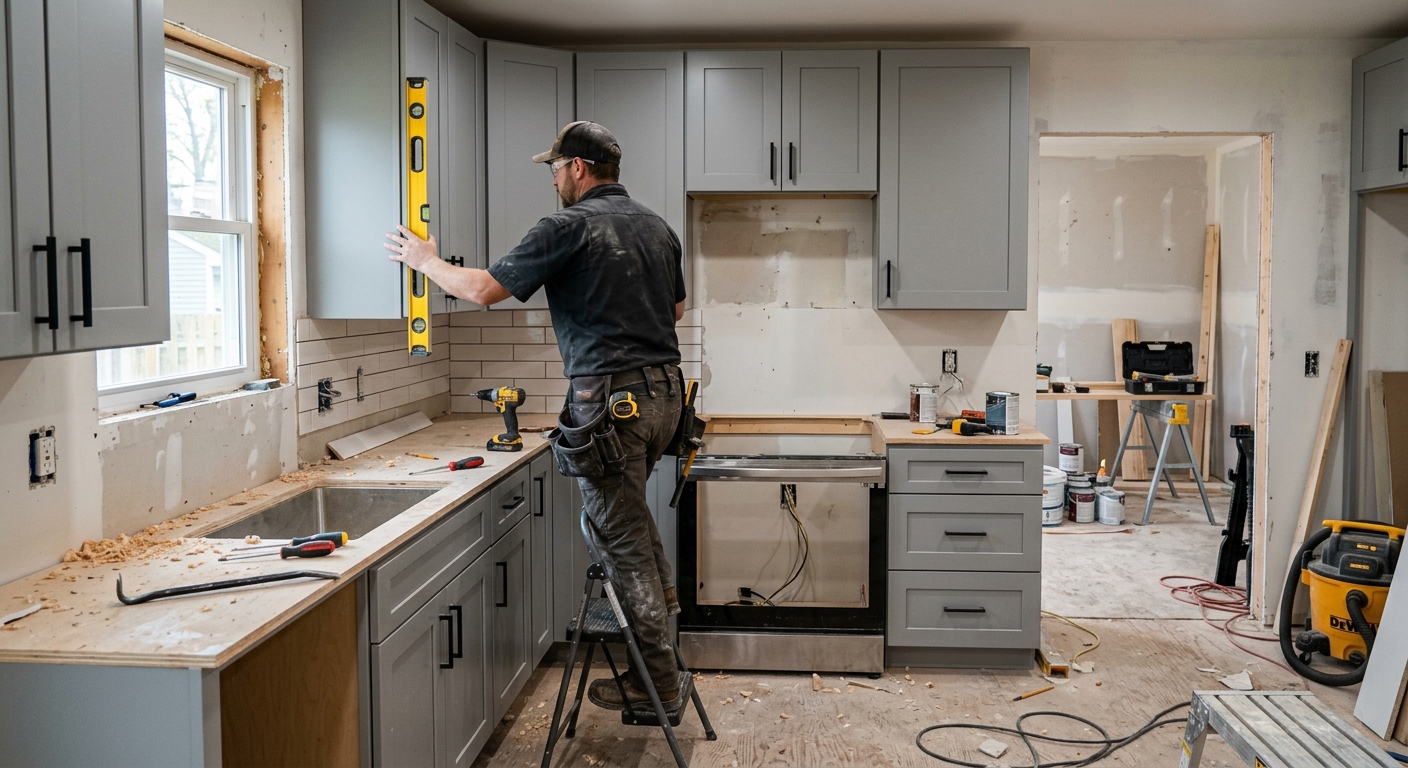
Unity kitchen renovation prices by scope — 2026
Kitchen renovation in Unity is a significant decision, and most owners considering this project weigh it carefully due to both cost and disruption. With a homeownership rate of 80.3% and a median household income of $75,528 (U.S. Census Bureau, ACS 2024), Unity’s market is mostly owner-occupied single-family homes. That matters: owners tend to prioritize long-term value and layout, shaping renovation budgets that reflect both everyday function and resale. Westmoreland County’s housing is predominantly 1960s–1980s suburban stock, which means most kitchens here are dealing with older electrical and dated layouts—these factors drive up both costs and the frequency of complete gut projects or major layout changes.
The biggest reason kitchen budgets get blown in Unity is scoping the project as a finish update, then realizing midway that what they actually want requires moving plumbing or taking out a wall. Price tiers here are not granular—it’s not $500 more to move the sink, but a jump to another band entirely, especially when new code or permits are triggered.
| Scope |
What's included |
Duration |
Price range |
| Full gut remodel, same layout |
cabinets, counters, appliances, flooring, lighting, fixtures |
6–10 weeks |
$29,500–$118,500 |
| Gut plus layout change |
all of the above plus moved plumbing, electrical, walls |
10–16 weeks |
$64,000–$118,500 |
| Cabinet replacement (stock to semi-custom) |
remove and install cabinets, hardware, patching |
1–3 weeks |
$6,900–$29,500 |
| Cabinet refacing |
new doors and drawer fronts, veneer, hardware |
3–6 days |
$6,900–$19,500 |
| Countertop replacement only |
template, fabricate, install, reconnect sink |
1–3 weeks |
$3,900–$16,000 |
| Kitchen flooring only |
remove existing, install new flooring |
3–6 days |
$4,900–$19,500 |
Estimates for a typical Unity kitchen. Cabinet grade and whether the layout changes move these figures more than square footage.
The real timeline for a Unity kitchen
One of the biggest surprises for Unity homeowners is that a kitchen remodel is not a continuous, day-in day-out process. There’s a hard sequence that cannot be skipped: design decisions and measurements come first, cabinet order comes next—then the real demolition work begins. Demo goes quickly, especially in a 1960s–1980s Westmoreland home, where most cabinets come out as modular boxes. But once demo is done, nothing else can start until the new cabinets arrive.
Here’s where most frustration starts: Cabinet lead times are stretched in Westmoreland County, with more contractors serving Pittsburgh than the local area, so wait times can be four to ten weeks, especially for anything above basic stock. Demolition should always start after cabinets are already ordered. Tearing out first just leaves you with no kitchen for longer. Once cabinets do arrive and get installed, there is another unavoidable gap. The countertop fabricator cannot template and measure until cabinets are set in place, so expect at least 7–14 days of downtime while countertops are cut and polished. Nobody tells homeowners about this, but in Unity, that period is standard—not a failure of management.
After countertops, plumbing and appliances are connected, then flooring, backsplash, and trim finish the job. Electrical and plumbing rough-ins and associated inspections happen before cabinets, and must be cleared by certified third-party inspection agencies, especially in Greensburg and Hempfield.
Because the local labor market is stretched, expect some lead time securing qualified trades—and always plan on cabinets and countertops as the bottleneck, not demolition or tilework.
Appliance choices and the decisions they force
Unity homeowners often start shopping appliances late, but every cabinet line is designed around known appliance specs. If you pick cabinets before finalizing appliances, you are at real risk of finding your new fridge won’t fit, or that your sink base is wrong for the basin depth. Standard refrigerators stick out beyond most cabinet lines; choosing a counter-depth model keeps a clean visual but cuts cubic feet and changes the upper cabinet layout. Slide-in ranges require careful countertop cutout but look integrated—freestanding ones do not. Gas versus induction is not just taste: induction often means a dedicated new 240V circuit, which older Westmoreland housing stock rarely provides without electrical upgrades.
Panel-ready dishwashers and refrigerators provide a seamless look but require precision in cabinet sizing. If you want a truly flush installation, those details must be set at the start. Range hoods must be decided early. Ducting to the outside is always best, as recirculating models simply move smells around and satisfy code in the loosest sense—a common compromise, but not one that does much for real ventilation in a closed-up house.
Also, high-end “pro-style” appliances offer heavy-duty looks and feel, but the main upsell in this market is aesthetics and some controls. The cooking results are not always better than mid-range. Some appliance models now ship slower than cabinets, so secure your selections (with delivery dates) as early in the process as possible, especially if you’re after anything non-standard.
Layout changes and the cost cliff
The number one driver of budget inflation in Unity kitchen remodels is moving past finish upgrades into structural or service changes. As long as you keep plumbing, gas, and major electrical where they are, you stay in the lower-priced “same layout” band ($29,500–$118,500). As soon as you move the sink, relocate the range, or knock out a wall, you leap straight to the higher “layout change” band ($64,000–$118,500). The gap isn’t the distance; it’s the complexity. Running a new drain line means meeting slope—a hassle over a finished ceiling or slab, especially in older Westmoreland homes—while adding circuits may require a panel upgrade, not just an outlet. Removing a wall triggers the question of structural role. If it’s load-bearing, you need an engineer, a permit, and inspection.
Venting a relocated hood or range to the exterior isn’t always simple either. That can mean cutting brick or siding, and some homes in Unity’s subdivision stock don’t have an accessible direct run. Every one of these changes triggers permits in Greensburg, and often needs formal plan review—especially for wall removal or relocated utilities.
The bottom line: Scrutinize your current layout and ask honestly if it’s truly unusable, or just visually tired. Many people spend tens of thousands more than needed moving a sink a few feet, when finishes and lighting updates could give all the function (and most of the value) with half the cost and disruption.
Resale value and kitchen spending
Renovating your kitchen in Unity increases your home’s sale appeal, but it almost never returns dollar-for-dollar what you invest. High-quality kitchens definitely help homes sell more quickly and without discount, but that does not mean spending at the top end of the range—such as a $118,500 project—will translate to equal increases in resale. Historically, mid-range kitchen projects here recover a larger share of their cost than luxury ones, simply because the resale market is capped by neighborhood values.
The real value lies in use and enjoyment, not just ROI. Renovating to sell is its own project: it means affordable, neutral finishes, durable surfaces, and avoiding layout changes that rarely recoup extra cost. Renovating to live in is personal—prioritize what you use every day and don’t worry about resale so much.
The Unity market, with a typical household income of $75,528, simply does not support ultra-high investment kitchens above the local price baseline. Over-improving for the area means you’ll enjoy the kitchen, but should not expect to get your investment back at sale. Focus on appropriate upgrades for your house, not for the showroom, and remember most buyers notice cleanliness and modernity—not exotic materials or chef-grade ranges.
What a kitchen quote should specify
Unity kitchen quotes can appear almost impossible to compare directly, even for savvy homeowners. The biggest reason: allowances. An allowance is just a guess at a cost—say, for tile, appliances, or lighting—used when you have not selected the exact item. Two quotes with the same bottom line might actually be wildly different behind the scenes because one has padded the bid with lowball allowances and the other is more realistic. Always scrutinize allowance lines; one quote may require several thousand extra to reach the finish you want.
For cabinets, look for the brand, line, and details like box construction materials. “Quality cabinets” means nothing. Countertops: you want details on material (granite, quartz, laminate), edge profile, thickness, and how seams are handled—“granite tops” as a line item is too vague. For electrical, details on new circuits, outlet types, and GFCI locations are crucial—“as needed” is a red flag. Quotes should spell out how unforeseen wall or floor conditions will be handled, and how you’ll be notified and approve changes. Change orders (surprise work) should always require your written approval. Payments should be tied to progress milestones, not just to dates, and a modest, well-defined deposit is standard. Finally, insist that lien waivers from subcontractors are provided after each payment, so you’re not exposed to legal claims down the line.
Pennsylvania’s Home Improvement Consumer Protection Act requires a written contract for projects over $500 and gives a three-day right of cancellation. A fair contract will spell these rights out clearly.
| Line item |
What to look for |
Red flag if… |
| Allowances |
realistic amounts, itemised |
round numbers with no basis |
| Cabinetry |
brand, line, box construction |
'quality cabinets' |
| Countertops |
material, thickness, edge, seams |
material name only |
| Electrical |
circuits to be added, GFCI scope |
'as needed' |
| Unforeseen conditions |
how they are priced and approved |
not addressed |
| Change orders |
written approval before work |
verbal |
| Payment |
milestone-based, modest deposit |
front-loaded |
| Lien waivers |
from subs at each payment |
not offered |
What requires a permit in a kitchen renovation
In Unity and the rest of Westmoreland County, simple surface changes—such as painting, cabinet refacing, or replacing a countertop in place—almost never require a permit. What does trigger a building permit is work involving new or relocated plumbing lines, electrical circuits, or any changes to a structural wall. Greensburg specifically requires permits and, for structural or service upgrades, a formal plan review. Even moving the sink four feet, or knocking out a half-wall, puts your remodel in the permit-required category. Mechanical work, like installing a new range hood with exterior venting, often requires local mechanical permits as well.
Electrical inspections are sometimes performed by third-party agencies such as Code.sys, especially in Greensburg or Hempfield, and these steps cannot be skipped—not just a rubber stamp, but a detailed check for code compliance. Failure to permit any required work will cause trouble on resale; code enforcement checks for open permits and unauthorized changes are flagged during any legitimate sale transfer.
Contractors taking on kitchen renovations over $500 must hold a Pennsylvania Home Improvement Contractor (HIC) registration, issued by the Office of Attorney General—look it up at hic.attorneygeneral.gov. Employers must also carry workers’ compensation, which you can verify at the state’s WCAIS system. Never agree to a contract that suggests skipping the permit—any cost savings are dwarfed by later risk and hassle selling a Unity home.
Frequently asked questions — kitchen renovation in Unity
Does replacing cabinets require a permit?
Replacing cabinets in Unity typically does not require a permit, as long as you are keeping all major appliances, plumbing, and electrical exactly where they are. In fact, in places like Hempfield Township, it’s common to swap out old cabinets for new ones—stock or semi-custom—without any permit at all. Permits become necessary if your cabinet work involves moving plumbing lines, changing electrical circuits, or touching any structural wall. If you’re just updating the look but not the layout, you’ll fall into the $6,900–$29,500 range and sidestep the permitting process altogether. But always double-check with your municipality since Greensburg has stricter rules and may require a plan review for even moderate changes. Skipping a required permit can cause problems at resale, so it’s wise to confirm before work starts.
How should renovation payments be scheduled?
For kitchen remodels in Unity, the safest payment schedule uses milestones—not calendar dates. That way, each payment only comes due once real progress is made. A modest deposit (often $1,000–$3,000 or about 10-20%) is typical to secure your place on the schedule, with further payments due after demolition, completion of cabinet install, countertop install, and final punch list. Never agree to a front-loaded schedule or to pay for all the cabinets up front—many Unity homeowners have learned the hard way that contractor scheduling and material delays can stretch for weeks, especially as local demand competes with contractors coming from Pittsburgh. For a full gut renovation in Unity, you might see five or six staged payments within the $29,500–$118,500 range, tied directly to clear checkpoints, not unchecked calendar dates. Always demand clarity and written terms.
How much more does moving the sink and range cost?
Moving your sink and range—especially more than a foot or two—can shift your project from the basic gut remodel price band into the higher cost bracket, triggered by the need for new drain lines, electrical, sometimes gas, and permitting. In Unity, a kitchen gut remodel without moving services typically runs between $29,500–$118,500. Once you move a sink or range, especially in a slab or older house, you’re much more likely to hit the $64,000–$118,500 band. The jump is substantial because these changes trigger new inspections and, if a wall must be removed or cut, structural review. In older Westmoreland County homes, the complexity of running new lines—especially in finished ceilings or basements—means the cost can’t be effectively “just added” to the base price. It is truly a new class of project.
Why is there a gap after cabinets are installed?
The gap after cabinets is a fact of Unity kitchen remodeling that most homeowners are never told about up front. Countertops—especially stone—cannot be templated off a drawing. The fabricator needs your actual cabinets, set and level, to measure for a precision fit. This means after the cabinets are installed, there is a lull while the countertops are measured, cut, and finished. In Unity, this means a typical gap of 7–14 days, sometimes longer if finish-trade labor is backed up (which is common in Westmoreland County). No work-around exists: appliances and sinks cannot be plumbed until countertops go in. You should expect this pause as standard—not as a failure—on any mid- to high-range project ($6,900–$19,500 for cabinets, plus counters). Planning meals or alternatives ahead can make this stretch less frustrating.
What is the cheapest way to update a Unity kitchen?
For Unity homeowners who want a real refresh without the hassle or cost of layout changes, the lowest-cost, high-impact updates are cabinet refacing and new countertops. Refacing means new doors and drawer fronts go on the existing boxes, with a fresh veneer and upgraded hardware. This can often be done in 3–6 days and falls in the $6,900–$19,500 range. Replacing just the countertops (plus new sink and faucet) can transform appearance, starting around $3,900–$16,000. If your cabinets are structurally sound but look dated, this is a much smarter use of money than gutting the room. Save full remodels for cases where function or flow is truly broken—or where necessary electrical upgrades must be done regardless.
Do older Unity homes need electrical upgrades for a kitchen?
Most homes in Unity—where more than half of the housing stock predates 1980—will need some electrical upgrades with any significant kitchen project. Modern code calls for more outlets, dedicated appliance circuits, and GFCI protection than 1960s–1980s kitchens ever had. If you’re just swapping cabinets, you might get by with the existing wiring. But as soon as you pull permits for a gut remodel or layout change in Greensburg, expect to need some new circuits for dishwasher, microwave, or induction cooktop. This upgrade work is already built into the typical gut remodel cost ($29,500–$118,500), so any quote at the bottom end of that range for an older home is likely unrealistic unless the electrical is already up to spec. It’s not a DIY: All new wiring will require inspection, often by a third-party agency.
Should I choose plywood or particleboard cabinet boxes?
In Unity kitchens, budget often pushes homeowners toward particleboard cabinet boxes, but it’s important to weigh the pros and cons given southwestern Pennsylvania’s climate and construction style. Plywood cabinet boxes cost more (you'll see a jump toward the higher end of the $6,900–$29,500 range for replacement), but they are more moisture-resistant and hold fasteners better—a real advantage in kitchens where freeze-thaw cycles and occasional humidity spikes are the norm. Particleboard, especially furniture-board quality, can be fine if your kitchen sees little abuse and you have no moisture issues, but it is less durable in the long run. For most Unity homeowners, all-plywood construction isn’t strictly necessary, but it does offer peace of mind and better longevity, especially if you aren’t planning to remodel again while you own the house.
Why are kitchen quotes in Unity so far apart?
Kitchen quotes in Unity can differ by tens of thousands—sometimes for what appears to be the same project. The main causes are hidden in allowances and scope definition. Some contractors will lowball allowances for tile, appliances, or fixtures so their total looks lower, knowing you’ll have to pay the true cost later. Others use realistic numbers from the start. There may also be differences in cabinet quality, structural work, or how electrical/plumbing upgrades are handled. Labor availability is tighter in Westmoreland County than in Pittsburgh, so some quotes include “waiting time” costs that others don’t mention. A gut remodel can range from $29,500–$118,500 depending on all these factors. The only way to compare apples to apples is to drill into the details: read every allowance line, clarify what’s actually included, and demand written breakdowns. Don’t just compare the bottom line.
Does a kitchen renovation increase home value in Unity?
A kitchen remodel almost always helps a Unity home sell faster and at a better price, but it rarely recoups every dollar spent. Midrange projects—those in the $29,500–$64,000 range—see the best returns because they align with what buyers expect and can support with the local market’s median income of $75,528. Over-spending well above that level (such as doing a $100,000+ kitchen) will rarely come back dollar-for-dollar unless your neighborhood’s home values are unusually high. The real value is daily enjoyment and pride of ownership, especially if you plan to stay for years. If selling soon, stick to neutral, durable finishes and layouts buyers recognize. Remember: unity’s resale market rewards a well-maintained, modernized kitchen—but punishes over-improvement just as much as neglect.