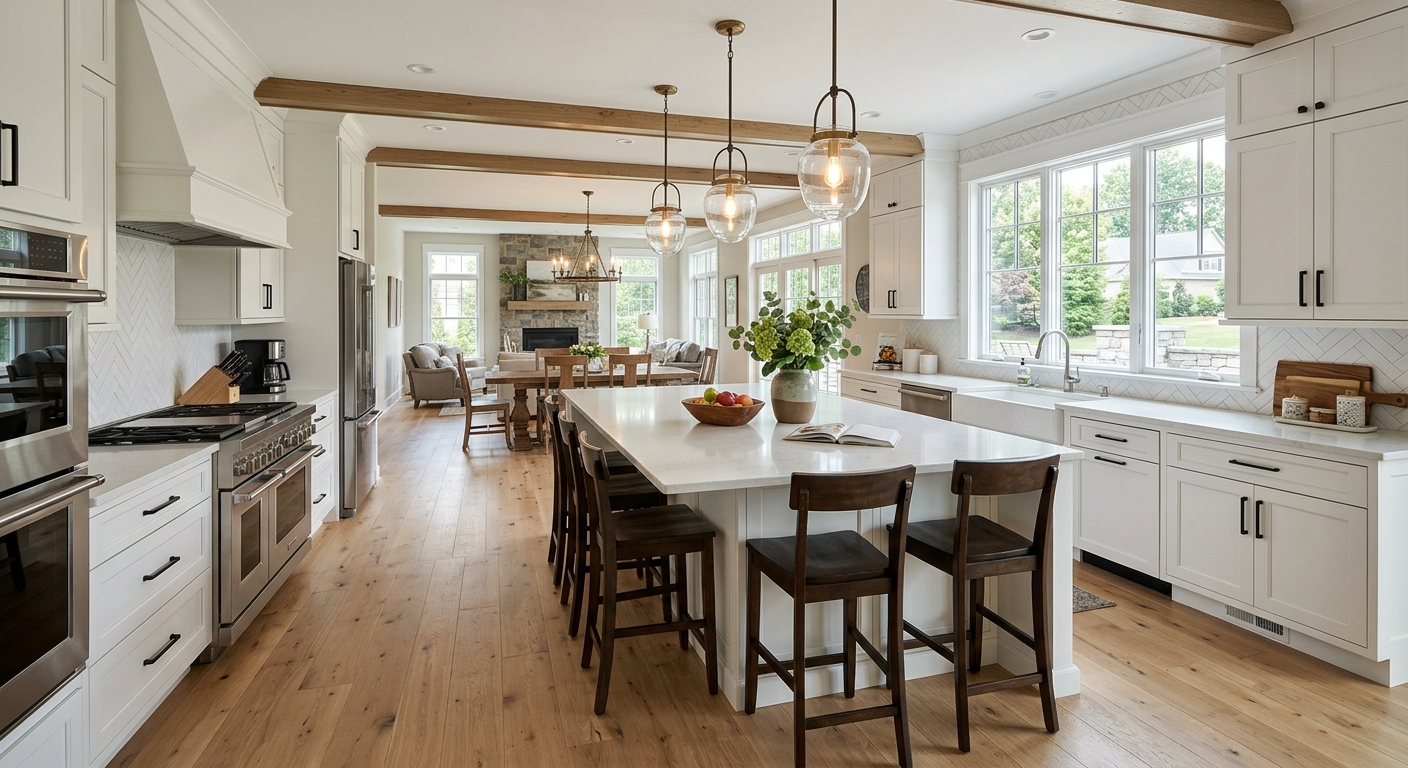
Kitchen renovation costs in Shenango — 2026
Kitchen renovations in Shenango follow the same rules as anywhere: your budget drives scope, and your scope drives most decisions downstream. With a median household income of $67,808 and a homeownership rate of 84.7% (U.S. Census Bureau, ACS 2024), most Shenango kitchen jobs are for people who plan to live in their homes, not landlords flipping a property. The local housing stock—dominated by 1900–1940 mill-worker homes—means many kitchens are small, galley-style, and often need more than just new cabinets or flooring to feel modern. The most common blowout in budgets comes from planning one tier of work and specifying another: for example, planning on a cabinet swap at a mid-range price, and then deciding halfway through to move walls or rewire the entire kitchen. That can double the cost and the timeline.
| Scope |
What's included |
Duration |
Price range |
| Full gut remodel, same layout |
cabinets, counters, appliances, flooring, lighting, fixtures |
6–10 weeks |
$29,000–$115,000 |
| Gut plus layout change |
all of the above plus moved plumbing, electrical, walls |
10–16 weeks |
$62,500–$115,000 |
| Cabinet replacement (stock to semi-custom) |
remove and install cabinets, hardware, patching |
1–3 weeks |
$6,700–$29,000 |
| Cabinet refacing |
new doors and drawer fronts, veneer, hardware |
3–6 days |
$6,700–$19,000 |
| Countertop replacement only |
template, fabricate, install, reconnect sink |
1–3 weeks |
$3,800–$15,500 |
| Kitchen flooring only |
remove existing, install new flooring |
3–6 days |
$4,800–$19,000 |
Estimates for a typical Shenango kitchen. Cabinet grade and whether the layout changes move these figures more than square footage.
Appliance choices and the decisions they force
Every kitchen project in Shenango has one sequencing pitfall: whatever appliances you buy, cabinets must be measured and built around those exact dimensions, not after. Ordering cabinets and then going appliance shopping is a fast way to end up with a refrigerator that either sticks out or does not fit. Counter-depth refrigerators give a cleaner look in tight spaces—especially important in the classic galley kitchens common here—but require planning for proper cabinet depth and sometimes trimming nearby panels. Slide-in ranges sit nearly flush with counters, but need special notches in countertop material; freestanding ranges are easier to swap but don’t deliver the built-in look. Gas cooking still dominates locally, but if you want to switch to induction, a big question is whether your panel supports an additional 240-volt circuit. Panel-ready dishwashers and fridges, which accept a wood front to match cabinets, almost always require a higher spend and precise sizing during the cabinet phase.
Ventilation is another fork in the road. Ducted hoods, vented outside, are the gold standard for serious cooking and moisture control. Recirculating hoods are a compromise, passing air through a filter and back into the room—acceptable, but not ideal for daily frying or heavy use, and sometimes the only option in densely built neighborhoods where running new ductwork isn’t permitted or practical. If you’re eyeing professional-grade ranges or refrigeration, make sure you want what these bring—the additional cost is often more about style and visual impact than measurable performance in a family kitchen. Finally, supply chains mean that lead times for appliances in Shenango sometimes exceed cabinet production, so pick these up front before final cabinet orders go in.
Who should run your Shenango renovation
How you deliver the job makes as much difference as what you pick for cabinets and counters. The design-build kitchen firm is the smoothest route: a single company handles design, cabinetry, all contracting, and most finishes. You pay more—sometimes by a lot—but you deal with one contract and have recourse if anything isn’t right. Mid-tier is hiring a general contractor, who brings in their own trades and often leaves you or an outside designer to pick cabinets and appliances. It’s less expensive than design-build, but you’re still hands-off with scheduling and liability is clear if something runs late.
The most budget-driven way is to self-manage: hiring every trade and supplier yourself, scheduling each sequence, and making sure everyone shows up at the right time. With Lawrence County’s spread-out, rural market and thinner finish-trade labor, lead times are longer and finding someone to finish the details is trickier than in Pittsburgh’s city core. Owner-managed jobs often run over on timeline because a missed trade can push things back weeks. If you have a demanding day job, or your project will trigger permits (like touching plumbing or moving walls), owner-management is rarely worth the savings. What you gain in cash, you lose threefold in headaches and risk.
Electrical work in an older Shenango kitchen
If your house in Shenango was built before 1980—and 62.1% were (U.S. Census Bureau, ACS 2024)—you’re almost certain to hit an electrical snag once the kitchen walls are open. Older mill-worker homes, many built before 1940, tend to have a single, shared circuit running lights and outlets on knob-and-tube or early Romex wiring, little or no grounding, and sometimes outdated or aluminum branch wiring. Every time you open the walls for a full kitchen renovation, any new work has to be brought up to current code. That’s not optional; inspectors will insist, and it’s one of the top hidden costs in local kitchen jobs.
Modern code calls for two or more dedicated small-appliance circuits serving countertop outlets (with GFCI protection), proper spacing of outlets (no point more than 24 inches from a plug along the counter), a dedicated circuit for the dishwasher, garbage disposal, microwave, and a 240-volt feed for an electric range, if you have one. Many panels in older homes lack open spaces for new breakers, so a subpanel or even a main panel upgrade could be required. These upgrades are seldom in the first draft of a homeowner’s budget. For a typical Shenango kitchen, expect electrical to code to run between $4,800–$15,500 if you’re moving appliances or doing a gut remodel; sometimes higher if the service or main panel needs changing.
Code requirements for Shenango kitchens
In Shenango, painting, swapping out hardware, or refacing cabinets does not generally trigger a permit—nor does replacing a countertop, as long as no plumbing or electrical is disturbed. But if you’re doing anything with structural walls, running new plumbing lines, or changing any wiring in New Castle or Neshannock Township, a permit is likely required. Plan review is mandatory in New Castle if structural or service locations (water, drains, lines) are moved.
Electrical inspections are performed not by a municipal officer but by certified third-party agencies approved by the City of New Castle Code Enforcement Office, which surprises many homeowners. For all contracts above $500, Pennsylvania law requires the contractor to hold a Home Improvement Contractor (HIC) registration from the Office of Attorney General—verify records at hic.attorneygeneral.gov. Proper workers’ compensation coverage is mandatory for all employers and can be confirmed at the WCAIS (wcais.pa.gov) system. If prior work was done without permits, it may need to be disclosed at resale and corrected—lenders and buyers will often expect proof of permit and inspection on major kitchen changes. Unpermitted work can slow, or even derail, a sale.
Practical survival during the work
Living through a kitchen renovation in Shenango takes planning—not just with cabinets and tile, but with where you’ll make coffee and clean dishes for weeks on end. Set up a temporary kitchen in another part of the house: move the fridge nearby (often the dining room or basement), plug in a microwave, kettle, and maybe a hot plate. Use a laundry or bathroom sink for rinsing dishes or prepping food—a dish tub goes a long way. Paper plates will save your sanity, but plan for more takeout or restaurant meals. In truth, that jump in the food bill over six or eight weeks is usually larger than the cost of new flooring—so budget for it instead of being surprised.
Dust will travel anywhere air does, so insist on plastic sheeting, zipper walls, and floor protection. It’s worth the time, since mill-built homes collect dust fast in their old trim and open stairs. Expect to have a dumpster and pallet staging in the driveway or yard for at least a week during demolition. Keep pets out—doors will be open and tools everywhere. Moving out during demo week makes sense if you have young kids, pets, or are highly sensitive to noise. Otherwise, most Shenango families make it through at home by planning the temporary setup first, well before demo starts.
Cabinets: reface, stock, semi-custom or custom
Deciding on cabinets is usually the line between a manageable budget and a runaway one. Refacing, which means keeping existing cabinet boxes and putting on new doors, drawer fronts, and a fresh veneer, is by far the most cost-effective for Shenango kitchens—if the boxes are square, solid, and the current layout works. It does not allow for reconfiguration or adding storage. Most Lawrence County homes are older, built with galley kitchens that rarely line up with modern standard cabinet sizes, so what starts as a plan for cheap stock cabinets often shifts to semi-custom mid-project, when fillers and awkward storage become obvious.
Stock cabinets are cheapest, in fixed sizes (like 24" or 36" units), and often need filler strips to cover gaps—okay in newer layouts but awkward in pre-1940 homes with wavy plaster walls. Semi-custom is the strong middle ground: sizes, finishes, and accessories can be tailored, which gets you around the “it-almost-fits” problem, but with a 6–12 week lead time. Full custom fits any space, any finish, and is priced accordingly. For quality, the materials matter more than the label: plywood boxes last much longer than particleboard, soft-close and full-extension drawer glides make a difference, and dovetail joinery is worth the extra cost for drawers, even in semi-custom options. Frameless (“Euro”) cabinets maximize space in tight kitchens, but installation demands precision—face-frame cabinets are more forgiving in the sloped-floored old houses common in Shenango.
| Option |
Cost |
Best when |
Limitation |
| Painting existing cabinets |
$1,200–$3,500 |
boxes and doors sound, tight budget |
no layout or style change |
| Refacing |
$6,700–$19,000 |
boxes square and layout works |
storage unchanged |
| Stock cabinets |
$6,700–$29,000 |
standard dimensions fit |
filler strips, limited finishes |
| Semi-custom |
$19,000–$29,000 |
non-standard walls or finishes |
6–12 week lead time |
| Full custom |
$19,000–$29,000 |
unusual layout or high-end design |
longest lead, highest cost |
Frequently asked questions — kitchen renovation in Shenango
How much does a kitchen renovation cost in Shenango?
Most Shenango kitchen renovations, even for typical galley kitchens in the county’s older homes, will land between $29,000–$115,000 for a full gut remodel, with the most common projects tending toward the lower-to-middle end of that range. If you’re only replacing cabinets using stock or semi-custom options, your spend can be between $6,700–$29,000, but as soon as you move walls or upgrade plumbing and electrical, costs rise quickly. Every budget should include a cushion for contingency, especially given how older Lawrence County homes spring surprises when the walls come apart.
How do I set up a temporary kitchen?
In Shenango, plan your living arrangement before demolition begins. Move your refrigerator and a microwave to an accessible space, like the dining room or basement. A folding table for prep and drawer storage helps, and most families use a laundry or bathroom sink for washing dishes. Stock up on disposable plates and utensils, since keeping up with dishwashing is harder than expected without a kitchen sink. The food bill often jumps — eating out during an eight-week renovation can easily cost more than $4,800–$19,000, which is what a new kitchen floor runs. Take time to set up a space you’ll be able to use every day, because you’ll need it more than you first imagine.
What countertop material is best for a family kitchen?
For families in Shenango and across Lawrence County, quartz is often the top pick for a balance of durability, cleaning ease, and resale value. Granite is also strong, but quartz resists both staining and chipping a little better and requires no periodic sealing. Laminate can work on a tighter budget (in the $3,800–$15,500 band), but it won’t hold up nearly as long with heavy daily use. For those considering solid surfaces or butcher block, both are fine but each comes with its own care instructions you’ll need to follow. In most cases, stick with quartz or granite if you plan to stay put and want the countertop to last as long as the cabinets.
How much do new kitchen cabinets cost in Shenango?
Cabinet costs depend on your route: stock (basic sizes, limited finishes) lands between $6,700–$29,000, and semi-custom options hit the top of that range. Refacing quality boxes can be much less, while custom work is rarely less than $19,000–$29,000 in this area. Because older Shenango homes often have non-standard wall sizes, many projects intended as “stock” end up needing some semi-custom pieces to fit right. Always include soft-close hardware and real plywood boxes in your spec sheet for best long-term value.
What happens if previous work was unpermitted?
In Pennsylvania, and specifically in Shenango, unpermitted kitchen work can lead to real trouble if it comes up during resale. Buyers and their lenders often demand evidence that electrical, plumbing and structural changes were inspected. If not, you may be forced to get “as-built” permits and possible corrections, which can cost thousands and delay closing by weeks. A straightforward cabinet or countertop change rarely causes issue, but anything involving moved walls, plumbing, or wiring in the $29,000–$115,000 tier should always have permits and inspections documented by the City of New Castle Code Enforcement Office or your local authority.
Do older Shenango homes need electrical upgrades for a kitchen?
Almost always. With 62.1% of homes built before 1980, original wiring often falls far short of today’s safety requirements. Opening up an old kitchen almost guarantees discovery of outdated or under-powered circuits. Modern code (as enforced in Lawrence County) requires more circuits, GFCI outlets, and frequently new service panels. Upgrades can add anywhere from $4,800–$15,500 to your project, particularly if rewiring or a panel change is needed. This cost is best faced early, rather than risking failed inspections or unsafe conditions.
How far ahead should I book a contractor in Shenango?
Due to thinner finish-trade labor in Lawrence County compared to metropolitan areas, reputable kitchen contractors are often scheduled out several months—three to six months is typical. The demand isn’t just from Shenango, but also from surrounding townships and New Castle itself. If you want work done during a specific season, plan to sign contracts at least 12–16 weeks in advance, especially for jobs in the $29,000–$115,000 price band. Leaving it late may result in rushed quotes and less reliable schedules.
Can I renovate a kitchen in stages?
Yes, though it isn’t always the best way financially. In Shenango’s pre-1980 homes, phasing work means paying for some steps twice—pulling and resetting counters or appliances, for instance. But if your budget only allows cabinet refacing or countertop replacement (in the $3,800–$19,000 range) now, and a full gut later, it’s possible. Just know that tearing out even part of a kitchen in an old Shenango house often reveals hidden issues (like wiring or plumbing) that can make you wish you did the whole job at once to avoid multiple headaches and labor trip charges.
Does a kitchen renovation increase home value in Shenango?
Yes, a well-executed kitchen renovation almost always raises resale appeal. For typical owner-occupied Shenango homes, buyers expect modern kitchens, especially since so much of the stock dates from before 1940. While you’re unlikely to recoup every dollar spent (especially on upper-end choices above $62,500), neglected or original kitchens lose value at resale by more than the cost to update. Stick to quality basics that fit the home and avoid the priciest trends—it’s function and layout buyers want in Lawrence County, not just more granite or an imported fixture.