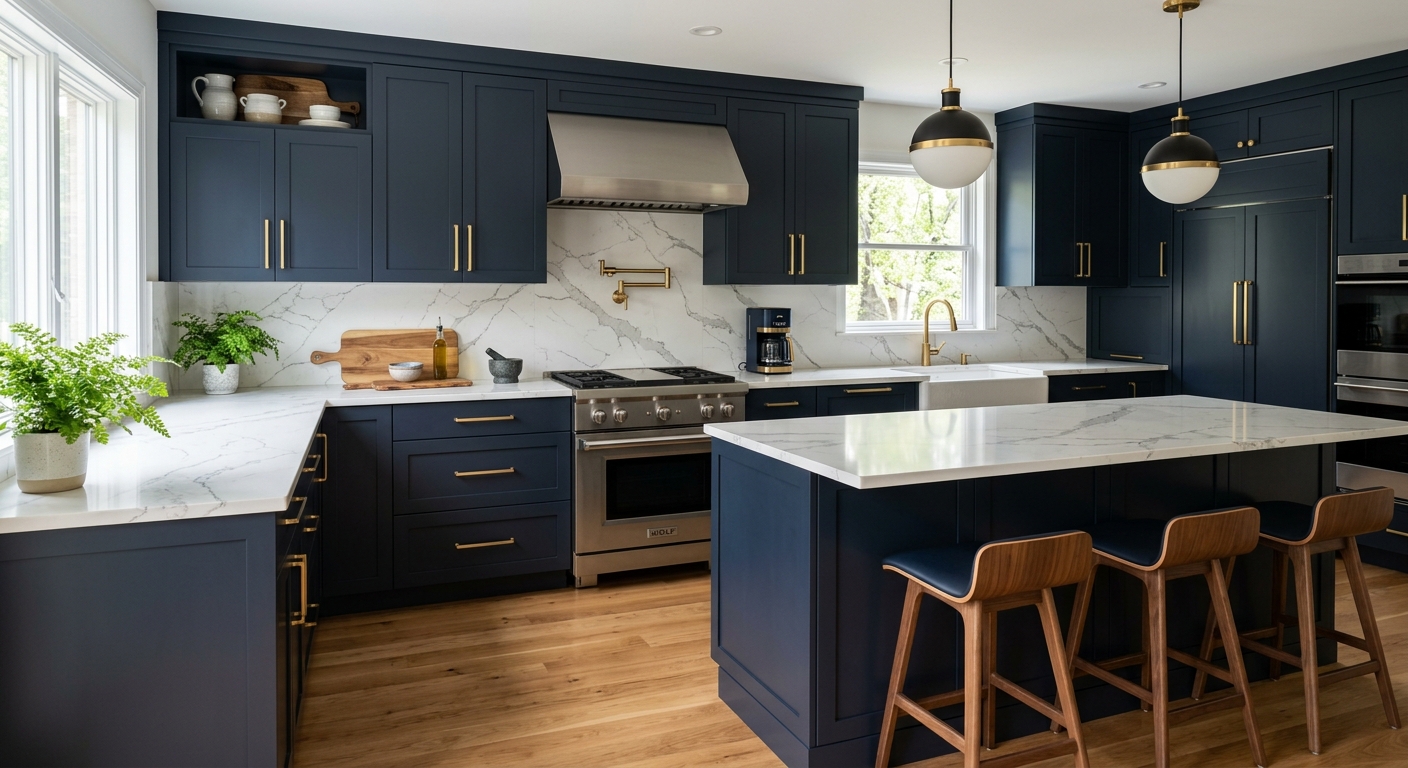
What a kitchen remodel costs in Kennedy
In Kennedy, where 78.2% of homes are owner-occupied and median incomes reach $78,063 (U.S. Census Bureau, ACS 2024), kitchen renovation plans are shaped by the value and age of the housing stock. Much of the nearby Pittsburgh area—including Kennedy’s own neighborhoods—features homes built before 1980, with a significant portion pre-1940. This means homeowners are often faced with tight, compartmentalized kitchens that may require complete gutting and reconfiguration, not just cosmetic upgrades. If you’re budgeting based on costs for a simple pull-and-replace, it’s easy to misjudge—what looks like a surface job may demand layout changes and more involved electrical or plumbing upgrades.
The biggest mistake most Kennedy residents make is pricing one scope—such as a simple cabinet swap—then specifying features from a higher tier, like moving the sink or enlarging the space. That leap can double the budget and timeline. It’s wise to clarify exactly which kind of renovation you need before shopping for contractors or products.
| Scope |
What's included |
Duration |
Price range |
| Full gut remodel, same layout |
cabinets, counters, appliances, flooring, lighting, fixtures |
6–10 weeks |
$30,000–$119,000 |
| Gut plus layout change |
all of the above plus moved plumbing, electrical, walls |
10–16 weeks |
$64,500–$119,000 |
| Cabinet replacement (stock to semi-custom) |
remove and install cabinets, hardware, patching |
1–3 weeks |
$6,900–$30,000 |
| Cabinet refacing |
new doors and drawer fronts, veneer, hardware |
3–6 days |
$6,900–$20,000 |
| Countertop replacement only |
template, fabricate, install, reconnect sink |
1–3 weeks |
$4,000–$16,000 |
| Kitchen flooring only |
remove existing, install new flooring |
3–6 days |
$5,000–$20,000 |
Estimates for a typical Kennedy kitchen. Cabinet grade and whether the layout changes move these figures more than square footage.
Appliance choices and the decisions they force
One of the quickest ways to cause a budget and schedule problem on a Kennedy kitchen remodel is to choose your appliances after you’ve ordered the cabinets. Cabinet dimensions—especially for refrigerators, ranges, and dishwashers—are built around the spec sheets of those units. Waiting too long, or changing your mind late, often leaves you with gaps, overhangs, or an appliance that simply will not fit.
Here’s where specifics matter: standard fridges stick out several inches past the counter, while counter-depth models sit flush, but cost more and hold less. If you want a seamless look, that’s a call to make before any cabinet drawings are finalized. Slide-in ranges and freestanding models aren't interchangeable cabinetwise, and induction ranges nearly always demand an upgrade to the electrical service—cost and lead time both increase.
Panel-ready dishwashers—designed to accept a matching cabinet panel—need careful cabinet planning. As for range hoods, ducted-to-outside is far superior for venting real cooking odors and particulates, but may require opening walls or ceilings, which is often skipped in tight Pittsburgh-area homes. Recirculating hoods are a compromise at best, filtering grease and little else.
If you’re drawn to professional-grade appliances, know that their main premium is not always performance. In most Kennedy kitchens, the draw is appearance, with higher BTUs and pro styling. Be realistic: in a small vintage kitchen, the extra dollars won’t deliver more value unless you truly cook at volume. Finally, be aware that post-pandemic, appliances—even basic models—can have longer lead times than cabinets, so order early.
Who should run your Kennedy renovation
In Kennedy and the wider Allegheny County area, who actually directs the renovation shapes the whole experience—budget, schedule, and your own stress level. There are three main models, and they offer different trade-offs.
A design-build kitchen firm handles everything from concept to installation under a single contract. This is the high end for cost, but you get full accountability and spend the least of your own time in management. If you want a finished kitchen with minimal effort by you, and you’re willing to pay for that certainty, this is the way.
General contractors are the middle lane. They’ll coordinate all the trades—demo, carpentry, electrical, plumbing—but look to you, or possibly a designer, for the details of what to specify and what to order. Expect more communication and decision-making on your end, but typically some cost saved over design-build.
Owner-managed, where you hire each trade yourself and handle the scheduling, is the cheapest option. But unless you’re retired or on a career break, this is not realistic in Kennedy. Skilled finish trade labor is tight here, and the best trades are rarely available on your schedule. If your project triggers permits (new circuits, layout change, etc.), managing the subs, inspections and paperwork is a task most homeowners underestimate.
Bottom line: unless you have flexible weekday availability, self-management is only viable for small, cosmetic projects. For a full remodel, bring in a GC or design-build team and avoid being left with an unfinished kitchen.
How a Kennedy kitchen budget breaks down
The budget for a Kennedy kitchen renovation almost always looks different once you see the real breakdown. Many homeowners put too much weight on visible items, but the unseen costs—labor, contingency, soft costs—eat a bigger share than expected, especially in older homes. Cabinetry is usually the largest single line (often 25–35%), with labor next. Stone counters and appliances have the widest range. If you decide to upgrade a cabinet, that’s money wisely spent; but dropping premium appliances into a kitchen with basic cabinets is almost never worth the outlay.
There are two lines every Kennedy homeowner skips until forced: contingency for what’s behind the walls (wires, pipes, old framing), and the soft costs—permits, design work, deliveries, and hauling away debris. In pre-1980 homes, that contingency is not optional. If you have an extra thousand, put it on quality cabinets or professional electric and plumbing—rarely do luxury faucets, expensive lighting, or an appliance upgrade move the needle the same way in this market.
| Category |
Share of budget |
Notes |
| Cabinetry |
25–35% |
the largest line and the longest lead time |
| Labour and installation |
20–30% |
rises sharply if the layout changes |
| Countertops |
8–15% |
material choice drives the swing |
| Appliances |
10–20% |
widest range of any category |
| Flooring |
5–10% |
|
| Lighting and electrical |
5–10% |
higher in older homes needing circuits |
| Plumbing and fixtures |
4–8% |
|
| Permits, design, disposal |
3–6% |
usually forgotten in early budgets |
| Contingency |
10–15% |
not optional in a pre-1980 house |
Cabinets: reface, stock, semi-custom or custom
Your Kennedy kitchen budget will move more on the cabinet decision than any other single line. Refacing is the most underestimated option—it keeps the existing cabinet boxes (if they’re square, solid, and in a usable layout), replaces the doors and drawer fronts, and adds a new finished veneer. Refacing cannot move walls, add storage, or correct bad layouts, but when the bones are good, it saves thousands and has fast turnaround.
Stock cabinets are mass-produced in set sizes and finishes, requiring filler strips to fit walls that are never straight—especially a problem in Kennedy’s older homes. Semi-custom cabinets adjust these dimensions and finishes, bridging the gap in homes with odd wall runs and non-standard depths (common in pre-1940s construction just outside Pittsburgh). Full custom is the answer for unique layouts or a highly specified design—think seamless fit, maximum storage, and no dead corners. Lead times go up with customization.
Quality is not guaranteed by price. Best practice is plywood cabinet boxes, dovetail drawer construction, and soft-close, full-extension hardware. Frameless cabinets offer sleek looks and better access, but traditional face-frame is still popular and more forgiving when walls are out of square.
| Option |
Cost |
Best when |
Limitation |
| Painting existing cabinets |
$1,200–$3,500 |
boxes and doors sound, tight budget |
no layout or style change |
| Refacing |
$6,900–$20,000 |
boxes square and layout works |
storage unchanged |
| Stock cabinets |
$6,900–$30,000 |
standard dimensions fit |
filler strips, limited finishes |
| Semi-custom |
$20,000–$30,000 |
non-standard walls or finishes |
6–12 week lead time |
| Full custom |
$20,000–$30,000 |
unusual layout or high-end design |
longest lead, highest cost |
Four kinds of kitchen project, four budgets
It’s easy to say you want a “kitchen remodel,” but in Kennedy, that phrase covers a fivefold price and schedule range. Knowing your project tier before you call anyone saves hours and lots of money.
Cosmetic refresh means painting, changing knobs and pulls, updating lighting, and sometimes adding a tile backsplash—no cabinets are replaced and the layout stays the same. Pull and replace is the most popular: new cabinets and counters in the current footprint, but keeping the plumbing and wiring as they are. Gut, same layout strips everything to the studs but puts the new kitchen back in the same shape—useful for fixing decades of wear or spotting old wiring and pipes before trouble strikes. Layout change is when you move a sink, range, wall, or doorway, triggering plan review, engineer sign-off, and extra expense.
The cost cliff comes between gut/same layout and layout change. As soon as you move anything structural or mechanical, your price and duration go up sharply, and you’ll need professionals experienced in kitchen permitting and construction in Allegheny County. Every contractor in Kennedy will want to know which tier you’re in before offering an estimate—without that clarity, no number is meaningful.
Code requirements for Kennedy kitchens
For Kennedy homeowners, the code requirements on kitchen remodels are well defined if a bit tricky in older homes. Cosmetic upgrades—paint, new hardware, cabinet refacing, and replacing a countertop that fits the current cabinets—do not require a building permit in most Allegheny County boroughs.
Once you start moving walls, relocating plumbing or electrical lines, or installing new circuits (as with a new induction range or vent hood), permits are almost always needed. In Pittsburgh itself, changes to structure or utility runs call for a permit and often a plan review by the Department of Permits, Licenses, and Inspections. Some suburbs use third-party inspection agencies for electrical, which catches homeowners off guard at inspection time.
Pennsylvania requires any contractor working on a home improvement contract over $500 to be registered with the Home Improvement Contractor registry, which you can verify at hic.attorneygeneral.gov. Employers must maintain workers' compensation coverage—check this on the WCAIS system (wcais.pa.gov) before signing. For homes built before 1978, federal EPA Lead RRP rules apply for disturbing paint during renovations; only hire certified contractors from the federal listing.
Skipping permits in Kennedy can come back to bite at resale. Every so often, unpermitted changes fail appraisal or prolong a closing when municipal inspectors spot unapproved work. It’s always cheaper to do it right the first time.
Frequently asked questions — kitchen renovation in Kennedy
How far ahead should I book a contractor in Kennedy?
If you’re planning a full kitchen remodel in Kennedy, start speaking with contractors at least three to four months before you want work to begin. The local labor market is tight, with experienced finish trades often booked out for several months in advance—especially as demand in Allegheny County has stayed high. For major gut remodels, lead times stretch even further if you’re seeking semi-custom or custom cabinets, since these can require 6–12 weeks just to fabricate. If your timeline is tight and you’re flexible on materials, you can sometimes move faster with stock cabinets and in-house labor, but expect even a straightforward “pull and replace” job to require at least 4–6 weeks from contract to start of demolition, plus your build time. Booking early also gets you on scheduling lists during peak season.
What does a quartz countertop cost in Kennedy?
Quartz countertops in Kennedy fall right in line with national mid-range estimates, but most projects here see total installed costs between $4,000–$16,000 for replacement only, with most homeowners spending around $8,900 for a typical kitchen. This pricing includes measuring, templating, fabrication, installation, and sink cutouts. In older Kennedy homes with uneven walls, there can be extra labor charges for scribing and fitting, so factor in a little contingency, especially if you are also updating the cabinets. If you want a top brand or extra-thick material, you’ll be at the higher end of that range. For backsplashes or waterfall island edges, costs can rise further.
Is induction worth it over gas?
Induction cooking is steadily gaining ground in Western Pennsylvania, including Kennedy, but the switch isn’t always straightforward. Induction ranges are safer and highly efficient, and they boil water faster than gas. The downside is the electrical: most older Kennedy homes will need a dedicated 240V circuit, sometimes requiring a panel upgrade, so installation can add $1,000 or more. Gas offers precise heat but does not vent well in most older homes unless you plan on a ducted range hood. Induction is often worth it for safety, speed, and a cleaner kitchen, especially if you’re redoing wiring as part of a gut remodel (budget for a full kitchen: $30,000–$119,000), but less so if you’re trying to swap out a single appliance in an older house unless the panel is already upgraded.
How much does a kitchen renovation cost in Kennedy?
The range is wide because “kitchen renovation” means many things to different people—but in Kennedy, the numbers are concrete. A simple cabinet replacement can run from $6,900–$30,000, while a full gut renovation of a typical kitchen space lands between $30,000–$119,000. The average spend for a complete overhaul is about $64,500. Older homes with small, compartmentalized kitchens often need more work than you might anticipate, making the scope (and thus budget) jump. Final price depends on product selection, whether you move plumbing or structure, and what’s uncovered once demolition is underway.
Should I reface or replace my kitchen cabinets?
This decision in Kennedy depends mainly on the quality and configuration of your existing cabinets. Refacing—adding new doors, drawer fronts, and a matching veneer—is dramatically less expensive than new cabinets, with most projects coming in at $6,900–$20,000. It’s best when your cabinet boxes are solid, square, and already where you want them. If you have awkward layouts or want to add storage, refacing won’t help. Replacement, especially with stock or semi-custom cabinets, becomes cost-effective if your boxes are failing, water damaged, or don’t take advantage of your space—a common issue in Kennedy’s pre-1940 houses. Weigh how many changes you want to make before deciding to avoid overspending.
Can I live in the house during a kitchen renovation?
Most Kennedy homeowners stay in the house while their kitchen is being renovated, but be prepared for disruption. For a full gut (budget: $30,000–$119,000), expect 6–10 weeks without a cooking space or sink, plus dust and noise. Contractors will help you set up a temporary kitchen in the basement or dining room during construction. If it’s just cabinet refacing or countertop replacement, disruption is short and manageable. Families with small children or pets sometimes choose to stay elsewhere for part of the process. Ultimately, if you plan for mess and set realistic expectations, most Kennedy residents can live through a typical remodel with only minor inconvenience.
Should I renovate before selling or let the buyer do it?
This decision in Kennedy depends on your goals. If your kitchen is outdated but functional, a full renovation might not recoup its entire investment at resale. Buyers in Allegheny County, especially with so many homes built before 1980, often want to do their own updates. Minor improvements—fresh paint, new hardware or lighting—deliver more bang for the buck and help your place stand out in listings. Unless your kitchen is very dated or nonfunctional, save your major dollars. For homes that need “move-in ready” status to command top dollar, a basic pull-and-replace job (budget: $6,900–$30,000) will attract more buyers, but gut level projects are best left to new owners with their own vision.
Does replacing cabinets require a permit?
As a rule, replacing cabinets in Kennedy does not require a building permit as long as you keep the same layout and do not change plumbing or run new electrical circuits. This is true for most Allegheny County boroughs. However, if you plan to move a sink, range, or walls—or to install new outlets or lighting—then local code may require you to pull permits. For homes within Pittsburgh city limits, any change to wall layout or utilities requires a permit and a plan review. If you’re unsure, check with your local code office or with your contractor (who should be registered under Pennsylvania’s Home Improvement Contractor registry) before starting any work to avoid resale troubles later.
Are Kennedy kitchens typically small galley layouts?
Many Kennedy homes, especially those built before 1940, do have small, narrow kitchens—typically galley style—similar to what’s found in older Pittsburgh neighborhoods. That’s a direct result of how homes were built in that era. These layouts often lead homeowners to gut and reconfigure the kitchen entirely to open up the space or create better flow. If your house is from that period, expect more challenges fitting standard cabinets and appliances—the most common reason to choose semi-custom cabinets (costing $20,000–$30,000) so everything fits correctly. Newer homes in Kennedy may have wider or more open kitchen layouts, but the small galley remains common in the area’s older stock.