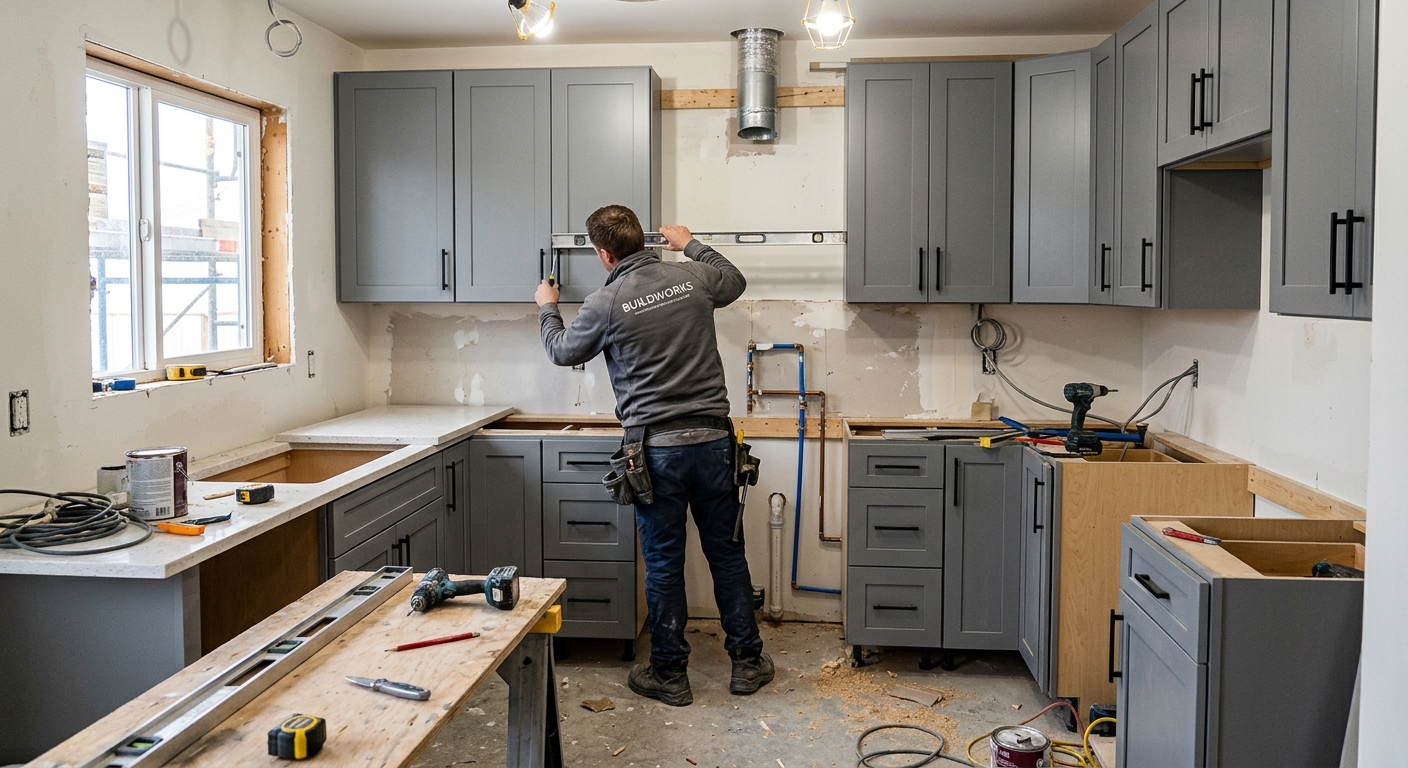
What a kitchen remodel costs in Franklin Park
In Franklin Park, kitchen remodel plans are shaped by high home values and an owner-occupancy rate of 91.9% (U.S. Census Bureau, ACS 2024). Owners here approach kitchen renovation as a long-term investment, matching upgrades to homes with a median household income of $158,052. The age of homes in the Pittsburgh area means projects can differ dramatically in complexity—older layouts often need gut renovations, while 1990s builds may just need fresh finishes. Large pre-1940 housing stock in Pittsburgh creates frequent kitchen gut-renovations to reconfigure small, compartmentalized rooms. For newer homes, the footprint and utility locations typically suit modern living, making less invasive remodels feasible.
What drives blown budgets across Franklin Park is planning for a cosmetic update but ending up with large-scale work that includes layout changes or moving utilities. The cost to gut a kitchen while keeping the layout, for example, is far different from moving the sink and opening up walls. Be realistic about your needs up front to avoid this common pitfall.
| Scope |
What's included |
Duration |
Price range |
| Full gut remodel, same layout |
cabinets, counters, appliances, flooring, lighting, fixtures |
6–10 weeks |
$33,000–$132,000 |
| Gut plus layout change |
all of the above plus moved plumbing, electrical, walls |
10–16 weeks |
$71,500–$132,000 |
| Cabinet replacement (stock to semi-custom) |
remove and install cabinets, hardware, patching |
1–3 weeks |
$7,700–$33,000 |
| Cabinet refacing |
new doors and drawer fronts, veneer, hardware |
3–6 days |
$7,700–$22,000 |
| Countertop replacement only |
template, fabricate, install, reconnect sink |
1–3 weeks |
$4,400–$17,500 |
| Kitchen flooring only |
remove existing, install new flooring |
3–6 days |
$5,500–$22,000 |
Estimates for a typical Franklin Park kitchen. Cabinet grade and whether the layout changes move these figures more than square footage.
Practical survival during the work
Living through a kitchen renovation in Franklin Park means trading convenience for progress, often for six to ten weeks. Your refrigerator can usually stay plugged in nearby, perhaps in a dining room or garage. A folding table with a microwave, toaster oven, and electric kettle carries you through for quick meals. Most homeowners use paper plates and eat takeout more than they expect. The bump in your food budget over eight weeks often outpaces the cost of new kitchen flooring.
Daily life will center around a makeshift sink—usually in a powder room or laundry, not ideal but workable. Plastic sheeting and zip walls make a world of difference for dust, especially in open floor plans, but only if they go up before demolition. Keep pets and kids well away; doors will be propped open for hours for deliveries and debris.
Plan where the crew will put a dumpster and materials. If your driveway is steep or tricky to access, staging may happen in the yard. Most Franklin Park homes have the space, but the disruption is real. Some owners move out for the demolition week if possible—noise, dust and lost routines can be hard, especially if you work from home. For those staying, breakfast and dinners out should be seen as a budget line item, not an extravagance. In truth, survival during a gut renovation costs time, money, and patience, but knowing what’s coming is half the battle.
Code requirements for Franklin Park kitchens
In Franklin Park, most kitchen remodeling projects can be completed legally without a building permit if you’re only swapping cabinets, countertops, flooring or paint—so long as you’re not changing the floor plan or the locations of plumbing or electrical lines. Simple surface updates like refacing cabinets, replacing a countertop in place, or installing new hardware don’t trigger permits. But once you move a sink, relocate outlets, knock down or open a wall, or upgrade mechanical equipment (like installing a new vent hood), permits enter the equation.
If your project does require permits, the code authority is defined by the Pennsylvania Uniform Construction Code (UCC). In Pittsburgh proper, plan review is typically required when structural changes or new utility lines are involved, and the Department of Permits, Licenses, and Inspections oversees this step. In Franklin Park and other nearby boroughs, your town’s code office typically handles permitting, but electrical inspections could be run by a third-party agency approved by the municipality. It’s always worth confirming who inspects your job before you start.
For any work costing over $500, Pennsylvania requires contractor registration through the Home Improvement Contractor registry, which you can verify at hic.attorneygeneral.gov. All employers must carry workers’ compensation insurance; use the WCAIS system (wcais.pa.gov) to double-check coverage. Unpermitted or non-compliant work creates a paper trail that could trip up your home’s resale or complicate insurance claims. When in doubt, confirm what’s legal before hiring—and never let anyone talk you into skipping the paperwork.
What moving the sink really costs
Keeping plumbing and electrical in the same place is what keeps a kitchen remodel in the lower price band. The minute you plan to move a sink, the budget jumps by tens of thousands—not because a pipe is expensive, but because of everything else involved. Relocating drains takes slope; over a finished ceiling or in a concrete slab, there isn’t always room. You could be opening up walls, ceilings or even cutting through concrete, requiring demolition, new framing, and full patching. Electrical rework sometimes means adding circuits, which can run up against the main panel’s capacity—a surprise upgrade for some older Franklin Park homes, where electrical systems may lag behind modernization.
If you want to remove or alter a wall, first, you have to determine if it’s load-bearing. That means hiring an engineer for plans and pulling a permit, since structural changes always require plan review in the Pittsburgh area. Venting a relocated range hood through an exterior wall adds time, expense, and maybe even exterior repair. Inspections will follow for each major step, and finishing the job right—patching old holes, matching floors—adds invisible cost.
This is where honest planning matters. Is the current kitchen unworkable, or just dated? Those four feet often cost more than new cabinetry. If you keep to the existing layout, a full kitchen gut remodel in Franklin Park typically runs $33,000–$132,000. Adding moved utilities and walls pushes you to $71,500–$132,000, just to gain a different footprint. Unless the old floor plan is truly a dealbreaker, the extra cost is hard to justify in many homes.
Who should run your Franklin Park renovation
The way you structure your kitchen renovation project drives both cost and stress. A design-build kitchen firm handles design, cabinetry, construction, and all trades under one roof. It’s the highest cost, but it gives you one agreement and accountability for everything from plans to punch list. A general contractor works with subcontractors for electrical, plumbing, and drywall; you may work with a designer separately, and you’ll still have a single point for questions, but you’re more hands-on in making selections and approvals. The cost sits mid-range.
Owner-managed projects—where you hire trades directly and schedule them—save the markup, but you become not just a project manager, but a coordinator of inspections, material deliveries and repairs. In Allegheny County, labor for kitchen renovations is tight due to saturated demand, so managing each step without delays is more of a risk than it sounds.
The owner-managed model can work in Franklin Park, but only if you have the time to chase trades, line up permits, and handle manufacturers’ delays—not recommended if you have a day job. If your project will involve moving plumbing or walls, or if it needs permit-triggered inspections, contracting a design-build company or reputable general contractor is the safer, less stressful approach.
The biggest line item in your Franklin Park kitchen
Cabinet decisions are the single largest factor in your Franklin Park kitchen renovation budget. Four main options exist: refacing, stock cabinets, semi-custom, and full custom. Refacing saves serious money when your boxes are solid, square, and already where you want them—it swaps out doors, drawer fronts and face veneer. However, it cannot change your storage, adjust for awkward layouts or remedy sagging boxes.
Stock cabinets come in fixed sizes, requiring filler strips and sacrificing a tailor-fit aesthetic. Semi-custom allows for modification to size, finish, and features, making it the go-to for most older homes in this area, where walls are rarely perfectly square or standard. Full custom is the most expensive and is best only for highly unusual layouts or when aiming for maximum resale in a premium Franklin Park home. Remember, lead times for semi-custom and custom are longer.
Independent of price, focus on construction quality: plywood boxes hold up better than particleboard, dovetail drawer joints last longer than staples, soft-close hardware feels more solid in daily use, and frameless (Euro-style) boxes give more storage but need accurate installation.
Large pre-1940 housing stock in Pittsburgh creates frequent kitchen gut-renovations to reconfigure small, compartmentalized rooms., so for many Franklin Park homes, semi-custom is often the “right fit” even when the initial plan was to use stock.
| Option |
Cost |
Best when |
Limitation |
| Painting existing cabinets |
$1,200–$3,500 |
boxes and doors sound, tight budget |
no layout or style change |
| Refacing |
$7,700–$22,000 |
boxes square and layout works |
storage unchanged |
| Stock cabinets |
$7,700–$33,000 |
standard dimensions fit |
filler strips, limited finishes |
| Semi-custom |
$22,000–$33,000 |
non-standard walls or finishes |
6–12 week lead time |
| Full custom |
$22,000–$33,000 |
unusual layout or high-end design |
longest lead, highest cost |
Countertop materials compared
Day-to-day kitchen use should drive your countertop choice in Franklin Park—not just appearance, but maintenance, toughness and how forgiving the surface is to heat and stains. Quartz is engineered, hard and non-porous, so it resists staining and doesn’t need sealing; its weak point is heat—set down a hot pan and the resin can scorch or crack. Granite is fully natural, unique in pattern, and handles heat better, but it does require periodic sealing to stay stain-resistant.
Laminate counters are much improved from decades past, cost-effective, and easily cleaned; in a Franklin Park rental or practical kitchen, it’s a wise choice, not a compromise. Butcher block is warm and inviting, excellent for prep, yet demands monthly oiling and doesn’t handle water or heat well—it stains and scratches easily, but these issues can be sanded out. Solid surface materials, like Corian, have invisible seams, can be repaired and refinished, and come in a wide range of colors, though they don’t handle excessive heat either.
Fabrication affects the bottom line: more elaborate edge profiles, additional cutouts, and maximizing slab usage for big islands will move prices up. Professional templating—where a technician measures your actual space after cabinets are installed—ensures the fit is right. For most Franklin Park kitchens, choose based on what you can live with every day; laminate and solid surface can be the smartest money spent when heavy use or modest budgets guide the project.
Frequently asked questions — kitchen renovation in Franklin Park
Can I over-improve for my Franklin Park neighbourhood?
Choosing finishes or features far above neighborhood norms can mean not recouping your investment when you sell. In Franklin Park, home values are strong, but spending at the very top end—such as a $132,000 gut remodel with luxury appliances and full custom cabinets—might overshoot typical market returns. Most buyers here still expect quality, but investing well beyond the standard for your street sets a hard resale ceiling. Staying in the middle or upper-middle price bands, picking durable fixtures, and avoiding fads is usually the safest bet. This is especially true since the area is 91.9% owner-occupied (U.S. Census Bureau, ACS 2024), meaning buyers are looking for lasting value instead of showpiece upgrades. If you expect to move soon, pause before over-personalizing or splurging on premium features that only suit your taste.
What does a quartz countertop cost in Franklin Park?
Quartz countertops are popular in Franklin Park kitchens for their low maintenance and consistent color. The cost for fabrication and installation is typically within $4,400–$17,500 depending on the square footage, chosen edge profile, and number of cutouts for sinks or cooktops. The bulk of homes in Franklin Park accommodate mid-range quartz choices near the middle of that band. Quartz is non-porous and resists stains, but it’s not fully heatproof, so always use trivets. Lightweight and clean-lined, quartz works well in modern kitchens, but if your project involves a complex island or waterfall edge, costs are at the high end. For many kitchens in this market, quartz hits the right balance between long-term appearance and practicality.
How long does a kitchen renovation take in Franklin Park?
For a full gut renovation of a Franklin Park kitchen, expect a timeline of 6 to 10 weeks if keeping the same layout, or up to 16 weeks if you move plumbing or knock down walls. Smaller projects—like just replacing cabinets or countertops—may be finished within 1 to 3 weeks. Most projects run longer than homeowners expect because of lead times for cabinets, inspection scheduling, and the need to coordinate skilled trades in Allegheny County’s tight labor market. Waiting for a city inspector or special-ordered hardware often adds a week or two. Always plan for a little longer than your contractor’s “best-case” estimate, especially if your kitchen needs custom work or encounters hidden issues during demolition.
Can I renovate a kitchen in stages?
Staging a kitchen renovation—such as new countertops now, flooring later, and cabinets last—does happen in some Franklin Park homes, especially when budgets are tight. However, there are tradeoffs. You save money up front, but each return visit by a tradesperson often involves repeating prep, patching, or even redoing some work. Seamless coordination is difficult, and you may lose out on bulk material or labor discounts. Some work scopes, such as flooring beneath cabinets, can’t be “patched in” later without visible seams or height transitions. If you must proceed in stages, try to bundle tasks according to what gets removed and installed first—usually cabinets and rough plumbing/electrical, then counters and appliances. For comparison, a full gut remodel done at once typically falls within $33,000–$132,000 and disturbs your home only once.
What countertop material is best for a family kitchen?
In most Franklin Park family homes, quartz and solid surface are the prime countertop choices. Quartz is non-porous, resists most stains, and shrugs off spills from juice or sauces—good for daily kid use, though it does need protection from hot pans. Solid surface (like Corian) allows for invisible seams and can be sanded or repaired if chipped or scratched, making it forgiving in high-traffic family kitchens. If your budget is tighter, high-quality laminate comes in vibrant colors and handles spills well, even though it can be damaged by sharp knives and heat. Expect to pay $4,400–$17,500 for most countertop installs in Franklin Park. Granite is beautiful and durable, but it does require periodic sealing—something to consider with busy family life.
Are Franklin Park kitchens typically small galley layouts?
The answer depends on the age of your Franklin Park home. While many houses here are newer with larger, open kitchens, a significant portion of the regional housing stock is older, especially in neighborhoods closer to Pittsburgh. These often feature compartmentalized rooms and small galley kitchens, reflecting how people lived pre-1940. In these cases, gut renovations are common—not for finishes, but to open up space and improve function. If your kitchen feels unusually cramped or boxed in, you’re not alone; it’s a typical problem across renovated homes in western Allegheny County. For post-1980 builds, you’re more likely to find kitchens with functional layouts and island seating.
What does a full gut kitchen remodel cost in Franklin Park?
For a full gut renovation in Franklin Park where the layout stays the same, expect to pay between $33,000–$132,000, with most homeowners landing near $71,500. This scope covers everything—cabinets, flooring, countertops, lighting, appliances and fresh drywall. If you need to move walls, relocate plumbing, or rework electrical panels, your budget moves to $71,500–$132,000. The range reflects size, materials, and whether the house’s original layout creates hard surprises during demolition. Projects that keep the layout and utilities in their original place will almost always be less expensive and faster.
Who inspects kitchen electrical work in Franklin Park?
In Franklin Park and most boroughs outside the city of Pittsburgh, electrical inspections for kitchen projects are overseen by your town’s municipal code office, but the inspection itself might be performed by a third-party agency approved by the borough. This can differ from block to block, so always check before work begins. Inside Pittsburgh, the City of Pittsburgh permitting authority inspects electrical work, but Franklin Park relies on a separate process. If your project triggers new circuits or altered wiring, your contractor must request the inspection as part of final approvals. Uninspected electrical work can cause complications at resale and with insurance, so never skip it—even for “simple” kitchen remodels that include wiring changes.
What is a change order and how should it work?
A change order is a written agreement that documents any revisions to the original kitchen renovation contract—scope, schedule, or price—in Franklin Park, as in the rest of Pennsylvania. If something unexpected comes up (rot behind cabinets, electrical upgrades, or changes you request), the contractor must provide a change order detailing what changes and what it costs, which you sign before work proceeds. Under Pennsylvania’s Home Improvement Consumer Protection Act, this written documentation is required for additional work over $500. For example, if you add a new backsplash midway, a change order will outline that it bumps your project from a basic cabinet install (at $7,700–$33,000) up to a more substantial scope. Treat every change order as a fresh mini-contract, so there’s no dispute at completion. Never let a contractor proceed based on a handshake or verbal agreement—get it all in writing.