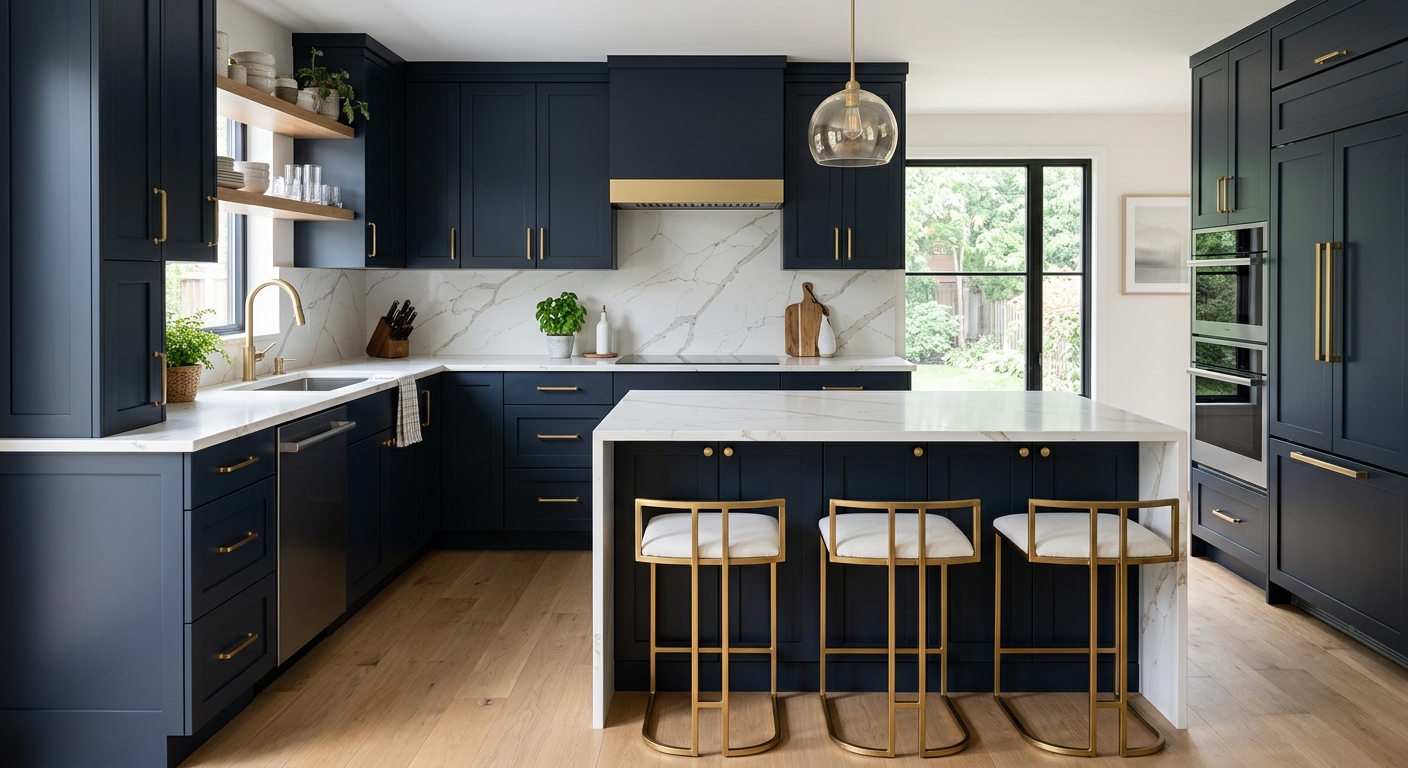
Kitchen renovation costs in Lititz — 2026
In Lititz, kitchen renovation pricing tracks directly with how homeowners use their space and how old their house really is. With a median household income of $80,533 and a homeownership rate of 69.4% (U.S. Census Bureau, ACS 2024), most kitchen makeovers here are for people planning to stay, not quick flips. The real drivers of budget are hidden in the walls: many homes around Lititz and neighboring Manheim Township went up in the post-World War II building boom, so you’ll see a lot of sturdy but closed-off, mid-century layouts begging for a wall to come down—or, in 1990s homes, just a tired look needing fresh cabinets and tops. That construction era determines whether you’re approaching a full gut with layout changes or a finish-level refresh.
The most common way Lititz kitchens blow their budget is by starting with a “cabinet replacement” price, then ending up with “gut-plus-layout-change” by moving the sink or knocking out a wall. Each major decision—new appliance locations, changing lighting, re-routing gas—bumps you up a price tier. Staying in the original layout, versus moving everything, changes both cost and required permits.
| Scope |
What's included |
Duration |
Price range |
| Full gut remodel, same layout |
cabinets, counters, appliances, flooring, lighting, fixtures |
6–10 weeks |
$30,000–$120,000 |
| Gut plus layout change |
all of the above plus moved plumbing, electrical, walls |
10–16 weeks |
$65,000–$120,000 |
| Cabinet replacement (stock to semi-custom) |
remove and install cabinets, hardware, patching |
1–3 weeks |
$7,000–$30,000 |
| Cabinet refacing |
new doors and drawer fronts, veneer, hardware |
3–6 days |
$7,000–$20,000 |
| Countertop replacement only |
template, fabricate, install, reconnect sink |
1–3 weeks |
$4,000–$16,000 |
| Kitchen flooring only |
remove existing, install new flooring |
3–6 days |
$5,000–$20,000 |
Estimates for a typical Lititz kitchen. Cabinet grade and whether the layout changes move these figures more than square footage.
Why appliance selection comes first
The number-one sequencing trap in kitchen remodels—especially in homes around Lititz—is picking cabinets before appliances. Cabinet design is dictated by appliance dimensions. If you don’t lock in your fridge, range, and dishwasher choices before ordering cabinets, you set yourself up for last-minute headaches and expensive adjustments: a range that doesn’t fit, a refrigerator that sticks out, or doors that hit oven handles.
Standard refrigerators are almost always deeper than modern counters, so if you want a counter-depth look, plan for it early—your cabinet layout and even pantry locations depend on this choice. Slide-in ranges need a tight cut-out and no backsplash behind them, while freestanding ranges are more forgiving. Switching from gas to induction means running a new dedicated 240V line; sticking with gas limits your options if there’s only one run to that part of the kitchen. Panel-ready dishwashers can disappear into cabinet runs but require different panel sizing than stainless fronts. When it comes to range hoods, venting to the outside is always best, especially in the local climate, while recirculating hoods filter but do not actually remove humidity, smoke, or cooking smells—a real compromise in older Lititz kitchens that might still have recircs or no hood at all.
Professional-grade appliances offer power, some durability improvements, and a visual “wow,” but the premium is mostly in aesthetics and brand prestige rather than a measurable leap in function for most households. Keep in mind: on higher-end models, appliance lead times can now exceed the wait for cabinets, so order early or be prepared to anchor your schedule around delivery dates.
Quartz, granite, laminate or butcher block
For a Lititz homeowner, the real test of countertop material isn’t just how it looks, but how it holds up to daily life—cooking, hot pans, spills, dropped mugs, and scrubbing. Quartz counters are engineered stone, highly consistent with zero maintenance for sealing, but they can be damaged by direct high heat, like a pan off the stove. Granite is natural, heat-tolerant, and each slab is unique, but it needs resealing every year or two to stay stain-resistant. Laminate remains a practical, budget-friendly option: the modern versions are far more durable and attractive than their reputation suggests, resisting stains, looking convincing, and fine for many rental or modest kitchens. Butcher block brings a warm, welcoming vibe to a kitchen but needs regular oiling, isn’t thrilled by water, and will show every chop and stain—good in a cottage, not so much as a main run.
Solid surface counters (like Corian) occupy a middle ground: they’re seamless, warm to the touch, and can be sanded and repaired after scratches or burns. The fabrication side can swing your budget: standard vs. complex edge profiles, number of seams (dictated by slab size and kitchen shape), sink and cooktop cutouts, backsplashes, and whether your counter needs templating by skilled fabricators or is just measured from diagrams. Templating means a custom-fit that works around your kitchen’s real-life quirks.
Don’t overspend on stone if you’re renting out or refreshing an affordable Lititz house. Laminate isn’t a compromise in a modest kitchen—it’s common sense.
Living through a kitchen renovation
No spreadsheet prepares you for the daily grind of being without your kitchen for weeks. Lititz families who remodel often set up a temporary kitchen in a basement, dining room, or garage—wherever a GFCI outlet and a folding table will fit. The fridge migrates nearby; a microwave and kettle cover basic meals. Washing up happens in a laundry tub or bathroom sink, not ideal but workable for a short stretch. Disposable plates and flatware are more than convenience—they’re a coping strategy when dishwashing is a struggle.
What routinely surprises people is just how much dust and noise a kitchen project makes. Good contractors zip off the work zone with plastic walls and tape, but even so, fine dust finds a way into nearby rooms. Plan for air filters, frequent vacuuming, and keeping bedroom doors closed. Expect crews to stage materials in the driveway or garage, which means parking somewhere else for a time. Demolition and deliveries require that the main door is open a lot longer than you’d think, which is a hazard for pets.
Move out? For most in Lititz, it’s rare—unless you’re doing a full gut remodel in winter or have very young kids. The food bill climbs: buying takeout or ready-to-eat food for even four weeks often outpaces what you’d spend picking out new flooring, so be realistic about that soft cost when planning.
Renovating to live in versus renovating to sell
For most Lititz homeowners, pouring money into a dream kitchen makes sense only if you’ll actually enjoy it. Renovating specifically to sell is almost a separate strategy: fresh, neutral finishes and a moderate investment get houses sold faster but rarely deliver a dollar-for-dollar return. A mid-range project—new surfaces, modest updates, no moving of gas lines or walls—recovers a much larger share of its cost than any high-end gut remodel, especially when the neighborhood’s median household income is $80,533 (U.S. Census Bureau, ACS 2024). A kitchen that’s dramatically better than those around it might get attention, but buyers don’t usually pay an extra $50,000 for features they didn’t request, especially when most homes here fall in the mid-market band.
If you’re planning to stay and cook every day—pick the finishes and appliances you actually want! In that case, resale value should not be your guide. But if you think you might move within a few years, resist the upgrades that push you beyond the local standard: neutral cabinets, a practical layout, and solid surfaces please the most buyers. Over-improving for the area is the most common pitfall in Lititz and every surrounding township. Remember, renovation helps a house sell; it rarely pays for itself fully after closing costs and moving fees are factored in.
Permits and inspections for a Lititz kitchen
In Lititz and the surrounding Lancaster County townships, whether you need a permit for your kitchen project comes down to what you are actually changing. Cosmetic work—paint, new cabinet doors, refacing, counters (if you’re not moving the sink), and installing new pulls—rarely needs a permit. If your renovation involves structural work, new or moved plumbing, or new electrical circuits, a permit is required. In Lancaster city, any kitchen remodel that moves a wall, adds plumbing, or runs new electrical lines must file for a building permit and will likely go through formal plan review. For townships near Lititz, swapping out cabinets in the same location can typically be done without permits, but moving a sink or adding recessed lights in new locations will require municipal involvement.
Inspections are performed either by the municipality itself or by certified third-party agencies—Lancaster city and area townships often use agencies like Middle Department Inspection Agency for electrical work, which surprises some homeowners expecting a city official instead. All kitchen contractors on jobs over $500 must hold a Home Improvement Contractor (HIC) registration from the Pennsylvania Office of Attorney General—this can be checked publicly at hic.attorneygeneral.gov. For employers, workers' compensation is mandatory and can be verified in the state’s WCAIS system (wcais.pa.gov).
Do not skip permitting: unpermitted work can delay or derail a sale when buyers’ attorneys check municipal records, or force you to open finished walls for a belated inspection. For any kitchen upgrade that’s more than skin-deep, that resale risk isn’t worth saving a permit fee.
Comparing kitchen renovation bids in Lititz
In Lititz, reviewing kitchen bids isn’t about finding the lowest number—it’s about understanding what’s missing and what’s assumed. The common pitfall is allowances: placeholder figures for appliances, flooring, or tile when exact selections aren’t locked in. One contractor might plug in a $900 range allowance, another just $300, which means two “equal” totals can end up thousands apart when you actually pick your finishes. Always compare the allowances first; a low overall bid may rely on minimal projected costs that become higher change orders once selections are made.
Next, look for real detail: is a specific cabinet brand, series, and construction method listed, or just “quality cabinets?” Are countertop material, edge style, and thickness spelled out? For electrical and plumbing, does it list exactly what’s being added (number of new circuits, outlets, and GFCIs), or is it vague (“as needed”)? Change orders should be in writing and require homeowner approval before work continues—verbal approvals mean you’re flying blind. Payment schedules should be tied to work milestones with modest upfront deposits, not heavily front-loaded; and at each payout, you should get lien waivers from subcontractors so nobody can make a claim on your property later.
By Pennsylvania’s Home Improvement Consumer Protection Act (HICPA), written contracts are mandatory over $500 and every homeowner has a 3-business-day right to cancel. Ignore any bid that doesn’t reference these.
| Line item |
What to look for |
Red flag if… |
| Allowances |
realistic amounts, itemised |
round numbers with no basis |
| Cabinetry |
brand, line, box construction |
'quality cabinets' |
| Countertops |
material, thickness, edge, seams |
material name only |
| Electrical |
circuits to be added, GFCI scope |
'as needed' |
| Unforeseen conditions |
how they are priced and approved |
not addressed |
| Change orders |
written approval before work |
verbal |
| Payment |
milestone-based, modest deposit |
front-loaded |
| Lien waivers |
from subs at each payment |
not offered |
Frequently asked questions — kitchen renovation in Lititz
What is an allowance in a renovation quote?
An allowance in a kitchen renovation quote is a budget placeholder for an item not yet specified, like the price for a backsplash tile, appliances, or cabinet hardware. Suppose your contractor lists a $3,000 allowance for appliances: if you select a fridge, range, and dishwasher totaling $4,200, you’ll owe the difference. In Lititz, allowances matter more than anywhere with established housing—many older homes throw unexpected surprises once demo starts, so contractors use allowances to give flexibility before selections are final. Always check if the numbers are realistic for Lititz’s price bands, rather than just round placeholders. It’s common for bids for the “same job” to swing thousands based on which allowances are tight and which are generous. Always clarify every allowance before signing.
What should I expect in a pre-1980 Lititz kitchen?
In Lititz, about 72.5% of homes were built before 1980, so old-school layouts and aging systems are the norm (U.S. Census Bureau, ACS 2024). Many of these kitchens have small footprints—often galley or U-shaped—and lack modern lighting, ventilation, or open sight lines. Expect to find original wiring, limited electrical circuits, and possibly lead paint if built before 1978 (the federal EPA Lead RRP Rule applies). Plumbing upgrades are frequently needed, and it’s rare that you can upgrade these spaces for less than $30,000–$120,000 for a full gut remodel. Walls may need to come down to achieve an open concept, which usually means permits and plan review. Always budget for surprises behind walls in older Lititz houses.
What are cabinet lead times in Lititz right now?
In 2026, cabinet lead times in Lititz run from about three weeks for basic stock to over twelve weeks for semi-custom or painted cabinets. The tight finish-trade labor market in Lancaster County tends to add a couple of weeks to actual project starts beyond what suppliers quote. An average project with removal and replacement of semi-custom cabinets (costing $7,000–$30,000) might see a seven to ten week lag from order to installation. If you need rare colors or unusual configurations, order as early as possible to avoid holding up the rest of your schedule—builders around here have no magic wand for fast-tracking missing cabinets.
What countertop material is best for a family kitchen?
For family life in a Lititz kitchen, the best fit is often quartz: it’s non-porous, shrugs off stains, and handles kids’ messes. However, don’t put a hot pan from the range on quartz—thermal shock can crack it. Granite is more heat-tolerant but needs routine sealing and is less forgiving with stains if neglected. Butcher block is beautiful and warm, but easily scratched and stained (don’t pick it for heavy-use zones). Laminate has improved dramatically and is a fine choice for moderate budgets, especially if installed professionally. Expect to pay between $4,000–$16,000 for a countertop replacement, depending on the material. Only pay for what your daily life really requires—quartz is overkill in most tenant-occupied properties but holds up wonderfully in busy owner-occupied family spaces.
What is the cheapest way to update a Lititz kitchen?
If you want to refresh your Lititz kitchen without gutting it, start with cosmetic updates: paint cabinets, change out hardware, and replace counters if budget permits. Cabinet refacing can dramatically change the look without the expense of full replacement, coming in at $7,000–$20,000 depending on scope. Laminate counters are affordable, and painting, plus a new sink or faucet, often does more for the room than new cabinets. Flooring can also change the feel for less than a full renovation, with new vinyl or tile options starting around $5,000. Save your big tickets for real functional improvements—and don’t move plumbing or walls unless you have a strong reason.
How do I verify a kitchen contractor in Pennsylvania?
In Pennsylvania, any kitchen contractor working on jobs over $500 must hold a Home Improvement Contractor (HIC) registration, issued by the Office of Attorney General. You can verify this at hic.attorneygeneral.gov in under a minute—never sign a deal with anyone who dodges this. If the contractor employs their own staff (instead of just subs), they must also carry workers’ compensation insurance, which you can check via WCAIS (wcais.pa.gov). Check references from recent Lititz or Lancaster County jobs, and make sure your written contract addresses the Home Improvement Consumer Protection Act’s requirements, including your three-day right of cancellation.
Should I renovate before selling or let the buyer do it?
In Lititz, most homes benefit from some kitchen update before sale, even if it’s only cosmetic. Buyers react well to fresh paint, new counters, or updated flooring. However, a full gut renovation costing $30,000–$120,000 is rarely recovered at closing, especially as the local median income is $80,533 (U.S. Census Bureau, ACS 2024). For houses sitting at the top end of the market or in original 1950s condition, minor improvements pay off better than doing everything. If the existing kitchen is severely outdated or nonfunctional, at least do a modest upgrade to make it livable—don’t gamble on buyers visualizing their own dream if the space feels dirty or broken. Let the buyer decide on major layout changes and higher-end finishes.
What does a quartz countertop cost in Lititz?
For an average Lititz kitchen, expect a quartz countertop replacement to fall in the $4,000–$16,000 range, with most jobs coming in around $9,000. That price covers removal of existing counters, templating (a critical custom fit step), fabrication, and installation, including basic cutouts for sinks and cooktops. Edge details, extra cutouts, and splashbacks will adjust the final bill. Quartz fabricators in Lancaster County typically have access to major brands, so price changes are more a function of the edge and slab than the zip code. Always get the color and edge profile quoted in writing, as upgrades add up quickly.
What is a realistic contingency for a Lititz kitchen?
Every Lititz kitchen project should include a contingency—money set aside for the surprises that appear once walls or cabinets are opened, especially in older homes. For most projects, five to fifteen percent of the contract sum is realistic. On your typical gut remodel costing $65,000, set aside at least $3,000–$10,000 for contingencies. Common surprises include outdated or unsafe wiring, hidden water damage, or venting problems. In post-WWII houses, unforeseen conditions are almost a given, so don’t stretch your budget so tightly that an extra thousand derails the whole project.