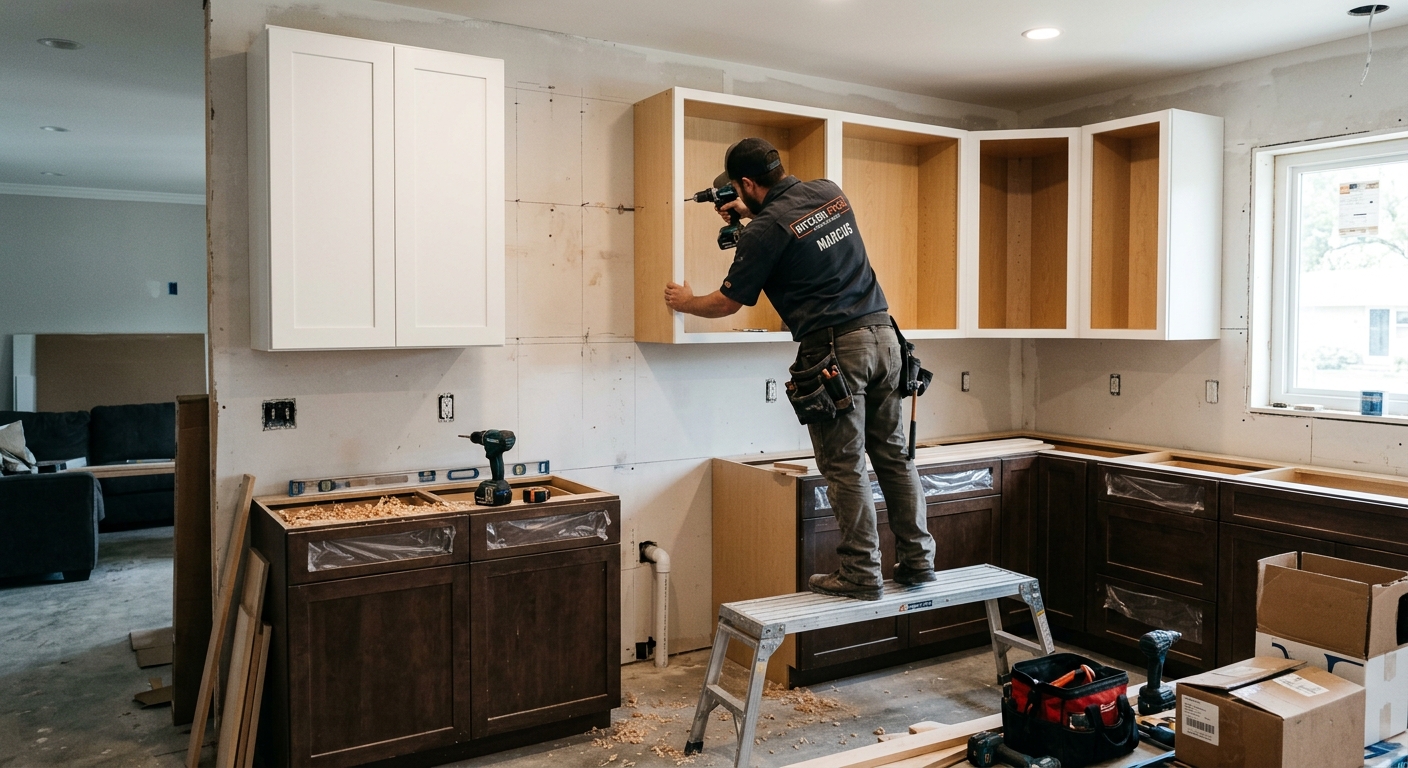
Kitchen renovation costs in Adams — 2026
Adams, as part of Cambria County, sits in a market where homeowner decisions are shaped by real factors: a homeownership rate of 88.6% means most are fixing up houses they plan to keep, and a median household income of $70,980 puts a rational bracket on what’s practical for resale or a long-term upgrade (U.S. Census Bureau, ACS 2024). Kitchen projects here run the gamut—from replacing tired surfaces in modest mid-century homes, to gutting and reconfiguring the chopped-up, 1900s–1940s kitchens common in nearby Johnstown and Westmont. These older layouts often force tough decisions about moving walls, relocating plumbing, or accepting small spaces.
The most common source of blown budgets is pricing out a mid-range update, then adding layout moves or high-end finishes after the fact. Clear up your scope early to avoid this pitfall. Durations are longer in Adams than in urban markets due to limited trade availability, and travel surcharges are common when pulling from Johnstown–Ebensburg–Richland.
| Scope |
What's included |
Duration |
Price range |
| Full gut remodel, same layout |
cabinets, counters, appliances, flooring, lighting, fixtures |
6–10 weeks |
$29,000–$116,500 |
| Gut plus layout change |
all of the above plus moved plumbing, electrical, walls |
10–16 weeks |
$63,000–$116,500 |
| Cabinet replacement (stock to semi-custom) |
remove and install cabinets, hardware, patching |
1–3 weeks |
$6,800–$29,000 |
| Cabinet refacing |
new doors and drawer fronts, veneer, hardware |
3–6 days |
$6,800–$19,500 |
| Countertop replacement only |
template, fabricate, install, reconnect sink |
1–3 weeks |
$3,900–$15,500 |
| Kitchen flooring only |
remove existing, install new flooring |
3–6 days |
$4,800–$19,500 |
Estimates for a typical Adams kitchen. Cabinet grade and whether the layout changes move these figures more than square footage.
Resale value and kitchen spending
Renovating a kitchen in Adams almost always helps a house sell, but it very rarely returns every dollar put in—especially if you go beyond what the local market supports. With a median household income of $70,980, there’s a real ceiling on what buyers will pay, and spending far above that curve is money you’re unlikely to get back when selling (U.S. Census Bureau, ACS 2024).
If you’re renovating to list the house, your best bet is a mid-range refresh: neutral finishes, modest appliances, and don’t move walls unless the kitchen is truly dysfunctional. In older Johnstown and Westmont homes, where the kitchen is often small and boxed in, even a smart cosmetic update can make a big difference to buyers hunting for a move-in-ready space. High-end upgrades rarely pay off unless matched to the very top of the local housing market—or if you’re planning to live there long enough to enjoy them yourself.
Renovating for yourself is a different project. Spend where it matters for your daily use—on layout, storage, and quality hardware—and ignore resale concerns. The moment you start choosing bold colors or specialty features, do it for your own satisfaction, not investment. In Adams, over-improving a typical kitchen with a $100,000+ gut remodel won’t return the difference come resale. But a clean, practical redesign around $29,000–$63,000 is almost always money well spent for both living and future marketing.
General contractor, kitchen firm, or manage it yourself?
How you structure the job matters more than the countertop you pick. In Adams, your main choices are: kitchen design-build firms, general contractors, or overseeing every trade yourself. Each model shapes cost, timeline, and stress.
A kitchen firm (design-build) handles the design, sources cabinetry, schedules the work, and acts as one point of contact. This is your highest-cost, lowest-effort option. It’s the surest route if you want minimal disruption or have a job where cabinetry, counters, and layout must all mesh without a hitch. You pay more, but the hassle is contained.
A general contractor lands in the middle. They hire and schedule the plumber, electrician, cabinet installer, and coordinate with your cabinet supplier (or your kitchen designer if you have one). Your main involvement is in approving choices and handling any design decisions.
Managing the job yourself seems cheaper, but in Adams, where “finish-trade labor” is already thin and slow to schedule outside the Altoona metro area, delays and finger-pointing can snowball. Hire separately, and every bit of failed scheduling or miscommunication lands on you. Unless you have time to meet deliveries, follow up with sub-trades, and fix mistakes, it’s more risk than savings—especially if your scope triggers permits or code inspections that need proper documentation.
For most Adams homeowners, self-managing is best left to those who are either in construction or have a flexible schedule and know Adams trades well. Otherwise, hire experience for a smooth result.
Choosing a countertop for a Adams kitchen
Countertop choice comes down to daily use and what you want to avoid—stains, chips, repairs, or routine sealing. Quartz has become the go-to for many Adams kitchens: it’s engineered, non-porous, handles spills and casual neglect well, but will scorch if you set down a hot pan. Granite is natural, unique, and handles heat better—but needs periodic sealing and can stain if neglected. It also has visible seams in most kitchens unless you are ordering jumbo slabs.
Laminate is not what it was in the 1970s; today’s options are hard-wearing, come in realistic stone looks, and cost far less than stone. For rentals or modest kitchens, laminate is a smart, unpretentious pick—hard to damage, easy to replace, and not a compromise in a $6,800–$15,500 kitchen scope.
Butcher block brings warmth and is easy to refinish or spot-repair, but it’s a commitment: water and maintenance are constant issues, and it will darken and mark over time. Solid surface (like Corian) lands between quartz and laminate. It can be repaired after the fact, and seams are nearly invisible, which helps in the odd-sized kitchens typical of older Adams homes.
Fabrication costs are shaped more by edge profiles, sink or cooktop cutouts, and the number/location of seams than by square footage alone. Most stone installers, even in rural Adams, will template (create an exact pattern) before cutting—worth the time so your tops actually fit the crooked walls common to the area.
Cabinets: reface, stock, semi-custom or custom
Cabinet choice is the item that sets the entire budget. Refacing is excellent when boxes are square, solid, and the layout works—the installer swaps doors, drawer fronts, and applies new veneer, turning tired cabinets into something presentable for much less money. But if boxes are cheap, warped, or you want to move walls or add storage, refacing is not a solution.
Stock cabinets come in fixed sizes. In the 1900–1940s houses that dominate Johnstown, Westmont, and Adams, room dimensions are rarely standard. Installing stock often means lots of filler strips, uneven reveals, and compromises on finish. Semi-custom lets you adjust depth, height, and finish—a necessity when walls aren’t square or you want features impossible with stock. Custom is a local carpenter building just for your space, at a cost and lead time to match.
Beyond type, quality matters. Plywood boxes last longer and hold hardware better than particleboard. Dovetail drawers and full-extension, soft-close slides add to both durability and comfort. Frameless construction maximizes storage in small spaces; face-frame holds up better in high-use households. In Adams, older homes with non-standard sizes nearly always steer toward semi-custom, even when owners hoped to save with stock.
| Option |
Cost |
Best when |
Limitation |
| Painting existing cabinets |
$1,200–$3,500 |
boxes and doors sound, tight budget |
no layout or style change |
| Refacing |
$6,800–$19,500 |
boxes square and layout works |
storage unchanged |
| Stock cabinets |
$6,800–$29,000 |
standard dimensions fit |
filler strips, limited finishes |
| Semi-custom |
$19,500–$29,000 |
non-standard walls or finishes |
6–12 week lead time |
| Full custom |
$19,500–$29,000 |
unusual layout or high-end design |
longest lead, highest cost |
Where the money actually goes
Most Adams homeowners are surprised how much of their kitchen budget goes to cabinetry and labor. Cabinetry alone is often 25–35% of a full remodel budget—so in a $63,000 renovation, that’s $15,750–$22,050. Labor is the next largest line, and it rises quickly if you change layout: demo, framing, drywall, plumbing, and wiring all add up, especially as Adams has a thinner, often slower trade market.
Countertops, appliances, flooring, lighting, and plumbing follow. Appliance costs swing the most: you can spend $3,000 for decent basics or triple that for pro-style brands, which rarely make sense in a kitchen finished with stock cabinets. Lighting and electrical often run high in older homes needing new circuits.
Areas most commonly neglected: contingency for what’s uncovered behind the walls (old plumbing, wiring, structure issues) and the soft costs—permits, design, delivery, disposal. Don’t remove these lines. An extra $1,000 is far better spent upgrading drawer hardware or lighting than buying a higher-end range for lower-end cabinets.
| Category |
Share of budget |
Notes |
| Cabinetry |
25–35% |
the largest line and the longest lead time |
| Labour and installation |
20–30% |
rises sharply if the layout changes |
| Countertops |
8–15% |
material choice drives the swing |
| Appliances |
10–20% |
widest range of any category |
| Flooring |
5–10% |
|
| Lighting and electrical |
5–10% |
higher in older homes needing circuits |
| Plumbing and fixtures |
4–8% |
|
| Permits, design, disposal |
3–6% |
usually forgotten in early budgets |
| Contingency |
10–15% |
not optional in a pre-1980 house |
Permits and inspections for a Adams kitchen
In Adams and the surrounding Cambria County municipalities, cosmetic kitchen updates—like painting, swapping hardware, or refacing cabinets—do not typically require a permit. Simple countertop replacements done without touching plumbing or electrical also stay permit-free. However, once you move or add plumbing, run new electrical circuits, or make layout changes involving framing or walls, a permit is typically required. The City of Johnstown, for example, requires a building permit for moving kitchen plumbing or electrical circuits, and a formal plan review if you're making structural changes in a full-gut remodel.
Electrical inspections in this county are commonly performed by third-party agencies such as Middle Department Inspection Agency, not the municipality itself. This can add a bit to the scheduling and costs, and sometimes surprises first-time renovators.
Contractors working in Adams must be registered as Home Improvement Contractors (HIC) with the Pennsylvania Office of Attorney General for any work over $500—a status you can verify at hic.attorneygeneral.gov. Any contractor with employees must carry workers’ compensation insurance, verifiable through WCAIS (wcais.pa.gov). Skipping a permit or hiring an unregistered contractor can come back to bite you badly at resale. Unpermitted work often surfaces in title searches or insurance reviews—even if it looks fine, fixing it later can be far costlier than getting it permitted from the start.
Frequently asked questions — kitchen renovation in Adams
Does replacing cabinets require a permit?
In Adams, simply replacing cabinets—where you pull out the old ones and install new units in the exact same locations—typically does not require a permit if you are not touching electrical, plumbing, or layout. This is especially common in Richland Township, where cabinet replacement without structural, plumbing, or electrical changes is routinely done permit-free. However, the moment you plan to move outlets, rework lighting, or adjust plumbing, permitting requirements kick in. In the City of Johnstown, for example, a building permit is required if you move kitchen plumbing or run new electrical circuits. To avoid issues at resale, always clarify with your local code office before the job begins. Cabinet replacement costs for most Adams homeowners fall into the $6,800–$29,000 range, depending on what you pick for finish and layout.
How long does a kitchen renovation take in Adams?
A full gut remodel in Adams usually takes 6 to 10 weeks if the layout stays put—longer if you’re moving walls or waiting for semi-custom cabinets. If you’re hiring local trades through a general contractor or kitchen firm, expect it to be slower than bigger markets: finish-trade labor in Cambria County is thinner and often booked far out. Add to this travel surcharges for anything complex, and delays are common, particularly if inspections require coordination with outside agencies. If you’re just doing countertop or flooring replacement, you can be looking at 3 days to 3 weeks. The price for a full gut remodel with the same layout ranges from $29,000–$116,500, with timelines tied closely to that complexity.
Is induction worth it over gas?
Induction cooktops have become popular around Pennsylvania for their speed, safety, and energy efficiency. In Adams, where winter utility rates and a long heating season can nudge people toward energy-conscious upgrades, induction is worth considering seriously. They are fast, safer with kids or older adults, and don’t add heat to the kitchen like gas. However, induction ranges do come at a higher upfront cost and may require an electrical circuit upgrade—especially in pre-1980 kitchens. If you’re budgeting for a full gut remodel (in the $29,000–$116,500 range), adding the cost of induction is a modest fraction, especially if your wiring is already being updated. For minor renovations, consider whether the upgrade justifies running a new circuit.
How much more does moving the sink and range cost?
Moving key fixtures like the sink or range means relocating plumbing, gas, and electrical circuits and often opening up floors and walls—a luxurious step in a kitchen project. In Adams, this typically shifts a remodel into permit-required territory and adds both design complexity and inspection costs. Expect to add anywhere from $10,000–$30,000 on top of your renovation budget for even straightforward moves, pushing you solidly into the $63,000–$116,500 band. This is especially the case in older homes, where rerouting lines is rarely simple due to old materials and hidden surprises behind walls.
Are Adams kitchens typically small galley layouts?
Many Adams kitchens—especially those in Johnstown or Westmont built between 1900 and 1940—are indeed small and galley-style, sometimes cramped and lacking in modern flow. These layouts often have limited countertop space and are walled off from other rooms. That’s why so many kitchen remodels here include reconfiguring the footprint or removing a wall to create better sightlines and function. If you’re considering a full gut remodel, be realistic: bringing these spaces up to modern expectations is what often moves the price into the $63,000–$116,500 range. For those not ready to tackle walls and new plumbing, a surface refresh or cabinet refacing is a practical step.
Is a cosmetic refresh enough or do I need a gut remodel?
In Adams, whether a cosmetic update or a full gut is “enough” depends on your goals and the state of your space. If the kitchen layout basically works, cabinets are solid but tired, and all mechanicals function, consider a cosmetic refresh: painting cabinets or re-facing, new counters, and flooring can turn a worn kitchen around for $3,900–$19,500. Older homes with chronic storage issues, awkward layouts, or decades-old wiring and plumbing often need the full gut treatment—and the price climbs accordingly. If you plan to stay long-term and want to fix daily frustrations, invest in layout and infrastructure. If you’re prepping to sell or simply want clean, updated finishes, start with the surfaces.
How should renovation payments be scheduled?
Adams homeowners are protected by Pennsylvania’s Home Improvement Consumer Protection Act, which requires a detailed, written contract for jobs over $500 and gives you a 3-day right of cancellation. Do not pay for more than the value of materials delivered or work completed at any point; good contractors in Adams typically ask for a deposit (10–30%), with further payments tied to milestones: after demolition, after cabinets are installed, and finally at completion. For projects in the $29,000–$63,000 range, splitting into three or four staged payments is fair for both sides. Never pay all up front, and always get receipts—protect yourself if there are delays or quality issues.
Which upgrades are not worth the money?
In Adams, spending on high-end appliances—like pro-style ranges or ultra-premium fridges—rarely returns value unless the overall kitchen is designed to match. It’s better to focus your budget on lasting, visible finishes: quality cabinets, counters, and storage. Waterfall countertops, specialty tile features, or elaborate lighting packages are easy places to overspend and rarely boost resale or daily function if the basics are lacking. For those working in the $6,800–$29,000 cabinet range, avoid allocating more than 15% to appliances or trendy finishes. Good layout, storage, and simple lighting matter more than flashy gadgets or ornamentation.
What does a quartz countertop cost in Adams?
In Adams, quartz countertop replacement—including template, fabrication, and installation—typically falls in the $3,900–$15,500 band. Most homeowners pay around $8,700 for an average Cambria County kitchen. Your price depends on the color and brand, edge profile, number of cutouts, and of course, the not-always-square walls found in older homes around Adams. Some local suppliers may add a premium for templating or for backsplashes. Remember also to budget for plumber reconnection of the sink if the countertop is replaced. For modest kitchens or rentals, don’t be afraid to consider laminate—it’s much more durable than old reputations might suggest and often lands under $6,800.