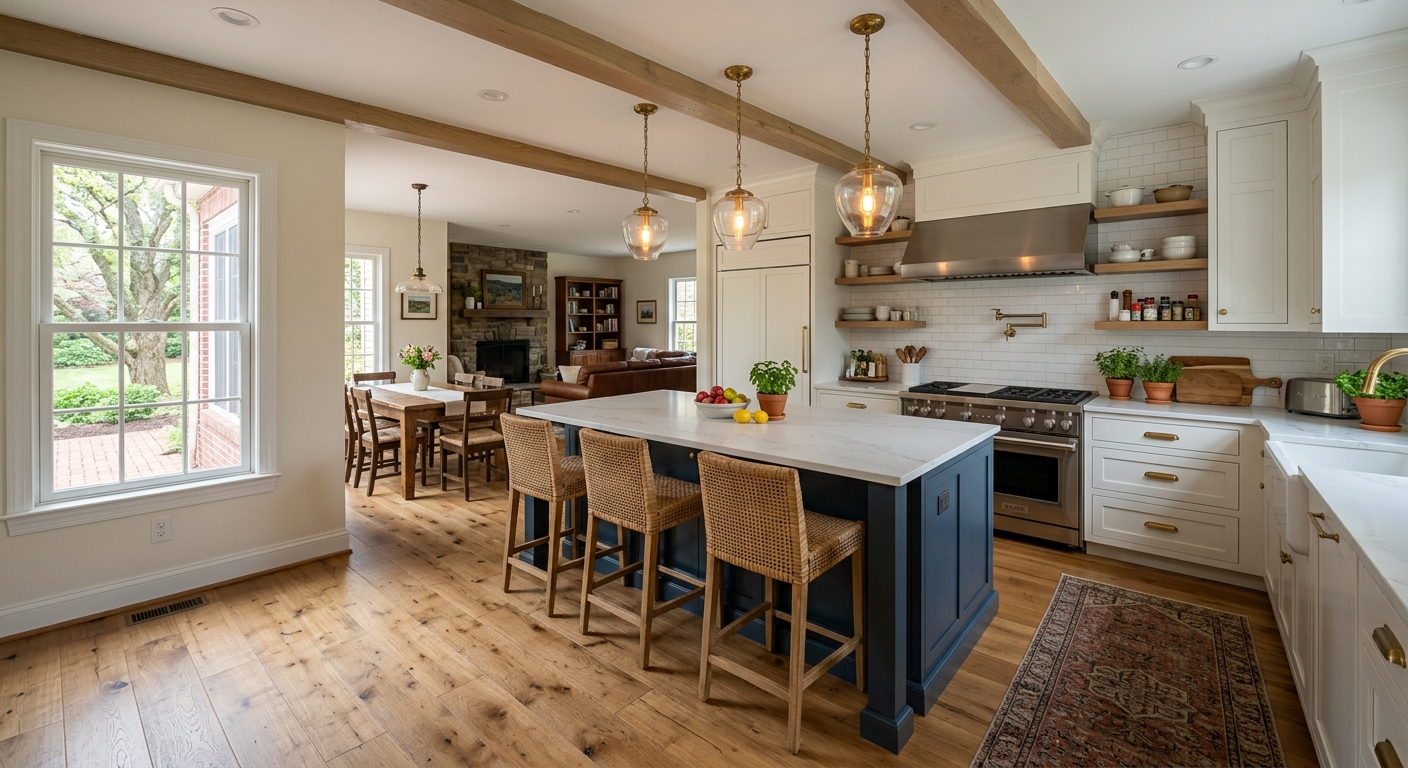
Reading kitchen renovation prices by scope — 2026
Reading stands apart in Berks County for the number of mid-century homes with compact kitchens—many unchanged since the original owners moved in. About 89.5% of local housing predates 1980 (U.S. Census Bureau, ACS 2024), and countless Reading kitchens are narrow 1950s or ’60s galley layouts. These homes often need much more than new cabinets: knocking down walls just to achieve modern function is common. Owners here face different calculations than landlords, since the homeownership rate (39.3%) and median household income ($42,852) shape what people actually spend. If you own your place in Reading, your kitchen likely hasn’t been redone in decades and sits on a smaller property value than surrounding regions, so it’s essential to match your budget to real needs—not to the neighbor’s renovation splurge.
Most blown kitchen budgets come from pricing out a pull-and-replace remodel, then falling for magazine layouts that demand new plumbing, wiring, or layout. Every extra move or spec shift lands you in a higher price class.
| Scope |
What's included |
Duration |
Price range |
| Full gut remodel, same layout |
cabinets, counters, appliances, flooring, lighting, fixtures |
6–10 weeks |
$29,000–$115,500 |
| Gut plus layout change |
all of the above plus moved plumbing, electrical, walls |
10–16 weeks |
$62,500–$115,500 |
| Cabinet replacement (stock to semi-custom) |
remove and install cabinets, hardware, patching |
1–3 weeks |
$6,700–$29,000 |
| Cabinet refacing |
new doors and drawer fronts, veneer, hardware |
3–6 days |
$6,700–$19,500 |
| Countertop replacement only |
template, fabricate, install, reconnect sink |
1–3 weeks |
$3,900–$15,500 |
| Kitchen flooring only |
remove existing, install new flooring |
3–6 days |
$4,800–$19,500 |
Estimates for a typical Reading kitchen. Cabinet grade and whether the layout changes move these figures more than square footage.
Why the electrical line grew
For most Reading homeowners, the biggest mid-project cost increase comes from electrical work—especially in the older homes common here. The Pennsylvania Uniform Construction Code (UCC), enforced locally in Reading by the Property Maintenance and Codes office, sets modern standards that kitchens must meet when remodeled. That means dedicated 20-amp small-appliance circuits, GFCI outlets by each countertop, no receptacle more than four feet apart, and separate circuits for dishwashers, disposals, and microwaves. If you want an electric range, you’ll need a 240-volt circuit—often absent from mid-century kitchens, where a single shared breaker ran all outlets and lights.
Most Berks County kitchens were built well before these standards—around 89.5% of homes were built pre-1980 (U.S. Census Bureau, ACS 2024). These kitchens usually have two-wire ungrounded circuits, no spare panel capacity, and sometimes even aluminum branch wiring. Once the walls are open, you cannot keep "grandfathered" wiring in a newly renovated kitchen: inspection will require the work to meet current code, and the cost is rarely in the initial estimate.
Bringing a Reading kitchen fully to electrical code usually adds $3,900–$8,700 to a gut remodel, especially if a new panel or rerouted service is needed. In late-1990s homes, the existing circuits may still be short of what modern kitchens are expected to have, so do not assume newer means ready without upgrades.
Living through a kitchen renovation
The first surprise in a Reading kitchen remodel is how much of your daily life centers on that room. Planning where to set up a temporary kitchen—often in the dining room or basement—is worth every minute ahead of the demo. Most people move the fridge into another room, clear a folding table for a microwave and coffee maker, and resign themselves to take-out or frozen meals. Washing up in a laundry or bathroom sink, eating on paper plates, and tracking the inevitable dust become the new normal.
Dust control is not cosmetic: without zip walls or taped plastic sheeting, demolition dust travels through even the best-kept Berks County house, settling into room corners and HVAC returns. The dumpster—yes, you’ll need one—usually sits in the driveway, and flooring deliveries or cabinets will claim your garage or porch for several weeks. Pets can’t always be contained, and the back door often stays open for hours each day during haul-out and installations.
Whether to move out during demolition week is an honest question—if you have young children or work from home, one solid week out might be cheaper than the stress. Realistically, eating out for eight weeks in Reading will rival or exceed your new flooring costs at $4,800–$19,500, so budget for that as part of living through the upgrade.
Surprises in an older Reading home
With Berks County's housing so heavily dominated by pre-1980 homes (89.5%, per U.S. Census Bureau, ACS 2024), Reading renovators uncover more "hidden" issues during demolition than in most places. Cabinet installation quickly gets complicated with out-of-plumb walls and uneven floors—correcting these with shims and custom cuts adds both labor and time. If your kitchen is still on old two-wire or undersized electrical, expect another $3,900–$8,700 to bring it to current standard. Plumbing surprises are very real: galvanized supply lines and cast iron drains may need partial or full replacement, and those are rarely included in the basic estimate.
It’s common to find exterior kitchen walls with no insulation at all, and for cast iron stack drains to be at the end of their useful life. Add to that previous “repairs” done without permits—unlicensed electrical taps or abandoned junction boxes are frequent in neighborhoods where kitchen layouts changed without municipal review. Disturbing painted surfaces in any pre-1978 Reading home triggers the federal EPA Lead RRP Rule: testing is required before work can start, and remediation or lead-safe practices can add days and hundreds to thousands of dollars, depending on findings. Likewise, if you discover 1960s/70s sheet flooring, possible asbestos means testing before removal.
Each one of these surprises means delays and added cost, usually paid out of the all-important contingency line discussed below.
How a Reading kitchen budget breaks down
If you’ve never done a full kitchen remodel before, seeing how the budget actually splits is a shock. Most Reading jobs, especially gut renovations in mid-century houses, follow a pattern: cabinetry is the biggest single cost, soaking up about a quarter to a third of the whole budget. Labor is the next monster—especially if you touch plumbing or electrical or move a wall, because those changes ripple into every other line. Countertops, appliances, and flooring are sizable but more controllable; lighting, fixtures, and plumbing typically round out the picture.
Two lines get overlooked by nearly everyone at first: contingency and soft costs. The contingency—at least 10% of your budget—pays for what’s uncovered behind the walls, from bad wiring to a floor that drops an inch corner-to-corner. Permits, design services, delivery charges, and disposal feel small, but they add up and cannot be skipped in Reading, where proper documentation matters at resale.
An extra thousand dollars is best spent on cabinet upgrades that you’ll touch every day, or slightly better lighting/electrical. It’s wasted on a pro-grade oven if your cabinets and counters are bargain stock.
| Category |
Share of budget |
Notes |
| Cabinetry |
25–35% |
the largest line and the longest lead time |
| Labour and installation |
20–30% |
rises sharply if the layout changes |
| Countertops |
8–15% |
material choice drives the swing |
| Appliances |
10–20% |
widest range of any category |
| Flooring |
5–10% |
|
| Lighting and electrical |
5–10% |
higher in older homes needing circuits |
| Plumbing and fixtures |
4–8% |
|
| Permits, design, disposal |
3–6% |
usually forgotten in early budgets |
| Contingency |
10–15% |
not optional in a pre-1980 house |
For a Reading gut-remodel median project (total $62,500), that puts cabinetry at $15,600–$21,900 alone.
When a Reading kitchen needs walls moved
There’s a sharp jump in cost and complexity the moment you decide to change your kitchen layout in Reading—especially if you need walls moved, plumbing or wiring relocated, or the “galley” destroyed. Leaving all utilities in place and replacing everything around them (cabinets, counters, appliances) keeps your project in the lower price class. The instant you relocate a sink, move a stove across the room, or remove a dividing wall, you’re in full “gut-plus-layout” territory, with costs that can double the budget.
Drain lines need to slope continuously, which can be a serious issue on a slab or over finished spaces. New or relocated electrical circuits mean you need available panel space—many older homes in Reading have undersized or near-capacity electrical panels, pushing another upgrade. Removing a wall isn’t just demolition: you have to determine if it’s load-bearing (that means hiring an engineer and detailed permitting), and venting a range hood from a new spot usually means cutting through brick, siding, or stucco. All of this work triggers municipal plan review in Reading and requires a permit before starting.
The honest advice: if your kitchen layout is cramped but functional, see if smarter cabinetry or opening an entryway is enough before moving everything. Relocating the core elements easily adds $20,000–$40,000 to a project and pushes your total remodel cost into the $62,500–$115,500 range.
What requires a permit in a kitchen renovation
In Reading, a permit is typically required for any interior kitchen project involving structural work, new or moved plumbing, or electrical changes. Common triggers include expanding the kitchen, opening or moving walls, swapping out appliances that need new breakers or gas lines, and installing or moving sinks, dishwashers, or major lighting. Cosmetic work—such as painting, re-tiling a backsplash, replacing cabinet doors or drawer fronts, or swapping out an existing countertop in exactly the same spot—does not usually require a permit in Reading or Spring Township if no layout, electrical, or plumbing changes are made.
When a permit is required in Reading, municipal plan review applies to most full remodels with wall, plumbing, or service changes. Final signoff requires passing code inspection. Electrical inspections, in Reading and neighboring Muhlenberg Township, are often handled by third-party agencies like Approved Code Services rather than city inspectors, which can catch off-guard anyone assuming only the city is involved.
Legally operating contractors must hold Home Improvement Contractor (HIC) registration from the Pennsylvania Office of Attorney General for contracts over $500. You can verify this at hic.attorneygeneral.gov. All employers are required to carry workers’ compensation insurance; homeowners should check via WCAIS (wcais.pa.gov). Soft costs like permits and disposal should be on your contract, which Pennsylvania law also mandates for any job over $500 (with a 3-day right of cancellation).
Unpermitted kitchen work is a recurring problem at resale in Reading—especially when a bank or home inspector spots new electrical or plumbing without supporting paperwork, which can delay or even scuttle the sale.
Frequently asked questions — kitchen renovation in Reading
What countertop material is best for a family kitchen?
For family kitchens in Reading, choose a countertop that stands up to heavy daily use and is easy to maintain. Quartz is a top pick in Berks County: it resists stains, doesn’t need sealing, and has no issue with young kids’ spills. Laminate is still common in older Reading homes due to its lower price, but scratches and burns quickly, especially under rough use. Granite is durable but does require sealing several times a year—something many busy families skip. Solid surfaces like Corian are softer and can scratch, but are easy to clean. For most Reading homeowners, a mid-range quartz installation comes in between $3,900–$15,500 depending on size and cutouts. Remember, in an area with so many mid-century kitchens still in service, durability and low effort for cleaning often matter more than high-end luxury looks.
Can I cancel a renovation contract in Pennsylvania?
Yes, if you sign a kitchen renovation contract with a Reading contractor, Pennsylvania’s Home Improvement Consumer Protection Act gives you three business days to cancel after signing, for any contract over $500. This “cooling-off” period is designed to protect homeowners under state law, regardless of what reason you give. The contractor must provide this cancellation information in writing when you sign. If you cancel in the proper window, you are entitled to a full return of any money paid upfront. It’s important to note that this rule applies throughout Reading, all of Berks County, and the rest of Pennsylvania for home renovations, including jobs with deposits in the $6,700–$29,000 range for cabinet replacement. Always check your contract for paperwork on this right—if it’s missing, the contractor isn’t compliant.
Is a cosmetic refresh enough or do I need a gut remodel?
In Reading, with so many homes built before 1980, the big difference comes down to what you’re trying to solve. If your cabinets are solid, appliances work, and there’s no history of wiring or plumbing issues, a cosmetic refresh—paint, new counters, maybe a faucet swap—can dramatically improve appearance at a fraction of the price of a gut remodel ($3,900–$19,500 vs. $29,000–$115,500). But if cabinet boxes are falling apart, outlets are in the wrong place, or the space just plain doesn’t work, a full gut may be the only way to address deeper problems. Lead paint, bad wiring, past water leaks, or lack of insulation—all common in Berks County—also tip the decision toward a gut. If in doubt, bring in a contractor for a quick inspection before making the call.
What adds the most resale value in a kitchen?
In Reading, the changes that add the most resale value are those that correct the house’s age-related shortcomings—functional layouts, solid cabinetry, and durable countertop materials. Buyers in Berks County look for updated electrical (with GFCIs), cabinets that aren’t at the end of their life, and counters with some pop—such as quartz or granite. High-end ranges or wine coolers rarely move the resale needle unless the rest of the kitchen is up to date. In most typical Reading neighborhoods, new cabinets and counters in the $6,700–$15,500 range deliver far more value than pro appliances, especially if the kitchen’s old galley layout was opened up a bit. Keep upgrades practical: solid midrange fixtures and modern lighting will do more for closing price than going ultra-custom.
Do older Reading homes need electrical upgrades for a kitchen?
Almost always, yes. With close to 89.5% of Reading homes built before 1980 (U.S. Census Bureau, ACS 2024), most kitchens are still on original wiring—often two-prong outlets, lacking grounding or GFCI protection. Current residential code enforced in Reading requires multiple dedicated 20-amp circuits, GFCIs near every sink, and enough outlets to serve all modern appliances. Simply swapping out a countertop or painting won’t trigger this, but once you open up walls or replace cabinets, an electrical upgrade is nearly always mandatory. For most older Reading homes, bringing the kitchen to code means planning for an added $3,900–$8,700 in the budget, sometimes more if the panel is full or obsolete.
Can I live in the house during a kitchen renovation?
Yes—most Reading homeowners do stay in their homes during a kitchen remodel, but you need to plan carefully. In a standard 6 to 10-week gut remodel ($29,000–$115,500), your kitchen will be torn up, noisy, and dusty. You’ll need to set up a temporary kitchen space somewhere else in the house (often the basement or dining room) for the duration. Pets and children may find the upheaval stressful, and exterior doors are often propped open for long stretches to move debris and materials. Many people eat out or rely on microwaves, so add those food costs to the overall project budget. If your family is particularly sensitive—young children, medical needs, work-from-home jobs—you may want to move out for the demolition week, but most Reading homeowners ride it out onsite.
Why are kitchen quotes in Reading so far apart?
Kitchen renovation quotes in Reading can cover a wide span for the same space. The biggest driver is scope—quotes for a cosmetic refresh and a true gut remodel ($3,900–$115,500) are apples and oranges. Labor in Berks County is tight, and some contractors build in wait-list premiums to guarantee their preferred crew. Material choices (from basic cabinets to custom everything) and hidden surprises (like out-of-level floors or old wiring) make estimating harder up front. Some quotes skip soft costs or contingency—then hit you with change orders mid-job. Always check in detail: what does the quote include, what’s missing, and what happens if they uncover surprises? In Reading, due diligence on the written scope and fine print always pays off.
How much do new kitchen cabinets cost in Reading?
In the Reading area, replacing kitchen cabinets with stock to semi-custom units typically costs between $6,700–$29,000, with most projects falling in the middle of that range. Cabinet quality, finish, and hardware options are the big spreaders here: tight galley kitchens can see the lower end, while larger kitchens or homeowners opting for semi-custom or high-end storage solutions land near the top. Lead times also matter—custom work can add weeks, especially with labor schedules in Berks County stretched thin. If you’re considering only refacing, your price may drop into the lower range. Always compare the cost of full replacement to refacing for your specific kitchen shape and cabinet condition, as sometimes the premium for all-new boxes over new doors is smaller than expected.
How long does a kitchen renovation take in Reading?
A full kitchen gut remodel in Reading runs 6 to 10 weeks if you keep the same layout, and as much as 16 weeks if you move walls or utilities, as is common in older Berks County homes. Cabinet replacement alone is usually 1 to 3 weeks, while a simple countertop or flooring swap can happen in a few days. Delays can stretch jobs, often because of finish-trade labor scheduling constraints in Reading and the surrounding townships. Inspections—particularly electrical, often performed by third-party agencies—can also add time, especially when multiple trades are involved. Pre-construction planning and timely permit applications help reduce downtime. Be ready for the full period spelled out in your contract, and ask your contractor for realistic weekly updates—not just the showroom estimate.