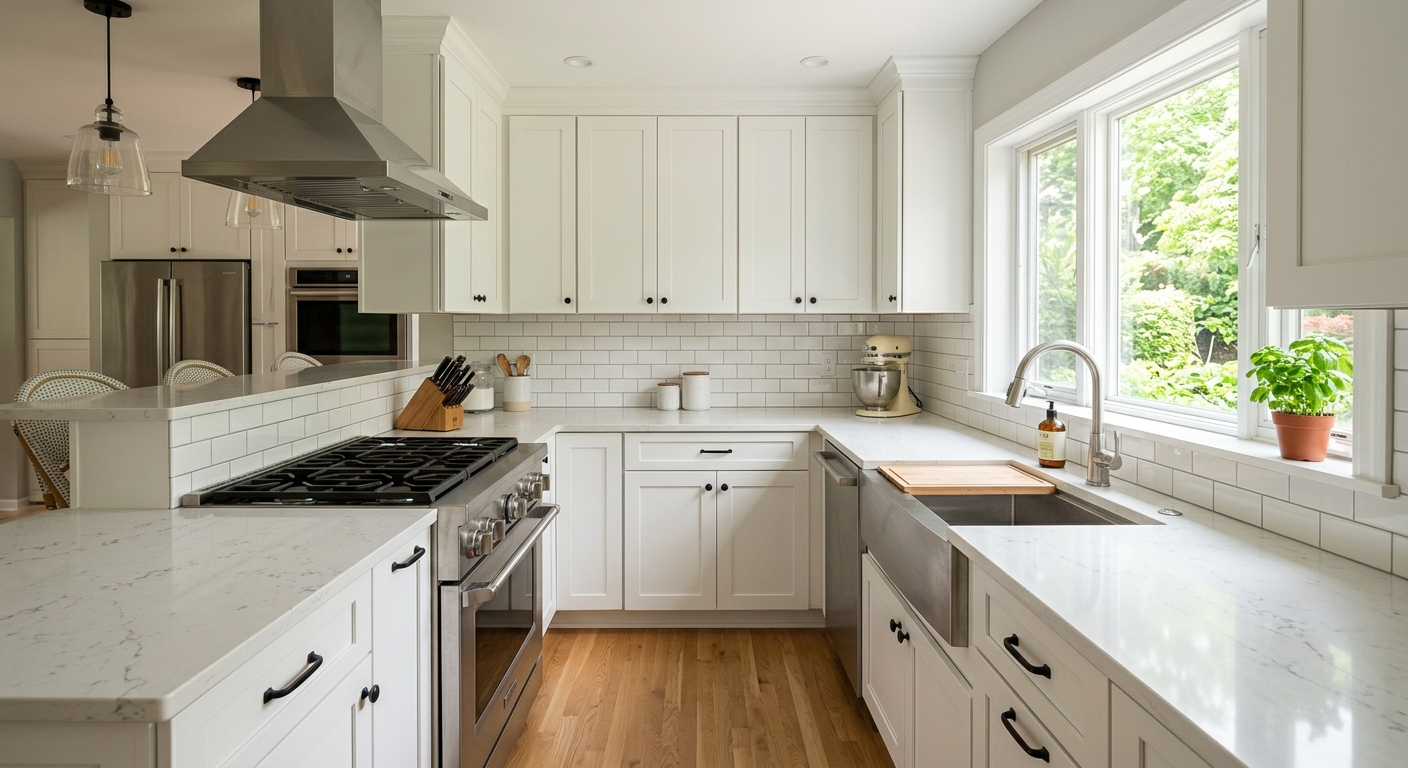
Kitchen renovation costs in Chestnuthill — 2026
Chestnuthill has a high homeownership rate and a median household income that supports renovation investments (U.S. Census Bureau, ACS 2024). This means homeowners often plan kitchen renovations not just for looks, but for durability and resale. A big factor in what your Chestnuthill kitchen will cost is the era of your home. Monroe County’s rapid 1990–2010 Pocono housing boom yields many builder-grade kitchens needing full-gut remodels today. If your home was built in that wave, you may be looking at materials and layouts designed for speed, not longevity. The most common surprise: finishes and boxes showing their age all at once.
The main reason kitchen budgets get blown is that homeowners (and even some contractors) initially price a low-scope update—like just replacing cabinets—then upgrade specs midstream, or discover they’re really doing a full layout change. That’s why scopes below are split out clearly: compare them before making selections. A “remodel” can mean five-figure or six-figure planning, depending on tier.
| Scope |
What's included |
Duration |
Price range |
| Full gut remodel, same layout |
cabinets, counters, appliances, flooring, lighting, fixtures |
6–10 weeks |
$30,500–$121,500 |
| Gut plus layout change |
all of the above plus moved plumbing, electrical, walls |
10–16 weeks |
$66,000–$121,500 |
| Cabinet replacement (stock to semi-custom) |
remove and install cabinets, hardware, patching |
1–3 weeks |
$7,100–$30,500 |
| Cabinet refacing |
new doors and drawer fronts, veneer, hardware |
3–6 days |
$7,100–$20,500 |
| Countertop replacement only |
template, fabricate, install, reconnect sink |
1–3 weeks |
$4,100–$16,000 |
| Kitchen flooring only |
remove existing, install new flooring |
3–6 days |
$5,100–$20,500 |
Estimates for a typical Chestnuthill kitchen. Cabinet grade and whether the layout changes move these figures more than square footage.
What requires a permit in a kitchen renovation
In Chestnuthill and the surrounding Monroe County townships, you usually do not need a building permit for basic cosmetic kitchen updates like paint, cabinet hardware swaps, refacing doors, or simply replacing countertops in the same location. However, as soon as you move any plumbing, run new electrical circuits, make structural changes, or sometimes even add mechanical ventilation (like a new range hood), the project will require a permit—most often with plan review if you’re changing the kitchen’s functional layout.
Code enforcement is handled at the township level in Monroe County, so your local office sets the requirements and performs inspections. Electrical, plumbing, and other specialty trades are municipally regulated. While Pennsylvania does not issue a statewide electrical or plumbing license, municipal code enforcement inspects completed work.
If your contract for kitchen work totals over $500, your contractor must have a Home Improvement Contractor (HIC) registration from the Pennsylvania Office of Attorney General. You can verify their registration at hic.attorneygeneral.gov. Any business with employees must maintain workers’ compensation insurance—proof can be checked through the WCAIS system at wcais.pa.gov.
Skipping permits can haunt you at resale. Unpermitted kitchen work is a leading reason a home sale falls apart during buyer inspection or title search. Permitted, inspected work protects both your wallet and your investment.
Quartz, granite, laminate or butcher block
Quartz, granite, laminate, and butcher block each bring tradeoffs that matter in a Chestnuthill kitchen, where temperature swings and family use challenge every surface. Quartz—engineered from stone and resin—is non-porous and resists stains, but direct hot pans can burn it. Granite is natural, highly heat-tolerant, but needs sealing every year or two in a busy kitchen here to prevent stains. Laminate is often underestimated: modern versions are durable, easy to clean, and forgiving on budget. They resist most stains, but scratching and delamination (at seams or edges) remain risks. Butcher block offers unmatched warmth, but needs regular oiling and is susceptible to staining, gouges, and water damage if not maintained.
Solid surface, like Corian, splits the difference: seams can be almost invisible and, if scratched or scorched, can often be refinished in place—something not possible with granite or quartz without disruption. When comparing quotes, know that price isn’t just about the surface material: edge profile, cutouts for sinks and cooktops, seam placement, and whether a company measures onsite with a physical template or just from plans can all push the number up or down.
In a modest Chestnuthill rental or builder-grade kitchen in need of a durable upgrade, new laminate can be absolutely appropriate. It’s not a compromise—just a reasonable fit for many homes and budgets. Durable, easy to live with, and much improved over older generations.
Allowances, exclusions and change orders
Allowances are the largest source of confusion—and disappointment—when comparing kitchen renovation quotes in Chestnuthill. An allowance means an item has not been specified yet, so the contractor uses a placeholder dollar amount: “$2,000 for tile,” for example. Two bids can look almost identical up front, but the one with unrealistic, round-number allowances will balloon in cost when you actually choose your products. Before you look at totals, compare the allowance lines in detail—if they’re lowball numbers, so is the bid.
Check that the contract names the exact cabinet brand and line, the thickness and type of countertops, and how electrical and plumbing are specified. If your house springs a surprise (like rotted subfloor or a pipe where a cabinet goes), how will that be priced and approved? Change orders—add-ons and unplanned shifts—should always require written approval before work continues, not just a verbal go-ahead. Your payment schedule should be tied to milestones (like completion of rough inspection or cabinet install) and start with a modest deposit, not a front-loaded sum.
HICPA, Pennsylvania’s Home Improvement Consumer Protection Act, requires a written contract for anything over $500 and protects you with a three-day right of cancellation. Always confirm that subs provide lien waivers at each payment—protecting you from hidden claims later.
| Line item |
What to look for |
Red flag if… |
| Allowances |
realistic amounts, itemised |
round numbers with no basis |
| Cabinetry |
brand, line, box construction |
'quality cabinets' |
| Countertops |
material, thickness, edge, seams |
material name only |
| Electrical |
circuits to be added, GFCI scope |
'as needed' |
| Unforeseen conditions |
how they are priced and approved |
not addressed |
| Change orders |
written approval before work |
verbal |
| Payment |
milestone-based, modest deposit |
front-loaded |
| Lien waivers |
from subs at each payment |
not offered |
Cosmetic, replacement, gut, or layout change?
“Kitchen remodel” in Chestnuthill means anything from a $5,000 spruce-up to a $100,000+ architectural overhaul. Here’s what those mean:
- Cosmetic refresh: You’re painting, changing hardware or a light, maybe a new backsplash, but cabinets and layout remain untouched. This is the quickest, safest option and rarely calls for permits.
- Pull and replace: Often called “replace in kind”—old cabinets and countertops come out, new ones go in their exact place. Flooring, lights, and paint may change, but plumbing and electrical stay put.
- Gut, same layout: Back to studs: full demo, update insulation or wiring if needed, new drywall, all finishes replaced—but layout and major service locations stay.
- Layout change: Sinks, stoves, or walls move. This is a different beast, requiring permits, inspections, planning, and sometimes engineering.
The tipping point in cost is when you cross from “gut, same layout” to “layout change.” Moving a sink or range is a leap: plumbing and electrical need rerouting, sometimes a new subpanel or HVAC venting. That means code review, municipal permit, and a different contractor pool.
The most useful decision for a Chestnuthill homeowner is picking which tier fits your needs and budget before calling a contractor. Until you settle the scope, a meaningful price is just not possible—or worth anyone’s time to guess.
Why the electrical line grew
A big reason Chestnuthill kitchen budgets jump halfway through a job is electrical work that’s bigger than expected. Modern code expects a kitchen to have at least two dedicated 20-amp small-appliance circuits, GFCI protection at all countertop outlets, spacing so no spot on a countertop is more than two feet from a plug, and separate circuits for the dishwasher, disposal, microwave, and any electric range (which needs a 240-volt line).
In Monroe County, 32.4% of homes were built before 1980, so you may find two-wire, ungrounded circuits or old panels with no room for expansion. Even homes from the late 1990s boom can have too few circuits by today’s standards, with more appliances than planners of the era anticipated. Once the walls are open, an inspector will require all new work to meet current code—this is not optional and not always covered in initial ballpark estimates.
Bringing an older kitchen up to modern electrical code—including circuits, GFCI, and necessary panel upgrades—typically adds $4,100–$16,000 to a full project, especially if more circuits or a subpanel is needed. It’s money well spent for safety, resale, and reliability.
What's behind the walls in a Chestnuthill kitchen
Much of Chestnuthill’s housing stock came in the 1990–2010 boom, but 32.4% of homes are pre-1980, so surprises are still common in a kitchen renovation. In the older group, demo often reveals out-of-plumb walls, which means time-consuming shimming for cabinets (can add $1,000–$4,100), and out-of-level floors, leading to extra subfloor prep. You’ll also run across undersized or ungrounded wiring ($2,000–$8,000 for full update), galvanized supply pipes (budget $1,500–$5,000 for replacement), cast iron drain lines, and sometimes no insulation on exterior walls—common in kitchen bump-outs.
Pre-1978 homes fall under the federal EPA Lead RRP Rule, requiring testing by a certified renovator before disturbing painted surfaces. If lead paint is found, safe work practices and cleanup are mandatory, adding time and cost. Asbestos tile or adhesive, common on old floors, also requires testing before removal.
In newer builder-grade homes, shortcuts often appear: aging particleboard cabinet boxes, minimal electrical circuits (as seen in many late ‘90s boom kitchens), and laminate counters wearing out all at once. These aren’t hazards, but they do make “replace everything” more common than repairs or upgrades, since piecemeal fixes aren’t cost-effective once the original materials reach expiration together.
Frequently asked questions — kitchen renovation in Chestnuthill
Is lead paint a concern in Chestnuthill kitchen renovations?
If your Chestnuthill home was built before 1978, then yes, lead paint may be present, especially on walls, trim, or older cabinets. Federal law requires any contractor working in these homes to be certified under the EPA Lead RRP Rule. Before any demolition or sanding in a pre-1978 kitchen, a certified renovator must test for lead paint. If it’s found, extra steps are required to contain dust and follow cleanup protocols. This adds both time and cost, but protects your family and the workers. If your home was built after 1980, this concern drops off, but always check your closing documents or township records if you’re unsure of your home's construction year. Safe handling is especially important if there are small children in the house. Expect costs for compliance to run into the low thousands, especially if lead must be removed during a $30,500–$121,500 gut remodel.
How long does a kitchen renovation take in Chestnuthill?
Timeline depends on scope. In Chestnuthill, a straightforward cabinet replacement usually takes 1–3 weeks from start to finish, including minor touch-ups and inspections. A full gut remodel in the same layout runs about 6–10 weeks if everything is ordered and scheduled well, but can extend to 16 weeks or more if you’re making major structural or layout changes that require township plan review and multiple trade inspections. Weather delays are uncommon, but material backlogs or labor shortages—more common here than in the Lehigh Valley—can stretch things further. Always build in a few extra days for unexpected findings, especially if your kitchen is part of the older 32.4% of homes built before 1980. Your typical Chestnuthill kitchen, with mid-tier finishes, is usually done in about 8 weeks for a $66,000 job.
What is the difference between stock and semi-custom cabinets?
Stock cabinets are mass-produced in standard sizes, usually available on short lead times from local distributors or big-box stores. They’re a good fit if your Chestnuthill kitchen layout is basic and you’re aiming to keep costs controlled (think the lower end, such as $7,100–$12,000). Semi-custom cabinets offer more finish choices, flexible sizing, better materials, and optional extras like soft-close hardware or glass doors. They cost more but can handle odd runs, spacing concerns, or rooms with out-of-plumb walls—an issue in some pre-1980 homes. If you’re swapping in the same footprint but want upgrades beyond “builder basic,” semi-custom cabinets may be the smart middle ground. Most Chestnuthill kitchen replacements fall in this category, letting you get a custom look without fully bespoke pricing.
How much does a kitchen renovation cost in Chestnuthill?
Costs vary widely depending on scope and materials. For a full gut remodel in the same layout, expect $30,500–$121,500, with a typical Chestnuthill job coming in around $66,000. Cabinet replacement only (stock to semi-custom) generally falls between $7,100–$30,500. High-end finishes, changing the layout, or major upgrades (like electrical, plumbing, or insulation) all push the cost higher. Home values in Chestnuthill support serious reinvestment, but most homeowners opt for midrange finishes unless they plan to stay for decades. If you’re on a tight budget, focusing on cosmetic improvements can bring noticeable change for much less outlay.
Can I over-improve for my Chestnuthill neighbourhood?
Chestnuthill’s median household income and high homeownership rate mean most kitchen renovations are recouped on resale, but it’s easy to spend more than you’ll get back if you chase luxury features. In a neighborhood of 1990s builder-grade homes, a $121,500 kitchen rarely returns its premium unless you’re solving genuine space or functionality issues (like expanding for a larger family). If you plan to move in the next few years, avoid hyper-custom solutions or appliance packages that don’t fit local expectations. Stick to solid midrange cabinets, stone or quartz counters, and practical layout tweaks. Your future buyer pool in Monroe County will value fresh, well-finished, but not over-the-top spaces.
Who inspects kitchen electrical work in Chestnuthill?
Electrical work—especially any that involves new circuits or moving wiring—must be inspected by your township’s code enforcement office in Chestnuthill. Pennsylvania has no statewide electrical license, but municipalities enforce the code and dispatch inspectors to ensure all changes meet the Pennsylvania Uniform Construction Code (UCC). If you’re adding a dishwasher circuit or upgrading outlets to GFCI in a kitchen renovation (a common requirement), expect an inspection after rough-in and before drywall goes up. Passing these checks protects you at resale and builds confidence that your project meets safety standards. Costs to bring everything up to code can average $4,100–$16,000 as part of a full kitchen project.
How should renovation payments be scheduled?
The most secure payment schedule in Chestnuthill is tied to project milestones rather than dates on a calendar. A typical schedule might start with a modest deposit (10–20% of the project cost), then further payments as major benchmarks are reached: after demolition, post-inspection, after cabinet installation, and so on. Never agree to a front-loaded payment—Pennsylvania’s Home Improvement Consumer Protection Act (HICPA) requires a written contract and protects you from unreasonable deposit demands. Insist that your contractor provides lien waivers from all subcontractors at each payment. This protects you from hidden claims on your property after you’ve paid. For a $30,500–$66,000 kitchen, expect four to five payments in total, capped at reasonable percentages per phase.
What is a realistic contingency for a Chestnuthill kitchen?
A good rule in Chestnuthill is to reserve at least 10% of your total kitchen budget as a contingency for unpleasant surprises once demolition starts. For most homeowners here, that means setting aside $3,000–$12,000 on a full-gut or layout-change project. The older the home or the less known about previous work, the more important this becomes—common issues are hidden electrical violations, unlevel floors, plumbing upgrades, or previously undiscovered water damage. Newer homes have fewer wild cards, but even builder-grade 1990s stock can conceal wiring shortcuts or undersized circuits. Planning for contingency helps you control decisions instead of rushing under deadline.
Should I reface or replace my kitchen cabinets?
Cabinet refacing makes sense if your existing cabinet boxes are solid (no water damage, delamination, or sagging shelves) and you’re happy with your current kitchen layout. Refacing swaps the doors, drawer fronts, and hardware—sometimes adding a veneer wrap to frame exteriors—saving both time and money: expect $7,100–$20,500 in Chestnuthill. Replacing makes more sense if your cabinet boxes were builder-grade to begin with, or if you want to alter the setup – especially in homes from the 1990–2010 boom, where trades went for speed over lasting quality. If you have peeling particleboard, broken drawers, or just want a different footprint, replacement—while pricier—brings more value and flexibility in the long run.