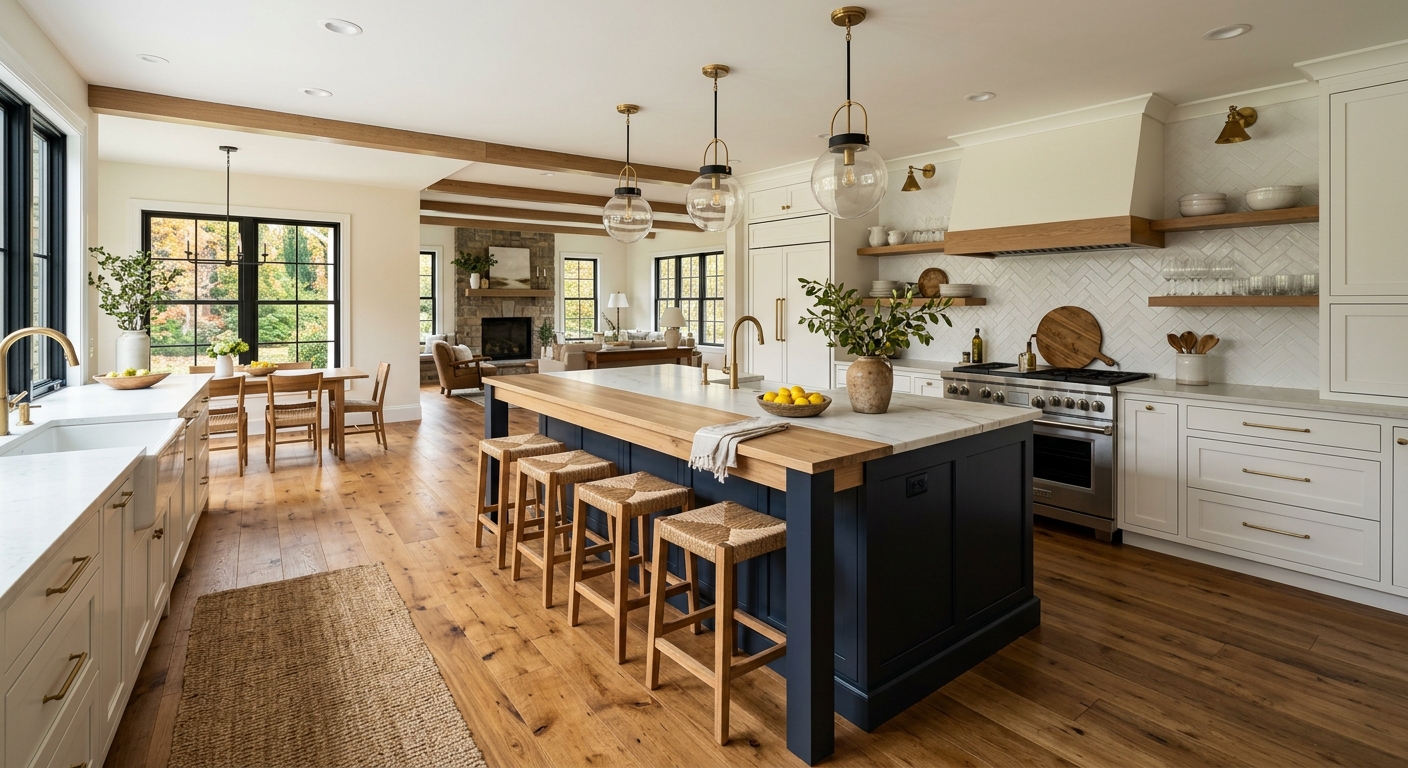
Penn Forest kitchen renovation prices by scope — 2026
Penn Forest homeowners are well above the Pennsylvania average for homeownership, with 88.8% of households owning their homes and a median household income of $68,799 (U.S. Census Bureau, ACS 2024). This means most kitchen renovations are owner-driven, with owners focused on long-term use and resale. For much of Penn Forest—and throughout Lehighton and Palmerton—kitchens are leftovers from the postwar building boom, and many layouts come from 1945–1970 single-family designs. In these homes, remodels often balloon in scope, as owners seize the opportunity to open walls or rework a galley into an open-plan kitchen during a gut renovation. But if your kitchen is a later 1990s design, the scope and requirements likely differ; you may not need the same interventions, so spending can be controlled more easily.
The most common way kitchen budgets spiral in Penn Forest is by pricing for a cosmetic or replacement job and then deciding—midstream—to change the layout or move plumbing and electrical. The gap between “new cabinets, same layout” and “move the sink, move the stove” is not linear and is usually where Penn Forest projects slip out of budget. Below are 2026 price bands for this area. Every number reflects the reality on the ground in Carbon County’s rural, travel-surcharge market:
| Scope |
What's included |
Duration |
Price range |
| Full gut remodel, same layout |
cabinets, counters, appliances, flooring, lighting, fixtures |
6–10 weeks |
$29,000–$115,500 |
| Gut plus layout change |
all of the above plus moved plumbing, electrical, walls |
10–16 weeks |
$62,500–$115,500 |
| Cabinet replacement (stock to semi-custom) |
remove and install cabinets, hardware, patching |
1–3 weeks |
$6,700–$29,000 |
| Cabinet refacing |
new doors and drawer fronts, veneer, hardware |
3–6 days |
$6,700–$19,000 |
| Countertop replacement only |
template, fabricate, install, reconnect sink |
1–3 weeks |
$3,800–$15,500 |
| Kitchen flooring only |
remove existing, install new flooring |
3–6 days |
$4,800–$19,000 |
Estimates for a typical Penn Forest kitchen. Cabinet grade and whether the layout changes move these figures more than square footage.
Electrical work in an older Penn Forest kitchen
Bringing a Penn Forest kitchen up to current electrical code is one of the most common ways budgets get blown open mid-project—especially in homes built before 1980, which make up a significant chunk of this market. The Pennsylvania Uniform Construction Code, enforced locally, requires that a renovated kitchen have dedicated 20-amp small-appliance circuits for countertop receptacles, GFCI protection at every countertop outlet, outlets spaced at least every four feet, and dedicated circuits for every major appliance: dishwasher, garbage disposal, microwave, and (if electric) a 240-volt line for your range. All of this is code minimum in a modern kitchen.
Older postwar homes in Lehighton and Palmerton often have a single shared circuit—sometimes ungrounded two-wire, occasionally aluminum wiring (in a few 1960s models), and frequently undersized panels with no spare capacity. The minute you open up walls for a gut job, the inspector will expect all new kitchen wiring to meet current code. No exceptions: “grandfathering” doesn’t protect you in a major remodel. Owners can find themselves facing panel upgrades and whole-circuit rewires that were not in the initial estimate. Even late-1990s kitchens in Penn Forest may lack enough circuits to comply today.
Expect to spend from $6,700–$19,000 to fully rewire and bring an older kitchen’s electrical to current standards. This includes labor, new circuits, breakers, GFCIs, and patching walls. This is rarely the line to try to save money—Carbon County’s finish-trade labor market is tight, and shortcuts will get red-flagged at inspection or resale.
Eight weeks without a kitchen
Eight weeks is not just a number—it's life without a kitchen, and it’s more disruptive in Penn Forest’s single-family homes than many realize. The way to survive is by setting up a temporary kitchen: a folding table against a wall with a microwave and kettle, moving the refrigerator nearby, and using a laundry or bathroom sink for washing up. Paper plates and takeout become part of the daily routine, and your grocery bill will drop while your takeout bill jumps—eating out for eight weeks is a real line item. In most jobs, eating out costs more than the new flooring itself.
Dust is real. Proper contractors install plastic sheeting with zipper doors—dust gets everywhere in an old Penn Forest house without these. Material staging and the contractor’s dumpster require driveway or yard space, so plan your parking and expect some disruption. If you have pets, expect them to be stressed or escape when doors are open for material delivery and debris removal. For some, moving out during demolition week—that first brutal phase of noise and dust—can be a reasonable choice. Don’t underestimate the logistics: make your plan before demo starts, and budget accordingly.
Layout changes and the cost cliff
The "cost cliff" in Penn Forest kitchen remodels appears when you decide to move plumbing, electrical, or walls. Keeping everything where it is—cabinets, appliances, sink—means costs remain in the base tier: demolition, finish trades, patching. The minute you relocate the sink or stove, you cross into a higher class of labor, cost, and permitting. The extra isn’t proportional to the distance. Moving a sink three feet usually means new supply and drain lines; if your kitchen sits on a slab or over a finished basement, getting the right slope for drains often means opening more structure than homeowners expect.
New electrical circuits require space in your panel—and many Carbon County homes built between 1945 and 1970 have limited or no spare panel slots. Moving or removing a wall means first determining if it’s load-bearing, which triggers structural review and sign-off by the borough code office (as seen in Palmerton). Ranges moved across the room need a new vent to the outside, and every new wall or opening needs proper header sizing—no shortcuts if you want the job inspected or permitted.
In Lehighton, any kitchen renovation involving structural changes or new rough-ins triggers a building permit—and with it, code compliance. The jump from “gut remodel, same layout” ($29,000–$115,500) to “layout change” ($62,500–$115,500) isn’t the price of a new drain or cord; it’s the price of stepping onto the next cost plateau. Unless your kitchen is truly unworkable, most Penn Forest owners are better off working within the existing layout.
Permits and inspections for a Penn Forest kitchen
Penn Forest homeowners are often surprised which projects require permits and which don’t. Cosmetic updates—painting, swapping in new cabinet doors, refacing, or just changing hardware—generally don’t require a permit. If you’re replacing a countertop or sliding in a new appliance of the same type, you can usually proceed without one, especially in Jim Thorpe. But as soon as you move an electrical circuit, relocate plumbing, knock out a wall, or even install a high-powered range hood, you cross into permit territory. In Lehighton, any work involving structural changes, new wiring, or new plumbing rough-ins demands a building permit.
Palmerton’s borough code office will formally review any permit application for jobs that rework layouts or move fixtures—plan review is real here. Electrical inspections in many Carbon County municipalities, like Lehighton, are often performed by third-party agencies such as BIU of Pennsylvania instead of town code officers, so expect a separate scheduling process. Skipping permits or inspections can haunt you on resale, as unpermitted work is a red flag for buyers and their agents.
Every job over $500 requires a contractor with Home Improvement Contractor (HIC) registration from the Pennsylvania Office of Attorney General; you can verify them at hic.attorneygeneral.gov. Employers must carry workers' compensation insurance—check for current coverage through WCAIS. Skipping these protections puts owners at risk if there’s a problem down the line.
Why appliance selection comes first
The number one sequencing mistake is ordering cabinets before appliances are selected in your Penn Forest kitchen. Cabinets are built—literally—around the dimensions and needs of your appliances. Standard versus counter-depth refrigerators directly affect how deep the cabinets are set and how the refrigerator doors clear. Slide-in ranges demand different cabinetry than freestanding ones. Gas or induction cooktops may require new circuits or even panel upgrades; switching from gas to induction is not a plug-and-play decision, especially in a house that may already lack spare electrical capacity.
Dishwashers come in standard or “panel-ready,” which integrate with the cabinet faces and affect spacing. Range hoods must be specified early, since ducted hoods require routing a new vent to the exterior—a big deal in some Carbon County homes, where vent runs may have to cross finished rooms. Recirculating hoods are simpler but always a compromise, especially for those who cook frequently.
Higher-end, professional-style appliances offer better durability and aesthetic, but their biggest real value is for enthusiastic cooks or for resale in high-value neighborhoods. Appliances at this level are often more about look and less about function if you’re not a heavy home chef. And beware: current supply chain realities mean some appliances now have longer lead times than semi-custom cabinets—always choose and order appliances before finalizing cabinetry.
Where the money actually goes
Most homeowners in Penn Forest expect to spend on the “wow” features—stone countertops and new appliances. In reality, cabinetry eats up the biggest share of the budget by a wide margin, followed by labor and installation. Counters and appliances are significant but usually don’t come close to cabinets, even at the high end. Flooring, lighting, and fixtures are smaller lines.
What most homeowners leave out—sometimes at their peril—are two things: contingency for what’s found inside the walls, and soft costs like permits, design fees, disposal, and delivery. In a pre-1980 Carbon County home, skipping contingency is a false economy—the odds of finding questionable wiring or plumbing are high. Homeowners often ask where to put an extra thousand dollars for the best effect: the answer is quality cabinet hardware or improved lighting, not high-end appliances in a kitchen otherwise fitted with builder-grade cabinetry. Spending on superior counters makes sense only after cabinetry and layout are set.
For a standard full kitchen gut remodel (the $29,000–$115,500 range), here’s how a real Penn Forest budget breaks down:
| Category |
Share of budget |
Notes |
| Cabinetry |
25–35% |
the largest line and the longest lead time |
| Labour and installation |
20–30% |
rises sharply if the layout changes |
| Countertops |
8–15% |
material choice drives the swing |
| Appliances |
10–20% |
widest range of any category |
| Flooring |
5–10% |
|
| Lighting and electrical |
5–10% |
higher in older homes needing circuits |
| Plumbing and fixtures |
4–8% |
|
| Permits, design, disposal |
3–6% |
usually forgotten in early budgets |
| Contingency |
10–15% |
not optional in a pre-1980 house |
Frequently asked questions — kitchen renovation in Penn Forest
What should I expect in a pre-1980 Penn Forest kitchen?
Pre-1980 kitchens in Penn Forest, and especially in Lehighton or Palmerton, are often narrow galley layouts with minimal circuits—usually two-wire, sometimes ungrounded. Expect issues like undersized panels, shared kitchen circuits, and possibly original plumbing. Walls may be plaster, which complicates wiring and patching. Storage is limited, and counter space is almost always less than what’s standard today. If you’re planning a gut renovation or even just replacing your cabinets, plan for electrical and plumbing surprises behind the walls—budgeting a contingency of 10–15% above your base project cost is wise. Renovation dollars in these homes go further than cosmetic upgrades, but expect your project to fall in the $29,000–$115,500 range for a full gut job that meets code.
Can I cancel a renovation contract in Pennsylvania?
Yes. Under Pennsylvania’s Home Improvement Consumer Protection Act (HICPA), you have a 3 business-day right to cancel any signed renovation contract over $500. This law applies in Penn Forest and across Carbon County. Contractors must provide you written notice of this right. If a contractor tries to start work or take deposits before the cancellation period is up, they are violating state law. If you cancel, you must do so in writing within that window. For kitchen projects—where costs routinely exceed $6,700–$29,000—this protection gives real peace of mind when committing to a major expense.
What countertop material is best for a family kitchen?
For Penn Forest families, quartz countertops are tough to beat for durability, maintenance, and value. They resist staining, don’t require sealing, and hold up well to heavy use—important for busy family life. Granite is another strong option, but does require periodic sealing. Laminate is the low-cost pick but won’t perform as well over the long run. Quartz will put your countertop replacement in the $3,800–$15,500 range, but the practical benefits and resale value make it a smart investment for most owner-occupied homes here in Carbon County.
Do I need to change my kitchen layout?
In many Penn Forest homes, especially those from the 1945–1970 era, the layout can feel closed-in or awkward by today’s standards. But changing the layout—moving the sink, range, or knocking down walls—moves your project to a much higher budget and complexity. Unless your kitchen is genuinely dysfunctional (not just dated), you may get better value working inside the existing footprint. Moving plumbing or electrical quickly escalates costs by tens of thousands. Keeping the layout can put your renovation in the $29,000–$115,500 bracket, while major reconfigurations push you to the top of the range. Think through your actual needs before committing.
Should I renovate before selling or let the buyer do it?
In Penn Forest, with the majority of homes owner-occupied and a tight rural housing market, a basic renovation can bump appeal and asking price, but a full gut job rarely returns its full price if your plan is to sell within a year or two. If your kitchen is functional but out of style, minor upgrades—painting, new cabinet hardware, fresh counters—usually offer the best cost recovery. A full gut remodel in the $29,000–$115,500 band is only worth it if you’ll use the kitchen for many years first. Buyers today want updated, fix-free kitchens but may prefer to customize rather than pay for your taste choices if they’re moving in right away.
What is a change order and how should it work?
A change order is an official modification to your contract—covering anything that wasn’t included in the original price, like moving plumbing after hidden damage is found. In Penn Forest, as everywhere in Pennsylvania, change orders must be in writing and signed by both you and the contractor before work continues. Don’t approve anything verbally. Always ask for a specific price (even if it’s “time and materials with a maximum”), and get any timeline changes in writing. Frequently, change orders relate to discoveries during demolition in older Carbon County homes, so having a contingency (10–15% of your remodel, or $2,900–$17,300 on a full gut) will keep your project moving without stress.
What does a quartz countertop cost in Penn Forest?
Quartz countertop costs in Penn Forest generally range from $3,800–$15,500 installed, depending on your kitchen’s size, the brand, the edge profile, and whether sinks/faucets are relocated. This band is current for Carbon County’s market, including fabrication, installation, and basic cutouts for sinks. Moving plumbing or changing layouts will push you toward the upper end of that range. For most owner-occupied homes, quartz’s value and low maintenance make it a top choice in Penn Forest’s kitchens, especially for families seeking durability without the upkeep granite requires.
How long does a kitchen renovation take in Penn Forest?
A full gut renovation with new cabinets, counters, appliances, and flooring generally takes 6 to 10 weeks in Penn Forest, not counting any lead time waiting on materials. Kitchens with layout changes—where you move plumbing or take down a wall—can stretch to 10–16 weeks. Smaller jobs, such as cabinet refacing or just countertops, are usually 3–6 days to 3 weeks. Weather, inspection scheduling, and the local tight labor market in Carbon County can add delays. If your budget is in the $29,000–$115,500 range for a major remodel, expect eight weeks from demo to finish, with temporary living arrangements needed during most of that time.
How much do new kitchen cabinets cost in Penn Forest?
In Penn Forest, replacing all your kitchen cabinets with stock to semi-custom options—including removal, installation, and basic finish carpentry—will typically run $6,700–$29,000. The wide range depends on cabinet size, quality, door style, and installation details. Full custom cabinetry or hardwood interiors can push you closer to the top end. Given cabinet lead times and installation complexity, this is often the single largest chunk of a kitchen remodel budget in Carbon County—think one-quarter to a third of every dollar you spend on a full gut renovation.