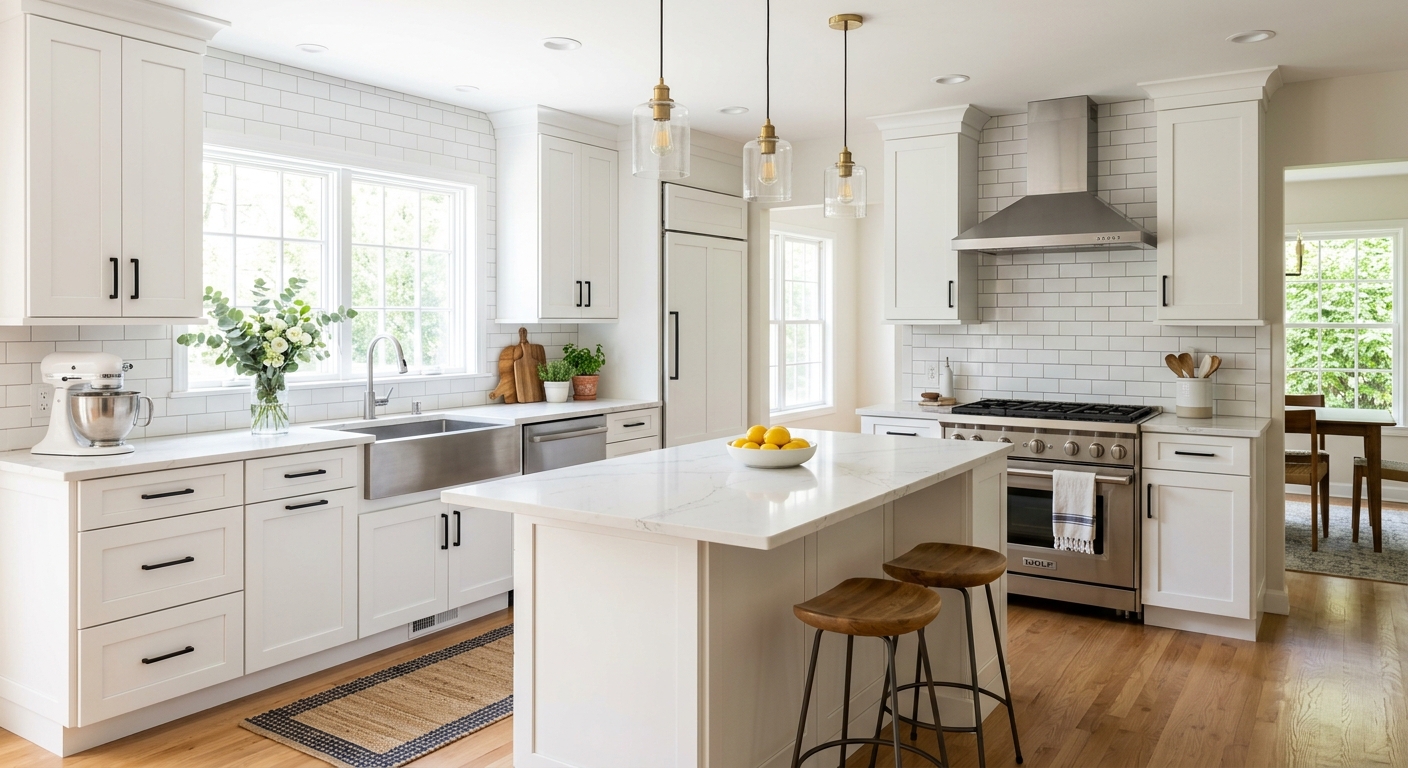
McCandless kitchen renovation prices by scope — 2026
McCandless homeowners, with a median household income of $99,739 and a homeownership rate of 73.4% (U.S. Census Bureau, ACS 2024), often approach kitchen renovations as long-term investments. The scale of a project here is heavily influenced by the age and style of the home. A significant share of houses in Allegheny County were built before 1980, and much of the local stock mimics Pittsburgh’s older, closed-off kitchens, making gut remodels with wall changes more common than in newer developments. If your kitchen layout dates to the 1950s, opening walls or rearranging rooms may be required just to achieve a modern workflow—driving costs higher than simple finish updates seen in late-century builds.
The most common mistake is estimating costs for cosmetic work, then choosing upgrades that actually require structural or mechanical changes. This upends budgets and timelines. Below is a breakdown of price ranges in McCandless by project scope. All pricing reflects market conditions in Allegheny County and the actual cost of qualified trades here.
| Scope |
What's included |
Duration |
Price range |
| Full gut remodel, same layout |
cabinets, counters, appliances, flooring, lighting, fixtures |
6–10 weeks |
$32,000–$128,000 |
| Gut plus layout change |
all of the above plus moved plumbing, electrical, walls |
10–16 weeks |
$69,500–$128,000 |
| Cabinet replacement (stock to semi-custom) |
remove and install cabinets, hardware, patching |
1–3 weeks |
$7,500–$32,000 |
| Cabinet refacing |
new doors and drawer fronts, veneer, hardware |
3–6 days |
$7,500–$21,500 |
| Countertop replacement only |
template, fabricate, install, reconnect sink |
1–3 weeks |
$4,300–$17,000 |
| Kitchen flooring only |
remove existing, install new flooring |
3–6 days |
$5,300–$21,500 |
Estimates for a typical McCandless kitchen. Cabinet grade and whether the layout changes move these figures more than square footage.
Three ways to organise the project
How you structure your kitchen renovation in McCandless is as important as the design itself. The three main routes carry distinct trade-offs in cost, oversight, and risk. At the premium end, a design-build firm provides a complete package: design, cabinetry, installation, and project management under a single contract. This simplifies everything for the homeowner, puts accountability in one place, and reduces your daily involvement—but you’ll pay the highest rates for that convenience.
General contractors have clear value in this market, where trades like tile, cabinetry installation, plumbing, and electrical are all busy and often overbooked. In Allegheny County, labor for finish trades is particularly tight, driving up the cost of coordination and making an experienced general contractor’s network a real asset. You or your designer will make product and layout choices; the general contractor schedules, oversees, and ensures code compliance. This approach sits in the middle on both cost and stress for the homeowner.
Self-managing, where you directly hire and schedule every trade, looks cheapest on paper. But in reality, it’s far more demanding than most anticipate. You must know how to sequence trades, negotiate with each, handle permits and inspections, and troubleshoot the unexpected. If you have a day job and your project will trigger electrical or plumbing permits, this is not the route for you. Missed steps or poor scheduling lead to delays and strained relationships with trades.
Living through a kitchen renovation
Few homeowners grasp what it’s really like to live through a kitchen remodel in McCandless. You will need to carve out a temporary kitchen—most families set up a microwave and coffee maker on a folding table near the dining area, with the refrigerator plugged in wherever it fits. Bathroom or laundry sinks become dishwashing stations, and disposable plates are often easier than fighting for clean-up space. During an 8–10 week project, expect your grocery bill to edge up and restaurant spending to spike; the real cost of eating out during a major remodel often exceeds the price of new flooring.
Dust is persistent and surprisingly intrusive once demolition starts, especially in houses with open air returns or unfinished basements. Experienced contractors hang plastic sheeting and install zip walls, but even then, fine grit may land in nearby rooms. Plan for a dumpster and material delivery; in most McCandless neighborhoods, these go at the curb or in the driveway, with crews needing ready access. Keep pets and kids in mind—doors will be propped for hours, and strangers will be coming and going. Some homeowners choose to stay elsewhere for the noisy and dusty demolition phase, even if just for three days. This is worth considering if your work-from-home situation is critical or you have health concerns. Preparing for these disruptions up front makes the process easier—and limits surprises to what’s inside your walls.
The biggest line item in your McCandless kitchen
Cabinet decisions set the direction for your entire kitchen project in McCandless. There are four practical paths: painting, refacing, replacing with new (stock or semi-custom), and full custom. Refacing—swapping doors, drawer fronts, and skinning visible panels—delivers dramatic updates for far less than full replacement. But it only works when the existing cabinet boxes are solid, true, and set up in a way that still fits your needs. It does not allow for layout changes or added storage.
Stock cabinets offer fixed dimensions and finishes, requiring filler strips in rooms with quirky measurements or out-of-square walls—typical in older homes throughout Allegheny County. Semi-custom expands the menu of widths, depths, and finishes, making it easier to fit non-standard spaces and achieve a tailored look in older McCandless houses, many of which were built before uniform kitchen measurements became the norm. Full custom means anything is possible, but with higher price tags and lead times.
Quality matters regardless of price point. Plywood cabinet boxes hold fasteners better and withstand moisture longer than particleboard. Drawer construction—dovetail joints beat stapled corners—affects durability. Hardware matters, too: full-extension, soft-close slides make daily use better. Frameless (European-style) cabinets maximize storage in tight spaces, which can be helpful in compact, compartmentalized older homes around Pittsburgh and McCandless.
| Option |
Cost |
Best when |
Limitation |
| Painting existing cabinets |
$1,200–$3,500 |
boxes and doors sound, tight budget |
no layout or style change |
| Refacing |
$7,500–$21,500 |
boxes square and layout works |
storage unchanged |
| Stock cabinets |
$7,500–$32,000 |
standard dimensions fit |
filler strips, limited finishes |
| Semi-custom |
$21,500–$32,000 |
non-standard walls or finishes |
6–12 week lead time |
| Full custom |
$21,500–$32,000 |
unusual layout or high-end design |
longest lead, highest cost |
What requires a permit in a kitchen renovation
In Allegheny County, the need for a permit on a kitchen project depends on what you’re changing. Cosmetic work—painting, hardware swaps, cabinet refacing, or replacing countertops in place—rarely requires a permit. More involved work triggers one: moving or adding electrical circuits, relocating plumbing, removing or building walls, or mechanical changes such as a new ducted hood. In Pittsburgh, projects altering layout or structure go through a plan review; in surrounding boroughs, permits are typically required for plumbing or electrical line relocations. Check with your local township office for specifics if you’re outside city limits.
Electrical inspections in Pittsburgh are conducted under city permitting, but outlying townships often contract with third-party agencies for inspections—you may not know the inspector until they contact you to schedule. This surprises many, and it’s important so that work passes before drywall goes up.
Contractors working on projects over $500 must carry a Home Improvement Contractor (HIC) registration, issued by the Pennsylvania Office of Attorney General. You can verify this registration at hic.attorneygeneral.gov. Workers’ compensation coverage is also mandatory in Pennsylvania, with inquiries handled through WCAIS (wcais.pa.gov). Not checking these is a risk to you as the homeowner.
Skipping permits to save time or money often backfires at resale—unpermitted electrical or layout changes almost always get flagged during pre-listing inspections and can hold up a sale or force costly corrections.
Circuits, GFCI and code compliance
Older McCandless homes, especially those built before 1980, rarely have kitchens wired to current standards. The Pennsylvania Uniform Construction Code (UCC), based on the IRC, now expects dedicated 20-amp circuits for countertop appliances, GFCI receptacles for all counter outlets, and separate circuits for dishwashers, disposals, and microwaves. Electric ranges require a 240-volt line. Spacing rules keep outlets within 4 feet of every countertop edge so no appliance cord needs to stretch dangerously.
Here’s the reality in our area: Pre-1940 and mid-century housing stock often has two-wire, ungrounded circuits and a single breaker serving the whole kitchen, sometimes shared with adjacent rooms. Many McCandless kitchens have antiquated panels with no space for new breakers. Once demo begins and existing wiring is exposed, any new work must meet the latest electrical code standards—partial upgrades are not permitted. This surprises many homeowners and is often not fully budgeted.
In a typical McCandless gut remodel, bringing the kitchen up to code—with new circuits, outlets, GFCI, arc-fault protection, and panel upgrades if needed—generally falls in the $4,300–$17,000 range, depending on the condition and size of your existing electrical system. Factor this in if your house is older, as previous remodels often left legacy wiring grandfathered until walls are opened up.
The real timeline for a McCandless kitchen
Kitchen renovations in McCandless take longer than most homeowners expect, especially given dense demand for skilled trades across Allegheny County. The actual process runs in sequence, with key steps dependent on what comes before. First comes design and final field measurement. Only then can cabinets be ordered, and with semi-custom or custom, expect a 6–12 week lead time—even before demolition begins. This is the critical path; ordering cabinets after demo turns the entire space into a dust-filled storage room while you wait.
Once cabinets arrive, demolition gets underway, typically 1–4 days. Next are rough-ins for plumbing and electrical, which cannot be boxed in before passing code inspection. Then cabinets are set. The countertop template happens only after cabinets are perfectly installed and leveled—no reputable fabricator will template from plans. Expect a dead period here while stone or quartz is fabricated (often 1–3 weeks). Only after countertops are in can the plumber return for final hook-ups and the backsplash go on, with flooring and final trims wrapping up last.
Allegheny County’s active contractor market and long cabinet lead times mean the fastest full-kitchen timeline from measure to move-in is about 8 weeks, more often stretching to 12–16 weeks when any surprises are found after the walls open. Lining up all orders and trades in advance is critical. The number one frustration for McCandless homeowners is underestimated timelines—plan for waiting on cabinets and counters, not just demolition and build-out.
Frequently asked questions — kitchen renovation in McCandless
What is the difference between stock and semi-custom cabinets?
In McCandless, stock cabinets are factory-made in fixed dimensions and a limited set of styles and colors. They’re designed to fit quickly into newer, standard-sized rooms, keeping costs lower—typically $7,500–$32,000 for a full kitchen replacement. Semi-custom cabinets, on the other hand, can be adjusted during manufacturing—having custom widths, depths, and unique finishes added in the factory, which is crucial when working with older or out-of-square kitchen walls that are common in McCandless’s pre-1980 homes. Semi-custom adds flexibility for odd corners or nonstandard layouts and achieves a more built-in look. You get more options but at a higher price, and with longer lead times (often 6–12 weeks). In most older homes around McCandless, semi-custom solves fit and appearance problems that stock simply can’t address.
How should renovation payments be scheduled?
In Pennsylvania, large kitchen renovations are always governed by a written contract if the cost exceeds $500. The Home Improvement Consumer Protection Act requires clear payment terms. Standard payment schedules in McCandless are a deposit up front (usually 10–20%), a progress payment once cabinets arrive or demolition is complete, another as counters or other major deliveries happen, and the final balance after inspection and completion. Never pay more than one-third upfront; withholding a portion until punch-list items are resolved keeps everyone motivated. A full gut remodel runs $32,000–$128,000, so scheduling payments with tangible milestones protects both homeowner and contractor. A reputable contractor in McCandless should never request most of the project cost before significant work is completed.
What does a quartz countertop cost in McCandless?
Quartz countertop prices in McCandless kitchens range from $4,300–$17,000, depending on the stone selected, edge profile, and whether cutouts for sinks or cooktops are needed. The typical kitchen falls around $9,600. This includes template, fabrication, installation, and reconnecting plumbing. Labor here is at Pittsburgh metro market rates, and most fabricators won’t template from dimensions—cabinets must be installed before the slab is cut. If you want true seamless runs or specialty colors, costs push toward the top end. Always get a physical sample to view in your home’s light before finalizing, as quartz can look very different in showroom lighting.
How does McCandless's housing stock affect cabinet fit?
Many homes in McCandless were built before the 1980s, meaning kitchen walls often aren’t square and dimensions vary from modern standards. When you try to install stock cabinets in these older houses, you end up with gaps or filler strips—wasted space that’s especially noticeable in small or galley layouts. This is why semi-custom or custom cabinets, with flexible dimensions and options, are so commonly selected here, even when homeowners first plan on stock. The extra spend—often $21,500–$32,000 for a whole set—solves both visual and practical issues. For more recent constructions, the standard sizing of stock cabinets often fits with fewer compromises.
Should I reface or replace my kitchen cabinets?
Refacing can be a smart move in McCandless if your existing cabinet boxes are in good shape, you like your current kitchen layout, and all you want is an updated look. Refacing costs between $7,500–$21,500, versus up to $32,000 for new cabinets. It’s less disruptive, takes less time, and sends less to the landfill. However, refacing can’t fix poor storage or change your kitchen’s layout—and in many older McCandless homes, the real problem is an awkward or dated footprint. If you want new features, organization, or a modern cabinet style and need to adjust the kitchen’s bones, replacement is the better long-term value despite the higher upfront cost.
Can I cancel a renovation contract in Pennsylvania?
Yes, under the Pennsylvania Home Improvement Consumer Protection Act, you have a three business-day right of cancellation for any kitchen renovation contract signed in your home (for projects over $500). This applies to McCandless residents and should be clearly stated in the contractor’s paperwork. The clock starts when you receive a copy of the signed contract. If you change your mind within those three days, notify your contractor in writing—email or letter—so you can recover your deposit. This protection acts as a cooling-off period, especially important for higher-dollar scopes like full kitchen remodels that range from $32,000–$128,000. After three days, contract-specific penalties or refund policies apply.
What is a realistic contingency for a McCandless kitchen?
For kitchen renovations in McCandless, a 10–20% contingency is wise. Existing conditions in the area’s older housing stock—hidden plumbing runs, unsafe wiring, or past amateur repairs—are impossible to forecast until the walls are open. For a project with a typical scope of $69,500, budgeting an additional $7,000–$14,000 keeps you from financial surprises when the old floor is pulled up or circuits are checked. The older the house and the less recent the last upgrade, the more likely you'll encounter costly contingencies. Even with newer construction, unplanned code upgrades or appliance issues can drive up costs.
What adds the most resale value in a kitchen?
In McCandless, kitchen investments that boost resale are those that update layout, storage, and finishes to meet buyer expectations—open, functional plans and quality cabinets are key. More buyers prefer semi-custom cabinets and quartz counters over builder-grade replacements. Home values here track with kitchen quality, especially in owner-occupied neighborhoods, but nobody recoups every dollar spent. Focus on visible upgrades—cabinets and counters first—and don’t overspend on luxury appliances unless the rest of the house supports it. The sweet spot for resale return is a gut remodel in the $69,500–$128,000 range, especially if you can address an outdated or boxed-in layout. Cosmetic upgrades (refacing, fresh paint, updated hardware) help but will not change the market perception as much as solving poor workflow or dated style.
Why is there a gap after cabinets are installed?
There is always a gap—often a week or two—between cabinet installation and countertop, no matter how well your project is run. This dead period happens because countertop fabricators in McCandless will only template and make your stone or quartz counters after the cabinets are set and perfectly leveled. They can’t work from shop drawings, since even small errors in wall straightness or cabinet placement affect fit. After cabinets go in, the template is made, fabrication takes place back at the shop, then installation is scheduled. During this time, your project may look stalled, but it is part of every kitchen requiring stone tops, which run $4,300–$17,000. Being prepared for this lag makes the final weeks less stressful—plan your living setup to stretch just a little longer than you think necessary.