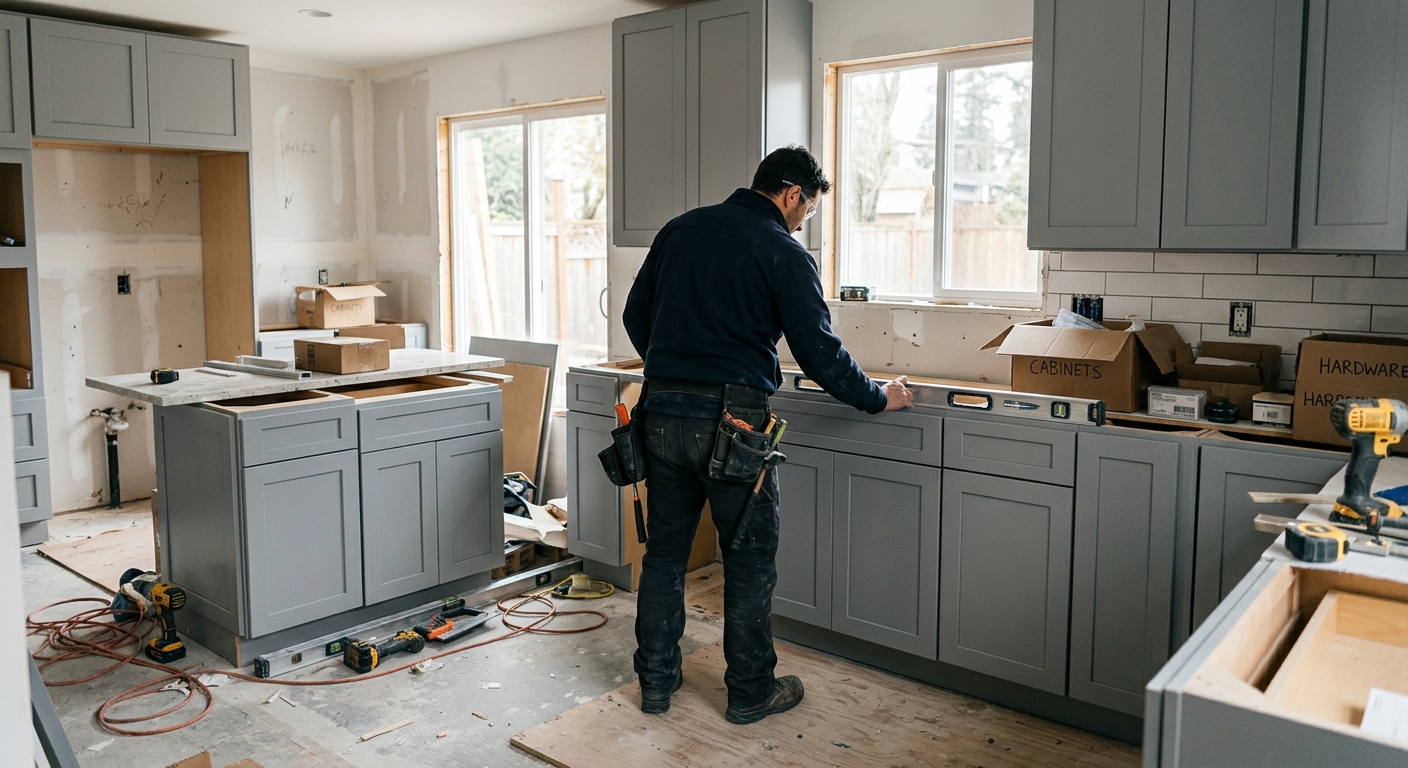
Penn kitchen renovation prices by scope — 2026
Penn homeowners approach a kitchen renovation differently from landlords, because 77.6% of households here are owner-occupied (U.S. Census Bureau, ACS 2024). With a median income of $76,591, most Penn budgets are tied to maximizing long-term use and value. The single biggest variable is the construction era. Post-World War II tract housing, especially north and west of Lancaster, means owners routinely confront small, closed-off kitchens built for a simpler appliance set. These layouts require more than a surface upgrade if the goal is open flow or modern cooking.
Actual kitchen costs in Penn are dictated by scope. The most common mistake is budgeting for a “pull and replace” (where everything stays put) and then deciding partway through to knock down a wall or move the sink—doubling both cost and timeline. Before spending a dollar, pin down whether you are painting cabinets or rebuilding the room from the subfloor up. Below is what to expect:
| Scope |
What's included |
Duration |
Price range |
| Full gut remodel, same layout |
cabinets, counters, appliances, flooring, lighting, fixtures |
6–10 weeks |
$29,500–$118,500 |
| Gut plus layout change |
all of the above plus moved plumbing, electrical, walls |
10–16 weeks |
$64,500–$118,500 |
| Cabinet replacement (stock to semi-custom) |
remove and install cabinets, hardware, patching |
1–3 weeks |
$6,900–$29,500 |
| Cabinet refacing |
new doors and drawer fronts, veneer, hardware |
3–6 days |
$6,900–$20,000 |
| Countertop replacement only |
template, fabricate, install, reconnect sink |
1–3 weeks |
$4,000–$16,000 |
| Kitchen flooring only |
remove existing, install new flooring |
3–6 days |
$4,900–$20,000 |
Estimates for a typical Penn kitchen. Cabinet grade and whether the layout changes move these figures more than square footage.
The biggest line item in your Penn kitchen
Cabinetry drives both the budget and the look of a renovated Penn kitchen—and retrofitting a 1950s or 1970s layout, common around Lancaster and Manheim Township, usually means you need a solution beyond simple cabinet swaps. You have four practical options: painting or refacing, stock cabinets, semi-custom, or full custom. Honest truth: most postwar kitchens around here have non-standard dimensions and funky corners, meaning that stock cabinets force you to use filler strips or give up storage. Semi-custom fits the typical Penn era home much better—in both width and finish—without pushing you all the way to custom pricing. Refacing, meanwhile, is by far the most budget-friendly and disruptive only for a few days, but only works if your cabinet boxes are solid, square, and exactly where you want them.
Quality matters over labels. Plywood boxes last longer than particleboard, dovetail drawers outlast anything stapled, and full-extension soft-close hardware is worth it every time. Frameless (European) cabinets give more storage, but are pickier about installation. Face-frame cabinets are a bit more forgiving of walls that aren’t plumb or square—the norm in pre-1980 Penn homes—so your installer’s experience matters as much as materials.
| Option |
Cost |
Best when |
Limitation |
| Painting existing cabinets |
$1,200–$3,500 |
boxes and doors sound, tight budget |
no layout or style change |
| Refacing |
$6,900–$20,000 |
boxes square and layout works |
storage unchanged |
| Stock cabinets |
$6,900–$29,500 |
standard dimensions fit |
filler strips, limited finishes |
| Semi-custom |
$20,000–$29,500 |
non-standard walls or finishes |
6–12 week lead time |
| Full custom |
$20,000–$29,500 |
unusual layout or high-end design |
longest lead, highest cost |
Quartz, granite, laminate or butcher block
Countertop material affects how your Penn kitchen works every day, not just how it looks the day it’s installed. Most homeowners want the easy maintenance of quartz, since it’s engineered, non-porous, and shrugs off stains—just don’t set down a hot pot directly, because quartz will scorch. Granite is classic and unique to each slab; it slightly edges out quartz for heat tolerance but needs sealing every year or two to stop stains. Laminate gets a bad rap, but the latest generations are highly scratch-resistant, easy to clean, and don’t need special care; they work in a rental or an everyday family kitchen and can be replaced for much less money on the next go-round. Butcher block surfaces are warm and great for light prep, but they demand regular oiling and can stain—use them on an island, not next to a sink.
Solid surface is a flexible mid-tier—seams are nearly invisible and scratches can be buffed out, but it won’t handle much direct heat. The cost for Penn kitchens is shaped by the edge profile you pick, the number of cutouts for sinks and cooktops, and whether the space needs a template (for tight fits or odd angles)—a must for postwar homes with wavy walls. If you have a room that isn’t “by the book,” plan on higher installation labor for templating, seaming, and scribing panels to fit just right.
What requires a permit in a kitchen renovation
Permits in Penn depend entirely on what aspects of your kitchen you touch. Cosmetic upgrades—paint, new cabinet hardware, refacing, or a direct countertop swap—don’t require permits in Lancaster County townships. The line is drawn once you move or add plumbing or electrical circuits, install new walls, or make any structural changes. In Lancaster city, a permit is required for structural changes or for new plumbing and electrical circuits in the kitchen. Full remodels that change the layout will generally trigger a building permit, and in Lancaster city (unlike neighboring townships), formal plan review is likely if you touch walls or systems.
Electrical inspections in Penn are commonly performed by certified third-party agencies like Middle Department Inspection Agency—instead of the city itself—which often surprises first-time remodelers. Plumbing, electrical, and mechanical licensing is handled municipally, not at the state level. Contractors working on your Penn project must be registered as a Home Improvement Contractor (HIC) with the Pennsylvania Office of Attorney General if the job exceeds $500. All workers on site must be covered by workers’ compensation (verify through WCAIS). Unpermitted work can stop a home sale in its tracks, or worse, force you to open finished walls and bring everything to current code at your own expense.
Defining your scope before you get quotes
The term “kitchen remodel” in Penn covers upgrades from a simple paint job to a full-gut rework that changes how you use your house. Here’s how the tiers break down:
- Cosmetic refresh: Paint, swap cabinet hardware, update light fixtures, maybe a new backsplash—no cabinet or layout changes.
- Pull and replace: New cabinets and counters in the same positions as before. Electrical and plumbing stay put—no walls moved, no major rerouting.
- Gut, same layout: Everything comes down to the studs, with new wiring, insulation, lighting, and plumbing—but all in their current locations.
- Layout change: Walls, plumbing, or structure are moved. This opens the floor plan and modernizes the kitchen, but it is a different universe in price and complexity.
The cost jump from gutting with the same layout to moving the sink or range is significant. It triggers permits, possible engineering, and a longer, more expensive build. It also means your project moves from cosmetic to one that affects the bones of the home—especially in the postwar stock around Penn, where opening a wall can reveal outdated wiring or past DIY fixes. Decide your tier before calling contractors; nobody can give you a reliable number if you’re not clear how far you intend to go. More scope means more risk for surprises and a bigger budget is needed up front.
Electrical work in an older Penn kitchen
Electrical work increases the price and time for more kitchen remodels in Penn than any other single factor. Current code expects your kitchen to have its own dedicated small appliance circuits, GFCI-protected outlets at every possible splash or prep spot, regularly spaced receptacles (no more than 4 feet apart), dedicated circuits for every major appliance—dishwasher, microwave, garbage disposal—and 240-volt service for an electric range if you have one. If you want under-cabinet lighting or smart switches, those draw even more power.
Nearly half of homes in Penn were built before 1980, and many around Lancaster and Manheim Township were laid out with a single circuit for the whole kitchen—worst case, it’s ungrounded or aluminum wiring. Bringing these systems up to today’s standard isn’t optional once the walls are open. Inspectors in Lancaster city and many townships require that any new work fully meets modern code. Even in late-1990s kitchens, the circuit count is usually short compared to current standards. For a typical Penn kitchen, expect electrical upgrades to run $3,500–$12,000 depending on panel access, wiring complexity, and how much gets moved or added.
Where the money actually goes
The biggest surprise in Penn kitchen budgeting isn’t the total—it’s realizing just how much cabinetry dominates the costs. Cabinetry usually claims more than a quarter of the bill, followed by labor, then counters, appliances, flooring, lighting, and plumbing. Permits, design, delivery, and disposal are necessary soft costs that almost everyone forgets, only to be reminded the week before demolition. A healthy contingency is essential, especially in Penn homes built before 1980, as walls often hide out-of-date wiring or plumbing not visible until things come apart.
If you’re adding an extra thousand dollars, allocate it where you use the kitchen every day—cabinet upgrades, counter finish, or functional lighting yield far more satisfaction than a designer label on a fridge. Conversely, dropping top-tier appliances into stock cabinets is a waste of the appliance and adds nothing to resale. Below is an honest breakdown for a typical full-gut remodel in Penn, with percentages mapped to real dollars from the current price band.
| Category |
Share of budget |
Notes |
| Cabinetry |
25–35% |
the largest line and the longest lead time |
| Labour and installation |
20–30% |
rises sharply if the layout changes |
| Countertops |
8–15% |
material choice drives the swing |
| Appliances |
10–20% |
widest range of any category |
| Flooring |
5–10% |
|
| Lighting and electrical |
5–10% |
higher in older homes needing circuits |
| Plumbing and fixtures |
4–8% |
|
| Permits, design, disposal |
3–6% |
usually forgotten in early budgets |
| Contingency |
10–15% |
not optional in a pre-1980 house |
Frequently asked questions — kitchen renovation in Penn
What flooring works best in a kitchen?
In Penn kitchens, most homeowners are best served by luxury vinyl plank (LVP), porcelain tile, or sheet vinyl—these all handle moisture, regular mopping, and dropped pans without complaint. Hardwood looks great but needs constant care and, with our freeze-thaw cycles in Lancaster County, it moves a lot more than you’d guess. Sheet vinyl and LVP also make sense in older Penn homes where the subfloor isn’t perfectly flat, since they’re forgiving and don’t require expensive prep. Tile delivers the best durability, but installation costs more and often needs a sturdier subfloor to prevent cracks, especially in tract homes from the postwar era. Cost-wise, most kitchen flooring projects in Penn land between $4,900–$20,000, driven by the material and especially any work needed to level the floor underneath.
Is a cosmetic refresh enough or do I need a gut remodel?
In Penn, a cosmetic refresh—paint, new hardware, lighting changes—can work wonders if your kitchen is basically functional: cabinets are solid, the layout fits how you cook, and the wiring and plumbing are up to snuff. This option makes sense if you’re looking for quick resale or your budget just doesn’t reach for a full gut project. Where it doesn’t pay is in postwar tract homes around Lancaster or Manheim Township that still have cramped layouts and dated wiring; in those cases, a gut remodel often pays dividends in both function and home value. A top-to-bottom gut with no major layout change in Penn runs $29,500–$118,500, but you only spend it once a generation. Most cosmetic projects are well under $6,900.
Why is there a gap after cabinets are installed?
Gaps after cabinet installation in Penn homes are almost always the result of older, out-of-square walls or uneven floors—common in houses built before 1980 and in postwar tracts. Modern cabinets are usually perfectly square, but old houses in Lancaster County rarely are. Installers use scribe molds and filler strips to hide these gaps, but a perfect, tight fit isn’t always possible without custom cabinetry or a lot of wall repair. These gaps are not a sign of poor work—they’re the reality of fitting new boxes to old spaces. Investing in semi-custom cabinets (from the $20,000–$29,500 band) can reduce the need for visible filler and create a tighter, better-looking result.
How much more does moving the sink and range cost?
Moving the sink or range in a Penn kitchen jumps your project straight into the “layout change” tier, which means opening walls, new plumbing and wiring, and engineering if structure is touched. This usually triggers both plan review and building permits in Lancaster city. The bump is substantial—full gut remodels with a layout change in Penn start at $64,500 and can climb well above $100,000 depending on scope and finish. Unless you truly need a new flow or have long-term plans in your home, keeping the original locations saves a substantial amount of time, cost, and hassle.
Who inspects kitchen electrical work in Penn?
In Penn, electrical work in kitchens isn’t inspected by the city itself as often as you might think. Instead, certified third-party agencies like Middle Department Inspection Agency handle most electrical inspections in Lancaster city and nearby townships. This means you need to coordinate with your contractor to schedule inspections, and you can’t skip this step—it’s mandatory, and paperwork will be needed if you resell. For any job involving new circuits or layout changes, especially in older homes, expect the inspector to require full code compliance. Bringing a kitchen’s electrical up to code will usually add $3,500–$12,000 to your budget.
Is lead paint a concern in Penn kitchen renovations?
Yes, lead paint is a documented concern for Penn homes, especially with nearly half built before 1980 (U.S. Census Bureau, ACS 2024). Federal EPA Lead RRP rules are in force for any renovation work in pre-1978 homes here, including kitchens. If you’re disturbing painted surfaces during demolition—or even just replacing windows, cabinets, or trim—your contractor must be EPA-certified. This isn’t a formality. Proper lead-safe work practices protect your family during the project and keep you on the right side of both liability and resale law. Plan for additional steps and costs if you fall into this category, especially during a full gut remodel (budget $29,500–$118,500).
Does a kitchen renovation increase home value in Penn?
In Penn’s mostly owner-occupied market, a quality kitchen renovation is one of the best ways to strengthen home value and sale appeal. Buyers expect updated kitchens, especially since many Penn homes were built in the postwar boom and often still reflect original layouts. Full kitchen gut remodels can recoup a strong portion of their cost upon sale, provided the work is permitted, well-executed, and complemented by upgraded wiring and finishes. Cosmetic refreshes do less for resale, but in a tight market, even small upgrades can tip a buyer’s decision. Spending in the typical range of $29,500–$118,500 for a full upgrade almost always makes sense if you plan to stay at least five years.
What is an allowance in a renovation quote?
In Penn, an “allowance” in your kitchen renovation quote means the contractor has budgeted a set amount for items that aren’t chosen yet—like lighting, appliances, or backsplash tile. For example, a quote might set a $4,000 allowance for countertops. If your selected materials run over this amount, you pay the difference; if you go under, you save. Allowances are useful when you want to control your total cost but haven’t finished all product selections. Just keep in mind: lowball allowances in bids are the easiest way for unscrupulous contractors to appear less expensive up front. Always clarify which products your allowance covers and whether installation costs are separate.
How much does a kitchen renovation cost in Penn?
Kitchen renovation costs in Penn for 2026 vary with scope. A full kitchen gut remodel with no layout changes runs $29,500–$118,500, with the most common spend around $64,500. Replacing just the cabinets will land in the $6,900–$29,500 range, while countertop or flooring-only projects are each typically under $16,000. Layout changes—moving sinks, walls or adding major electrical—are where prices jump, starting at $64,500 and up. Always pin down your tier (cosmetic, pull and replace, gut, or layout change) before collecting quotes so your budget matches the upgrades you want.