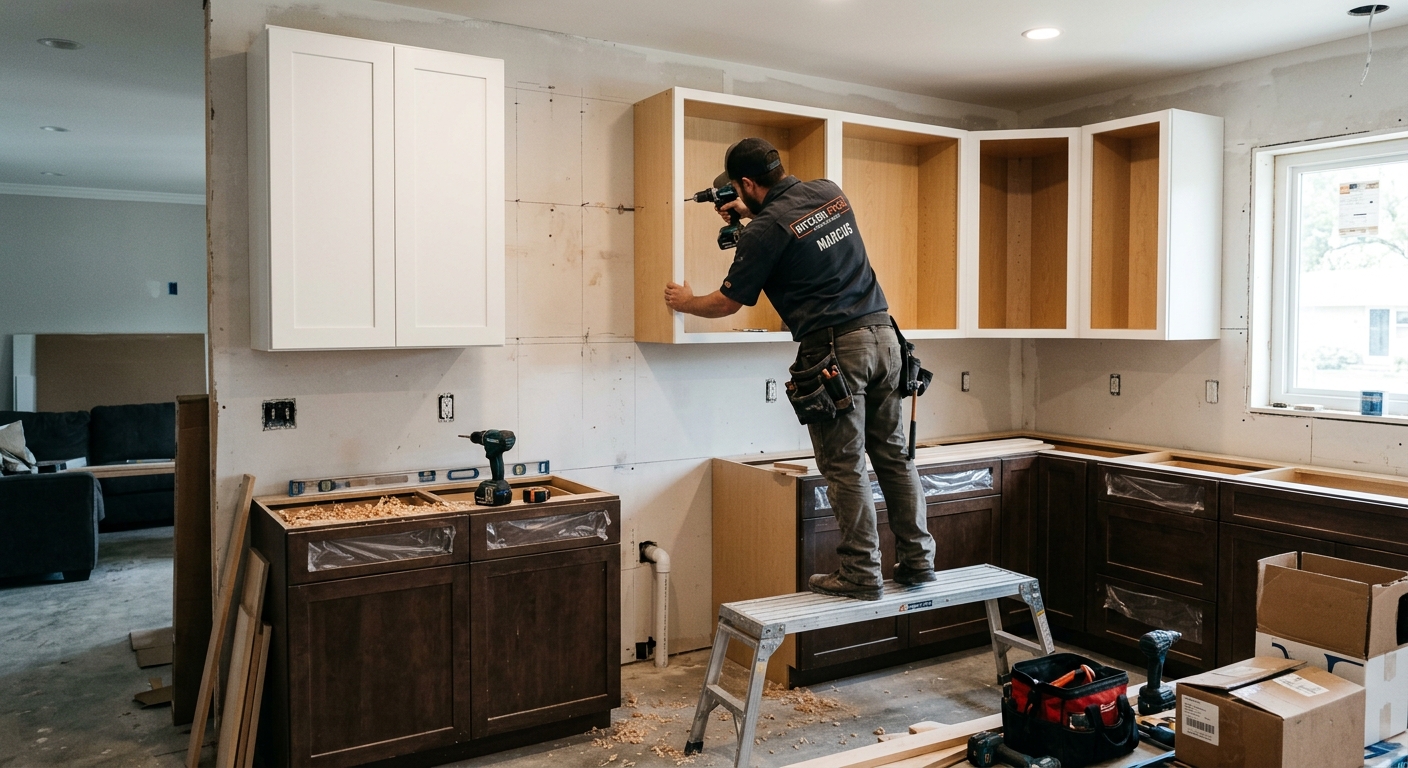
Pine kitchen renovation prices by scope — 2026
Pine, with its high homeownership rate (83.9%) and a median household income of $171,804 (U.S. Census Bureau, ACS 2024), typically sees kitchen budgets that reflect investment for long-term use over flip-and-go upgrades. In an area like Allegheny County, kitchen projects are shaped by the era of construction. Many older houses in the Pittsburgh region, including Pine, have small, closed-off kitchens dating back before 1940. These often require wall reconfiguration or even full-gut renovations to get to the open layouts today’s buyers expect. Meanwhile, homes built in the 1980s or later may just need cabinets and new counters—big difference in both price and duration.
The biggest reason for blown kitchen budgets in Pine is starting with numbers meant for simple replacements and then specifying the upgrades that only a full remodel covers—like moving plumbing or reworking walls. Here’s what different kitchen renovation scopes really cost in Pine today:
| Scope |
What's included |
Duration |
Price range |
| Full gut remodel, same layout |
cabinets, counters, appliances, flooring, lighting, fixtures |
6–10 weeks |
$33,000–$132,000 |
| Gut plus layout change |
all of the above plus moved plumbing, electrical, walls |
10–16 weeks |
$71,500–$132,000 |
| Cabinet replacement (stock to semi-custom) |
remove and install cabinets, hardware, patching |
1–3 weeks |
$7,700–$33,000 |
| Cabinet refacing |
new doors and drawer fronts, veneer, hardware |
3–6 days |
$7,700–$22,000 |
| Countertop replacement only |
template, fabricate, install, reconnect sink |
1–3 weeks |
$4,400–$17,500 |
| Kitchen flooring only |
remove existing, install new flooring |
3–6 days |
$5,500–$22,000 |
Estimates for a typical Pine kitchen. Cabinet grade and whether the layout changes move these figures more than square footage.
Quartz, granite, laminate or butcher block
Choosing a countertop in Pine isn’t all about looks. Daily use tells the real story. Quartz is engineered, so it’s non-porous—wine, coffee, and oil won’t soak in, and you don’t need to seal it. But if you set a hot pan directly on quartz, it can scorch or split. Granite is natural stone; it resists heat and looks fantastic, but it does need regular sealing to prevent stains, especially with the kind of clay subgrade and frequent freeze-thaw cycles that can nudge foundations—and seams—in older Allegheny County homes. Laminate shouldn’t be dismissed. Modern laminate resists stains, needs no sealing, and runs at a price that makes sense for rentals or practical budgets: you’re not “cheapening” a modest kitchen by using it. Repairs are tough, but for a kitchen you rent out or a keep-it-simple update, laminate works. Butcher block feels warm and forgiving under the hand, but it’s high-maintenance—prone to cuts, stains, and water damage if not oiled and wiped carefully.
Solid surface (like Corian) holds a niche: seamless for undermount sinks and, if lightly damaged, professionals can sand out scratches and burns—something not possible with quartz or granite.
Beneath the surface, fabrication can move a countertop price far beyond material. Edge profile, sink cutouts, and how many seams must be worked all matter. Countertops can’t be cut to size perfectly until cabinets are installed—measurements from drawings don’t cut it, as walls in older Pine homes are rarely square. That’s why a templating visit—making a physical template after cabinets are in—is standard even on high-end jobs.
What requires a permit in a kitchen renovation
Pulling a permit in Pine hinges on what’s being done, not what it costs. Cosmetic work—painting, swapping cabinet hardware, refacing, or simply replacing a countertop with the same sink and appliance locations—does not typically require a building permit in most Allegheny County boroughs. The line is crossed the moment changes touch structure, relocate plumbing or electrical, or involve new mechanical (like a vented range hood). In Pittsburgh, building permits are triggered by moving plumbing or electrical runs, or taking out walls. For full gut remodels changing the kitchen layout or structure, plan review by Pittsburgh’s code office is routine. Even in boroughs outside Pittsburgh, serious layout changes almost always mean paperwork.
Inspections work differently depending on the municipality. In Pittsburgh, electrical inspections for kitchen remodels are performed by the city’s permitting authority. In suburbs, independent third-party inspectors often handle this, which can surprise homeowners used to dealing with one city office. Regardless of your scope, Pennsylvania requires your contractor to have Home Improvement Contractor (HIC) registration for projects over $500, verifiable at hic.attorneygeneral.gov, plus active workers’ compensation insurance, which you can check on WCAIS.
Unpermitted work might not cause issues day-to-day, but it can stall or kill a sale when the buyer’s title company finds out—especially in a market like Pine, where most homes are owner-occupied and buyers expect clean records.
Cabinets are the critical path
Homeowners in Pine often underestimate the time their kitchen will be out of service. Design and measurement come first, then ordering cabinets. Order those before demolition. Most delays and frustration come from waiting on cabinets, especially since finish-trade labor is tighter in Allegheny County than in the outlying areas. Once the old kitchen is out, rough-ins for electrical and plumbing are completed—and often inspected—before cabinets even arrive.
Cabinets are always the critical path. Countertops (quartz, granite, or solid surface) can’t be templated from plans. The tops are custom-fabricated after the cabinets are set, not before. That templating visit can’t be skipped, as homes—even new ones in Pine—rarely have perfectly square walls. Expect at least a week, sometimes two, between cabinet install and countertop installation. Nobody warns you about that dead period, but it comes into play on every project.
While it’s tempting to start demo first, waiting until cabinets are landed reduces your out-of-service time. Market demand keeps local cabinet lead times at six weeks or more during busy periods. Only after countertops go in can the sink, faucet, and appliances be connected. Flooring, tile, and trim work follow, and scheduling these trades can take a back seat to material delivery. Proper planning along this sequence prevents a kitchen project from stretching out for months.
Allocating a kitchen budget
Most Pine kitchen budgets get built around the visible parts—cabinets, counters, appliances—and then need major reshuffling midway. Here’s the reality: cabinetry is almost always the single largest line item, pushed up by the cost of long-lead semi-custom or custom units that suit many older Pine layouts. Next is labor and installation—especially if the project expands beyond replacement to a layout change or structural work. Counters, appliances, flooring, and lighting make up most of the rest. But it’s the two “hidden” lines—permits/design/disposal and a real contingency for what’s behind the walls—that make or break whether the numbers hold.
Where does it make sense to put extra budget? Well-made cabinets last 30 years, but high-end appliances look dated within a decade. Extra dollars buy the most in cabinet construction and workmanlike installation, and pay off least in premium faucets or a six-burner range in a kitchen with stock cabinets. For a typical Pine gut remodel in the $71,500 range, this is how the budget often shakes out:
| Category |
Share of budget |
Notes |
| Cabinetry |
25–35% |
the largest line and the longest lead time |
| Labour and installation |
20–30% |
rises sharply if the layout changes |
| Countertops |
8–15% |
material choice drives the swing |
| Appliances |
10–20% |
widest range of any category |
| Flooring |
5–10% |
|
| Lighting and electrical |
5–10% |
higher in older homes needing circuits |
| Plumbing and fixtures |
4–8% |
|
| Permits, design, disposal |
3–6% |
usually forgotten in early budgets |
| Contingency |
10–15% |
not optional in a pre-1980 house |
Living through a kitchen renovation
Even a well-run kitchen renovation in Pine means weeks without a real kitchen. Set up a temporary space wherever you can fit it—move the fridge to the dining room or garage and put a microwave and kettle on a folding table. Plan on using a bathroom or laundry sink for simple dishwashing, and stock up on paper plates. The honest truth is your food budget will jump, whether you’re picking up takeout or buying more prepared food. The cost of eating out for six to eight weeks can outpace new flooring. Budget for it at the start.
Dust is every bit as disruptive as noise. Experienced crews will hang plastic sheeting or zip walls to keep renovation dust out of the rest of your house, but seal off nearby HVAC returns as well—Pine’s clay-rich soils mean any demo releases a lot of fine particulates. The crew will need space for a dumpster and to stage cabinets and appliances—a typical two-car driveway is often half taken for the duration. Pets are a consideration; workers will be in and out, and doors will be open. If you have small kids or sensitive pets, consider moving out at least for the initial demolition week. Plan for the mess and disruption to last longer than you think—even on a “smooth” job.
Cabinets: reface, stock, semi-custom or custom
Cabinet choice is the single biggest decision in a Pine kitchen renovation. Refacing is the budget-saver: it keeps the old cabinet boxes but swaps doors, drawers, and all visible faces. If the boxes are sturdy, square, and the layout works, refacing can look and function like new—just know that you can’t add storage this way. For homes with 1950s or older kitchen layouts, the box sizes or locations rarely match modern needs, limiting refacing’s value.
Stock cabinets come in set sizes and tend to need filler strips in older Pine homes where walls rarely run square. Finishes and styles are limited but the price beats custom every time. Semi-custom cabinets offer more flexibility—altered sizes, more finishes—which is why so many Pine projects land here, especially in homes with quirky room shapes. Plan for a 6–12 week lead time. Full custom is the top end and best for truly unusual layouts or high-end design, but price and wait both follow suit.
Regardless of price, look beyond the catalog—plywood boxes hold up far better than particleboard in humid Allegheny County basements. Full-extension, soft-close drawers are worth it. Frameless construction gets you more storage and a different look. In Pine, the push is often toward semi-custom or custom simply because of the housing stock.
| Option |
Cost |
Best when |
Limitation |
| Painting existing cabinets |
$1,200–$3,500 |
boxes and doors sound, tight budget |
no layout or style change |
| Refacing |
$7,700–$22,000 |
boxes square and layout works |
storage unchanged |
| Stock cabinets |
$7,700–$33,000 |
standard dimensions fit |
filler strips, limited finishes |
| Semi-custom |
$22,000–$33,000 |
non-standard walls or finishes |
6–12 week lead time |
| Full custom |
$22,000–$33,000 |
unusual layout or high-end design |
longest lead, highest cost |
Frequently asked questions — kitchen renovation in Pine
Why is there a gap after cabinets are installed?
After your new cabinets are set in your Pine kitchen, there’s always a gap of a week or more—sometimes two—before the countertops go in. That’s not a scheduling error. Countertops (especially quartz or granite) can’t be measured precisely until every cabinet is securely installed and level, because the walls in Pine homes, many of which predate 1980, are rarely perfectly straight. Fabricators will come out to template the space in person. Only after that visit do they cut and polish your tops at the shop, which can easily take 7 to 12 days. This is an unavoidable part of every kitchen, regardless of budget—from a $7,700–$33,000 cabinet project up to a full gut remodel. Prepare for a “dead week” where nothing seems to be happening; it is built into the process to avoid expensive mistakes.
What does a quartz countertop cost in Pine?
Quartz countertop pricing in Pine is set by the size of your kitchen, how many cutouts (sink, cooktop) and edge profiles you need, and whether you’re pairing with new or existing cabinets. For a typical kitchen, expect to spend $4,400–$17,500 total, depending on layout and design. While the upfront cost is somewhat higher than laminate or even some granite, Pine homeowners often pick quartz for its low maintenance, non-porous surface, and broad choice of colors. It’s worth noting that sinks (undermount or drop-in) and backsplashes may add to the cost, so have your installer spell those out before you sign. Quartz offers excellent stain resistance, but remember, it can scorch if you set a hot pan directly on it—something to watch in your day-to-day routine.
Who inspects kitchen electrical work in Pine?
In Pine and surrounding Allegheny County boroughs, electrical inspections are usually handled by third-party inspection agencies approved by the municipality, not the borough itself. Homeowners moving here from Pittsburgh proper are often surprised by this, since the city has its own inspection authority. If your kitchen project in Pine involves new or moved circuits—say, for under-cabinet lights or a dedicated appliance breaker—the inspector will check wiring, box sizes, and AFCI/GFCI outlets before any drywall or cabinets cover the work. Don’t skip this, because uninspected wiring can stop a home sale cold and insurance won’t cover future claims. Inspections are part of any project above $500, which covers even many moderate upgrades.
What flooring works best in a kitchen?
In Pine, the best kitchen flooring balances ease of cleaning and water resistance with durability. Luxury vinyl plank is increasingly popular for its comfort and standing up to moisture—a big plus in homes with heavy freeze-thaw cycles that can telegraph minor subfloor shifts. Porcelain tile is classic, easy to wipe and hard to scratch, but colder underfoot. True hardwood looks great but will show signs of wear if not carefully maintained, especially near sinks or dishwashers. Sheet vinyl and laminate flooring also work depending on budget, and recent improvements have made them less of a “budget” pick. For a standard kitchen, a new floor runs $5,500–$22,000 depending on the material chosen. In homes built prior to 1980, check for asbestos in older vinyl before tearing up the existing floor.
Is lead paint a concern in Pine kitchen renovations?
Yes—if your Pine home was built before 1978, any demolition or sanding can disturb lead paint. Old kitchen windows, trim, and original cabinet frames are the typical culprits. For full gut remodels (which start around $33,000), expect your contractor to comply with the federal EPA Lead RRP Rule—look up their certification before hiring. Dust containment and proper cleanup are critical, both to keep your family safe and to avoid delays or legal headaches at resale. If your house was built after 1980, the risk drops off sharply, but double check records before assuming you’re in the clear.
Can I renovate a kitchen in stages?
Staging a kitchen renovation is possible in Pine, but efficiency and disruption should factor into your plan. You might replace floors first, then cabinets and counters later, or update appliances separately. But keep in mind that each stage involves setup, protection, and likely patchwork—resulting in a higher overall spend than if you coordinated everything together. For instance, replacing flooring before cabinets saves money if the layout changes, but can limit future redesign options. If you break up a typical $71,500 full renovation into phases, you may spend closer to the upper price band due to duplication of labor and extra trips for trades. Always map out the big picture before committing to any phased plan.
How much does a kitchen renovation cost in Pine?
A kitchen renovation in Pine generally costs $33,000–$132,000 if you’re gutting and redoing everything, with the average project landing near $71,500. If you’re only replacing cabinets and counters but keeping the same layout, expect a total nearer $22,000–$33,000. Factors moving your project up or down this scale are mostly layout alterations, finishing materials, and surprises behind walls in older houses. Since Pine’s homeownership rate is high, most owners here renovate for themselves, not to flip—so they tend to build kitchens for the long term, using materials suited to day-to-day family use.
Can I live in the house during a kitchen renovation?
Yes, most Pine homeowners do stay on site during a kitchen remodel, but comfort levels vary. Setting up a temporary kitchenette—fridge in the garage, microwave on a folding table—is a must, and expect a bump in your food spending. During intensive weeks (especially demo and rough-in), noise and dust will spread despite barriers, and workers need frequent access to driveways and entries. If you have pets or young kids, consider alternate arrangements for the dirtiest stages. Moving out for just the demolition week is a popular compromise, and honestly, the cost of eating out over 6–8 weeks easily equals the cost of replacing the kitchen flooring ($5,500–$22,000)—plan for both when building your budget.
Should I renovate before selling or let the buyer do it?
In Pine, the answer depends on your home’s age and the market. If your kitchen is original to a pre-1980 home and dated or poorly laid out, a dated kitchen can drag the sale price down even in a strong market. Investing in a cosmetic upgrade—painted cabinets, new counters, maybe replacing flooring (typically $4,400–$22,000 total)—often brings a good return and shortens listing times. Full gut renovations are rarely recouped dollar for dollar, but will help your home compete at the top of the price band. If you sell “as is,” expect buyers to mark down their offers generously for the cost and hassle of doing the kitchen themselves—usually by more than it would cost you to do a light update.