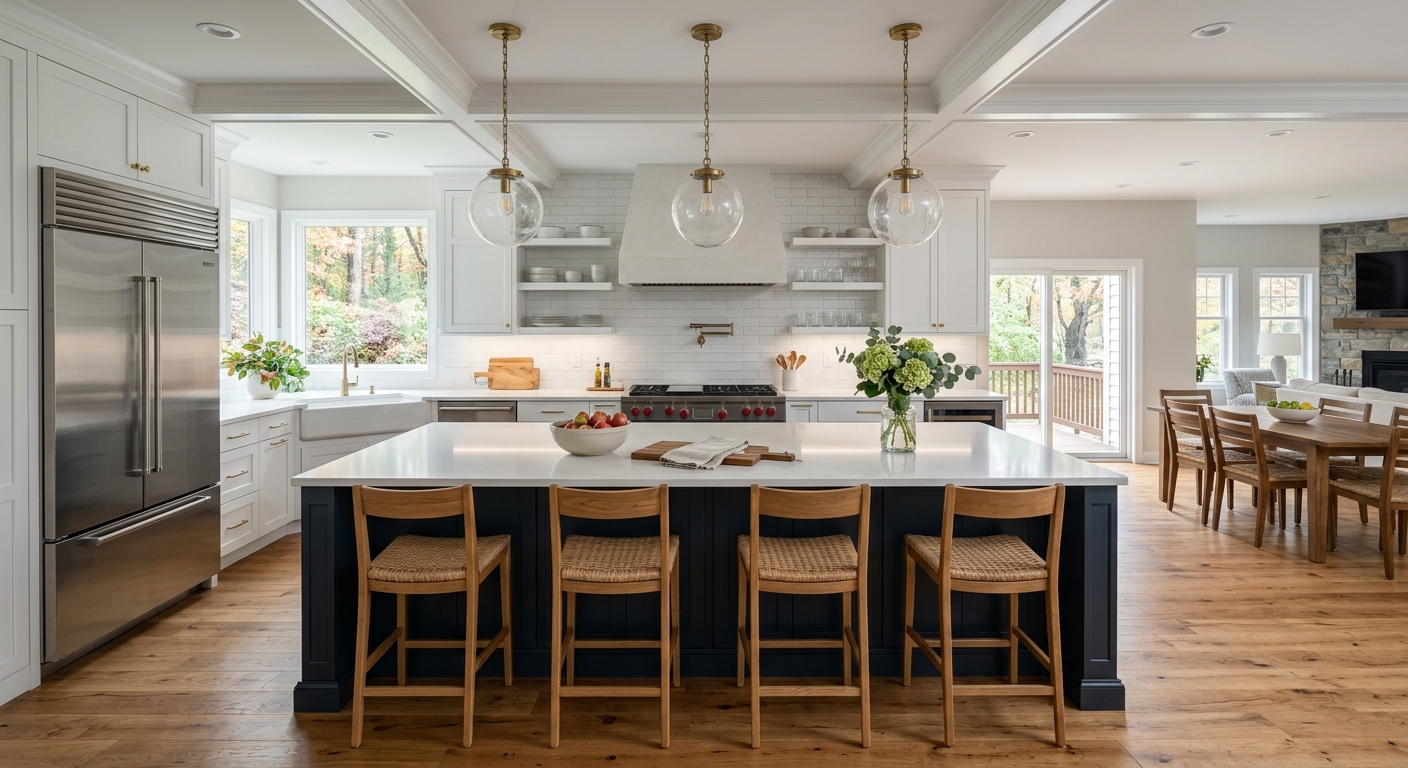
Kitchen renovation costs in Bethlehem — 2026
In Bethlehem, kitchen renovation budgets run the gamut—from modest cabinet updates to high-end gut remodels—because the housing mix is unusually diverse. More than half of households are owner-occupied (55.2%), but the older housing stock (85.9% built before 1980) means renovations often involve more than just cosmetic changes (U.S. Census Bureau, ACS 2024). Median household income here sits at $69,507, and full kitchen projects often match or exceed annual earnings.
The local wave of suburban development in Upper and Lower Macungie after 1960 produced many tract homes; these are now reaching the age where full kitchen replacement is typical rather than elective. Retrofits in these homes focus on replacing builder-grade cabinets and worn counters, while homes built earlier commonly require demolition down to the studs to correct aging infrastructure or substandard layouts.
One of the main reasons projects run over budget is homeowners pricing out a basic “pull and replace” update, then adding scope midstream—moving a sink, changing gas lines, or bringing everything to today’s standards. These changes shift the project into a different price and permit bracket entirely, so clear planning up front is crucial.
| Scope |
What's included |
Duration |
Price range |
| Full gut remodel, same layout |
cabinets, counters, appliances, flooring, lighting, fixtures |
6–10 weeks |
$29,500–$118,500 |
| Gut plus layout change |
all of the above plus moved plumbing, electrical, walls |
10–16 weeks |
$64,500–$118,500 |
| Cabinet replacement (stock to semi-custom) |
remove and install cabinets, hardware, patching |
1–3 weeks |
$6,900–$29,500 |
| Cabinet refacing |
new doors and drawer fronts, veneer, hardware |
3–6 days |
$6,900–$20,000 |
| Countertop replacement only |
template, fabricate, install, reconnect sink |
1–3 weeks |
$4,000–$16,000 |
| Kitchen flooring only |
remove existing, install new flooring |
3–6 days |
$4,900–$20,000 |
Estimates for a typical Bethlehem kitchen. Cabinet grade and whether the layout changes move these figures more than square footage.
Why the contingency exists
In Bethlehem, where 85.9% of homes were built before 1980 (U.S. Census Bureau, ACS 2024), contingency budgets are not a contractor’s trick—they reflect what is uncovered once walls and floors come up in a renovation. The post-1960 suburban homes in Upper and Lower Macungie often contain “builder-grade everything”—particleboard cabinets at the end of their lifespan, tight electrical panels, and laminate counters due for replacement.
But homes built before and during that housing wave bring specific surprises that push costs up:
- Out-of-plumb walls and floors, adding time and labor to properly install cabinets—plan for an extra $1,000–$4,000 in shimming and finish carpentry.
- Undersized, ungrounded, or mixed-aluminum wiring, common in 1960s and 1970s homes—electrical upgrades run $2,000–$8,000 extra.
- Galvanized steel supply lines and cast iron drains—replacement can add $2,500–$6,000 without moving walls.
- No insulation inside exterior walls behind cabinets—adding it during renovation improves comfort, especially with Bethlehem winters.
- Legacy issues: previous unpermitted layout changes or hidden do-it-yourself fixes that don’t meet code, adding either time or costs for correction.
- For pre-1978 homes, any project that disturbs paint falls under the federal EPA Lead RRP Rule. Lead testing and proper procedures are required by law, which adds both direct costs and scheduling delays.
This is why a standard contingency is built into most proposals. In the few tract homes with fewer than 40 years behind them, “hidden conditions” usually mean failing finish materials, but in most of Bethlehem and older township stock, expect the unexpected beneath the surface.
Appliance choices and the decisions they force
One of the biggest planning mistakes in Bethlehem kitchens is not selecting appliances before ordering cabinets. Virtually every base cabinet run is built to fit a specific refrigerator, range, and dishwasher; change those dimensions after the cabinet deposit and you either eat restocking fees or live with ill-fitting gaps.
Refrigerators come in standard and counter-depth varieties. A standard-depth fridge will project beyond your cabinets, while counter-depth units cost more but ensure a seamless profile. Ordering cabinets for one and then buying the other leads to visible alignment problems. Slide-in ranges offer a flush fit with countertops, but must be planned for—cabinets will be notched to straddle them. Freestanding models allow some flexibility but break up that high-end look.
Planning for gas versus induction matters. Switching to induction generally means running a new 240V electrical circuit; sticking with gas may require extending or rerouting piping, especially in homes never wired for an electric range. If you want a panel-ready dishwasher, cabinets must be ordered with precise panel dimensions and mounting points built in.
Range hood venting adds complexity: ducted hoods (the gold standard) vent to the outside, but require running a duct through the wall or roof. Recirculating hoods filter air back into the room—they’re easy to install, but less effective, and not a solution for avid cooks.
Professional-grade appliances deliver extra heat, capacity, and stainless steel style, but the price premium is mainly about aesthetics. Crucially, the lead time for some high-end appliances in the Lehigh County market now sometimes exceeds the wait for custom cabinets—start appliance shopping early.
Choosing cabinetry
Cabinetry is where most Bethlehem homeowners wind up spending the bulk of their kitchen budget—and it’s the area with the widest range of options and tradeoffs. The four main approaches are: repainting, refacing, stock, semi-custom, and full custom cabinetry.
Refacing is the lower-cost, less disruptive option, retaining the old cabinet boxes while updating the doors, drawer fronts, and exterior veneer. This method is excellent when boxes are sturdy, square, and in the right places. However, refacing cannot improve storage or change workflow—for many 1970s and 1980s tract kitchens with dated layouts, this limits its appeal.
Stock cabinets are budget-friendly and available quickly, but only work where the room is close to standard sizes. Fillers and blocks are often required to bridge odd corners or walls. Semi-custom cabinets strike a balance, letting contractors adjust dimensions to fit out-of-square walls—a frequent need in Bethlehem’s older homes shaped by post‑1960 suburban expansion, where remodeling often reveals non-standard sizes. Full custom options genuinely fit everything, but bring both longer lead times and a higher price.
Construction quality matters as much as price. Plywood boxes are sturdier and more durable than particleboard. Drawers with dovetail joints and full-extension, soft-close slides hold up to wear. Frameless (European-style) cabinets maximize storage, but face-frame units suit traditional looks and are easier to install over wavy plaster and lath walls.
| Option |
Cost |
Best when |
Limitation |
| Painting existing cabinets |
$1,200–$3,500 |
boxes and doors sound, tight budget |
no layout or style change |
| Refacing |
$6,900–$20,000 |
boxes square and layout works |
storage unchanged |
| Stock cabinets |
$6,900–$29,500 |
standard dimensions fit |
filler strips, limited finishes |
| Semi-custom |
$20,000–$29,500 |
non-standard walls or finishes |
6–12 week lead time |
| Full custom |
$20,000–$29,500 |
unusual layout or high-end design |
longest lead, highest cost |
Defining your scope before you get quotes
The reason “kitchen remodel” means so many things in Bethlehem is that project size spans from a $4,000 paint-and-fixtures refresh to a six-figure gut and expansion. Cost, disruption, and permit needs all depend on scope, so define it before you start calling contractors.
- Cosmetic refresh: Painting, new hardware, backsplash, light fixtures—no cabinet moves or service changes. Fastest and cheapest.
- Pull and replace: New cabinets and countertops, but with layout, plumbing, and electrical staying in their original locations. You get a brand-new look without chasing hidden conditions behind walls or floors.
- Gut, same layout: Stripped to the studs, with new electrical, lighting, insulation, and drywall, but everything (sink, range, refrigerator) stays in place. Modernizes the space but keeps it in the lowest permit and design bracket.
- Layout change: Anything that moves walls, plumbing (like the sink), electrical, or gas. This triggers building permits, engineering, and often much higher costs. In Bethlehem, the price jump here is abrupt because these jobs require licensed subcontractors, code inspection, and possibly stamped plans.
This “cost cliff” between tier three and four is where budgets dive off a ledge—moving a sink 4 feet is not just some added pipe, but a chain reaction of permits, trades, and patching. Decide your scope first. That’s how a contractor can give you a straight answer vs. a wild guess. Without knowing the tier, no price will hold up at contract signing.
Permits and inspections for a Bethlehem kitchen
Most cosmetic kitchen work in Bethlehem—like painting, installing new hardware, or refacing cabinets—can proceed without permits. Even countertop swaps often don’t trigger permitting. However, once you plan to relocate plumbing lines, install new electrical circuits, or move gas piping, a building permit is required, especially for jobs in Allentown and Lehigh Valley townships.
If you are redesigning the layout and moving structural walls, or planning any significant changes to mechanical or venting systems (such as installing a vented range hood), expect plan review and permits before work may begin. Allentown, for example, conducts its own building department plan reviews on remodels involving layout, structural, or systems changes.
Inspections differ depending on the municipality. Electrical inspections within Allentown are completed by the city’s code office. In the surrounding townships, third‑party agencies are often used, which can be surprising if you have only renovated in Philadelphia or more rural areas. Scheduling and requirements for these third-party inspections can add days or even weeks to timelines.
Every contractor working on jobs over $500 in Lehigh County must have Home Improvement Contractor (HIC) registration from the Pennsylvania Office of Attorney General. It is wise to verify this registration. Employers must also carry workers’ compensation insurance—check this in advance using the state’s WCAIS system so you’re not exposed to liability if an injury happens on your jobsite.
The resale risk of unpermitted work in Bethlehem is real. If regulators uncover non-compliant improvements during a buyer’s inspection, it can cost thousands to retroactively permit or even rip out renovations to meet code, stalling or scuttling your sale.
What moving the sink really costs
In Bethlehem, the difference between a straightforward “pull and replace” kitchen update and a full-blown remodel frequently comes down to this: do you change the kitchen’s layout, especially moving the sink? Keeping the plumbing and electric where they are limits scope, cost, and permit requirements. Move them, and the project enters a steeper, less predictable cost bracket—often adding $30,000–$50,000 or more above simple replacements.
Relocating the kitchen sink, for example, means running new supply and drain lines. Drains require a consistent slope all the way to the stack, and in Bethlehem’s split-levels or homes on slab, this can involve drilling, opening floors, and sometimes running lines through finished areas downstairs. Plumbing changes almost always trigger permit and city inspection in Allentown and most Lehigh County townships.
Electrical moves are just as involved. Adding circuits for a relocated range or additional outlets might require a panel upgrade, not just some new wire—that’s a job that demands planning, inspection, and access throughout the house.
If the new layout demands removing or moving a wall, you first need to determine if it’s load-bearing. That generally requires a licensed engineer’s review and calculations before a permit is issued, and brings both design and city review into the mix.
Venting a range hood (especially on an interior wall) may also require a new hole through masonry or siding, which adds both direct cost and coordination with mechanical trades.
Unless your current kitchen layout makes working or entertaining truly difficult, consider carefully before crossing this threshold. Many Bethlehem owners spend tens of thousands to move a sink or range a short distance, when a updates-in-place plan delivers nearly all the function and resale value with far less risk and regulation.
Frequently asked questions — kitchen renovation in Bethlehem
What happens if previous work was unpermitted?
If unpermitted kitchen renovations are found in a Bethlehem or Lehigh County home, two problems arise: delayed resale and possible fines or mandatory tear-out. At time of sale, appraisers or home inspectors often notice missing permits for past work—especially if plumbing, electrical, or wall layout has changed. Local code offices can require “as-built” permits, potentially involving expensive retrofits, hole-cutting to verify code compliance, or even removal and replacement of non-conforming improvements. This can add $6,900–$29,500 in unexpected costs. Pennsylvania law also allows buyers to pull out of a sale if undisclosed unpermitted work is discovered. For work over $500, a contractor should have provided a written contract and proper HIC registration. Always check permits and paperwork before signing, and don’t skip steps to “save” money upfront.
What does a quartz countertop cost in Bethlehem?
Quartz countertop replacement in Bethlehem typically falls between $4,000–$16,000 depending on size, edge profile, and whether backsplashes or undermount sinks are included. For a standard kitchen with 40 to 60 square feet of counter, most homeowners spend around $8,900 installed. That covers template, fabrication, delivery, removal of the old top, professional installation, and reconnecting the sink. Higher-end colors or complex layouts can push costs to the upper end of the range. Unlike metropolitan markets farther east, Lehigh County’s competitive remodeling sector and several local stone fabricators keep prices within this window. Always verify your installation contract includes proper disconnects and reconnects—especially if plumbing permits are triggered by moving sink locations.
Should I reface or replace my kitchen cabinets?
In Bethlehem’s housing market, whether to reface or replace kitchen cabinets comes down to the condition and configuration of your current boxes. Refacing—installing new doors, drawer fronts, veneer, and hardware—runs from $6,900–$20,000, and is a solid value if your cabinet layout makes sense and the boxes are sturdy, square, and not deteriorating. Refacing cannot change cabinet heights, add deep drawers, or remedy poor workflow in kitchens shaped by old layouts. If you want to change the footprint, add storage, or solve non-standard dimensions—which are common in older Bethlehem and township homes—full replacement using stock, semi-custom, or custom cabinets (at $6,900–$29,500) is warranted. Don’t spend money refacing if your boxes are warped or the layout frustrates you every evening.
Do older Bethlehem homes need electrical upgrades for a kitchen?
Yes, most older Bethlehem homes—especially those built before 1980—require at least partial electrical upgrades during a kitchen remodel. It’s common to find ungrounded outlets, limited circuits, and outdated wiring methods that can’t safely handle today’s appliances and lighting demands. Upgrading wiring during a full gut or layout change can add $2,000–$8,000 to the project cost but will bring the home up to safety and code standards. Electrical permits and inspection are triggered whenever new circuits are added or wiring is relocated in Bethlehem and throughout Lehigh County. This is not just a code requirement but a real insurance and safety issue—don’t skip this step, especially if your home still has two-prong outlets or aluminum branch wiring.
What adds the most resale value in a kitchen?
In Bethlehem and Lehigh County, the updates that add the most resale value focus on visible finishes and functional layouts. Complete gut remodels with new cabinets, high-quality quartz or granite counters, modern appliances, and improved lighting consistently attract the most buyers, especially in homes over 30 years old. According to local project bands, a full gut kitchen remodel (same layout) typically runs $29,500–$118,500, while high ROI upgrades include refacing sturdy cabinets and installing new counters for less than half that. Moving walls or changing the kitchen footprint is a bigger investment that doesn’t always recoup dollar-for-dollar at resale. Cosmetic upgrades—paint, hardware, backsplashes—add “wow” at low cost but won’t solve functional issues or code deficiencies if present.
How much do new kitchen cabinets cost in Bethlehem?
Cabinet replacement in a typical Bethlehem kitchen ranges from $6,900–$29,500, depending on style, finish, and whether you opt for stock, semi-custom, or custom cabinets. Stock cabinets are generally the least expensive and quickest to install but fit best in homes with standard-size layouts, often post-1980 construction. Semi-custom offers benefits for older homes with non-standard dimensions. Full custom, sometimes necessary in quirky layouts from earlier eras, is at the top end. Factor in hardware, trim, and labor, which is priced middling in Lehigh County’s tight but skilled labor market—more affordable than Philadelphia, higher than outlying rural counties. Cabinet costs are nearly always the largest single line item in a full kitchen remodel budget.
Can I live in the house during a kitchen renovation?
You can usually live in your Bethlehem home during a kitchen renovation, but expect significant dust, noise, and logistical headaches—especially with full gut or layout-change projects lasting 6 to 16 weeks. Shorter jobs like cabinet refacing or countertop replacement ($4,000–$20,000) are often completed in a few days and can be managed with careful planning. For gut remodels, most families set up temporary cooking and dish-washing in another room. If you have only one kitchen, be realistic: power and water may be off for days, and the older homes common here can make timelines unpredictable. Consider boarding pets elsewhere, and plan to seal off work areas to keep dust from spreading throughout your house.
How far ahead should I book a contractor in Bethlehem?
In the Bethlehem and greater Lehigh County area—a saturated market with experienced remodelers but steady demand—plan on booking your kitchen contractor 2–4 months ahead for major projects, or 4–8 weeks for cabinet or counter replacements. Lead times can stretch longer during peak spring and summer months, and for the most in-demand contractors or custom cabinet orders. Appliance procurement in this market can also delay timelines—some models now take longer to arrive than semi-custom cabinets ($20,000–$29,500). Start conversations early, verify HIC registration, and lock in schedules and contracts before making deposit payments or special orders. Rushed timelines inevitably add cost or compromise on quality.
Should I choose plywood or particleboard cabinet boxes?
For Bethlehem kitchens, plywood cabinet boxes are usually worth the extra cost—especially in homes older than 1980, where walls are rarely square and humidity can fluctuate. Plywood boxes resist screw pullout and moisture damage better than particleboard, and hold up over decades even as cabinets are removed for plumbing or electrical work. Particleboard is more affordable and works in dry, stable environments—typical of newer tract homes with less movement. Plywood base cabinets start at the higher end of the replacement band ($20,000–$29,500 for a typical kitchen with semi-custom), but you’re paying for longevity. Particleboard is fine for upper cabinets or in low-traffic areas, but don’t cut corners on the boxes bearing weight, especially in this climate.