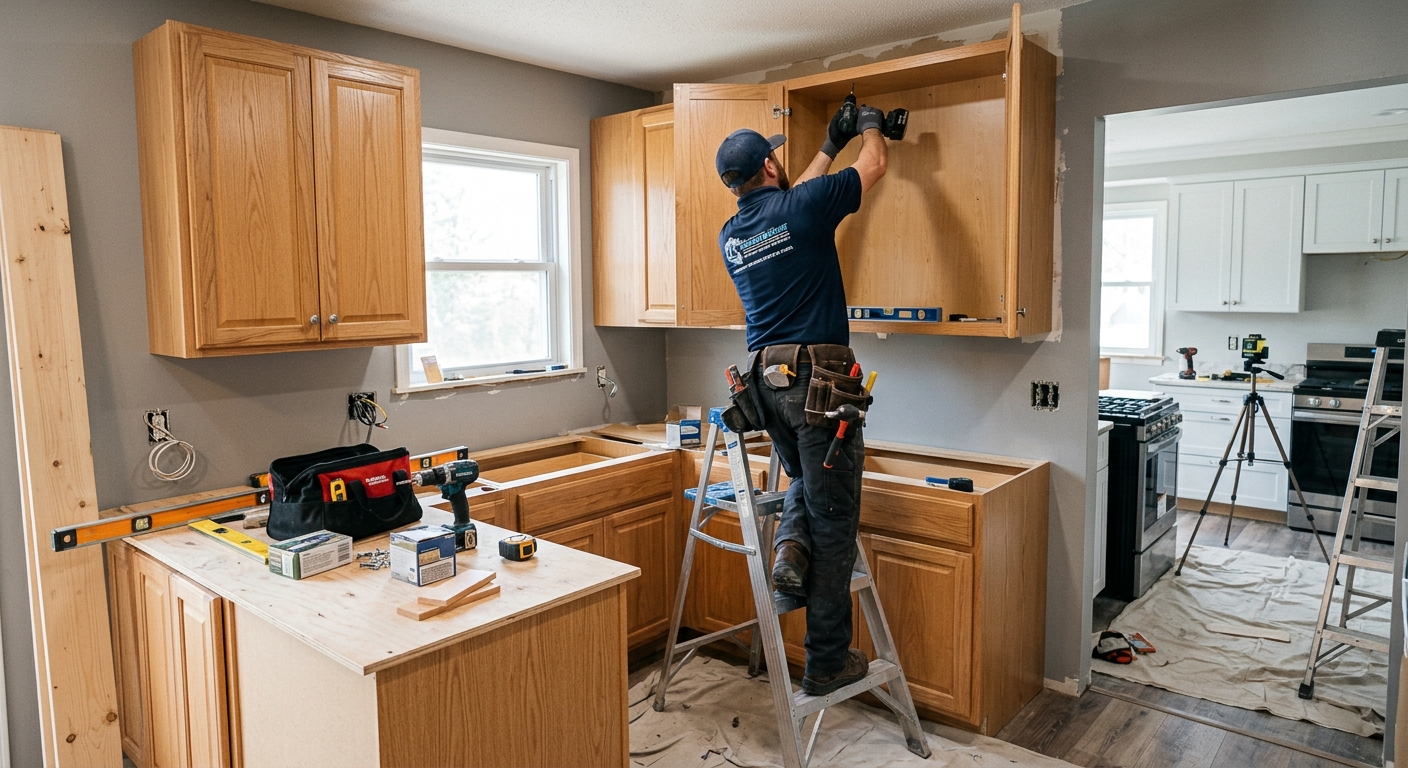
Kitchen renovation costs in Salisbury — 2026
Kitchen renovations in Salisbury stand out for one practical reason: the area’s high homeownership rate (75.2%) and a median household income that hovers near $86,310 (U.S. Census Bureau, ACS 2024) mean most residents plan projects as long-term investments, not short-term flips. For most, the real question is not whether a kitchen needs work, but whether the scope fits both the house era and your budget. Much of Salisbury’s housing was built in the post-World War II boom—especially the tract homes near Lancaster and Manheim Township—so it’s common to find compact, mid-century kitchens that need layout upgrades as much as fresh finishes. This era drives up the likelihood of wanting to move walls or relocate services, which pushes costs above a “surface only” makeover.
The biggest swing in kitchen prices comes from misalignment: pricing based on minor upgrades, then deciding mid-design to move walls or swap out every appliance. A typical Salisbury gut remodel—keeping the existing layout—starts at $30,500–$122,500, but costs rise fast if you want to change the footprint or relocate plumbing and electric. Cabinet replacement is the next largest chunk, which ranges from $7,100–$30,500 (stock to semi-custom). Surface updates—refacing, new countertops, new flooring—fall in lower bands, but even these quickly exceed $10,000 if the room is larger than average or entry-level materials are skipped.
| Scope |
What's included |
Duration |
Price range |
| Full gut remodel, same layout |
cabinets, counters, appliances, flooring, lighting, fixtures |
6–10 weeks |
$30,500–$122,500 |
| Gut plus layout change |
all of the above plus moved plumbing, electrical, walls |
10–16 weeks |
$66,500–$122,500 |
| Cabinet replacement (stock to semi-custom) |
remove and install cabinets, hardware, patching |
1–3 weeks |
$7,100–$30,500 |
| Cabinet refacing |
new doors and drawer fronts, veneer, hardware |
3–6 days |
$7,100–$20,500 |
| Countertop replacement only |
template, fabricate, install, reconnect sink |
1–3 weeks |
$4,100–$16,500 |
| Kitchen flooring only |
remove existing, install new flooring |
3–6 days |
$5,100–$20,500 |
Estimates for a typical Salisbury kitchen. Cabinet grade and whether the layout changes move these figures more than square footage.
Renovating to live in versus renovating to sell
In Salisbury, kitchen renovation pays off most reliably when your goal is to enjoy the space—not to turn a profit at sale. Modern buyers respond strongly to updated kitchens, but even in a high-ownership town, these projects seldom recoup their full cost. The exception is when work brings a worn-out kitchen up to neighborhood expectations without outspending nearby homes. If your kitchen is old enough to stand out negatively in a local market where the median household income is $86,310, an upgrade will likely help the house sell faster and closer to its asking price.
But there’s a ceiling: gutting and rebuilding a kitchen with premium finishes in a typical Salisbury home won’t bring back every dollar invested. Renovating to sell means choosing neutral cabinets and counters, sticking with mid-range materials, and never moving plumbing or knocking out walls—because layout changes rarely return what they cost. Renovating to live in, on the other hand, justifies spending on features and layouts that make daily life easier, even if the eventual resale value doesn’t keep pace. The difference is why most real estate agents advise staying within market norms: a $66,500 kitchen in the heart of a $200,000–$350,000 neighborhood risks over-improving, especially in the moderate Lancaster County market. Salisbury’s high homeownership rate means people stay put—and that tips the math toward long-term value, not quick resale.
Practical survival during the work
Life without a working kitchen for weeks is where most Salisbury homeowners underestimate the true cost of renovation. The first step is to set up a temporary kitchen—usually in a dining room or basement. Move the refrigerator nearby if possible, set up a folding table for a microwave and coffee maker, and resign yourself to using a bathroom or laundry sink for dishes. Paper plates, disposable cups, and a stock of shelf-stable meals become standard. Plan for your grocery budget to jump, since eating out—sometimes for up to eight weeks in a major gut—quickly adds up. For perspective, many families spend more on restaurants during a remodel than on the new kitchen flooring.
Dust will get everywhere unless the crew hangs plastic sheeting and uses zip walls to seal off the construction area—critical in open layouts common to the postwar homes around Lancaster and Manheim Township. Ask where the dumpster will go and which space (garage, driveway) is used for material delivery. Pets need extra care, as workers will have doors propped open during loading and cleanup. Some families choose to stay elsewhere for demolition week, which is the messiest phase and when utilities are out of service.
In short: living through a kitchen remodel in Salisbury is do-able, but only with planning and the right mindset.
Lead times, sequencing and why it takes longer
Kitchen renovations in Salisbury take longer than most expect, largely due to how each phase waits on the one before it. The process is sequential by necessity: after design and measurement, cabinets are ordered—which, in Lancaster County’s tightly scheduled labor market, means a typical cabinet lead time of six to twelve weeks. Demolition only starts once those cabinet delivery dates are confirmed; starting earlier just extends the time you’re without a kitchen.
After demolition, the rough plumbing and electrical work gets done—if you’re changing layout, these steps are lengthier and must pass inspection before anything can be closed up. Next, drywall is finished and the cabinet install begins. The biggest shock to most homeowners comes here: the countertop cannot be measured (“templated”) until every cabinet is installed and level. This triggers a dead period—a week or longer—before the countertop fabricator returns, measures, then builds the top. Only after the countertop is in does final plumbing, flooring, backsplash and trim work proceed.
Because Lancaster County’s finish-trade labor is tighter than the Harrisburg–York market, delays from trades running behind are common, especially if a third-party inspection is required at each stage. The critical path is always cabinets and counters: order cabinets before demolition, never after. Every week lost there lengthens the job more than anything else.
The biggest line item in your Salisbury kitchen
Cabinets are the single largest driver of cost and satisfaction in a Salisbury kitchen renovation. There are four practical options. First, refacing: this means keeping your existing cabinet boxes, putting on new doors and drawer fronts, fitting veneer to the outside, and swapping hardware. Refacing costs less and works well—but only if the cabinet boxes are square, undamaged, and laid out the way you want. It cannot add storage or change function.
Stock cabinets come in standard sizes with limited finishes and need filler panels in Salisbury’s many mid-century homes, where room dimensions are rarely precise. Semi-custom cabinets offer more flexibility in width, depth, and finish, helping fit walls that aren’t square—an issue across the county’s postwar housing stock. Custom cabinets do anything you can dream but take the longest to build and cost the most.
Regardless of option, construction features matter. Plywood boxes last longer and resist sagging better than particleboard. Dovetail drawers and soft-close full-extension slides make daily use more pleasant. Frameless (“European”) cabinets maximize storage but cost more to install, while face-frame designs can hide wall irregularities. In Salisbury, many remodels end up with semi-custom even if the original plan called for stock, just to fit a typical out-of-square kitchen built between 1950 and 1980.
| Option |
Cost |
Best when |
Limitation |
| Painting existing cabinets |
$1,200–$3,500 |
boxes and doors sound, tight budget |
no layout or style change |
| Refacing |
$7,100–$20,500 |
boxes square and layout works |
storage unchanged |
| Stock cabinets |
$7,100–$30,500 |
standard dimensions fit |
filler strips, limited finishes |
| Semi-custom |
$20,500–$30,500 |
non-standard walls or finishes |
6–12 week lead time |
| Full custom |
$20,500–$30,500 |
unusual layout or high-end design |
longest lead, highest cost |
Who should run your Salisbury renovation
How you structure your Salisbury kitchen remodel will determine your cost, stress, and timeline. The design-build model puts a single company in charge of design, product specification, and installation—simplifying communication, but at the highest cost. General contractors are more common in Lancaster County: they coordinate trades, pull permits, and stick to your designer’s or your own specs, which carries mid-range cost and effort. Owner-managed means hiring subcontractors directly and sequencing their work yourself; it’s the cheapest but also the riskiest and most time-consuming, with all coordination falling to you.
Finish-trade labor in Lancaster County is tighter and busy, meaning the risks of self-managing are higher than in larger urban areas. If your project triggers a permit—especially electrical or plumbing changes—it will involve inspections and coordination across several trades. Anyone with a day job is typically better served by a general contractor or design-build team unless they’ve got time to be on-site daily and manage schedules. Owner-management works for simple cabinet swaps or cosmetic refreshes, but quickly becomes overwhelming once multiple trades and inspections are involved. For full gut renovations, paying for professional oversight is almost always the least painful option in Salisbury.
Permits and inspections for a Salisbury kitchen
For most Salisbury kitchen projects, permits depend on both the scope and the address. Cosmetic upgrades—painting, changing hardware, refacing cabinets, or replacing a countertop without altering plumbing—are usually permit-free across most Lancaster County townships. The line gets crossed when you add or move electrical circuits, reroute plumbing, alter load-bearing walls, or make significant layout changes; in Lancaster city, these trigger a building permit and often a formal plan review, particularly on major remodels.
Most homeowners are surprised that, even outside Lancaster city, cabinet replacement alone rarely requires a permit unless you are also reworking mechanical systems. Electrical inspections in the city and nearby townships use certified third-party agencies like Middle Department Inspection Agency, rather than the municipality itself.
Any contract for more than $500 must be with a contractor registered with the Pennsylvania Office of Attorney General’s HIC registry (check hic.attorneygeneral.gov), and every employer must provide proof of workers’ compensation (checkable at wcais.pa.gov). Skipping permits can slow or even block future resale—unpermitted work is a red flag on sales and home insurance claims, and it is far costlier to fix after closing than to permit correctly from the start.
Frequently asked questions — kitchen renovation in Salisbury
Can I live in the house during a kitchen renovation?
For most Salisbury homeowners, living in the house during a kitchen renovation is entirely possible, but it takes some planning and flexibility. If your remodel is limited to surfaces—such as a countertop replacement or cabinet refacing, which each fall in the $4,100–$20,500 range—the disruption is usually limited to a few days without a sink or stove. When it’s a full gut, especially those running six to ten weeks, you’ll lose access to water, appliances, and a clean workspace. Many set up a temporary kitchen in a dining room or basement with a microwave and toaster oven and use a bathroom or laundry sink for dishes. The challenging week is demolition, when dust and noise peak and the crew comes and goes all day. If you have pets or young kids, or if anyone works from home, some choose to move out just for the worst week. Eating out will be part of your budget—many spend more at restaurants during a full gut than on their new flooring. Salisbury homes, especially older ones, can produce more dust and disruptions if walls are coming down, so be prepared for a more active household than you might expect.
What are cabinet lead times in Salisbury right now?
Cabinet lead times in Salisbury—and throughout Lancaster County—are typically in the six to twelve week range for semi-custom and custom orders. If you’re choosing from standard stock at a big-box store, you might get delivery within a few weeks, but as soon as you want a specific color, finish, or sizing adjustment that’s common with Salisbury’s out-of-square and mid-century walls, expect to wait at least two months. Since local finish-trade labor is tight, delays at the cabinet shop stack onto busy installer schedules, so always order before demo begins. Jumping the gun leads to weeks without a kitchen while you wait for the boxes to arrive. For reference, most Salisbury kitchen gut remodels—typically starting at $30,500–$122,500—are stalled more by the cabinet and counter schedule than actual installation work. Planning ahead keeps the overall timeline realistic.
Is induction worth it over gas?
Choosing induction over gas in a Salisbury kitchen remodel depends on your cooking habits and budget. Induction cooktops are extremely efficient, offer speedy heating, and are easier to keep clean since spills don’t bake onto the surface. They’ve become more popular locally, especially in postwar homes where running new gas lines isn’t practical or triggers permit headaches. Upfront costs for induction are higher, both in appliance price and in electrical upgrade if your panel is older—a common trait in Salisbury’s mid-century housing stock. The cleanability and safety (no open flame) win over many, especially families with young kids. Unless you’re set on old-school gas for wok cooking or grilling, induction suits most daily cooks. In a typical kitchen project (usually $66,500 for a gut renovation), the extra $1,000–$2,500 for induction is small in the context of the whole budget, but check your pans for compatibility before deciding.
How does Salisbury's housing stock affect cabinet fit?
Salisbury’s large share of homes built before 1980 (46.4%) means you’ll often encounter kitchens with non-standard dimensions, out-of-square walls, and shoulder-height soffits that eat up usable space. If your renovation simply replaces what’s there, stock cabinets in the basic $7,100–$30,500 range may require filler strips or leave awkward gaps. For a tighter fit, most owners go semi-custom, which can easily increase costs and stretch timelines (6–12 weeks lead time is standard). This is a direct result of how postwar tract homes were built around Lancaster: quick, cost-effective methods that didn’t focus on precise room dimensions. In practice, most Salisbury kitchen projects end up somewhere between stock and semi-custom cabinetry unless you’re set on keeping the existing layout unchanged. Planning for walls that aren’t perfectly square prevents costly surprises down the line.
Is a cosmetic refresh enough or do I need a gut remodel?
Deciding between a cosmetic refresh and a full gut remodel in Salisbury depends on your kitchen’s condition and your goals. A cosmetic refresh—cabinet refacing, new counters, or fresh paint—can give a tired space a dramatic lift for $4,100–$20,500. If the bones of the kitchen are solid—boxes square, layout functional, services reliable—a refresh is often enough to modernize and avoid the downtime, dust, and budget shakeout of a full gut. But Salisbury’s postwar era homes often have outdated layouts, old electrical, or cramped galleys; if those bug you daily or if you’re constantly wishing for better storage, it’s more cost-effective to bite the bullet and do a full remodel, even at the typical $66,500 cost. Patchwork fixes can sometimes chase one another forever—assess honestly whether a facelift will meet your needs for another decade.
What does a full gut kitchen remodel cost in Salisbury?
In Salisbury, a full gut remodel that keeps the kitchen layout roughly the same but replaces everything—cabinets, counters, appliances, flooring, lighting—runs from $30,500–$122,500, with most projects around $66,500. This wide range comes from the choices you make on cabinets (stock, semi-custom, custom), countertop material, appliances, and whether flooring extends into adjacent areas. Layout changes, which move plumbing or knock down walls, shift the figure to the higher end of the range. Because lots of houses in Salisbury are mid-century builds, fixes for crooked walls, electrical panel upgrades, or unexpected framing work are common, so smart renovators budget a bit for the unknown. It’s crucial to align the remodel budget with neighborhood values, since over-investing rarely pays off at resale. Plan the scope carefully and be wary of mid-project scope creep, which is the fastest way budgets go off the rails.
Can I over-improve for my Salisbury neighbourhood?
Yes, and it happens more than people think—especially with today’s appliances and high-end finishes. Salisbury’s median household income of $86,310 sets the spending baseline for most remodels, with bulk of kitchen gut jobs falling around $66,500. Going well above this—custom cabinets, pro-grade appliances, imported tile—can outstrip resale values in a moderate suburban market like Salisbury. The risk? You might love your new kitchen, but buyers in a neighborhood of $300,000 homes won’t pay a premium for upgrades meant for twice the price point. Instead, focus on quality functional improvements and a clean neutral style for better return. Unless you intend to stay long-term and value the upgrade personally, matching the expectation of local buyers provides the best financial safety. Over-improving is rarely recouped at sale in Lancaster County.
What does a quartz countertop cost in Salisbury?
Quartz countertop installations in Salisbury run from $4,100–$16,500, depending on the size of the kitchen, the quartz brand, and whether you’re moving sinks or adding custom edges. A typical mid-range kitchen tops out at about $9,200 for quartz, including removal of the old counter, templating, installation, and basic plumbing reconnection. If your layout is irregular—a common issue in postwar tract homes—expect small surcharges for seaming or custom fitting. Quartz is popular locally because it’s durable, resists staining, and doesn’t need sealing, suiting busy family homes in Salisbury. Remember, quartz installs can only happen after cabinets are set and level, so factor in the unavoidable dead period after cabinet installation into your renovation schedule.
Who inspects kitchen electrical work in Salisbury?
In Salisbury and surrounding Lancaster County townships, electrical inspections for kitchen remodels are commonly done by certified third-party agencies such as Middle Department Inspection Agency. This is different from some areas where the municipal code office handles everything. So, if your project adds or moves circuits—and most gut remodels in the $30,500–$122,500 range will—you’ll schedule inspection with the agency authorized by your local municipality, not the city office itself unless you’re in Lancaster proper. The inspector will check that all electrical work meets the Pennsylvania Uniform Construction Code. Being surprised at the end (and possibly failing an inspection) is the main reason it’s best to work with a contractor already familiar with Salisbury and Lancaster jurisdiction quirks. Passing these inspections is also required if you ever go to sell, as buyers and insurers check permits and inspection docs closely.