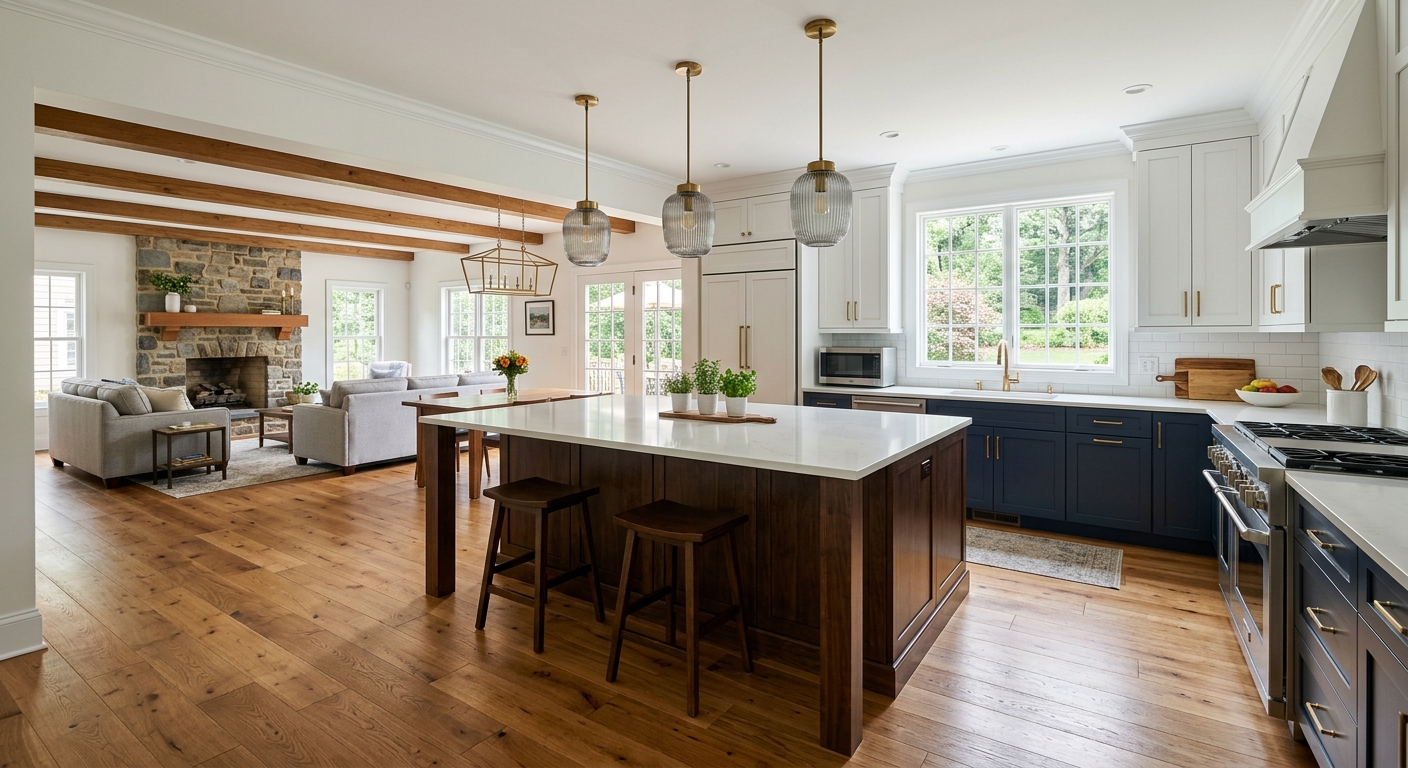
East Huntingdon kitchen renovation prices by scope — 2026
In East Huntingdon, kitchen renovation is a significant investment, frequently planned by homebuyers and families—78.2% of households here own their homes, and the median household income is $62,153 (U.S. Census Bureau, ACS 2024). Your home’s era also dictates cost drivers: most local houses were built before 1980, so renovations here often address not only finishes but layout and outdated electrical systems.
Westmoreland County homes skew toward 1960s–1980s construction, which means many projects cross the line from cosmetic upgrades into full-scale remodels with layout changes or major electrical work. That’s the point where costs climb sharply. The most common budget mistake in East Huntingdon is pricing out a “pull and replace” or surface-level upgrade, then approving a scope that moves utilities or removes walls. The price difference isn’t linear—it’s a leap in complexity, permitting, and inspection.
| Scope |
What's included |
Duration |
Price range |
| Full gut remodel, same layout |
cabinets, counters, appliances, flooring, lighting, fixtures |
6–10 weeks |
$28,000–$112,000 |
| Gut plus layout change |
all of the above plus moved plumbing, electrical, walls |
10–16 weeks |
$60,500–$112,000 |
| Cabinet replacement (stock to semi-custom) |
remove and install cabinets, hardware, patching |
1–3 weeks |
$6,500–$28,000 |
| Cabinet refacing |
new doors and drawer fronts, veneer, hardware |
3–6 days |
$6,500–$18,500 |
| Countertop replacement only |
template, fabricate, install, reconnect sink |
1–3 weeks |
$3,700–$15,000 |
| Kitchen flooring only |
remove existing, install new flooring |
3–6 days |
$4,700–$18,500 |
Estimates for a typical East Huntingdon kitchen. Cabinet grade and whether the layout changes move these figures more than square footage.
Circuits, GFCI and code compliance
Electrical upgrades are the most common cause of mid-project “scope creep”—especially in East Huntingdon’s pre-1980 homes, which make up 56.2% of the local stock. Code today requires at least two dedicated 20-amp small appliance circuits, GFCI protection for all countertop outlets, receptacle spacing every four feet, and dedicated circuits for a dishwasher, garbage disposal, and built-in microwave. If you’re installing an electric range, a 240-volt line is needed.
But a typical Westmoreland County kitchen—especially from the 1960s to 1980s—often has only one or two shared circuits, sometimes with no ground and the occasional run of aluminum wire. Many panels are maxed out. Once walls are open and electrical is touched, all new wiring in that area must meet the current Pennsylvania Uniform Construction Code (UCC) requirements, enforced locally. You cannot simply repair what’s there; code compliance is mandatory, not optional.
On the low end, bringing an older East Huntingdon kitchen’s electrical up to code might add $4,000–$8,000 to the budget—if your panel has space and access is easy. On a gutted kitchen with multiple wall opens, rewiring, GFCI outlets, and dedicated circuits, costs frequently land toward the upper end; if the main panel needs upgrading, that can easily exceed $8,000. Always budget for code-compliant electrical if your home was built before modern standards, as this is rarely “just an extra outlet or two.”
Code requirements for East Huntingdon kitchens
In East Huntingdon, it’s crucial to know where your project falls in the eyes of code. Work that’s strictly cosmetic—like painting, swapping cabinet pulls, refacing cabinets, or replacing a countertop in place—does not usually require a permit. But the line is drawn as soon as electrical work is done (adding or moving circuits), plumbing is rerouted, walls are moved or removed, or anything structural or mechanical (like installing a new duct for a range hood) is changed. For example, in nearby Greensburg, moving a wall or relocating plumbing lines triggers a building permit, and formal plan review is generally required if you change structural elements or upgrade services.
Electrical inspections in East Huntingdon are commonly conducted by certified third-party agencies, such as Code.sys, not just the township. This can catch some homeowners off-guard, especially if they’re used to a municipal inspector. It’s always best to clarify which body will inspect before work starts.
All contractors for projects over $500 must have Pennsylvania Home Improvement Contractor (HIC) registration. This can be verified on the state’s online registry. Workers’ compensation coverage is mandatory for contractors with employees, and can be checked in the WCAIS system.
Skip permitting and you may lose out at resale: unpermitted work can stall a closing or require costly corrections later. Written contracts are required by law for jobs over $500, and you’re entitled to a three-day right of cancellation under Pennsylvania’s Home Improvement Consumer Protection Act.
When a East Huntingdon kitchen needs walls moved
Cost and complexity rise sharply the moment you move plumbing, electrical, or walls in a kitchen renovation. If your East Huntingdon kitchen is the typical 1960s–1980s build, the original layout may feel cramped or inefficient—but whether to invest in a full layout change is the most consequential financial decision you’ll make.
Relocating sink drains or water lines isn’t as simple as moving the appliance. Drain lines need continuous downward slope to the main stack, and if your kitchen is on a slab or above a finished or living space, achieving that may require cutting concrete or opening ceilings below. Electrical relocations typically need additional circuits—and if your existing panel is out of capacity or not up to current code, this could mean a full panel replacement.
Removing a wall, especially in older Westmoreland County homes, first means identifying if it’s load-bearing. If it is, a beam (specified by an engineer and permitted accordingly) is required. Moving a range hood requires a new duct opening to the outside, which means an exterior wall penetration, careful flashing, and further inspection.
Permits and plan review are typically triggered by these sorts of scope changes, especially in jurisdictions like Greensburg. As a rule, if you move walls or “rough” utilities, expect the project to land firmly in the $60,500–$112,000 range, compared to a gut remodel with no major layout change, which would more typically be $28,000–$60,500.
Ask yourself if the current floor plan is truly unworkable or merely dated. Often, smarter cabinet design, better lighting, and some creative finishes solve more than you’d expect—without pushing you over the threshold into major construction costs.
What a kitchen quote should specify
Comparing kitchen quotes in East Huntingdon isn’t about headline totals—it’s the details that matter, especially on the allowance lines. An “allowance” is just a budget placeholder for an item you haven’t selected yet, like tile or lighting. One quote might allow $2,000 for stone counters, while another allows $500 for basic laminate. The difference won’t show up in the total until you go to order, when it hits your pocket directly. Scrutinize every allowance line before comparing total bid amounts.
Quotes should specify the cabinet brand, line, and box construction (plywood versus particleboard); for countertops, material name, thickness, pocket for seams, and edge style. Electrical upgrades—especially in older houses—must show how many circuits are being added and how GFCI protection will be handled. Every quote should explain how unforeseen issues (mold, hidden structural defects) are addressed and require that you approve change orders in writing before extra work begins.
Payment schedules should be structured around milestones—like demo complete, cabinets delivered, final walk-through—with reasonable upfront deposits. Finally, make sure you receive lien waivers from subcontractors every time you make a payment, protecting you from claims down the line. Remember, Pennsylvania law requires a written contract and gives you three business days to cancel jobs over $500.
| Line item |
What to look for |
Red flag if… |
| Allowances |
realistic amounts, itemised |
round numbers with no basis |
| Cabinetry |
brand, line, box construction |
'quality cabinets' |
| Countertops |
material, thickness, edge, seams |
material name only |
| Electrical |
circuits to be added, GFCI scope |
'as needed' |
| Unforeseen conditions |
how they are priced and approved |
not addressed |
| Change orders |
written approval before work |
verbal |
| Payment |
milestone-based, modest deposit |
front-loaded |
| Lien waivers |
from subs at each payment |
not offered |
Why appliance selection comes first
Choosing your appliances is the very first step in a successful kitchen project in East Huntingdon—not an afterthought. Cabinet sizes and layouts are literally built around the footprint of your refrigerator, range, and dishwasher. Wait until after cabinets are ordered, and you risk error: the 36-inch fridge you love may not fit, or you may find no trim kit that works with your space.
Standard-depth refrigerators stick out past the counters; counter-depth models are shallower but require deeper cabinet boxes to line up. Slide-in ranges need precise countertop cutouts, whereas freestanding units do not. A switch from gas to induction means pulling new 240-volt wiring (or looping in the gas plumber)—which is much more cost-efficient if determined in the design phase, not mid-construction. Panel-ready dishwashers blend in beautifully, but only if the cabinets are designed around them.
Venting matters especially in older Pennsylvania homes with heavy freeze-thaw: a true ducted range hood, vented to the outside, is much more effective than a recirculating unit that merely filters the air. Recirculating is only a compromise if ducting isn’t possible.
High-end or “pro-style” appliances deliver robust performance and aesthetics, but often the biggest premium is visual, not functional. Choose appliances up front—especially since some models now have lead times longer than custom cabinets.
How a East Huntingdon kitchen budget breaks down
Most homeowners are surprised when they see a kitchen budget broken down by category. In East Huntingdon, cabinets eat up the largest share—typically 25–35%—because they’re both the most visible feature and the first manufacturing step. Labor and installation (20–30%) is close behind; this line gets much larger if you change your kitchen’s layout or open up walls to meet code. Countertops usually claim 8–15% of the spend, with appliances just behind.
Some lines often don’t make it onto early budgets but absolutely should: a contingency fund for what’s found in the walls (think old plumbing, mystery wiring, or water damage in our older housing stock), and the “soft costs”—permits, design, delivery, and disposal.
If you have an extra thousand dollars to allocate, you’ll see the biggest return by investing in durable cabinetry or practical electrical upgrades—especially in homes built before 1980. You’ll get the least value from top-tier appliances paired with low-cost cabinets. On a typical East Huntingdon full kitchen remodel budget of $60,500, even a modest flooring or lighting splurge can shift the quality of the finished space.
| Category |
Share of budget |
Notes |
| Cabinetry |
25–35% |
the largest line and the longest lead time |
| Labour and installation |
20–30% |
rises sharply if the layout changes |
| Countertops |
8–15% |
material choice drives the swing |
| Appliances |
10–20% |
widest range of any category |
| Flooring |
5–10% |
|
| Lighting and electrical |
5–10% |
higher in older homes needing circuits |
| Plumbing and fixtures |
4–8% |
|
| Permits, design, disposal |
3–6% |
usually forgotten in early budgets |
| Contingency |
10–15% |
not optional in a pre-1980 house |
Frequently asked questions — kitchen renovation in East Huntingdon
How much do new kitchen cabinets cost in East Huntingdon?
For most East Huntingdon homes, replacing your kitchen cabinets with new stock or semi-custom units will land between $6,500–$28,000 depending on size, cabinet construction quality, and finish options. Typical jobs using well-built, semi-custom cabinetry sit around $18,500. Older homes often require extra cabinet modifications to fit out-of-square walls or updated layouts, which can move the total up quickly. One way to control cabinet cost is to keep your kitchen’s existing layout, since moving walls or appliances kicks you into a much higher bracket. Make sure quotes list the cabinet brand and construction (plywood box is more durable than particleboard) to compare apples to apples.
How long does a kitchen renovation take in East Huntingdon?
The time depends on scope. A straightforward cabinet or countertop replacement in an East Huntingdon home may take 1–3 weeks, but a full gut remodel with updated electrical, floors, and plumbing can run 6–10 weeks if you keep the same layout, or 10–16 weeks if you move walls or change the floor plan. Most delays locally come from tight finish-trade labor availability and permitting or inspection timing—especially if there’s a need for formal plan review. Factor in longer appliance or cabinet lead times, particularly on semi-custom orders. On average, expect to be “out of kitchen” about two months on a full remodel.
Is lead paint a concern in East Huntingdon kitchen renovations?
Yes—if your East Huntingdon house was built before 1978 (which is common, given that 56.2% of local homes are pre-1980), there is a significant likelihood of lead-based paint. Pennsylvania contractors working on these properties must follow the EPA Lead RRP Rule for safety, containment, and cleanup. This means a properly certified contractor, with lead-safe practices, is non-negotiable for any demolition or sanding in kitchens that old. Confirm your contractor’s EPA certification before work begins; it’s easily verifiable.
How do I set up a temporary kitchen?
In East Huntingdon, where a kitchen renovation may stretch 6–10 weeks, a temporary kitchen can make life much easier. Most families set up a folding table or utility bench in another room, moving the microwave, toaster oven, coffee maker, and a small fridge. A deep laundry sink or bathroom works for simple dishwashing. Disposable plates and utensils help, as do prepping freezer meals. If plumbing or power is being worked on, let your contractor know where your temporary kitchen will be so circuits aren’t interrupted. It’s a good idea to give this some forethought during scope planning rather than improvising after demo starts, since some decisions (like which fridge to keep plugged in) may affect the construction sequence.
What countertop material is best for a family kitchen?
In an East Huntingdon family kitchen, quartz is the most popular choice because of its durability, low maintenance, and wide color options. It resists staining from kids’ spills, doesn’t need annual sealing (unlike granite), and has fewer seams than tile. Laminate is affordable, but will chip or scorch more easily; solid surface is repairable but softer. Granite is a good choice if you prefer a natural stone, but it does require periodic sealing. Cost-wise, countertop projects in East Huntingdon typically fall between $3,700–$15,000, with quartz often in the middle to upper part of that band. If you cook or entertain a lot, invest in a material that won’t make you worry about every little accident.
Is a cosmetic refresh enough or do I need a gut remodel?
In East Huntingdon, it often comes down to what’s behind the walls. If cabinets are solid and the layout works, a paint, new hardware, and counters can be enough—saving a great deal of money. However, in many pre-1980 homes, you may find outdated electrical, failing plumbing, or layouts designed for much smaller families. If you’re spending over $8,400 for new counters alone and the rest of the kitchen is failing, you may be putting good money after bad. Ask your contractor to check inside wall and floor cavities before you commit; sometimes, targeted updates (like just a cabinet and circuit upgrade) split the difference without a full gut.
What does a full gut kitchen remodel cost in East Huntingdon?
For a standard-size kitchen in East Huntingdon, a full gut remodel—stripping back to the studs, all new cabinets, counters, floors, lighting, and appliances, but keeping the same basic layout—typically costs $28,000–$112,000, with most projects landing close to $60,500. The wide range reflects whether you’re choosing stock or custom cabinets, entry-level or high-end appliances, and the current state of your kitchen’s structure and utilities. If you also move walls or relocate plumbing and electrical, that will move you instantly to the top of this band.
Who inspects kitchen electrical work in East Huntingdon?
Electrical inspections in East Huntingdon are commonly performed by certified third-party agencies—Code.sys is a frequent inspector in this part of Westmoreland County. This is different from some large cities where the municipal office inspects directly. If your kitchen renovation includes new circuits, panel upgrades, or relocated wiring (which is especially common in our 1960s–1980s homes), the third-party agency will check that all work meets the current Pennsylvania Uniform Construction Code (UCC). Always confirm who does your electrical inspection upfront so there are no surprises mid-project.
Does a kitchen renovation increase home value in East Huntingdon?
In East Huntingdon, the value added depends on your project’s scope. Kitchens are a top selling point for buyers in Westmoreland County’s suburban market, especially as most homes are pre-1980 and likely need upgrades. A full kitchen gut in the $60,500 range will not return dollar-for-dollar at resale, but it can be the difference between a home selling quickly or sitting on the market. Cosmetic refreshes—paint, hardware, countertops—offer strong ROI if the underlying structure is good. The best value comes from functional improvements that fix dated layouts and electrical, not just aesthetics.