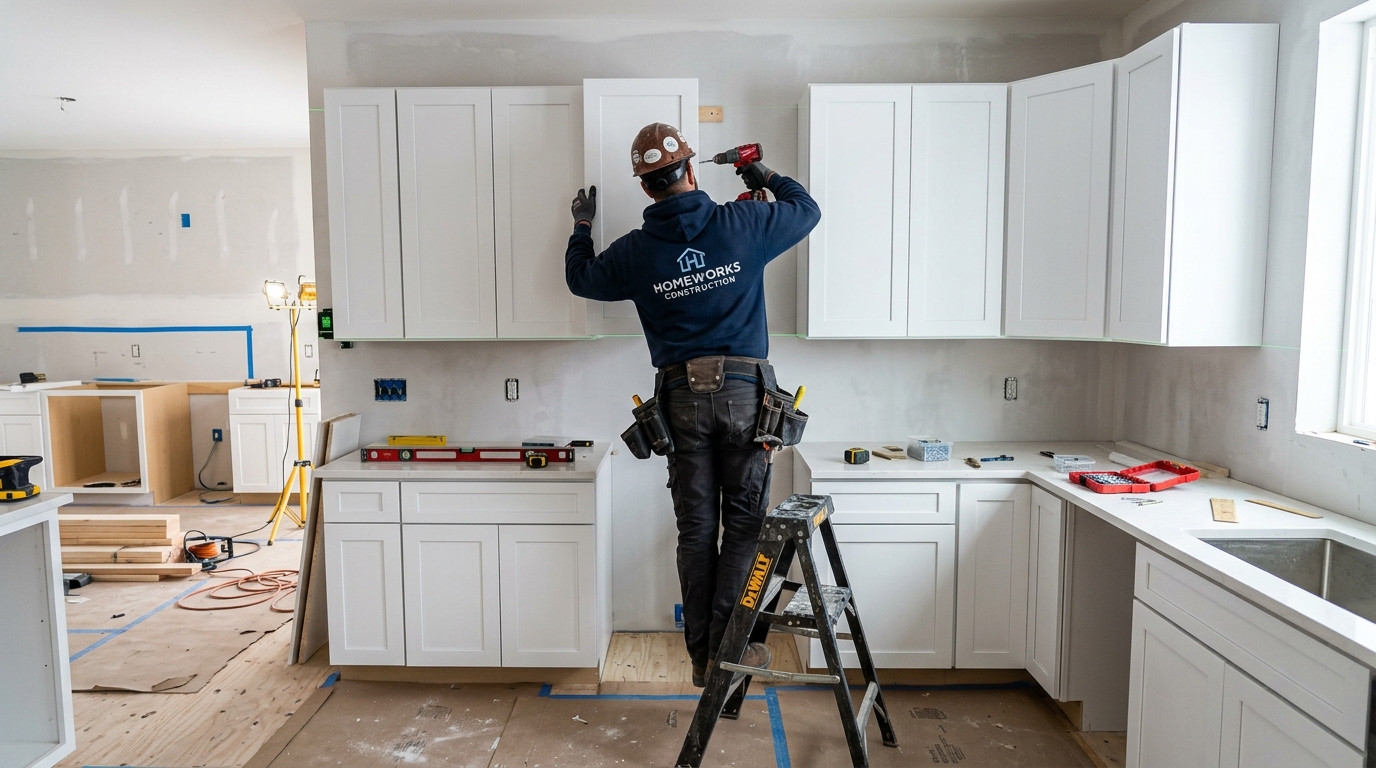
Turtle Creek kitchen renovation prices by scope — 2026
For Turtle Creek homeowners, planning a kitchen renovation means contending with both local housing realities and your own budget. The median household income is $42,344 (U.S. Census Bureau, ACS 2024), so even a midrange gut kitchen remodel represents a major investment—and with only 36.8% homeownership, most projects happen in primary residences, not rental units or flips. Much of Turtle Creek shares the region’s old housing stock, a legacy of the Pittsburgh area’s pre-1940 construction boom. That means many kitchens are still small and compartmentalized, driving full gut jobs that move walls—these run at the high end of the price bands—but plenty of homes just need surfaces and storage updated.
The main factor driving blown budgets here is overcommitting to the wrong scope: pricing for a surface-level refresh, then selecting custom cabinets, layout changes, or all-new appliances that push you quickly into a higher tier. Know where your project lands before you get attached to features beyond it.
| Scope |
What's included |
Duration |
Price range |
| Full gut remodel, same layout |
cabinets, counters, appliances, flooring, lighting, fixtures |
6–10 weeks |
$28,000–$113,000 |
| Gut plus layout change |
all of the above plus moved plumbing, electrical, walls |
10–16 weeks |
$61,000–$113,000 |
| Cabinet replacement (stock to semi-custom) |
remove and install cabinets, hardware, patching |
1–3 weeks |
$6,600–$28,000 |
| Cabinet refacing |
new doors and drawer fronts, veneer, hardware |
3–6 days |
$6,600–$19,000 |
| Countertop replacement only |
template, fabricate, install, reconnect sink |
1–3 weeks |
$3,800–$15,000 |
| Kitchen flooring only |
remove existing, install new flooring |
3–6 days |
$4,700–$19,000 |
Estimates for a typical Turtle Creek kitchen. Cabinet grade and whether the layout changes move these figures more than square footage.
Allowances, exclusions and change orders
Comparing kitchen renovation quotes around Turtle Creek can be frustrating because the headline number often hides more than it reveals. By far the most common issue is how contractors write allowances—these are placeholder dollar amounts for items you haven’t picked yet, like tile, faucets, or appliances. One bid might slot in sensible allowances based on local pricing, while another uses unrealistically low figures just to keep the total down. This can leave you thousands out of pocket as you’re forced to upgrade during the project. That’s why you should always compare the allowance lines—not just the bottom line—before deciding who offers the real number.
Besides allowances, look closely at whether a quote states the exact cabinet manufacturer and model, the countertop material (by name and thickness), and details itemized labor for rough-in, finish, and specialty trades. A good contract will clearly state what happens if something unexpected turns up, whether you need to approve change orders in writing before extra work, and how the payment schedule ties to key milestones like demolition or cabinet installation—not just calendar dates. For anything over $500 (almost everything for a kitchen), Pennsylvania’s Home Improvement Consumer Protection Act requires a written contract and gives you a 3-day right of cancellation. Upstanding firms will also provide lien waivers at each payment, releasing you from double-payment risk for subcontractors.
| Line item |
What to look for |
Red flag if… |
| Allowances |
realistic amounts, itemised |
round numbers with no basis |
| Cabinetry |
brand, line, box construction |
'quality cabinets' |
| Countertops |
material, thickness, edge, seams |
material name only |
| Electrical |
circuits to be added, GFCI scope |
'as needed' |
| Unforeseen conditions |
how they are priced and approved |
not addressed |
| Change orders |
written approval before work |
verbal |
| Payment |
milestone-based, modest deposit |
front-loaded |
| Lien waivers |
from subs at each payment |
not offered |
Surprises in an older Turtle Creek home
Ninety-eight percent of Turtle Creek’s housing was built before 1980 (U.S. Census Bureau, ACS 2024), and the old school construction shows itself once demolition starts. Common surprises include out-of-plumb or bowed walls, and floors with enough slope that installing cabinets straight means extensive shimming and custom scribing—this can add days of labor and increase installation costs by $1,000–$2,000 above a flat new build. Wiring often proves to be undersized or missing grounds, pushing a modest electric tweak into a $2,000–$4,000 rewire for safe outlets and new circuits. Galvanized pipes (especially for supply lines) and cast iron drains can be brittle or corroded, and full replacement runs $3,000–$9,000 depending on length and access. If there’s an exterior wall with no insulation behind the cabinets, patching that is usually worth the $900–$2,200 in comfort and efficiency.
Another headache: prior kitchen fixes by amateurs or handymen, often with creative plumbing or rogue wiring not up to Pennsylvania Uniform Construction Code. Fixing these can eat into contingency funds. For pre-1978 homes, any work disturbing paint—even only window or trim areas—falls under the federal EPA Lead RRP Rule, which mandates testing and certified work practices. If demo might hit 1970s linoleum or old tile, expect possible asbestos—contractors will halt until testing is complete, and safe abatement increases both duration and cost. Build in a 10–15% contingency for these realities.
Allocating a kitchen budget
Many Turtle Creek homeowners are surprised when they see an actual project budget broken out—cabinets alone typically eat up 25–35% of the total, far more than appliances or even countertops. Labor is the next biggest line, especially in older homes or whenever you move walls or relocate services. Appliances vary more than anything else—spending $12,000 on a Wolf range in a $28,000 remodel rarely makes sense. Counters and flooring matter, but splurging for high-end quartz won’t rescue tired cabinetry or shortcut installation.
Don’t neglect two numbers: contingency (to cover what shows up behind the walls, which you can bank at 10–15% easily in this borough), and soft costs—permits, design fees if needed, delivery and debris disposal. If you have some flexibility, spending an extra $1,000 on better cabinetry hardware or more functional lighting often pays off in daily use; spending it on premium appliances rarely returns as much unless everything above it is top-tier. For a full gut job at $28,000–$113,000, here’s how the pieces really break down:
| Category |
Share of budget |
Notes |
| Cabinetry |
25–35% |
the largest line and the longest lead time |
| Labour and installation |
20–30% |
rises sharply if the layout changes |
| Countertops |
8–15% |
material choice drives the swing |
| Appliances |
10–20% |
widest range of any category |
| Flooring |
5–10% |
|
| Lighting and electrical |
5–10% |
higher in older homes needing circuits |
| Plumbing and fixtures |
4–8% |
|
| Permits, design, disposal |
3–6% |
usually forgotten in early budgets |
| Contingency |
10–15% |
not optional in a pre-1980 house |
The real timeline for a Turtle Creek kitchen
Few Turtle Creek homeowners expect a kitchen to take as long as it does, and most of the difference comes down to what must be built—and in what order. The process typically starts with finalizing the design and measurements. Only once you’ve locked in those details can you order cabinets; lead times for even semi-custom boxes run several weeks minimum, and market demand in Allegheny County pushes these out further in the busy season. Demolishing the old kitchen then rarely reveals a quick shortcut, especially in older homes, as unexpected wall problems or wiring issues are common.
The critical path is this: install the base cabinets, then have the countertop fabricator come to template the counters (they need real, leveled, anchored cabinets—not drawings). Fabrication for stone or solid-surface counters takes another 1–2 weeks even once you’re in the queue. Nobody tells you this up front, but there’s always an unavoidable “dead” week or longer after the cabinets before the counters can go in—plan for it. Backsplashes, flooring, and final trim come last.
If you want to save time, order cabinets before demo, not after. The labor market here runs tight for finish trades compared to exurban counties, so scheduling multiple subs in sequence means any slip can quickly add a week or two to total duration. Typical start-to-finish stretches between 6 and 16 weeks depending on the complexity and scope.
What requires a permit in a kitchen renovation
In Turtle Creek and surrounding boroughs, cosmetic upgrades—painting, swapping hardware, refacing, or replacing countertops without layout changes—are generally outside the scope of building permits. The moment you move plumbing, rewire or add circuits, take down or move a wall, or install major mechanical ventilation (like a new range hood duct), you enter permit territory, per Allegheny County norms. In Pittsburgh proper, these changes nearly always require a permit and plan review for any full kitchen remodel beyond basic surface work. Structural and service-altering changes are what matter.
Inspections for electrical work generally fall to the permitting municipality—in Pittsburgh, the Department of Permits, Licenses, and Inspections reviews kitchen plans and inspects, while nearby boroughs may use approved third-party inspectors instead of city staff. This switch surprises many and can slow down re-inspection or approval. For work over $500, Pennsylvania requires contractors to be registered with a Home Improvement Contractor (HIC) number (you can verify at hic.attorneygeneral.gov), and for any job using employees, workers’ compensation coverage must be in place (check status at WCAIS, wcais.pa.gov).
Cutting corners on permitting sometimes slides through here, but it will catch up at resale, especially if a future buyer’s title company or home inspector pulls up unpermitted work. Don’t skip it to save a few weeks.
Who should run your Turtle Creek renovation
Your choice of project delivery model has more impact on cost and headache than any particular product. A design-build kitchen firm handles everything from initial plans to the last drawer pull under a single contract—this is usually the most expensive but the least labor for the homeowner, with a single point of accountability when something goes wrong. General contractors coordinate trades for you, requiring more involvement but potentially saving on markups if you’re diligent in scheduling decisions and selections.
Owner-managed projects—where you hire and sequence carpenters, plumbers, electricians and handle ordering—can be cheapest on paper but succeed only if you have time and construction experience. In Turtle Creek, the labor market is tight enough that even experienced owners find it hard to coordinate specialty trades back-to-back. If your renovation triggers permits (plumbing or electrical moves, walls coming down), self-management is risky unless you can afford schedule slips and know all the inspection steps.
For most homeowners who have a day job or limited experience, hiring a GC or a full-service remodeler is worth the extra outlay. The local pace of work often means your contractors are juggling multiple jobs at once—whoever’s in charge needs strong project management or your kitchen will linger in limbo.
Frequently asked questions — kitchen renovation in Turtle Creek
How should renovation payments be scheduled?
Contractors in Turtle Creek and throughout Pennsylvania typically use a milestone-based payment schedule. Don’t accept a schedule based on calendar dates or one that asks for most of the payment upfront. A sensible plan ties payments to clear progress—such as a modest deposit (often 10–20%), payment once demolition is complete, a draw after the cabinets are in, and the remainder after final inspection. For a kitchen remodel in the $28,000–$113,000 range, avoid paying more than one-third before work is underway. Every payment should follow the delivery of goods or a completed stage. Also, ask for lien waivers from subcontractors as you pay—this way, you won’t risk paying twice if a sub goes unpaid. A well-written contract (required in Pennsylvania for jobs over $500) should spell out these milestones right at the start.
How do I verify a kitchen contractor in Pennsylvania?
In Pennsylvania, including Turtle Creek, any contractor doing home improvements over $500 needs a Home Improvement Contractor (HIC) registration—searchable at hic.attorneygeneral.gov. You’ll want to verify this before signing any contract, along with checking that they carry workers’ compensation insurance (if they use employees) via WCAIS (wcais.pa.gov). The written contract is a must for any sizeable job, as required by state law, and gives you a 3 business-day right of cancellation. For a cabinet replacement or full remodel, which are commonly at or above $6,600–$113,000, these protections become crucial. Skipping these checks in Turtle Creek opens you up to legal and financial risks that can haunt you at resale or after a dispute.
What should I expect in a pre-1980 Turtle Creek kitchen?
In Turtle Creek, almost every home was built before 1980. Expect out-of-level floors, out-of-square corners, older wiring, and potentially galvanized or cast iron plumbing. Cabinets might be installed directly onto sloped floors, making replacement a bigger job than you’d find in new construction. Electrical upgrades—whether to add outlets or circuits—can run $2,000–$4,000 if the existing wiring is subpar. There’s a high chance of encountering lead-based paint if the home predates 1978, which means the federal EPA Lead RRP Rule applies and certified practices must be used. It’s wise to plan for a contingency budget, often 10–15% of the total, added to your primary renovation band of $28,000–$113,000. Surprises are the norm here—plan for them, and you’ll be less frustrated along the way.
Is induction worth it over gas?
Induction ranges offer fast cooking, better control, and a cooler kitchen, but they do cost more up front—both for the appliance itself and for the electrical upgrades that might be needed in a typical Turtle Creek kitchen. Many older homes here have marginal wiring, so switching from gas or standard electric to induction might push you into a panel upgrade, which can easily add a few thousand dollars, especially within a $28,000–$113,000 full remodel budget. That said, if you cook a lot, have young kids, or want a safer, easier-to-clean option, induction is worth considering. But get your electrician’s assessment first—sometimes, the electrical work is the bigger consideration, not the appliance price.
Why is there a gap after cabinets are installed?
In every Turtle Creek kitchen I’ve worked on, there’s a pause between cabinet installation and countertop installation. That’s because the countertop fabricator only measures (“templates”) once the cabinets are in, leveled, and fixed in place—drawings or rough measurements just aren’t accurate enough for stone or solid-surface counters. Most template to install times are a week or two, especially with the tight finish-trade labor market in Allegheny County. So if your kitchen is out of service, this gap can feel endless, but it is necessary to get a proper fit and finish. Don’t let anyone promise you can skip this step—the real timeline for a kitchen gut remodel in Turtle Creek is 6–16 weeks, with this “dead week” in the middle no matter what.
Should I renovate before selling or let the buyer do it?
In Turtle Creek, with the median household income at $42,344, it almost never pays to go all-in on a top-tier kitchen right before selling. Most local buyers expect clean and functional, not magazine-caliber. A modest update—new counters, paint, basic appliances—at the $3,800–$15,000 to $6,600–$28,000 level often returns more than a blowout gut job. Unless your kitchen is in truly rough shape, let the buyer customize to their own taste and needs. Save your money for repairs and upgrades that bring the whole home to marketable condition, unless a realtor shows numbers that say otherwise.
What does a quartz countertop cost in Turtle Creek?
A quartz countertop replacement in Turtle Creek generally falls in the $3,800–$15,000 band. The wide range covers both material and installation: subtle colors, thicker slabs, premium patterns, and complex edge work all cost more. The lower end often gets you a builder-grade quartz with standard edges and a drop-in sink, while the upper end includes seamless looks and undermounts. Don’t forget to check exactly what’s included—undermount sinks, backsplashes, faucet hole drilling, and removal of the old counter can add hundreds. For a typical kitchen, budgeting the typical $8,500 is realistic. Be wary of allowances that seem too cheap; if quartz is important to your project, get the material and installation fully specified in your quote.
What does a full gut kitchen remodel cost in Turtle Creek?
A full gut kitchen remodel—where you rip everything out, rewire, re-plumb, but keep the layout the same—will run between $28,000–$113,000 in Turtle Creek for 2026. More intricate projects, such as those involving layout changes or wall removal, can climb to the top end of this range. The biggest factors are cabinetry grade, appliance package, and how much you need to address the old bones of the house—especially with 98% of homes built before 1980. Expect finishes, contingencies for hidden issues, and build times of 6–16 weeks to be typical for this level of job. Getting several quotes showing clear line item breakdowns (not just totals) makes a world of difference for comparing apples to apples here.
Can I renovate a kitchen in stages?
Yes, you can split a Turtle Creek kitchen renovation into stages—say, tackling flooring and paint now, then cabinets and counters later—but you need to plan the order carefully. Start with anything under the floor (like new subfloors), then rough-in electrical or plumbing, flooring next, followed by cabinets, counters, and finally backsplashes and trim. Piecemeal work can sometimes shoot your budget if trades have to return multiple times or if materials change color batch-to-batch. You might pay more in the long run, but with projects in the $28,000–$113,000 band, staging makes sense for some budgets. Just be sure any new work lines up legally and physically with what you leave in place, so you’re not re-doing things you just paid for.