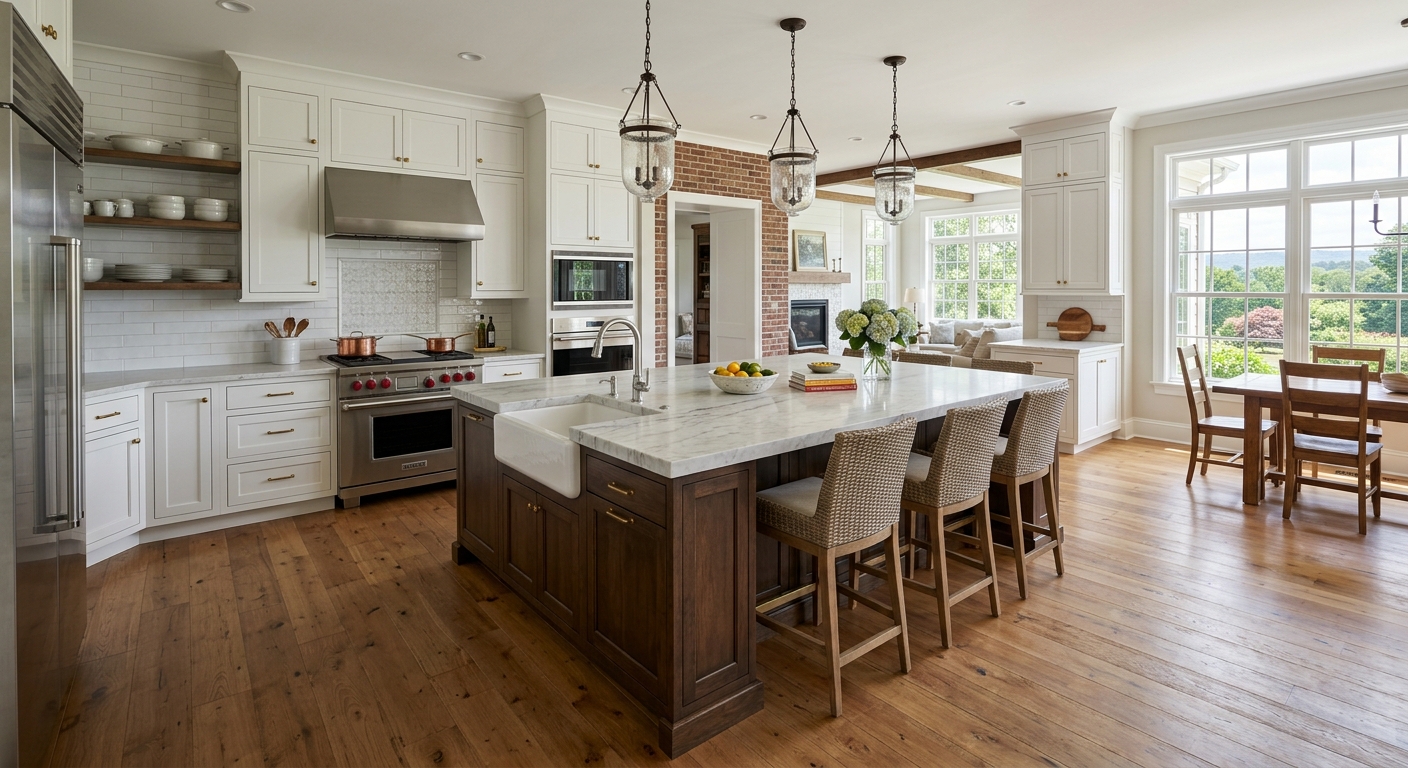
Patton kitchen renovation prices by scope — 2026
In Patton, kitchen renovation costs vary widely, and the line between a reasonable investment and a blown budget is easier to cross than most expect. With a median household income of $75,231 and a homeownership rate just above 50.0% (U.S. Census Bureau, ACS 2024), local kitchen budgets are shaped by what owners can reasonably expect to recoup or enjoy—not the sky-high designs seen elsewhere.
The large wave of 1960–1985 subdivision building around State College means many homes in Patton still have small-galley kitchens. In these spaces, layout changes are often necessary to make the kitchen genuinely functional—particularly if your kitchen still feels stuck in the 1970s. However, the spend escalates sharply once you move from cosmetic upgrades to layout changes.
The most common budgeting mistake is pricing a lower-tier scope—like basic cabinet replacement—and then specifying higher-tier features or layout moves. Each tier has very different cost and duration, so clarity upfront matters.
| Scope |
What's included |
Duration |
Price range |
| Full gut remodel, same layout |
cabinets, counters, appliances, flooring, lighting, fixtures |
6–10 weeks |
$29,500–$118,000 |
| Gut plus layout change |
all of the above plus moved plumbing, electrical, walls |
10–16 weeks |
$64,000–$118,000 |
| Cabinet replacement (stock to semi-custom) |
remove and install cabinets, hardware, patching |
1–3 weeks |
$6,900–$29,500 |
| Cabinet refacing |
new doors and drawer fronts, veneer, hardware |
3–6 days |
$6,900–$19,500 |
| Countertop replacement only |
template, fabricate, install, reconnect sink |
1–3 weeks |
$3,900–$15,500 |
| Kitchen flooring only |
remove existing, install new flooring |
3–6 days |
$4,900–$19,500 |
Estimates for a typical Patton kitchen. Cabinet grade and whether the layout changes move these figures more than square footage.
Does a kitchen renovation pay back in Patton?
A new kitchen is one of the most convincing selling points for a Patton home, but the full cost almost never comes back dollar-for-dollar at resale. In Centre County’s moderate market, mid-range kitchen renovations—clean lines, practical choices, no major layout moves—tend to recover a larger share of the investment than a top-end overhaul. If your plans include high-end appliances, custom cabinetry, and structural changes, know that most buyers in Patton will not pay a premium above what the neighborhood supports.
There is a sharp difference between renovating for your own use and renovating to sell. If you plan to stay five years or more, spend your money where it matters to you—maybe you want soft-close doors and an induction range instead of a wall removal. If you are sprucing up to sell, keep finishes neutral, avoid moving walls or plumbing, and focus on a functional, updated look at a mid-range spend.
Patton’s median household income of $75,231 offers a reliable signal: pouring $100,000 or more into a kitchen remodel in this area rarely gets back the excess. If the rest of your house is dated, buyers will not pay for a kitchen out of pace with the neighborhood. Instead, plan a level of project that fits both the house and the market, and treat anything above that as an investment in daily comfort—not a future payout.
How a Patton kitchen budget breaks down
Most Patton kitchens follow a predictable budget split—one that upends what many people expect. Cabinetry nearly always leads as the largest line item, commonly accounting for 25–35% of the total. Labor and installation run close behind, especially if walls are moved or the house is older. Countertops, appliances, and flooring share the next slice, each heavily influenced by material choices and appliance brands. Lighting, plumbing fixtures, design costs, permits, and the not-to-be-missed contingency fund round out the rest.
Blowing the contingency or ignoring soft costs is where most budgets go sideways. In pre-1980 homes, set aside at least 10% for what appears behind the walls. Permits and design can run another 3–6%. If you have a little extra—spending that on cabinetry hardware or better lighting pays off daily. On the other hand, spending big on appliances before updating the rest of the kitchen is often a waste, especially if you still have stock cabinets and basic counters.
Here's a breakdown for a mid-range Patton kitchen gut (service band: $29,500–$118,000):
| Category |
Share of budget |
Notes |
| Cabinetry |
25–35% |
the largest line and the longest lead time |
| Labour and installation |
20–30% |
rises sharply if the layout changes |
| Countertops |
8–15% |
material choice drives the swing |
| Appliances |
10–20% |
widest range of any category |
| Flooring |
5–10% |
|
| Lighting and electrical |
5–10% |
higher in older homes needing circuits |
| Plumbing and fixtures |
4–8% |
|
| Permits, design, disposal |
3–6% |
usually forgotten in early budgets |
| Contingency |
10–15% |
not optional in a pre-1980 house |
Why the contingency exists
Patton has a significant number of homes built before 1980—over a third of local stock (U.S. Census Bureau, ACS 2024). Tearing out a kitchen in these houses routinely uncovers surprises: walls that lean or floors that slope, making cabinet installation a job of shims and corrections; old wiring, maybe without a ground, or an overloaded panel; iron or galvanized supply pipes and cast iron drains at the end of their lifespan; none or minimal insulation on exterior walls; and sometimes traces of unpermitted DIY repairs from decades past. Each surprise lands as a cost: electrical rewiring $3,900–$15,500, plumbing upgrades easily another few thousand, floor leveling, and patching old framing—costs that add up fast.
For homes built before 1978, federal rules apply for disturbing lead paint. No contractor is allowed to assume lead is absent; if they're not testing before disturbance, they're taking a risk with your home and their business. The same caution applies to certain resilient flooring, which may contain asbestos—again, it must be checked before work starts.
If your Patton kitchen is a 1980s or later build, the risks shift—now you're typically up against builder-grade cabinets finally giving out, aging laminate counters, and often the minimum number of circuits required at the time. Skimped materials and minimal layouts are the story, and replacement becomes much more common than true repair.
Layout changes and the cost cliff
In Patton, the most significant jump in kitchen renovation cost comes the moment you move from replacing components where they sit to changing the layout. Relocating plumbing for a new sink or dishwasher, running new electrical circuits, or removing a wall—these all pull your project over the “cost cliff.”
Relocating drain lines is more than a simple switch: drains need slope, and where the kitchen sits over a finished basement or slab, it can mean opening ceilings or jackhammering concrete. Every new circuit means adding load to the electric panel—if you’re already maxed out, panel upgrades can add thousands. Taking out a wall demands figuring out whether it’s load-bearing, which means getting an engineer’s sign-off and a permit. Even venting a new range hood to the outside requires cutting through a wall or roof—something no one hopes to add once cabinets are up.
This is why pushing the fridge, sink or range “just a few feet” can add $20,000–$50,000 to your total. In State College and the Centre Region, any kitchen remodel involving plumbing or electrical system changes typically requires a building permit and plan review, so there’s no way to sneak a move past the process either.
If your kitchen is small and its workflow is genuinely dangerous or impossible, real changes may be necessary. But most dated layouts can be made much more functional by changing cabinets and lighting without redoing the bones. Have a hard look before committing to costly rework—sometimes what you have simply needs a better fit and finish, not a new footprint.
Permits and inspections for a Patton kitchen
Patton projects, like those in nearby State College, split cleanly on permits: surface-level work (cabinet refacing, paint, replacing appliances like-for-like, installing new countertops) usually does not require a permit. As soon as you’re moving or adding plumbing, running new circuits, touching structural elements, or installing a new range hood that requires venting, you’ll trigger the need for a permit—and if structural or mechanical changes are on the table, plan review is commonly required.
In State College, permits and plan reviews for kitchen work are handled by the Centre Region Code Administration, while other Centre County municipalities may use their own code offices or contract with third-party inspection firms. Electrical inspections in State College and Bellefonte are typically handled by certified third-party agencies retained by the local code authorities. That means you may deal with a municipal inspector for your plumbing work, but a different third-party for the wiring—don’t be surprised by multiple inspections before sign-off.
Every contractor working on projects over $500 must have valid Home Improvement Contractor (HIC) registration from the Pennsylvania Office of Attorney General; verify this at hic.attorneygeneral.gov. Employers must also carry workers’ compensation, checkable through WCAIS. Unpermitted work can cost you a sale: sales agreements often require proof everything was permitted and inspected, and title companies do check. Don’t skip step one—it comes back around at resale.
Circuits, GFCI and code compliance
Electrical surprises catch more Patton kitchen renovators off guard than anything else. Modern electrical code expects at least two dedicated 20-amp small appliance circuits for countertop outlets; GFCI protection at every counter outlet; receptacles spaced so no point is more than 24 inches from an outlet; and dedicated lines for each large appliance, including dishwasher, disposal, microwave, and often a 240-volt supply for an electric range.
But most Patton kitchens from the dominant 1960–1985 subdivision construction—and certainly anything before that—are often far behind those standards. Homeowners regularly find: only one or two circuits serving both kitchen and nearby rooms, few or no grounded outlets, fuse panels with no spare capacity, and, occasionally, aluminum branch wiring. When a wall is opened, inspectors will expect all the new work to meet current code, and that’s not optional—plan for upgrades, not just repairs.
Even homes from the late 1990s can fall short here, as kitchens from that era often have just enough circuits to pass code at the time but not enough for today’s appliance loads.
Bringing your kitchen’s electrical up to code ranges from $3,900–$15,500—and the high end is frequent once new circuits, a panel upgrade, and full rewiring come into play in older homes. It’s never money wasted, but it does require planning.
Frequently asked questions — kitchen renovation in Patton
What does a full gut kitchen remodel cost in Patton?
A full gut remodel in Patton—removing everything down to the studs, updating all cabinets, surfaces, appliances, flooring, and fixtures—typically runs from $29,500–$118,000, with most projects falling around the middle of that range. The price varies mostly by cabinet type, fixture quality, and whether you stick to the existing layout or move plumbing and walls. Layout changes or luxury finishes put you at the higher end. With Patton’s moderate home values and a median household income of $75,231, spending above the middle rarely comes back at resale—so focus on the layout and finishes you’ll use daily.
Should I hire a general contractor or a kitchen firm?
In Patton, the answer depends on the project. If your work is strictly cosmetic—cabinet refacing, new counters, basic electrical swaps—a kitchen firm or even specialized trades can deliver efficient results. But for gut remodels or projects involving walls, plumbing, or major layout changes, a licensed general contractor with experience in kitchens is essential. Patton’s labor market has tight finish-trade availability, and managing schedules and inspections takes real know-how. Either way, make sure your contractor is registered through the Pennsylvania Office of Attorney General and carries workers’ compensation insurance. Expect professional oversight on projects above $6,900.
What adds the most resale value in a kitchen?
In Patton homes, neutral, functional kitchens tend to return the best value at resale. Think cabinet replacement with efficient storage, durable but not extravagant counters, upgraded lighting, and reliable mid-range appliances. Avoid luxury materials that outpace the rest of the house or neighborhood—the market doesn’t reward them here. If you’re eyeing resale, spending within the typical cabinet replacement band of $6,900–$29,500 and choosing timeless finishes will make the home more marketable without overshooting what buyers expect in Centre County.
Is induction worth it over gas?
For Patton kitchens, induction cooktops are gaining traction. They’re safer (no open flame), easier to clean, and heat more efficiently—especially welcome during our long heating season. That said, induction cooktops do cost more up front, and you may need new cookware. If your kitchen doesn’t have a dedicated 240-volt line, you’ll also face rewiring costs, often running $3,900–$15,500 if you’re upgrading an older home. Many homeowners still prefer gas for familiarity, but with fluctuating fuel prices and changing regulations elsewhere in Pennsylvania, induction is a future-proof choice—if you’re open to the upfront investment.
How long does a kitchen renovation take in Patton?
Project timelines in Patton depend on both scope and the local finish-trade labor crunch. A full gut remodel targeting a new layout usually takes 10–16 weeks, with the simpler same-layout gut averaging 6–10 weeks. Cabinet replacement without major changes can be wrapped up in 1–3 weeks, while refacing or countertop swaps are a 3–6 day job. Long order lead times on custom cabinets or specialty fixtures can stretch those estimates, especially if you’re aiming for the higher end of the $29,500–$118,000 project band. Plan for possible permit delays and build in buffer time, especially if you are in the pre-1980 housing stock.
Can I renovate a kitchen in stages?
Yes, you can break a Patton kitchen renovation into stages—especially practical if you’re living in the home and need to keep a working space. Upgrading cabinets first, then counters and appliances, or handling flooring after the main work wraps, are all common approaches. Just stay mindful: multiple phases mean repeated disruption, and you may pay more in labor and delivery fees. If electrical or plumbing upgrades are needed, it’s best to do them early, before walls close up. Staging is cost-effective for smaller projects like cabinet refacing $6,900–$19,500, but for full guts, a single phase is less hassle in the long run.
Does replacing cabinets require a permit?
In Patton and State College, simply swapping out cabinets—without touching plumbing, electrical, or taking down walls—typically does not require a building permit. That includes cabinet replacement or even cabinet refacing. But as soon as you move or add wiring for undercabinet lighting, shift appliances requiring new hookups, or reconfigure floorplans, you’re likely triggering permit and inspection requirements. In any case, check with your town’s code office before work begins. For a typical cabinet replacement cost of $6,900–$29,500, it’s worth confirming to avoid resale headaches down the line.
Is lead paint a concern in Patton kitchen renovations?
Yes—if your Patton home was built before 1978, federal guidelines apply to any renovation that might disturb lead paint. Contractors are required to test before demolition, and certified renovators must follow EPA lead-safe protocols if paint is present. Don’t let anyone skip this step; it’s there for your safety, especially if you have children. Proper handling will add some cost (typically within project contingency, about 10–15%), but skipping it is neither legal nor safe. If your home is newer, lead isn’t an issue—but many Patton homes are from the 1960–1985 wave, so always ask before work starts.
Why are kitchen quotes in Patton so far apart?
In Patton, you’ll see wide price swings between contractors for the same kitchen—sometimes tens of thousands of dollars. Several reasons: local labor is tight, especially for finish trades; project scopes get quoted very differently (one contractor may include electrical upgrades that another omits); and older homes can throw out major surprises that only the more experienced bidder budgets for. Some quotes account for contingency and code upgrades, some do not. For example, a full gut remodel can range from $29,500 for a straightforward layout to $118,000 for a project needing layout changes, new systems, and custom materials. Always scrutinize what’s included, and expect experienced local contractors to be booked out months in advance.