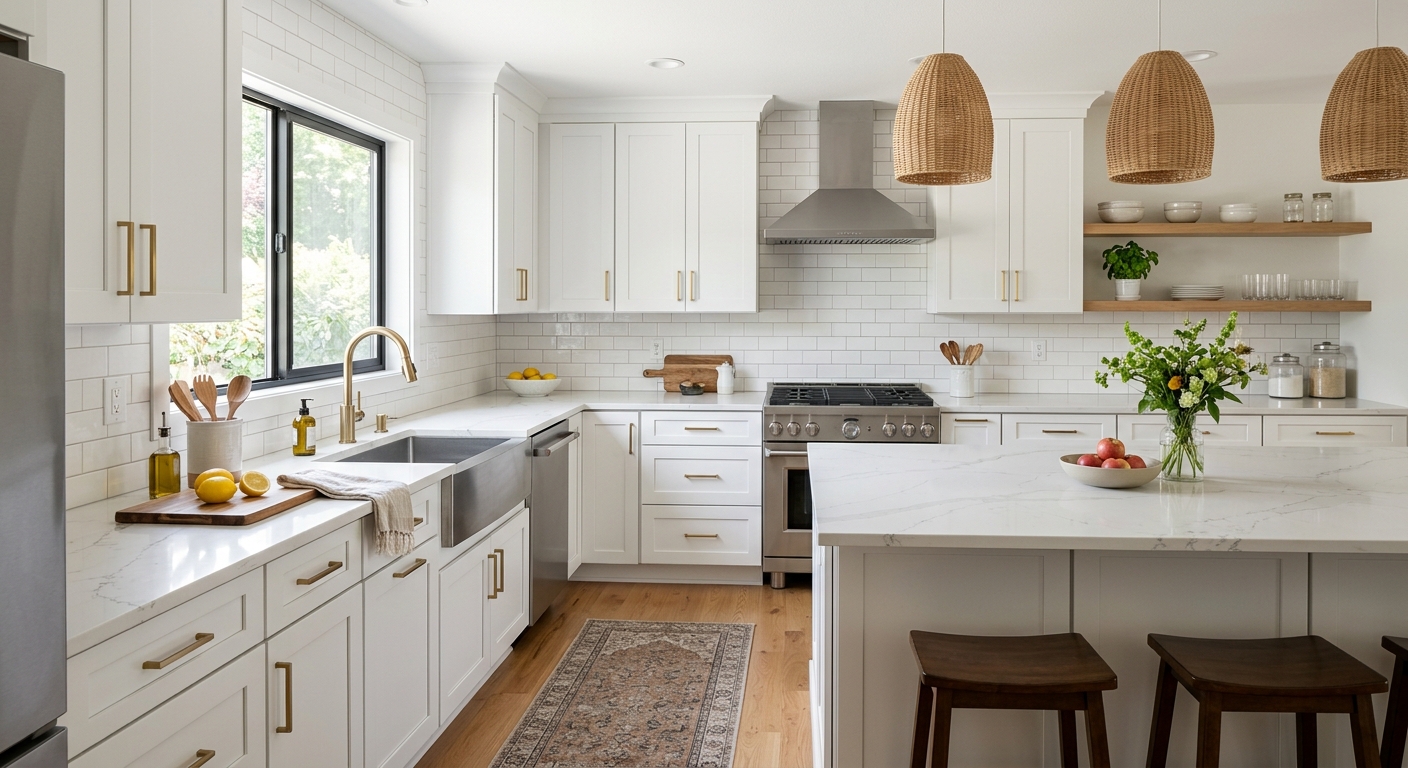
Kitchen renovation costs in Upper Merion — 2026
Upper Merion homeowners are renovating kitchens in the midst of rising costs and high expectations. With a median household income of $112,638 and a homeownership rate of 57.3% (U.S. Census Bureau, ACS 2024), most projects target long-term value, not quick resale. Kitchen spending here is shaped by the area’s mix of post‑1945 suburban tract housing—in Abington and Upper Dublin—where old 1950s galleys often call for wall moves and expanded layouts, while later 1990s builds tend to support finish-only updates. These differences drive dramatically different budgets, and picking the wrong scope for your home’s era is the fastest way to waste money.
The best way to contain costs is to match your plans to your house. Most blown budgets come from pricing a minor update and speccing a complex renovation instead. Below is what you can expect for major kitchen projects in Upper Merion. If your kitchen layout and systems are solid, you can save tens of thousands by skipping layout changes. If you’re dealing with small rooms, old wiring, or failing materials, be prepared for a full gut and modernization in line with area norms.
| Scope |
What's included |
Duration |
Price range |
| Full gut remodel, same layout |
cabinets, counters, appliances, flooring, lighting, fixtures |
6–10 weeks |
$33,500–$133,500 |
| Gut plus layout change |
all of the above plus moved plumbing, electrical, walls |
10–16 weeks |
$72,000–$133,500 |
| Cabinet replacement (stock to semi-custom) |
remove and install cabinets, hardware, patching |
1–3 weeks |
$7,800–$33,500 |
| Cabinet refacing |
new doors and drawer fronts, veneer, hardware |
3–6 days |
$7,800–$22,000 |
| Countertop replacement only |
template, fabricate, install, reconnect sink |
1–3 weeks |
$4,400–$18,000 |
| Kitchen flooring only |
remove existing, install new flooring |
3–6 days |
$5,600–$22,000 |
Estimates for a typical Upper Merion kitchen. Cabinet grade and whether the layout changes move these figures more than square footage.
Who should run your Upper Merion renovation
Choosing who manages your Upper Merion kitchen project makes more impact than any single construction choice. There are three common models. First, a design-build kitchen firm offers hands-off simplicity: they handle design, manage trades, source cabinets, and warranty the job under one contract. You pay the most, but avoid most headaches and have one throat to choke if things go wrong. This approach works best for busy professionals—with Montgomery County’s finish-trade labor tighter than Philadelphia but deeper than rural Bucks, the best firms are busy, so booking early is wise.
A general contractor sits in the middle. You hire a contractor who organizes the trades, but you may handle decisions with a designer or specify finishes. It’s a balance between cost and oversight, but you still need to monitor schedule and scope—especially if the job involves substantial layout or systems changes. This is suitable for homeowners with time to stay engaged, but who want to avoid juggling electricians, plumbers, and countertop templaters directly.
Owner-managed jobs are the cheapest—if you ignore your own time. That means hiring each trade, sequencing deliveries, and troubleshooting yourself. It’s hugely demanding, especially since many finish trades in Montgomery County are booked out and juggling multiple jobs. Unless you’re retired or between jobs, and your renovation doesn’t trigger permits, self-management in Upper Merion is a recipe for schedule slip-ups, delays, and possibly costly mistakes. Homeowners with day jobs should not self-manage any kitchen with a permit-triggering scope.
Surprises in an older Upper Merion home
With nearly 60% of Upper Merion homes built before 1980 (U.S. Census Bureau, ACS 2024), and a housing wave of post‑1945 suburban construction in nearby Abington and Upper Dublin, you’re more likely than not to encounter hidden issues when renovating. Once the kitchen is opened up, two things are almost certain: the floors and walls probably aren’t level or plumb. Installing new cabinets in these conditions will require shimming and careful scribing, adding time and labor cost—often $1,000–$3,000 depending on severity. Undersized or ungrounded wiring is common, and updating to meet modern code can cost an extra $3,500–$11,000 or more if the panel needs upgrading.
Old plumbing—galvanized supply lines and cast iron drains—tends to be discovered hiding behind cabinets. Addressing these can run from $1,500–$6,000, especially if you need to move fixtures for a new layout. Exterior kitchen walls may lack proper insulation entirely, which should be added when open ($1,000–$2,000). If your home was built pre-1978, the federal EPA Lead RRP Rule applies, requiring certified practices for any paint disturbance—you or your contractor can confirm compliance at certifiedrenovatorsearch.epa.gov. Testing for lead is mandatory before sanding, cutting, or demolishing.
In 1990s tract homes, the surprises tend more toward builder-grade shortcuts: particleboard cabinets crumbling, circuit counts too low for today’s appliances, and worn-out laminate counters. These don’t spike the budget like found wiring or lead abatement, but they do mean a lot of simultaneous replacements.
Cabinets are the critical path
Most frustration in an Upper Merion kitchen renovation comes from scheduling gaps—especially cabinets. The sequencing is fixed: design and measure first, then order cabinets, then schedule demolition. Only after the kitchen is empty can trades rough in plumbing and wiring, and these need to be inspected before you close the walls. Once the space is ready, cabinets come in and are installed. At that point—never sooner—a countertop fabricator can take exact templates, because countertop cutting requires the installed cabinet footprint.
This step always catches homeowners off guard: there’s an unavoidable dead week or more after cabinet installation before counters can even start fabrication. No shop will cut slab without an absolute measurement. In Montgomery County’s crowded contractor market, with finish trades in high demand, the cabinet and countertop timeline often outpaces other steps. Delivery of semi-custom cabinets can be 4–8 weeks after ordering; for custom, even longer. If there’s a hold-up during this stage, trades are idled and completion drags out.
The best way to shorten your project is to finalize your layout and order cabinets before the first sledgehammer swings. Waiting until demolition to start the order can delay everything by a month or more. Sequence matters: design, order, demo, rough-in, cabinets, countertops, then finish flooring and tile last, with trim and punch list bringing you home. Don’t let anyone tell you otherwise.
How a Upper Merion kitchen budget breaks down
Seeing the breakdown changes how most Upper Merion homeowners spend. For a full gut remodel in the $33,500–$133,500 range, cabinetry typically consumes 25–35% of the total, because these are not just boxes—they drive both look and suitability for local humidity and freeze/thaw conditions. Labor is next, reflecting both finish-trade scarcity and the tight scheduling needed in this market. Countertops—granite, quartz, or solid surface—run far more if you pick statement slabs, less for standard stone. Appliances can swing widely, but avoid splurging on a $12,000 range in a kitchen fitted with off-the-shelf cabinets. Flooring and lighting often get shortchanged, but minor upgrades here usually yield more noticeable daily improvements than smart refrigerators.
Don’t skip two essential lines—contingency and soft costs. Expect to spend 10–15% extra uncovering issues in Upper Merion’s older stock, from needing new circuits to hidden water damage. Permits, design, delivery, and disposal are a smaller percentage but not optional: missing these in early math causes pain at the end. Spend your next available dollar on upgraded drawer hardware, not unnecessary appliance features; skip the “cabinet lighting package” before you downgrade from plywood to particleboard boxes.
| Category |
Share of budget |
Notes |
| Cabinetry |
25–35% |
the largest line and the longest lead time |
| Labour and installation |
20–30% |
rises sharply if the layout changes |
| Countertops |
8–15% |
material choice drives the swing |
| Appliances |
10–20% |
widest range of any category |
| Flooring |
5–10% |
|
| Lighting and electrical |
5–10% |
higher in older homes needing circuits |
| Plumbing and fixtures |
4–8% |
|
| Permits, design, disposal |
3–6% |
usually forgotten in early budgets |
| Contingency |
10–15% |
not optional in a pre-1980 house |
Circuits, GFCI and code compliance
The leading mid-project budget spike in Upper Merion kitchen jobs is electrical. Whether you’re in a 1950s ranch or a 1990s tract house, today’s code expects more: two or more dedicated small-appliance circuits for countertop outlets, GFCI protection at every countertop receptacle, regular spaced outlets (no spot more than 24” away), and dedicated lines for dishwasher, garbage disposal, and microwave. If you have an electric range, a 240-volt circuit is needed too.
Old kitchens here often have one or two outlets, maybe a single shared circuit—and in houses built before 1980 (nearly 60% locally), it’s common to find ungrounded two-wire cable, crowded old panels, or occasionally even aluminum branch wiring. Once the walls are open for a renovation, inspectors expect all new work to meet current Pennsylvania Uniform Construction Code requirements—updates are not optional when replacing wiring or adding outlets. Updating kitchen electrical in Upper Merion typically ranges from $3,500–$11,000, especially if a new panel or additional circuits are needed. Even some late-1990s kitchens may not meet today’s circuit count, so don’t assume recency equals readiness.
What requires a permit in a kitchen renovation
Permit triggers in Upper Merion and surrounding townships are well defined. Cosmetic changes—installing new cabinet fronts, painting, refacing, or replacing a countertop without moving plumbing—proceed without a permit in Norristown, and commonly in much of Montgomery County. However, once you plan to add or move electrical circuits, reconfigure plumbing, demolish walls, or significantly alter the kitchen layout, a permit is required. In Lower Merion Township, even removing a structural wall for a kitchen remodel automatically triggers a building permit, and any job relocating plumbing or wiring gets municipal review.
If your project does need a permit, expect plan review (particularly for layout or mechanical changes) and periodic inspections. In Norristown, municipal inspectors handle electrical inspections; in neighboring townships, third-party electrical inspection agencies are used—don’t be caught off-guard on who signs off each stage.
Hiring a professional? For jobs over $500, Pennsylvania law requires your contractor to be Home Improvement Contractor (HIC) registered—verify at hic.attorneygeneral.gov, and check that all workers are covered by workers’ compensation insurance (wcais.pa.gov). Unpermitted work may go unnoticed for years, but it routinely fails appraisal and insurance review at resale, forcing costly after-the-fact updates or even legal problems.
Frequently asked questions — kitchen renovation in Upper Merion
How much do new kitchen cabinets cost in Upper Merion?
In Upper Merion, new kitchen cabinets run from $7,800–$33,500 for a typical stock to semi-custom installation. Most homeowners spend closer to $22,000 on cabinets, especially if they want soft-close hardware or custom features. Your cost will depend largely on your kitchen's size and whether you're altering the footprint. If you have a pre-1980 house (making up nearly 60% of the area per U.S. Census Bureau, ACS 2024), expect extra labor for leveling and shimming. Prices here are shaped by a strong local supplier network but also by labor that stays busy even when the market cools. Upgrading from basic particleboard to plywood construction or better hardware typically represents money well spent in this climate and can prolong the lifespan of your investment.
What is an allowance in a renovation quote?
An allowance in your renovation quote is a set dollar amount included by your contractor to cover items that haven’t been specified at contract signing—often appliances, fixtures, or flooring. For example, if your quote includes a $5,000 appliance allowance and you later pick a refrigerator and range totaling $6,200, you’ll owe the $1,200 difference. In Upper Merion, allow for real local costs: a typical quartz countertop alone may run $10,000. Be sure your allowances match the brands and finishes you want. Underestimating allowances is the most common way kitchen budgets get busted, usually because people use national averages and not actual prices from suppliers serving Montgomery County.
What happens if previous work was unpermitted?
If you discover unpermitted work during your kitchen renovation in Upper Merion, you’re not alone—many older homes, especially those built before 1980, have had DIY or handyman jobs done without the requisite permits. When this happens, you’re responsible for either legalizing that work through a permit and inspection process or, in some cases, tearing out and redoing portions that don’t meet code. Unpermitted improvements can complicate property sales, as buyers, appraisers, and insurers will want verification of code compliance. For kitchen systems, this might mean bringing all electrical up to Pennsylvania Uniform Construction Code standards, which could add $3,500–$11,000 to your remodel if wiring is involved. Always check with the local code office before closing up any walls.
Should I reface or replace my kitchen cabinets?
In Upper Merion, cabinet refacing is worth considering if your existing cabinet boxes are structurally sound and the layout works for you. Refacing typically costs $7,800–$22,000, compared to $7,800–$33,500 for full cabinet replacement. It's faster—only 3–6 days versus weeks—and it avoids demolition, reducing mess and disruption. However, if you have warped or damaged boxes (common in houses from the 1950s and 1960s here) or want a new layout, replacement is the better path. In newer Upper Merion tract homes, sometimes cabinet boxes are builder-grade particleboard and past their usable life—here, refacing won’t solve deeper problems.
Should I order cabinets before demolition?
Always order your kitchen cabinets before demolition in Upper Merion. Cabinet lead times can be as short as 4–6 weeks for semi-custom but stretch much longer during busy contractor seasons. If you wait until after demo, you risk a month or more with your kitchen torn up and no path forward. The area’s renovation market is saturated, so suppliers and installers may prioritize more organized projects. For a full gut remodel costing $33,500–$133,500, timely cabinet ordering is essential to controlling both schedule and cost. You’ll also avoid surprises with appliance openings, which should be confirmed for every cabinet run before anyone starts swinging a hammer.
Should I choose plywood or particleboard cabinet boxes?
In Upper Merion, plywood cabinet boxes hold up far better to the local climate—humid summers and winter freeze-thaw—than particleboard. While particleboard is commonly used in budget or builder-grade cabinets and costs less up front, it can swell or degrade if exposed to leaks or humidity, leading to sagging shelves and loose hinges. Plywood upgrades add $1,200–$2,000 to a typical kitchen cabinet package out of a $7,800–$33,500 range. In older homes with occasionally uneven floors and walls, plywood boxes are also easier for installers to shim and adjust. Over a twenty-year period, plywood is almost always the better investment for the area.
How does Upper Merion's housing stock affect cabinet fit?
Nearly 60% of Upper Merion homes were built before 1980 (U.S. Census Bureau, ACS 2024), which means installers routinely encounter walls and floors that are out of plumb and level. This directly affects cabinet fit—framers and drywallers of the post-war era didn’t always hit modern standards. Installing new cabinets could require significant shimming, which adds both time and labor cost, often in the $1,000–$3,000 range. Don’t expect Ikea-type cabinets to snap right in. If your house is from a builder-grade wave in the 1990s and onward, fits are usually better, but even then, surprises aren’t rare.
What adds the most resale value in a kitchen?
In Upper Merion, the top drivers of resale value are a functional layout, quality cabinets, and durable countertops, not the most expensive appliances. Full kitchen remodels that modernize layout (open up a galley, add prep area) see the biggest bump, but finishing quality counts too—buyers notice soft-close drawers and quartz counters before they check stove brand. For add-on value, a mid-scale gut remodel in the $33,500–$133,500 range will almost always outperform a high-end appliance update without layout or cabinetry improvements. If your appliances are less than a decade old, invest budget elsewhere for greater return.
What does a quartz countertop cost in Upper Merion?
Quartz countertops in Upper Merion typically run from $4,400–$18,000, with most installations coming in near the $10,000 mark for an average-sized kitchen. The wide range is due to slab quality, edge profile, backsplash options, and whether you need cutouts for an undermount sink or cooktop. Local fabricators handle both supply and installation, so you’re not paying a markup for out-of-market materials. Don’t forget that countertop installation must wait until cabinets are set, and in busy seasons, the fabricators may be booked out—so factor the wait into your schedule as well as your wallet.