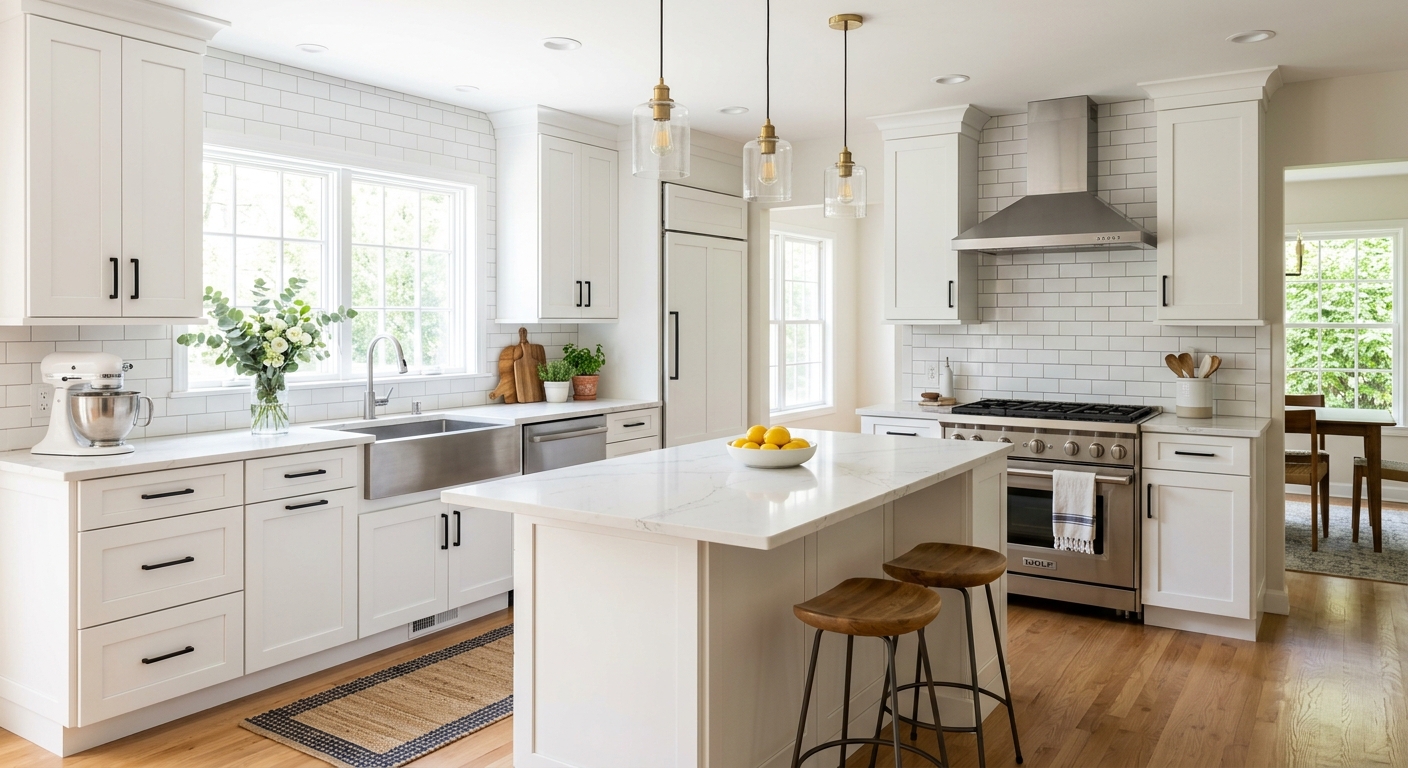
What a kitchen remodel costs in Milford
In Milford, Bucks County, most kitchen remodels are driven by high homeownership and significant investment in quality — with a homeownership rate of 95.2% and a median household income of $123,316 (U.S. Census Bureau, ACS 2024). That translates to owners treating their kitchens as long-term investments, not quick flips. The local housing eras matter: in post-1960 tracts found across Lower Bucks, many kitchens were built as narrow galleries, and these are now frequent gut-and-replace projects, especially where the original layout doesn’t suit today’s cooking or entertaining. If your kitchen is older — closer to 38.4% of homes in Milford built pre-1980 — you’re more likely facing a full gut down to studs, possibly moving walls, and upgrading everything from wiring to insulation. Newer kitchens (late ’90s on) can often get by with a surface-level refresh.
The biggest risk to your budget isn’t picking the wrong style — it’s pricing for a “cabinet swap” and then discovering midstream that you need electrical upgrades, a new layout, or new plumbing. The result is a blown budget. Here’s where typical Milford renovation projects land:
| Scope |
What's included |
Duration |
Price range |
| Full gut remodel, same layout |
cabinets, counters, appliances, flooring, lighting, fixtures |
6–10 weeks |
$34,500–$138,000 |
| Gut plus layout change |
all of the above plus moved plumbing, electrical, walls |
10–16 weeks |
$74,500–$138,000 |
| Cabinet replacement (stock to semi-custom) |
remove and install cabinets, hardware, patching |
1–3 weeks |
$8,000–$34,500 |
| Cabinet refacing |
new doors and drawer fronts, veneer, hardware |
3–6 days |
$8,000–$23,000 |
| Countertop replacement only |
template, fabricate, install, reconnect sink |
1–3 weeks |
$4,600–$18,500 |
| Kitchen flooring only |
remove existing, install new flooring |
3–6 days |
$5,700–$23,000 |
Estimates for a typical Milford kitchen. Cabinet grade and whether the layout changes move these figures more than square footage.
Electrical work in an older Milford kitchen
In Milford, running into electrical surprises is the single most common reason kitchen remodel budgets jump mid-project. Pennsylvania Uniform Construction Code (UCC) requires modern kitchens to have dedicated 20-amp circuits for small appliances, GFCI-protected outlets every four feet along the countertop, dedicated lines for dishwasher, disposal, and microwave, plus a 240-volt circuit for an electric range. Inspectors expect every new or opened wall to comply with present code, no exceptions.
Bucks County has a sizable share of homes built before 1980 (38.4%), so Milford's stock is full of small kitchens with minimal, often outdated wiring — sometimes only two-wire, ungrounded circuits shared among lights and appliances, no GFCI anywhere, breaker panels with zero spare capacity, and occasionally, aluminum branch wiring from the ’60s and ’70s. Even kitchens from the 1990s often lack enough separate circuits to pass modern code. Once the walls come down, you’re on the hook for upgrades whether you planned them or not.
Bringing a typical Milford kitchen’s electrical to present code, with new circuits, modern devices, panel work, and patching, usually lands between $8,000–$18,500 — and this is just for the electrical portion in the context of a gut renovation. If you want to avoid a budget-busting surprise, have the electrical inspected and scoped thoroughly before demolition starts.
Cabinets are the critical path
One of the biggest sources of frustration for Milford homeowners is the gap between advertised kitchen remodel timelines and the reality — thanks mainly to cabinets. Here’s the actual order: design and measurement come first, then you finalize and order the cabinets. Lead times in Bucks County, fueled by a saturated Philadelphia metro market, can stretch from three weeks for stock to over ten for semi-custom. Do not demo first and order later; you don’t want to live with chaos just waiting for a delivery truck.
Only after cabinets are on order does demolition begin. That’s when rough electrical and plumbing get done, and inspected if required. Cabinets are installed after walls are closed up — this is when a delay hits: countertops can’t even be measured for fabrication until every cabinet is set and permanently fastened. No good countertop shop will template off drawings; they need the real, installed cabinets because walls are seldom square or true, especially in older Milford homes. This unavoidable “dead week” (or longer) between cabinet install and countertop install is something most sales pitches never mention.
After counters come in, sink and appliances are hooked up, flooring and backsplash follow, and final trim closes the job. But if cabinets or counters arrive late, everything around them must wait. Plan your sequence with those product lead times — and get cabinets ordered before any wall comes down. That’s how you avoid doubling your project’s duration and cost from basic scheduling missteps.
Choosing a countertop for a Milford kitchen
Not all countertop materials suit every Milford kitchen, or every owner’s habits. Quartz countertops (engineered stone) are highly stain-resistant and don’t need sealing, but can be damaged by high heat from pots. Granite, being natural, varies in appearance, is durable with hot pans, but needs annual sealing and a bit of maintenance. Laminates, often overlooked, have drastically improved — they resist stains and are hard to scratch, and new finishes can mimic stone or wood convincingly. In modest or rental kitchens, a good laminate is budget-wise, not a compromise.
Butcher block adds warmth but is high-maintenance: regular oiling, vigilant wiping, and caution around water. Solid surface (e.g. Corian) doesn’t stain easily, seams are nearly invisible, and scratches or small chips can be repaired — a plus for long-term owners.
Fabrication and installation is where prices rise. The more complicated the edge profile, the more cutouts (sink, cooktop, outlets), and the trickier the seam placements, the higher the tab climbs. Countertops are templated on-site, only after cabinets are firmly installed, rather than merely measured — a critical scheduling detail. In Milford, where kitchen walls may be imperfectly square or true, this “template after cabinet install” rule is strict to avoid costly mistakes.
For residents who want quality without overspending, laminate fits the bill in many kitchens, especially where a full gut remodel isn’t justified. Invest in higher-end surfaces only if you really use, and plan to stay in, your house for years to come.
Surprises in an older Milford home
Demolition in Milford’s older homes — especially the 38.4% built before 1980 — nearly always turns up surprises. First are out-of-plumb walls and unlevel floors, common in post-1960 Lower Bucks tracts, turning cabinet installation into a shimming and custom-trim puzzle. Fixing framing and leveling costs from $1,000–$4,600 depending on extent. Wiring issues are next: old ungrounded or undersized circuits aren’t just out of code; they’re unsafe and always need replacement ($8,000–$18,500 for a full kitchen). Plumbing can mean galvanized pipes or cast iron drains, which should be replaced — expect $2,000–$7,000 if it’s more than a quick swap. Exterior walls may have zero insulation, driving up long-term costs if left unfixed.
Unpermitted work crops up in a good share of homes. Rerouted wires, spliced plumbing, or buried junction boxes slow down the job as they must be brought up to code. Pre-1978 homes demand care: the federal EPA Lead RRP Rule applies, so expect to pay for lead-safe practices if you’re disturbing old paint. If old linoleum or 9x9 tiles appear, asbestos is possible, and professional abatement is non-optional.
In newer suburban stock, the “surprises” are mostly product lifespan issues: particleboard cabinets failing, minimal code-compliant wiring, and tired laminate counters — with everything reaching end of life all at once. These shortcuts made sense for builders, but mean full replacements now for today’s owners.
Permits and inspections for a Milford kitchen
In Milford and wider Bucks County, understanding what work triggers a permit saves headaches later — especially at resale. Cosmetic changes like painting, hardware, cabinet refacing, or swapping an existing countertop in place generally do not require permits. However, in jurisdictions like Bensalem Township, if your kitchen renovation includes moving walls, running new electrical branch circuits, changing plumbing fixture locations, or structural work, a permit is required. Some localities also require plan review when making changes to walls or plumbing, not just finishes.
Inspections add another layer. In some Bucks County areas, electrical inspections aren’t handled by the township, but by third-party agencies such as Tri-County Inspection Company. This can affect scheduling and compliance: always verify the correct inspector before work begins to avoid mid-project holdups.
Contractors working on kitchen projects over $500 are required to have Home Improvement Contractor (HIC) registration issued by the Pennsylvania Office of Attorney General — you can verify at hic.attorneygeneral.gov. All employers must carry workers’ compensation, and this can be checked using the WCAIS system (wcais.pa.gov). Skipping required permits or using an unregistered contractor can come back to haunt you: issues at resale, or claims denied by insurers for unpermitted work, are common enough to outweigh any short-term savings.
Defining your scope before you get quotes
The word “kitchen remodel” covers everything from a quick spruce-up to a down-to-the-studs overhaul — that’s why prices in Milford range fivefold depending on scope. Before you call a contractor, define your tier; it’s the single best way to save time, money, and avoid misunderstandings later.
- Cosmetic refresh: This means paint, new pulls and knobs, maybe updated lighting or backsplash. No cabinets or walls move. No permits, no plumbing or electrical changes, and costs can stay modest.
- Pull and replace: New cabinets and countertops, but everything goes back in the same spot. Plumbing and appliances stay put. The bones of the room aren’t touched, and the electrical is only modified as needed for code.
- Gut, same layout: This is everything out down to the studs, new insulation, wiring, plumbing — but it all returns to the same locations. You get a “new-old” kitchen with the modern systems and finishes, but structural walls are not moved.
- Layout change: Walls come down or move, sinks and appliances are relocated, and you enter the world of major permits, engineering, and much more cost. This jump is steep in Bucks County, where plan review and inspections are required for structural or layout alterations.
The financial cliff is between the “gut, same layout” and “layout change” levels. Moving the sink, range, or a wall triggers permits and a different class of contractor, plus inspections and design fees. Deciding your scope up front means you get apples-to-apples quotes, not wishful ranges. A reputable contractor won’t price a job until your scope is clear — and you can save thousands by not upscaling your plans mid-project.
Frequently asked questions — kitchen renovation in Milford
What adds the most resale value in a kitchen?
In Milford’s high-owner, higher-income market, buyers focus first on updated kitchens — both for daily livability and long-term value. The best ROI in Bucks County typically comes from a “pull and replace” project: new cabinets, counters, flooring, and updated lighting, without reconfiguring the whole layout. This approach balances cost and impact. A full gut and layout change can certainly wow, but the spend often runs from $74,500–$138,000, which most sellers will not fully recoup unless the kitchen was functionally obsolete. Thoughtful materials selection also matters. Quartz counters, durable cabinets, and new appliances say “move-in ready,” but splurging beyond the norm for the neighborhood doesn’t always translate to higher resale prices. Focus first on solving obvious layout bottlenecks and appliance gaps before investing in luxury built-ins.
Should I order cabinets before demolition?
Yes — and in Milford, with the Bucks County labor market under pressure, it’s even more critical. Cabinet lead times range from three weeks (stock) to over two months (semi-custom) in the saturated Route 1 corridor. If you demo first and order after, you may live with a gutted kitchen for months waiting for delivery. The right workflow is to lock your design, finalize measurements, and place the cabinet order before a single sledge swings. That way, by the time demolition and rough-in are done, your cabinets are on track for installation — preventing weeks of lost time and keeping project costs from swelling. For a cabinet replacement in Milford, expect the project with lead times to run $8,000–$34,500; keeping the timeline tight makes life easier for everyone.
Should I choose plywood or particleboard cabinet boxes?
In Milford, both options are openly used. Plywood is stronger and resists screw pull-out and water damage better, so it makes sense for homes prone to leaks or for those planning to stay put for decades. Particleboard (furniture board) is cost-effective and can deliver a solid cabinet if kept dry. In post-1960 Bucks County suburbs, you’ll find both — but it’s often particleboard cabinets that reach end-of-life first and drive today’s replacement projects. For many homeowners, particleboard cabinets offer a reasonable compromise, especially for investment properties. Just be aware that quality semi-custom cabinets in plywood track toward the higher end: $23,000–$34,500 for an average kitchen. Don’t overspend if you don’t need the longevity or if you don’t plan to get the payback.
Do I need to change my kitchen layout?
Not necessarily — and in Milford, it’s smarter to question the need first. Many Bucks County kitchens, especially in post-1960 tracts, began as narrow galleries not suited to how people live today. If traffic flow, countertop space, or appliance placement is a daily annoyance, a layout change may be justified. But the jump from a “pull and replace” (where pipes and wires stay put) to a layout change can triple your project cost — from $34,500–$74,500 up to $138,000 or more with wall moves and re-routing. Each wall moved or appliance relocated triggers permits, inspections, and delays. Unless you’re correcting a fundamental flaw, keeping the layout and changing everything else is often the best balance.
What is a realistic contingency for a Milford kitchen?
Set aside 15–20% of your renovation budget as a contingency in Milford — especially since nearly two in five homes here were built before 1980, raising the risk of hidden electrical, plumbing, or structural issues. For a typical “pull and replace” running $23,000–$34,500, that means reserving $4,000–$7,000 for surprises. Reserve more if walls are coming down or if you’ve never had the wiring or plumbing inspected. In newer homes, you might get away with a 10% contingency, but older Bucks County kitchens hide plenty of unknowns — from ungrounded wires to lead paint. Fully gutting a kitchen with no contingency is asking for stress and stop-work orders.
How much do new kitchen cabinets cost in Milford?
For a straightforward replacement in Milford — removing old cabinets, installing new stock or semi-custom units, and basic patching — expect to spend between $8,000–$34,500, with most owner-occupied homes landing around $23,000. Higher prices reflect better materials (solid wood or plywood boxes), custom sizing, and more accessories or built-ins. If you’re only refacing (new doors and fronts), that often lands between $8,000–$23,000. The diversity in home size and layout — especially with older galley kitchens or expanded spaces — pushes numbers higher or lower. Always get a detailed proposal and clarify what’s included (demo, patchwork, hardware) to avoid hidden costs.
Can I live in the house during a kitchen renovation?
Yes, most Milford homeowners do stay in the house for basic kitchen projects, but there’s no sugarcoating the disruption. For short-duration jobs like cabinet refacing ($8,000–$23,000 over a few days), it’s mostly manageable. For a full gut remodel stretching six to ten weeks, expect to lose water and cooking access completely for days at a time. Dust, noise, and trade overlap are real. You’ll need a temporary setup — fridge, microwave, even a hot plate in another room. In Bucks County, lead times and labor tightness can extend projects if cabinets or counters are delayed. Families with allergies, infants, or those working from home should think twice and have a backup plan.
How do I verify a kitchen contractor in Pennsylvania?
For projects over $500 in Milford or anywhere in Pennsylvania, the contractor must have Home Improvement Contractor (HIC) registration from the Office of Attorney General. You can verify any local renovator at hic.attorneygeneral.gov. They also need to carry workers’ compensation insurance — check status via WCAIS (wcais.pa.gov). While there is no trade license for kitchen renovation itself, unregistered or uninsured contractors can leave you exposed: issues with insurance, liability for accidents, and no recourse under Pennsylvania’s Home Improvement Consumer Protection Act. Always ask for registration and insurance before signing. For bigger projects, get references from recent Bucks County jobs in case the labor market led to subbed or traveling crews.
How does Milford's housing stock affect cabinet fit?
Many Milford homes come from the post-1960 Bucks County suburban era, with small galley layouts and less-than-square framing. Cabinets often need extra filler, scribing, or custom trim to fit older houses’ imperfect walls and odd dimensions. Nearly 38.4% of homes were built before 1980, so every kitchen installer in town is used to shimming, adapting, or even odd-ordering base cabinets to handle field conditions. If you’re gutting down to the studs or making layout changes (budgeting $34,500–$138,000), it’s easier to get a clean fit — but in many cases, you’ll pay extra labor for adjustments in both older and “builder-grade” suburban homes. Factor this in when budgeting and selecting your contractor, as experience in Milford’s stock really does matter.