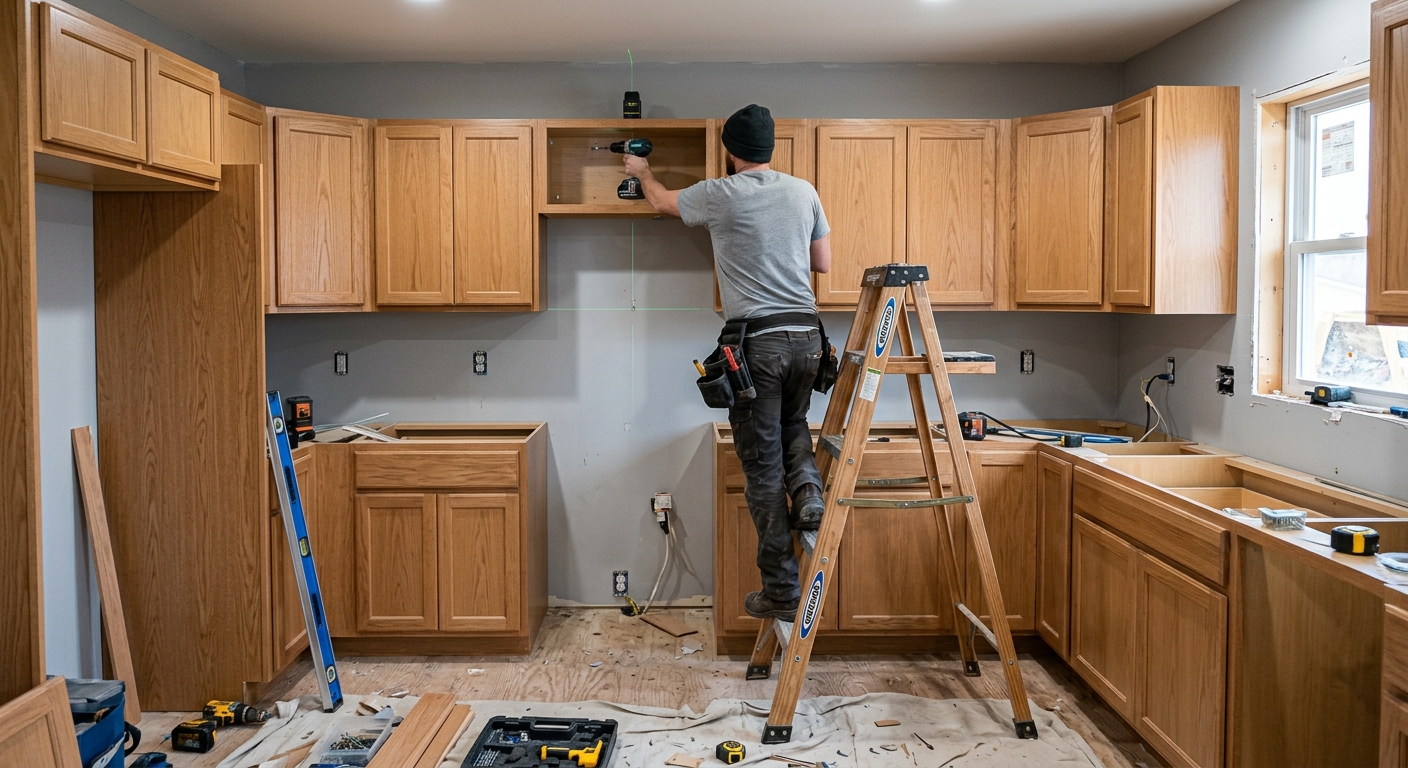
Somerset kitchen renovation prices by scope — 2026
In Somerset, most kitchens are owned rather than rented, and budgets reflect that: with a 79.6% homeownership rate and a median household income of $58,592 (U.S. Census Bureau, ACS 2024), owners need to know what they’re buying. Somerset Borough’s housing is dominated by pre-1950 construction, which means the original kitchen is often a small galley or awkward corner layout—much different from a newer suburban kitchen. In older homes, expect extra work opening up walls, moving plumbing, or upgrading electrical and HVAC, because it’s rare for everything to line up to modern standards.
This is where Somerset owners get tripped up: setting a budget for a “gut remodel” but then specifying a layout change and new services, which runs into a much higher price. The cost to gut and rebuild in the same layout is one band, while moving walls, plumbing, and wiring is a higher one altogether. It’s not about the square footage—it’s about the work behind the walls and the choices on every line item. Thin finish-trade availability in the county and travel surcharges also bump up the cost compared to Johnstown or metro markets.
| Scope |
What's included |
Duration |
Price range |
| Full gut remodel, same layout |
cabinets, counters, appliances, flooring, lighting, fixtures |
6–10 weeks |
$27,500–$110,500 |
| Gut plus layout change |
all of the above plus moved plumbing, electrical, walls |
10–16 weeks |
$60,000–$110,500 |
| Cabinet replacement (stock to semi-custom) |
remove and install cabinets, hardware, patching |
1–3 weeks |
$6,500–$27,500 |
| Cabinet refacing |
new doors and drawer fronts, veneer, hardware |
3–6 days |
$6,500–$18,500 |
| Countertop replacement only |
template, fabricate, install, reconnect sink |
1–3 weeks |
$3,700–$14,500 |
| Kitchen flooring only |
remove existing, install new flooring |
3–6 days |
$4,600–$18,500 |
Estimates for a typical Somerset kitchen. Cabinet grade and whether the layout changes move these figures more than square footage.
Choosing a countertop for a Somerset kitchen
Countertop selection in Somerset is less about what looks popular and more about how the surface handles daily reality. Quartz, for example, is engineered and non-porous so stains don’t set in—but it’s vulnerable to heat, so putting a hot pan down can damage it. Granite is natural stone, tough and heat-tolerant, but it needs resealing every couple of years or you’ll get stains and dull spots. Laminate counters have a reputation from the 1970s, but modern versions hold up well, clean easily, and they’re perfect for rentals or modest kitchens where a $3,700–$8,300 install makes more sense than spending on stone.
Butcher block offers warmth none of the others match, but it needs oiling and careful cleaning or it stains and splits. Solid surface, like Corian, is fully repairable if it scratches or chips—heat can still mark it, but you can sand it out. In any Somerset project, fabrication details matter: elaborate edge profiles, extra cutouts for a farm sink or pop-up outlets, and complicated seam placement all add cost. Ideally, your fabricator makes a template on site, which is more accurate than just measuring and keeps fit problems down when old walls aren’t square—a common issue in this county’s pre-1950 homes.
Don’t feel pressured into stone just because it’s trending. Laminate is not a compromise for the average Somerset kitchen, especially where you want the funds elsewhere. Repairs are easier, and replacement at this price point is simple if needed down the line.
The biggest line item in your Somerset kitchen
Cabinetry is the most expensive and the most impactful choice when renovating a kitchen in Somerset. Refacing—keeping your cabinet boxes and replacing only the fronts and hardware—saves dramatically. It’s the right move when the box structures are sound, plumb, and the current layout isn’t holding you back. But refacing does not add storage or fix bad layouts—critical in Somerset Borough’s older, non-standard kitchens.
Stock cabinets come in fixed sizes and are best when walls are straight, runs are standard, and there’s room for filler strips at the edges. Semi-custom cabinets adjust widths, heights, and finishes, fitting the quirky dimensions found in Somerset’s pre-1950 housing. Custom cabinets do anything, but at the highest price and longest lead—think carved corner units or odd ceiling heights.
Quality matters across all types: plywood boxes last longer than particleboard, dovetail drawer joints beat stapled ones, and full-extension, soft-close hardware is now a standard even at the lower end. Frameless cabinets give you more storage in the same footprint but need more precise installation—harder on out-of-plumb walls, which are common here. Because Somerset’s housing is often pre-1950, you’ll find layouts and wall conditions that push owners toward semi-custom whether they planned it or not.
| Option |
Cost |
Best when |
Limitation |
| Painting existing cabinets |
$1,200–$3,500 |
boxes and doors sound, tight budget |
no layout or style change |
| Refacing |
$6,500–$18,500 |
boxes square and layout works |
storage unchanged |
| Stock cabinets |
$6,500–$27,500 |
standard dimensions fit |
filler strips, limited finishes |
| Semi-custom |
$18,500–$27,500 |
non-standard walls or finishes |
6–12 week lead time |
| Full custom |
$18,500–$27,500 |
unusual layout or high-end design |
longest lead, highest cost |
What moving the sink really costs
In Somerset kitchens, keeping plumbing and electrical where they are is the difference between a manageable project and one where the budget leaps. The cost to move a sink or range isn’t just the new hole in the cabinet: relocating a drain means maintaining proper slope all the way, a big problem if you’re on a slab or there’s a finished ceiling underneath. Moving electrical isn’t just rerouting a wire—if the panel can’t take another circuit, you might suddenly need an upgrade. Moving a wall? Now you’re looking at determining if it's load-bearing, which brings in an engineer’s calculation, special inspection, and the required permit from Somerset Borough.
Venting a relocated range hood means an entirely new hole through brick or siding, which might not be simple in these older homes. All of these add up fast. For context, a gut remodel in the same layout usually sits in the $27,500–$110,500 band, while adding even one wall or moving utilities can quickly land you in the $60,000–$110,500 range.
This is why it pays to question whether the “awkward” existing layout is truly unworkable or just unfashionable. Many Somerset kitchens aren’t huge, and moving a sink a few feet could triple your project cost. Work with someone who will tell you honestly whether you’re paying for real function or just chasing an ideal.
Permits and inspections for a Somerset kitchen
In Somerset Borough, most purely cosmetic kitchen work—like painting cabinets, swapping hardware, or just replacing a countertop in place—doesn’t need a permit. But as soon as your project involves changes to plumbing, electrical systems, or structural elements, a permit is required. Even moving a sink a few feet or adding a new appliance circuit triggers this line. Some projects, like installing a new range hood vent, may also require mechanical permits, especially if an exterior wall needs to be penetrated.
The Somerset Borough Building Department, at 347 West Union Street, handles code enforcement and inspections for these permits. If you’re outside the Borough, check whether your township enforces the Pennsylvania Uniform Construction Code (UCC) or if oversight defaults to the state. For most homeowners, the registration to check is the Pennsylvania Office of Attorney General’s Home Improvement Contractor (HIC) registry, required for jobs over $500—verify at hic.attorneygeneral.gov. Every contractor with employees must carry workers’ compensation, and current coverage can be checked at wcais.pa.gov.
Skipping required permits can cause problems at resale: buyers may walk or lenders can refuse a mortgage if work wasn’t inspected. Somerset’s old housing means lots of do-it-yourself legacy wiring or plumbing, and undisclosed unpermitted changes are a major flag in this market.
What's behind the walls in a Somerset kitchen
Older homes are the rule in Somerset Borough, which means once demolition begins, it’s common to uncover the real work. Walls and floors are often out of plumb or not level, requiring heavy shimming to get new cabinets lined up. Old wiring, frequently ungrounded or undersized for today’s appliance loads, pushes many projects into a full electrical upgrade, typically costing thousands. Galvanized supply pipes and cast iron drains show up in kitchens built before the 1960s, each ripe for replacement if you want trouble-free plumbing for the next few decades.
Exterior walls may have no insulation, especially in kitchens done before energy codes—worth adding if walls are open. Prior unpermitted work crops up more often than most buyers expect; in Somerset’s older homes, the temptation to hack a fix runs high. Lead paint is likely if the home predates 1978—federal EPA Lead RRP rules apply, and any disturbance requires proper containment and a certified renovator. Asbestos-containing flooring tiles are still found under old linoleum or vinyl in mid-century houses; those must be tested before removal.
All these discoveries make up the “contingency” in your budget. Surprises add time and cost, and they’re so common in Somerset’s pre-1950 stock that you should expect at least one once you open up the walls.
General contractor, kitchen firm, or manage it yourself?
This decision sets the tone for your Somerset kitchen renovation more than any material choice. A design-build kitchen firm combines design, materials, and installation under one contract. You get a streamlined process, with one party responsible—but it’s the highest cost. If you want minimal involvement and have a clear vision or complex needs, this is your least stressful option.
A general contractor coordinates the carpenters, plumbers, electricians, and finish trades. You, or your designer, choose the appliances and fixtures. Costs are usually lower than with a kitchen firm, and you get more control of individual choices—but you’ll need to check references and manage your own allowances and change orders.
Owner-managed projects, where you hire individual trades and schedule each step, are the least expensive but require deep involvement and organizational skill. In Somerset County’s thin trade market, if a sub flakes or reschedules, it’s on you to fill the gap. Scheduling can become a full-time job, and travel surcharges from out-of-town trades are real in this part of Pennsylvania. Unless you have time flexibility and renovation experience, this is a hard way to save money—especially if permits are triggered or code inspections are needed.
For any scope that needs a permit—moved plumbing or walls—working with a GC or kitchen firm is safer and results in fewer headaches for most Somerset homeowners.
Frequently asked questions — kitchen renovation in Somerset
What is a realistic contingency for a Somerset kitchen?
For a kitchen renovation in Somerset—particularly in homes built before 1980—plan for a contingency fund of at least 15–20% of the project cost. Somerset Borough’s older homes frequently hide surprises: ungrounded wiring, cast iron drains, and out-of-square walls can all appear once demolition starts. On a typical gut remodel budget of $60,000, expect to hold $9,000–$12,000 in reserve. Any project that includes wall or floor opening needs this buffer. Newer homes may get by on less, but this county’s housing is dominated by mid-century or older buildings, so betting on smooth sailing isn’t wise.
How long does a kitchen renovation take in Somerset?
Renovating a kitchen in Somerset usually takes longer than in metro areas because of a thinner local labor pool and the quirks of older housing. A straightforward gut remodel of a Somerset kitchen, sticking to the existing layout, can take 6–10 weeks. If you’re changing the layout, moving plumbing or walls, 10–16 weeks is the realistic window. Finish-trade availability and seasonal schedules—especially during winter’s heavy freeze-thaw stretches—can affect timing. Be skeptical of anyone promising completion in under a month unless it’s a simple cabinet or countertop swap, which generally falls in the 1–3 week range, as shown in the $6,500–$27,500 cabinet band.
Is a cosmetic refresh enough or do I need a gut remodel?
Whether a cosmetic update will do or a full gut is needed depends mainly on the state of your kitchen’s bones. In Somerset’s older homes, it’s rare that only paint and hardware are needed—behind walls and under floors, you’ll often find outdated electrical, plumbing, or sagging substrates. If your cabinets are solid, finishes are simply tired, and utilities are already up to code, painting or refacing (usually $6,500–$18,500 for a full set) makes sense. But if outlets are ungrounded, pipes show corrosion, or you’re planning layout changes, a gut remodel is the safer long-term investment. Most Somerset kitchens that haven’t been updated in several decades end up needing a full tear-out to do it right.
What does a full gut kitchen remodel cost in Somerset?
A full gut remodel for a typical Somerset kitchen costs between $27,500–$110,500, with most homeowners landing around $60,000. The wide range is driven by the condition of the existing kitchen, the cabinet and countertop selections, and whether you’re keeping the same layout or moving plumbing and electrical. Somerset’s older, non-standard layouts and frequent need for utility upgrades can push projects toward the higher end, especially if surprises are uncovered behind the walls. Price also reflects the thinner local trade pool and travel costs common in Somerset County compared to larger metro areas.
Should I hire a general contractor or a kitchen firm?
In Somerset, the choice depends on your comfort with managing trades and your project’s complexity. A kitchen firm is the highest cost but handles design and coordination under one contract, which makes life easier if you’re busy or your job isn’t flexible. A general contractor is a bit more hands-on—you’ll work out design and material choices, and the GC coordinates the trades. For a typical gut remodel in the $27,500–$110,500 range, either route is valid. Unless your project is truly basic, owner-managing is not recommended here: schedule gaps and trade shortages can stall a self-managed job for weeks, especially in the Somerset labor market.
Are Somerset kitchens typically small galley layouts?
In Somerset Borough, yes. Because so much of the housing was built before 1950, most original kitchens are narrow, galley, or small U-shaped spaces. Newer homes in the area may have larger footprints, but most renovation projects are working with compact layouts, tight doorways, and awkward corners. That’s why many local kitchens lean towards semi-custom cabinetry, which fits non-standard dimensions better. If your house is post-1980, you’ll likely have more options for stock cabinetry, but in pre-1950 homes you’re often looking at selective wall moving—an upgrade that jumps the budget toward the $60,000–$110,500 band.
Which upgrades are not worth the money?
In Somerset, some upgrades are rarely worth the added expense—especially if they don’t solve functional problems. Expensive specialty appliances, integrated cabinet lighting with complex controls, or imported tile backsplashes can cost thousands and won’t return much in resale, especially compared to basics like decent cabinets and good lighting. In homes that still have dated layouts or tired cabinets, spending the $3,700–$14,500 typical on a luxury countertop rarely delivers satisfaction. Focus on solid structure, storage, and lighting before putting your budget into finishes that won’t change how the kitchen works or feels on a daily basis.
What happens if previous work was unpermitted?
Buying or renovating a kitchen in Somerset with a history of unpermitted work is a bigger risk than many realize. When you sell, any unpermitted changes—especially those involving electrical or plumbing—can halt the transaction. Lenders and buyers may require after-the-fact inspections, sometimes meaning opened walls or even partial demolition for code review. Somerset Borough enforces the Pennsylvania Uniform Construction Code, and failure to comply can lead to fines or mandatory corrections. For current projects, budget at least the $6,500–$27,500 band for bringing old, unpermitted work up to code if electrical or plumbing is involved.
Is laminate countertop a bad choice?
In Somerset, a laminate countertop is a good pick in more kitchens than you might think. Modern laminates are tough, forgiving of the heavy freeze-thaw cycles that homes here see, easy to clean, and can be replaced later without upheaval. The price—typically $3,700–$8,300 installed—leaves funds for better cabinets or smart storage. In rental properties or modest homes where value and durability matter more than prestige, laminate is smart, not a step down. Kitchens in Somerset aren’t cookie-cutter new builds, so the right choice is what’s functional and fits your budget, not what’s marketed as “upscale.”