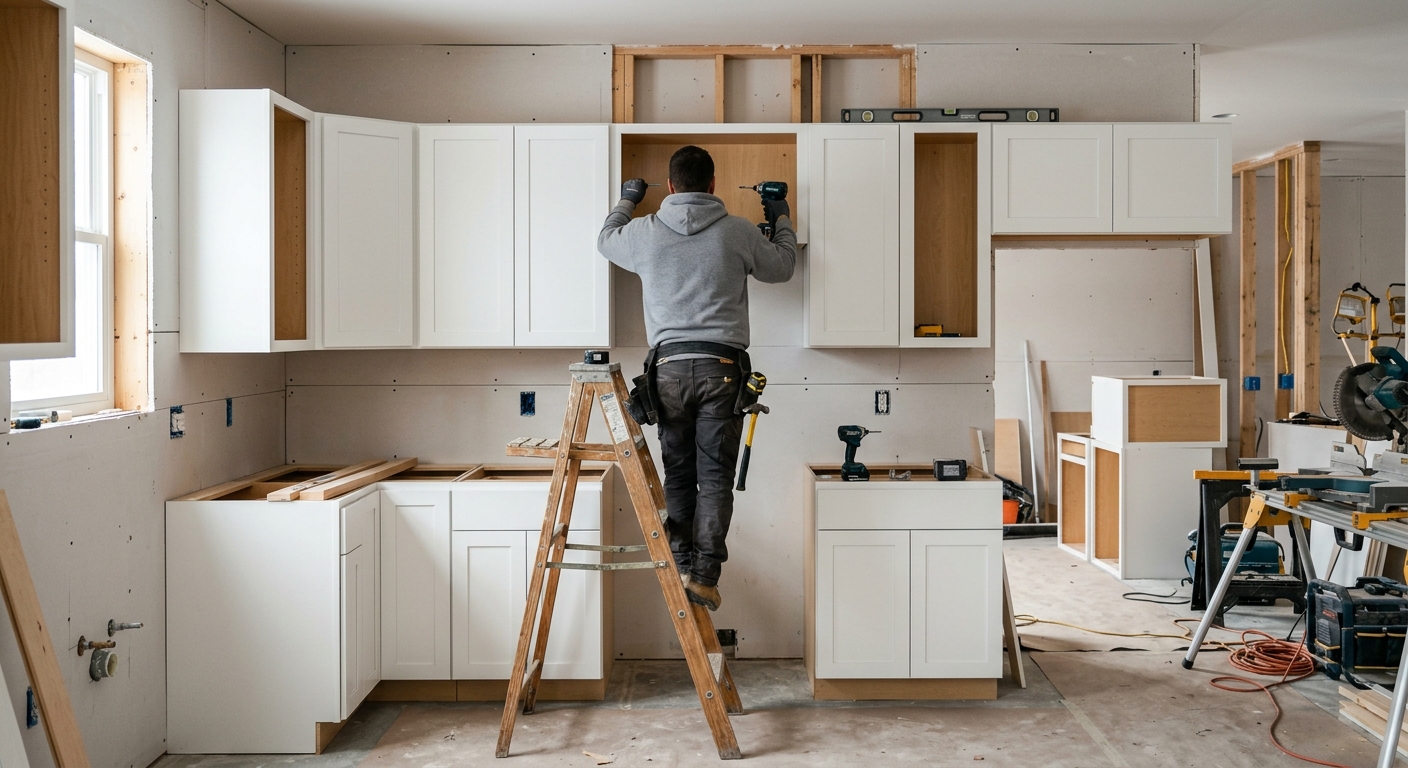
What a kitchen remodel costs in Lancaster
In Lancaster County, kitchen renovation costs range wider than many expect, with budgets shaped as much by housing stock as by homeowner choice. With a median household income of $61,014 (U.S. Census Bureau, ACS 2024) and a homeownership rate of only 46.7%, kitchen renovation is a careful investment here—especially in older, owner-occupied houses. Much of the local stock is post-World War II tract housing, particularly in Lancaster and Manheim Township, where cramped galley layouts and dated services are common. Whether your kitchen needs gutted and rebuilt or just upgraded finishes depends heavily on its vintage: 1950s homes often require moving walls or overhauling mechanicals; 1990s homes may only need cosmetic work.
The biggest budgeting trap is pricing for a simple job—like a cabinet “swap”—and then requiring all-new wiring or a layout change mid-project. Kitchen remodel costs in Lancaster track one critical factor: your project’s scope. Scope creep (from cabinet refacing to a full gut, for example) is the fastest way to overspend. Here’s what’s typical for each tier:
| Scope |
What's included |
Duration |
Price range |
| Full gut remodel, same layout |
cabinets, counters, appliances, flooring, lighting, fixtures |
6–10 weeks |
$29,000–$115,500 |
| Gut plus layout change |
all of the above plus moved plumbing, electrical, walls |
10–16 weeks |
$62,500–$115,500 |
| Cabinet replacement (stock to semi-custom) |
remove and install cabinets, hardware, patching |
1–3 weeks |
$6,700–$29,000 |
| Cabinet refacing |
new doors and drawer fronts, veneer, hardware |
3–6 days |
$6,700–$19,000 |
| Countertop replacement only |
template, fabricate, install, reconnect sink |
1–3 weeks |
$3,800–$15,500 |
| Kitchen flooring only |
remove existing, install new flooring |
3–6 days |
$4,800–$19,000 |
Estimates for a typical Lancaster kitchen. Cabinet grade and whether the layout changes move these figures more than square footage.
Why the electrical line grew
Electrical systems are the source of the most frequent budget jumps mid-job, particularly in Lancaster’s older homes. Current code, under the Pennsylvania Uniform Construction Code (UCC), expects a kitchen to have dedicated 20-amp small-appliance circuits (usually at least two), GFCI protection at every countertop receptacle, outlets spaced along the counters every four feet, and separate circuits for dishwasher, disposal, built-in microwave, and sometimes even the fridge. If you plan to switch from a gas to an electric range, a 240-volt line is required.
Most of Lancaster’s housing—88.0% is pre-1980 (U.S. Census Bureau, ACS 2024)—was not wired for modern kitchen loads. In a typical 1950s-1970s tract house around Lancaster or Manheim Township, you may encounter two-wire ungrounded circuits, the entire kitchen on a single shared breaker, or a panel box with no spares. Aluminum branch wiring occasionally shows up in late-1960s homes. When you open the walls, inspectors expect you to bring all open areas up to current code—not just “fix what’s bad.” This upgrade is mandatory and is almost never budgeted in smaller scopes.
Bringing an older Lancaster kitchen’s electrical up to code typically costs from $4,800–$11,500—and more if your panel itself needs replacement. In late 1990s homes, you may avoid full rewiring, but often still need additional dedicated circuits.
Quartz, granite, laminate or butcher block
Choosing a kitchen countertop in Lancaster is about how you live day-to-day—not just about looks. Quartz is now the most popular choice in mid- to high-end remodels. It’s engineered, non-porous, never needs sealing, and resists stains very well, but it is sensitive to direct heat—set down a hot pan and you may scorch the resin. Granite is all-natural stone, has real variation, and takes heat, but it must be sealed every few years to stay stain-resistant. Chips can be repaired but may show. Laminate is far better than its old reputation: modern designs are realistic, it resists staining, cleans up easily, and is hands-down the lowest maintenance option. Scratches show but don't require sealing—and for a modest kitchen or rental, laminate is a perfectly reasonable and not “cheap” decision. Butcher block gives warmth and a traditional look, but needs oiling and babysitting. It's easy to sand out scratches or stains but expects more from its owner.
Fabrication matters too. Edges beyond simple square—like ogee or bullnose—raise cost. Undermount sinks and range cutouts add complexity and expense. Most counters require a precise template visit after the cabinets are set (especially true for quartz, granite, and solid surface), not just a measurement or drawing. Seam placement is dictated by slab size and corners; quartz has nearly invisible seams, granite can vary, butcher block and laminate are most visible. Solid surface (like Corian) can be repaired and seams are nearly invisible, but price is similar to quartz.
Resale value and kitchen spending
Renovating a kitchen in Lancaster almost always helps a house sell faster and for more—but rarely returns every dollar. The largest share of cost is typically recouped by mid-range remodels done with resale in mind, not luxury features aimed at personal use. High-end spending—custom cabinets, premium appliances—rarely lines up with neighborhood values, especially when Lancaster’s median household income is $61,014 (U.S. Census Bureau, ACS 2024). Over-improvement is a real risk: putting a $115,500 kitchen in a block of $180,000 houses won’t return that investment at sale.
The decision boils down to your aim. Renovate to live in? Choose what you’ll use daily and ignore the resale math. Renovate to sell? Go with neutral finishes, durable surfaces, a layout that works for families, and hold the budget to mid-tier. In Lancaster, updating a very dated kitchen to a clean, functional space is almost always worth it when selling—but a major expansion almost never recoups its full cost. Skip the ultra-trendy features and focus on what’s reliably demanded.
Code requirements for Lancaster kitchens
In Lancaster County, most kitchen renovations do not require a permit for basic cosmetic work—like painting, replacing cabinet hardware, or installing a new countertop on top of existing cabinets. Permit requirements are triggered once you start new or relocated electrical circuits, move plumbing, alter load-bearing walls, or make layout changes. In Lancaster city, any kitchen renovation involving structural changes or new plumbing/electrical circuits requires a building permit, and if the remodel changes the layout or major services, a formal plan review is standard. In county townships, cabinet replacement typically doesn’t require a permit if utilities stay put.
Inspections for electrical work in Lancaster city and some surrounding townships are often performed by certified third-party agencies such as Middle Department Inspection Agency, not municipal officials. This catches many by surprise. Plumbing and mechanical permits are handled at the municipal level; there’s no statewide trade licensing for plumbers or electricians, so local requirements vary.
Contractors must carry valid Home Improvement Contractor (HIC) registration, verified at hic.attorneygeneral.gov. All employers must carry workers’ compensation insurance, which you can verify via WCAIS (wcais.pa.gov). Keep in mind: any work that should have been permitted but wasn’t can cause major headaches at resale, sometimes requiring re-opening finished walls for inspection.
Cabinets: reface, stock, semi-custom or custom
Cabinets are where most Lancaster kitchen budgets are made or broken. Four options matter. Refacing keeps your existing cabinet boxes but replaces the doors, drawer fronts, and applies new veneer—a great choice when the boxes are solid, square, and the layout fits your needs. It’s much less expensive but can't add storage or change the layout. Stock cabinets are budget-friendly, come in fixed dimensions (usually 3-inch increments), and need filler strips to fit irregular rooms. Semi-custom cabinets adjust sizing, depth, and finishes to fit the space. Full custom fits anything, costs the most, and has the longest lead time.
Quality isn’t always tied to cost. Look for plywood boxes when possible; lower-end cabinets tend to be particleboard. Dovetail joints last longer than stapled drawers. Full-extension, soft-close hardware isn’t just a luxury anymore—it's expected. Frameless (European-style) cabinets maximize storage but cost more; face-frame (traditional) are more forgiving in older houses.
Around Lancaster and Manheim Township, post-WWII tract homes often have rooms that aren’t perfectly square. This often pushes homeowners toward semi-custom cabinets (for fit) whether their original plan called for it or not. It’s worth spending here if your walls are out of plumb, or if you want to maximize space.
| Option |
Cost |
Best when |
Limitation |
| Painting existing cabinets |
$1,200–$3,500 |
boxes and doors sound, tight budget |
no layout or style change |
| Refacing |
$6,700–$19,000 |
boxes square and layout works |
storage unchanged |
| Stock cabinets |
$6,700–$29,000 |
standard dimensions fit |
filler strips, limited finishes |
| Semi-custom |
$19,000–$29,000 |
non-standard walls or finishes |
6–12 week lead time |
| Full custom |
$19,000–$29,000 |
unusual layout or high-end design |
longest lead, highest cost |
Lead times, sequencing and why it takes longer
Most delays in Lancaster kitchen remodels trace to how the work must be sequenced, not to “contractor slow-walking.” First, you finalize the design, take precise measurements, and order cabinets—which can have a six to twelve week lead time here, since finish-trade labor is especially tight in Lancaster County compared to the Harrisburg–York metro. Demolition only starts after cabinets are ordered, not before, to avoid holding up the project.
Once demolition is done, rough electrical and plumbing are installed and pass inspection. Only then are cabinets set in place. The countertop company templates for measurement—this cannot happen before cabinets are set, meaning there’s always “dead time” of a week or more while slabs are fabricated. Homeowners are rarely warned about this empty week in the middle of the job.
After counters are in, the sink and appliances are hooked up, flooring and backsplash can go down, and final trims finish. The cabinets and countertops are always the critical path—delay in one pushes all else. In rural or less densely served parts of Lancaster County, material logistics can add further days. Bottom line: order cabinets before demo, expect one or more inevitable pauses, and you’ll avoid most scheduling surprises.
Frequently asked questions — kitchen renovation in Lancaster
Should I reface or replace my kitchen cabinets?
Refacing your cabinets in Lancaster is worth considering if your existing cabinet boxes are solid, square, and the kitchen layout already works well for you. Refacing changes the doors, drawer fronts, and veneer, but not the box itself—no added storage or layout changes are possible. The cost is significantly lower than replacement, generally between $6,700–$19,000 for an average kitchen. Replacement is better when boxes are damaged, poorly laid out, or when you want a new cabinet configuration. Most older houses around Lancaster and Manheim Township have non-standard dimensions, so if you're dreaming of a new layout or additional function, replacement (possibly semi-custom) is often the better path.
Is induction worth it over gas?
In Lancaster homes, induction cooktops are gaining popularity for their safety, speed, and efficiency—especially in remodels where running a new gas line is complex or expensive. Induction heats pans directly, keeping the kitchen cooler and the surface safer to touch. The tradeoff is that you need compatible cookware, and repair or replacement is more specialized than with a standard gas cooktop. In post-war tract housing, where venting a new gas range can be tricky or trigger permit requirements, going induction often simplifies the job. Expect to spend about $3,800–$15,500 for a mid-range kitchen’s electrical and appliance update with induction, depending on the rest of the electrical upgrades required.
What does a quartz countertop cost in Lancaster?
For typical Lancaster kitchens, installed quartz countertops range from $3,800–$15,500. The price depends on the edge profile, the number of cutouts, and whether your kitchen has unusual angles or long runs needing multiple seams. The average kitchen lands near $8,700. Quartz is engineered, stain-resistant, and very popular here, but costs rise quickly with more difficult layouts. Don’t forget to factor in the cost for professional templating, which is always included in the quoted price for all but the smallest jobs. If you have a galley kitchen or simple footprint, your price will be at the lower end of the range.
Do I need a permit for a kitchen renovation in Lancaster?
In Lancaster city, a permit is typically required for any kitchen remodel that involves moving or adding electrical, plumbing, or making structural changes. Cosmetic updates like painting, installing new hardware, or replacing a countertop (without moving sinks or appliances) do not require a permit. In the surrounding townships, simply replacing cabinets (without relocating utilities) is often done without a permit. But as soon as circuits or plumbing lines are moved, a permit is necessary. Permits exist to protect you, and skipping them can lead to headaches when you try to sell—permitted remodels are checked at resale, and unpermitted work may have to be torn out. Budget between $29,000–$115,500 for a full gut job, part of which often goes to inspection and permit fees.
Which upgrades are not worth the money?
In Lancaster, the returns on high-end features—such as fully custom cabinetry or integrated luxury appliances—are often not worth the spend, especially when the median local income is $61,014. Upgrades that don’t fit the needs or tastes of typical buyers, like elaborate wine storage or a professional range in a modest neighborhood, also overrun their value. Stick to well-built semi-custom or stock cabinets, a practical layout, and mid-range appliances. Spending at the high end of the full gut remodel range—think $115,500—almost never pays off unless you’re intending to stay and enjoy every feature for years.
What is a change order and how should it work?
A change order is a formal, written agreement to modify the original kitchen renovation contract—often after hidden conditions in a Lancaster home are revealed, such as bad wiring behind the walls. It should detail the change in work scope, any added cost (for example, another $4,800–$11,500 for unforeseen electrical upgrades), and how the schedule is affected. Under Pennsylvania’s Home Improvement Consumer Protection Act, any change to a written contract must itself be documented in writing. Never accept verbal changes; always require a clear, signed change order to avoid disputes at project’s end.
Should I order cabinets before demolition?
Yes, in Lancaster County it is smart to order your cabinets before starting demolition. With both stock and semi-custom cabinets running 6–12 weeks for delivery—sometimes longer if you’re outside the city—the project will stall if you wait. Demolishing first, then waiting for cabinets, leaves your kitchen torn up for weeks. In a typical swap or gut job in Lancaster, cabinets (in the $6,700–$29,000 range) are nearly always the bottleneck. You want cabinets ordered, with delivery scheduled, before swinging the first hammer.
How does Lancaster's housing stock affect cabinet fit?
Because most Lancaster homes are pre-1980, especially the tract houses around Lancaster and Manheim Township, your kitchen’s walls are usually not perfectly square or straight. This often means stock cabinets don’t fit cleanly without visible fillers, and semi-custom cabinets (costing $19,000–$29,000) are commonly needed to make the most of the space. Remodels frequently uncover wall irregularities that require modifications to the cabinet plan mid-project. Account for these realities up front, not as an afterthought.
What does a full gut kitchen remodel cost in Lancaster?
For a full gut kitchen remodel in Lancaster—removing everything down to the studs, replacing all cabinetry, flooring, appliances, countertops, fixtures, and lighting—the current price range is $29,000–$115,500, with most projects for a typical home landing around $62,500. Costs sway higher with any layout changes, new plumbing or electrical circuits, or upgrades to semi-custom cabinets. Older homes (the majority here) run toward the higher end due to the need for service upgrades and extra prep. Always ask for a detailed, itemized proposal to keep from over-spending and to ensure the job scope fits your budget from the start.