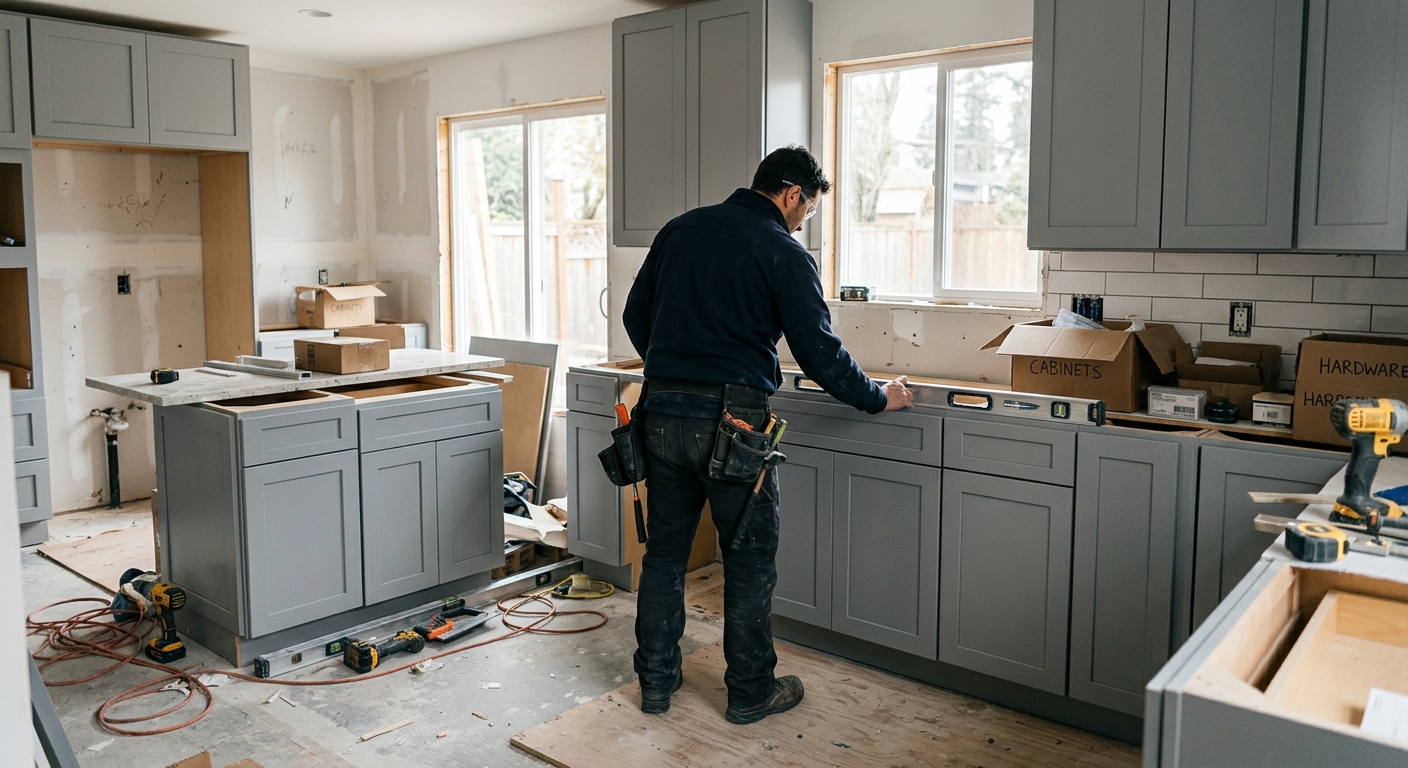
Manor kitchen renovation prices by scope — 2026
In Manor, with a homeownership rate of 75.8% and a median household income of $87,050 (U.S. Census Bureau, ACS 2024), most kitchen projects are investments in quality of life and long-term value. The budgets you see here are directly shaped by both the types of homes in the area and how owners plan. Much of Lancaster County’s housing—especially in Manor Township and the postwar tracts of Manheim Township—reflects post-World War II eras. Kitchens built during those waves were often modest in size and efficiency, leading to frequent full-gut remodels when families want open layouts or modern storage.
The critical mistake that leads to blown budgets is pricing the job as a cosmetic update—expecting a cabinet or counter refresh—then deciding midstream to move the sink or knock out a wall. Those single changes can double the overall spend. Clear up front which of these categories your project falls into, and only budget for more if you can live with the upper end of the range.
| Scope |
What's included |
Duration |
Price range |
| Full gut remodel, same layout |
cabinets, counters, appliances, flooring, lighting, fixtures |
6–10 weeks |
$30,500–$123,000 |
| Gut plus layout change |
all of the above plus moved plumbing, electrical, walls |
10–16 weeks |
$66,500–$123,000 |
| Cabinet replacement (stock to semi-custom) |
remove and install cabinets, hardware, patching |
1–3 weeks |
$7,200–$30,500 |
| Cabinet refacing |
new doors and drawer fronts, veneer, hardware |
3–6 days |
$7,200–$20,500 |
| Countertop replacement only |
template, fabricate, install, reconnect sink |
1–3 weeks |
$4,100–$16,500 |
| Kitchen flooring only |
remove existing, install new flooring |
3–6 days |
$5,100–$20,500 |
Estimates for a typical Manor kitchen. Cabinet grade and whether the layout changes move these figures more than square footage.
Who should run your Manor renovation
The biggest choice in a Manor kitchen remodel isn’t cabinet style—it’s who’s managing the project. A design-build kitchen company covers everything: they design the space, provide the cabinets and install them with their own crew. It’s the smoothest path, with a single contract and a clear warranty, but expect to pay at the higher end of the range for a full gut remodel—$30,500–$123,000.
A general contractor (GC) is the middle road. The GC oversees all the trades—plumbers, electricians, tile, and more—while you or a kitchen designer handle style choices and specifications. Your involvement goes up: expect more meetings and day-to-day questions, but you’ll pay less than a full design-build. This model is best for most Manor households wanting one-stop accountability but with more control and, potentially, savings if you already know exactly what you want.
Owner-managed projects, where the homeowner hires each trade and coordinates the schedule, are cheapest in theory, but often cost more in mistakes and delays. This route is not realistic for anyone holding a regular job, especially in Lancaster County where skilled kitchen labor is booked out due to a tighter market. If your job is going to need a permit or formal inspection—and moving plumbing, adding electrical or structural changes means it will—delegate. Scheduling slip-ups land on you and can drag a Manor kitchen project for months longer than planned.
Comparing kitchen renovation bids in Manor
When you get quotes from Manor contractors, don’t just compare the bottom-line totals—look at how the numbers are built. Allowances are the mechanism that hides wild swings between seemingly similar bids. An allowance is a placeholder dollar amount for items you haven't picked yet (like tile, fixtures, or lighting). If one bid carries a $1,500 tile allowance for a kitchen that needs $4,000 of tile and trim, your actual cost will rise with every selection. Always compare each allowance line, not just the total.
Review the rest of the contract for specifics: cabinetry should name the exact brand and line, countertop material and thickness should be spelled out (not just “granite” or “quartz”), and the contract should say how surprises will be priced. Change orders—any scope alteration—should require written approval before extra work or costs. Payment should match progress, not dates. Ask for lien waivers from every subcontractor once paid; this protects you from a mechanics’ lien if a sub goes unpaid. Pennsylvania’s Home Improvement Consumer Protection Act requires a written contract over $500 and gives you a three-day right to cancel. Read every line before signing.
| Line item |
What to look for |
Red flag if… |
| Allowances |
realistic amounts, itemised |
round numbers with no basis |
| Cabinetry |
brand, line, box construction |
'quality cabinets' |
| Countertops |
material, thickness, edge, seams |
material name only |
| Electrical |
circuits to be added, GFCI scope |
'as needed' |
| Unforeseen conditions |
how they are priced and approved |
not addressed |
| Change orders |
written approval before work |
verbal |
| Payment |
milestone-based, modest deposit |
front-loaded |
| Lien waivers |
from subs at each payment |
not offered |
Permits and inspections for a Manor kitchen
In Lancaster County, including Manor Township, most surface-level kitchen work—painting, hardware upgrades, refacing, and even swapping countertops in place—does not require a building permit. But the minute your renovation calls for moving or adding electrical circuits, relocating plumbing, structural changes (like removing a wall), or substantial mechanical work for upgrades like a new range hood duct, you enter permit territory. In nearby Lancaster city, a permit is required for any kitchen project that includes those scope triggers, and a formal plan review is often part of the process for bigger layout or system changes.
Electrical inspections for many projects around Manor are not always handled by your township—third-party agencies such as Middle Department Inspection Agency are commonly involved. This can impact your project timeline, as you must pass their schedule and requirements.
For any project over $500, Pennsylvania requires your contractor to be registered with the PA Office of Attorney General’s Home Improvement Contractor (HIC) registry. Always verify the registration before signing. Workers’ compensation insurance is legally mandatory for employers and can be checked through the WCAIS system. Skipping permits and proper documentation can have lasting consequences: unpermitted work may require correction—and re-inspection—if flagged during a future home sale, potentially delaying transfers or derailing a deal.
Quartz, granite, laminate or butcher block
The everyday realities of countertop material matter more in Manor kitchens than whichever pattern is trending on social media. Quartz is engineered, non-porous, and stain resistant, which means it shrugs off red wine and coffee with less fuss than granite. However, hot pans can scorch or crack quartz, so always use trivets. Granite is natural stone—each slab is unique—and holds up well to heat, but requires periodic sealing (a half-hour job once a year) to prevent staining. Laminate, once dismissed, is now both durable and far better-looking than its reputation. It shrugs off stains, and minor scratches can often be buffed—plus, it’s a sensible pick for rental units or budget-focused Manor kitchens. Butcher block brings warmth and feels like an upgrade, but it does demand frequent sealing and can stain or gouge if not wiped up or sanded regularly. Solid surface (like Corian) is repairable and seamless at the joins, but can still scorch and scratch.
Price in Manor depends less on the square footage and more on how many cutouts (for sinks and cooktops), the chosen edge profile, and seam placement—those all affect fabrication labor. Expect a fabricator to make a digital template after cabinets are in, not just measure dimensions. Unless your kitchen is exceptionally basic or you’re flipping a house, don’t dismiss modern laminate: in many Manor kitchens with tight budgets, it’s a perfectly sound and sensible choice, not a compromise.
What moving the sink really costs
In Manor, the moment you move a sink, oven or any plumbing or electrical beyond a few feet, costs make a leap. Keeping everything in place qualifies as a standard “gut remodel, same layout” (usually $30,500–$123,000), but as soon as you relocate services, the scope—and price—move to “gut plus layout change” ($66,500–$123,000). The added dollars aren’t just for pipe or wire, but for labor and the knock-on work: drain lines need slope, which in a slab or when there's finished space below often leads to ceiling demolition and patching. If you add circuits, your panel has to have capacity—sometimes a full upgrade is triggered. Knocking out a wall brings engineering costs to check if it’s load-bearing, plus the required permit and plan reviews in places like Lancaster city.
Venting a relocated range hood means drilling a new exterior hole, which on brick or stone is rarely trivial. That’s why a “minor” change, like shifting the sink four feet into an island, can bump a Manor kitchen toward the high end quickly. So, before finalizing plans, ask if your current kitchen is truly unworkable or just behind the times. In many postwar layouts around Manor, a bigger upgrade may be justified, but in plenty of 1990s kitchens, focusing funds on new cabinets or counters pays more daily joy than a sink position change.
Surprises in an older Manor home
With 38.2% of Manor homes built before 1980 (U.S. Census Bureau, ACS 2024), gutting a kitchen regularly turns up echoes from previous eras. Out-of-plumb walls and uneven floors mean the installer can spend as much time shimming as hanging cabinets—sometimes a day's labor or more. Electrical discoveries are common: original wiring may lack a ground wire or be undersized. Bringing this up to modern code might mean running new circuits—costing in the thousands on top of base cabinetry prices. Galvanized supply lines, cast iron drains, and the absence of insulation in exterior walls can all pop up once walls are open. Replacing old pipes is pricier than you’d think, especially if access is tight.
If your house predates 1978, the federal EPA Lead RRP Rule applies: any disturbance requires a certified renovator and, often, lab testing before demolition. Asbestos is also more likely in older sheet flooring or mastic but can only be confirmed by testing. In updated suburban homes, expect builder-grade particleboard cabinets or laminate counters to have reached their end of life together—sometimes making a full gut ($30,500–$123,000) more worthwhile than piecemeal replacement. Previous owners’ “DIY” efforts might reveal unpermitted electrical splices or odd plumbing runs—every fix adds time and dollars if you want to pass final inspection and ensure insurance covers the work.
Frequently asked questions — kitchen renovation in Manor
Why are kitchen quotes in Manor so far apart?
Kitchen renovation quotes in Manor often look wildly inconsistent because of how contractors structure “allowances” and what’s included in the base price. Some quotes might sound lower, but only because they carry allowances that couldn’t buy the basic products needed for your scope. For example, one bid could budget $7,200 for all cabinetry (the low band), while another starts the same line at $20,500 for semi-custom options—they’re not truly apples-to-apples. Another big factor is whether the quote includes moving plumbing or electrical, which instantly bumps the cost into a higher band (closer to $66,500–$123,000). Finally, local scheduling pressures in Lancaster County mean some firms charge more just to guarantee a completion slot. Always compare line by line—not by the total—before choosing your contractor.
Is lead paint a concern in Manor kitchen renovations?
Lead paint is a real consideration in Manor, especially since 38.2% of homes here were built before 1980 and the federal EPA Lead RRP Rule applies to any pre-1978 house. Before any demolition, your contractor should confirm the year built and follow certified procedures—to prevent contamination. If your kitchen falls under this rule, expect extra steps like lab tests and special containment, which can add several hundred or even a few thousand dollars on top of your remodel cost. Skipping these safeguards is illegal and also exposes your family to real health risks. Most reputable Manor contractors will spell this out in their bid and contract—if yours doesn’t, that’s a red flag. For newer homes, lead isn’t an issue, but for older kitchens, make sure your quotes reflect compliance with these federal requirements.
What happens if previous work was unpermitted?
If prior kitchen work in your Manor home wasn’t permitted when it should have been—say, electrical or plumbing was rerun or a wall was removed without sign-off—this can cause headaches at resale or during a new renovation. Most municipalities, including those around Lancaster, require permits for any substantial system or layout changes. During a future sale or renovation, inspectors or buyers may demand records, and if you can’t show them, you’ll likely have to open walls or bring systems up to current code. This often means unexpected costs in both time and money, potentially pausing or derailing a project. For new work, always make sure your contractor’s HIC registration is up to date, and verify inspection practices if you’re in a township where third-party electrical inspections are common. Trying to save by skipping permits can cost much more than the fee—especially if a fix pushes your job into the full gut price range of $30,500–$123,000.
What adds the most resale value in a kitchen?
In Manor and across Lancaster County, the best returns come from a well-planned full kitchen gut remodel where the layout is optimized but not dramatically changed. Buyers respond to bright, open kitchens with modern surfaces, semi-custom cabinets, and new appliances. Projects that hit the sweet spot—new cabinets, counters, LVT or wood flooring, and upgraded lighting—often get you closer to the middle of the full gut range, about $66,500, but rarely require structural walls moved. Super high-end spend rarely returns dollar-for-dollar, especially past the top of the local market band, while a kitchen that’s obviously updated commands more attention than one that looks 30 years behind. Cosmetic-only upgrades (paint, refacing, new counters) have less impact, but in a well-maintained home, even those can help capture a sale quickly in Manor’s competitive owner-occupied market.
Should I reface or replace my kitchen cabinets?
Cabinet refacing can be a smart option in Manor for kitchens where the existing boxes are solid and the layout works. Refacing means new doors and drawer fronts, fresh veneer, and hardware—usually completed in under a week and at a lower cost: $7,200–$20,500. The results make a dramatic style upgrade and cause less mess than full replacement. However, if the layout doesn’t work, or the old cabinets are particleboard, sagging, or water-damaged (common in some Lancaster postwar homes), replacement is the right investment. New cabinets mean the opportunity for better storage, more functional drawers, and soft-close hardware, but the cost is higher—$7,200–$30,500 for stock or semi-custom. If you’re on the fence, get quotes and compare them—including installation and any needed repairs to floors or walls. Sometimes, it’s penny wise and pound foolish to salvage boxes at the end of their life.
What is the difference between stock and semi-custom cabinets?
Stock cabinets are mass-produced in set sizes and styles—think what you’d find at a home center. They’re faster to get and usually cheapest, making them good for projects where budget is the top consideration. Semi-custom cabinets cost more (typically pushing a Manor kitchen into the top half of the $7,200–$30,500 range for cabinet replacement), but you get a wider choice of finishes, sizes, and features like built-in organizers or extra-deep drawers. They’re still made in factories, but are customized to your order. In many Manor Township tract houses with unusual layouts or where you want all your corners to fit perfectly, semi-custom bridges the gap between off-the-shelf and full custom. Always compare lead times too, since some semi-custom orders are running long due to kitchen labor shortages in the Lancaster region.
Why is there a gap after cabinets are installed?
Gaps between cabinets and the ceiling or floor are common in Manor, especially in older homes built before 1980. Out-of-level floors or out-of-plumb walls (frequently found in Lancaster’s postwar housing stock) mean installers must shim and adjust to get cabinets to line up visually and functionally. Standard cabinets aren’t designed for the quirks of every house, so trim pieces like crown molding or shoe molding cover small irregularities. In newer tract homes, gaps often occur if the builder used thinner subfloor or inconsistent framing. This is not a sign of poor installation—sometimes cabinetry needs to “float” slightly above a wavy floor to function. Finishing carpentry makes the difference between a DIY look and a clean, built-in result, and part of a typical cabinet replacement budget (usually between $7,200–$30,500) should include these detail pieces.
What is a change order and how should it work?
A change order is any documented alteration to the original kitchen contract in Manor—such as swapping materials, moving an outlet, or installing an extra cabinet. Good contractors require a written change order before any work begins or extra dollars are spent. This protects the homeowner and the crew: you sign off, they proceed, and the paper trail is clear if there’s a dispute. In Lancaster County, Pennsylvania law under the Home Improvement Consumer Protection Act means any kitchen job over $500 needs a written contract—so changes should also be on paper. Verbal-only change orders can lead to confusion and surprise costs. When you review quotes, check how the contractor handles change orders: if the contract just says “as needed” or relies on a handshake, you risk disputes and possibly paying the top of the $123,000 range for what started as a much smaller scope.
What does a quartz countertop cost in Manor?
Quartz countertops in Manor range from $4,100–$16,500 depending on thickness, pattern, and number of cutouts. Most kitchens fall near the typical $9,200 mark for a mid-sized install with a few custom details. Factors moving your price higher include complex edge profiles, waterfall ends, or a lot of slab waste due to layout. Harbor no illusions: installation costs for quartz are higher than for laminate, because quartz is heavy, requires fabrication, and any mistake ruins a slab. If you’re doing a full kitchen gut remodel, your countertop typically accounts for 10–15% of total project spend. In Manor, solid mid-range quartz offers low maintenance and helps future resale, while making your kitchen easier to live in day-to-day.