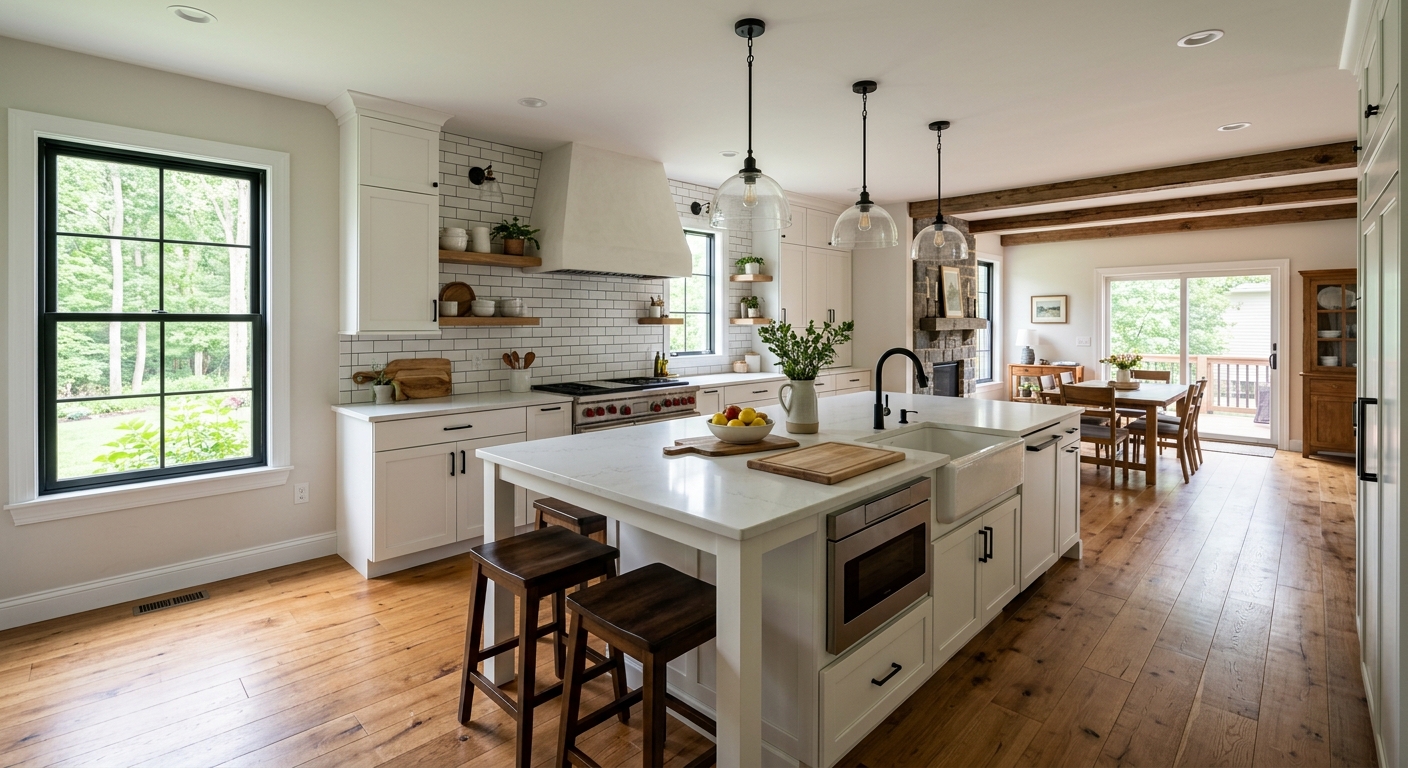
Lawrence kitchen renovation prices by scope — 2026
In Lawrence, where the median household income is $54,212 and the homeownership rate is 70.8% (U.S. Census Bureau, ACS 2024), most kitchen renovations are driven by long-term owners looking to improve a home they plan to keep. The price range is wide because Clearfield County homes are often 1940–1970 builds, which means you might be dealing with a cramped 1950s galley needing walls moved or a straightforward 1990s redo. Most projects see cost overruns when the budget is set for a simple pull-and-replace, but the scope creeps into a full gut job—often late, when electrical or plumbing surprises are found.
The dominant cost swings aren’t about square footage—in Lawrence, older homes dictate the extent of work needed to meet code. Changing the kitchen’s footprint or updating critical infrastructure will have a bigger impact than picking tile over hardwood or going up a cabinet grade.
| Scope |
What's included |
Duration |
Price range |
| Full gut remodel, same layout |
cabinets, counters, appliances, flooring, lighting, fixtures |
6–10 weeks |
$27,000–$109,000 |
| Gut plus layout change |
all of the above plus moved plumbing, electrical, walls |
10–16 weeks |
$59,000–$109,000 |
| Cabinet replacement (stock to semi-custom) |
remove and install cabinets, hardware, patching |
1–3 weeks |
$6,400–$27,000 |
| Cabinet refacing |
new doors and drawer fronts, veneer, hardware |
3–6 days |
$6,400–$18,000 |
| Countertop replacement only |
template, fabricate, install, reconnect sink |
1–3 weeks |
$3,600–$14,500 |
| Kitchen flooring only |
remove existing, install new flooring |
3–6 days |
$4,500–$18,000 |
Estimates for a typical Lawrence kitchen. Cabinet grade and whether the layout changes move these figures more than square footage.
Electrical work in an older Lawrence kitchen
The most common—and expensive—mid-project surprise in a Lawrence kitchen is electrical. In Clearfield County, 69.6% of homes were built before 1980, which nearly always means the electrical system is outdated by today’s standards. Modern code calls for dedicated small-appliance circuits, GFCI protection at every countertop outlet, regular spacing so there are no stretches of wall beyond two feet without a plug, dedicated lines for a dishwasher, disposal, and microwave, and a 240-volt circuit for an electric range or oven.
In the area’s typical 1940–1970 home, you’ll often find two-wire, ungrounded circuits, a single circuit handling the whole kitchen, an old electrical panel bursting at the seams, and sometimes even aluminum branch wiring. Once walls are open during a renovation, inspectors will expect wiring to be brought to current code—this isn’t optional, and it’s rarely budgeted in advance of demo.
Even homes from the late 1990s in Lawrence sometimes lack enough circuits for new appliances. In reality, bringing kitchen electrical fully to code—meaning new circuits, GFCIs, updated wiring, and new breakers—typically costs $4,500–$12,000 on top of your kitchen budget, depending on the panel, layout, and level of finish. If you find knob-and-tube or aluminum, costs rise further and may require whole-home updates. Always plan for an electrical audit before finalizing your scope.
Permits and inspections for a Lawrence kitchen
In Lawrence, cosmetic updates—like painting cabinets, changing hardware, refacing, or simply swapping out a countertop—don’t normally require permits. But if you are adding or moving electrical circuits, relocating plumbing, changing the layout, or doing much more than a direct cabinet swap, then you’re nearly always in permit territory under the Pennsylvania Uniform Construction Code (UCC). This code, enforced by your local municipality, is what guides the rules here—not a one-size-fits-all standard from elsewhere.
When it comes time for inspection, you should know that in DuBois, the City of DuBois Code Enforcement Office handles both building and electrical, while rural parts of Clearfield County such as Lawrence Township use third-party inspectors. That surprises folks who expect to just call the town office. Skipping permits can bite you hard at resale, since unpermitted renovations can stall or kill a sale if the buyer’s title company or appraiser finds code issues.
Beyond permits, Pennsylvania law says any contractor working on a project over $500 must have a Home Improvement Contractor (HIC) registration from the Pennsylvania Office of Attorney General—you can look this up online at hic.attorneygeneral.gov. All employers must carry workers’ compensation insurance, which you can verify at WCAIS (wcais.pa.gov). Confirm these before hiring, because it is your legal—and financial—protection if something goes wrong.
Four kinds of kitchen project, four budgets
People in Lawrence often ask for a “kitchen remodel,” but that phrase covers a fivefold price range—and the differences matter. Here’s what you’re actually deciding between:
- Cosmetic refresh: New paint, maybe a backsplash, updated lighting, a faucet, or cabinet pulls. No cabinet, countertop, or layout changes. This can usually be done for a fraction of a major job.
- Pull and replace: New cabinets and countertops, but everything stays in its current place—sink, range, fridge, plumbing, and electric are not moved. Good for mid-tier budgets, and avoids the major disruption or permit needs of a gut job.
- Gut, same layout: Everything down to the studs—removal of old cabinets, wiring, possibly some lead abatement in pre-1978 homes, new insulation, upgrading services—but all the major items (sink, range, fridge) return to where they were.
- Layout change: Walls move, plumbing or gas lines are relocated, or you dramatically reorient the space. This demands permits, sometimes engineering, more trades, and raises the project from a functional facelift to full construction site.
The cost cliff lies between the gut/same layout and the layout change—moving even one major item like a sink or gas range means $59,000–$109,000 is your realistic window. Decide your project’s scope early, because a contractor can’t give you meaningful figures if your plans slide between categories. That’s also how budgets quietly grow by tens of thousands before the first cabinet is ordered.
Why appliance selection comes first
One of the biggest pitfalls in a Lawrence kitchen renovation is picking out appliances after cabinets are already ordered. Appliance sizes and specs drive cabinet design—especially for things like wall ovens, fridge panels, and hood venting. If you flip the order, you can end up with a refrigerator that juts past your cabinets or a range with no clearance.
Counter-depth refrigerators are almost always the smarter pick if your kitchen is tight or you want built-in look—standard fridges stick out past cabinets, which affects traffic flow and cabinet depth. Slide-in ranges look seamless with counters but demand careful measurement; freestanding ranges have a gap at the back. Gas versus induction isn’t just taste—in older Lawrence homes, switching to induction might mean your panel needs a 40-amp, 240-volt line, driving up your electrical bill by $2,000–$4,000 if a service upgrade is needed.
Panel-ready dishwashers and refrigerators give extra polish but limit your appliance choices. As for range hood venting, ducting to the outside is always better—it actually removes smoke, smell, and grease. Recirculating hoods are a compromise and best used where ducting isn’t possible.
Professional-grade appliances mostly deliver aesthetic appeal and a robust feel; they’re rarely needed unless you truly cook daily. The honest catch: appliance lead times today can exceed cabinet lead times, especially on specialty models—so order early if you want your renovation on schedule.
Choosing a countertop for a Lawrence kitchen
Counters are about more than looks—they’re the most-used surface in the kitchen. For daily life in Lawrence, think about maintenance, repair options, and how the counter plays with heat, stains, and seams.
- Quartz: Engineered and nonporous, so it won’t stain or harbor bacteria. By far the easiest to live with, but it can scorch or discolor under hot pans. You can’t do a seamless repair if a section chips—replacing a whole slab is the fix.
- Granite: Fully natural, so each slab is unique. It holds up well to heat and scratches but wants sealing every year or two. Mild stains can usually be removed, and the look fits both classic and modern kitchens.
- Laminate: Far better than its older reputation, with finishes that can mimic stone or wood for less than a third of the price. Great for rentals or modest budgets, easy to clean, and the right choice in plenty of Lawrence kitchens. Major gouges aren’t repairable, but most damage is superficial.
- Butcher block: Warm, inviting, and great for prep, but needs regular oiling and can stain or scorch. Surface dings can be sanded out, but you have to keep up with maintenance.
- Solid surface (Corian): Can be refinished if scratched or chipped, with subtle seams. Not as hard as stone, but easy to repair and feels warmer underhand.
Fabrication can tip your budget—fancier edge profiles, extra cutouts for a secondary sink or pop-up outlets, and long runs that avoid seams all add dollars. Most shops do an in-person template before cutting; don’t rely on off-the-plan measurements. If you’re updating a rental or want to stay under $8,200, there’s nothing wrong with choosing a high-quality laminate—especially in a practical, modest Lawrence kitchen.
How a Lawrence kitchen budget breaks down
You might expect counters or appliances to be the main cost, but in a Lawrence kitchen renovation, cabinetry is the star—routinely 25–35% of the budget, especially with today’s lead times and material prices. After cabinets come labor and installation (which jumps up in complexity if your layout changes), then counters, appliances, flooring, lighting, and plumbing. Most first-timers forget two crucial lines: the contingency for what gets uncovered once the walls are open (especially in pre-1980 homes), and soft costs like permits, design, and delivery/disposal fees.
If you’re deciding where to put another thousand dollars, prioritize better cabinet or hardware quality—doors and drawers get the most abuse. Spend less on a premium range in a kitchen with stock cabinets, and remember: the cheapest way to go over budget is to find a surprise in a 1950s wall or skip a critical permit. For a typical gut remodel at $59,000, here’s what the actual breakdown looks like:
| Category |
Share of budget |
Notes |
| Cabinetry |
25–35% |
the largest line and the longest lead time |
| Labour and installation |
20–30% |
rises sharply if the layout changes |
| Countertops |
8–15% |
material choice drives the swing |
| Appliances |
10–20% |
widest range of any category |
| Flooring |
5–10% |
|
| Lighting and electrical |
5–10% |
higher in older homes needing circuits |
| Plumbing and fixtures |
4–8% |
|
| Permits, design, disposal |
3–6% |
usually forgotten in early budgets |
| Contingency |
10–15% |
not optional in a pre-1980 house |
Frequently asked questions — kitchen renovation in Lawrence
Should I order cabinets before demolition?
Ordering cabinets before demolition in Lawrence is risky, especially in pre-1980 homes where surprises behind the walls are the rule, not the exception. Any changes in wall alignment, mechanical obstacles, or the discovery that your room isn't square can force costly changes to cabinet orders that can't be returned. The best approach is to demo key walls and verify dimensions before placing a final cabinet order, unless it's a straight pull-and-replace with no layout changes. For a full gut job at $27,000–$109,000, holding off by even a week or two on the cabinet order can mean the difference between a smooth install and a week of last-minute patching or filler panels.
Does a kitchen renovation increase home value in Lawrence?
In Lawrence, a full kitchen renovation—completed to code and documented with permits—does improve marketability and resale value. Buyers in Clearfield County respond most strongly to functional upgrades: updated electrical, fresh cabinetry, and livable layouts. That said, expecting to recoup the entire project cost is unrealistic. For a typical kitchen gut at $59,000, you may recover 50–70% upon resale, depending on market timing and finishing choices. The real value lies in appeal and ease of sale, especially in a market where over two-thirds of homes date before 1980, and buyers are wary of hidden problems or unpermitted work.
How do I verify a kitchen contractor in Pennsylvania?
To verify a kitchen contractor in Pennsylvania, especially for a Lawrence project, confirm two things: First, check their Home Improvement Contractor (HIC) registration at hic.attorneygeneral.gov, which is mandatory for jobs over $500. This registration gives you certain rights under the Home Improvement Consumer Protection Act, including a written contract and three-day cancellation window. Second, make sure the contractor's employer has current workers’ compensation coverage at WCAIS (wcais.pa.gov), which protects you if a worker is injured on your job. For major gut projects in the $27,000–$109,000 range, skimping on verification exposes you to real financial risk, not just regulatory headaches.
How much does a kitchen renovation cost in Lawrence?
Lawrence kitchen renovation costs depend entirely on scope. For a basic cabinet refacing, you could spend $6,400–$18,000. Mid-tier cabinet replacement or counter upgrade projects land between $6,400–$27,000. A full gut renovation without major layout changes typically averages around $59,000. If you need to move plumbing, knock out walls, or add electric, you're facing a range up to $109,000. Factors like house age and the need for electrical upgrades play a huge role—especially in Clearfield County’s older stock where hidden problems are more common. Square footage alone is less important than project scope and what's discovered behind the walls.
How should renovation payments be scheduled?
In Pennsylvania, including Lawrence, your contractor should provide a written payment schedule in the contract, backed by HIC registration. Standard practice is a modest deposit up front (often 10–20% for a project in the $27,000–$109,000 range), then milestone payments tied to real progress—delivery of cabinets, installation of counters, completion of finishes, and a final payment only upon satisfactory completion. Avoid paying large sums before materials arrive on site. Never pay all cash. Payment should always trail work, not lead it, and the final 5–10% should be held until you’re satisfied with the punch list. This protects you from subpar work and from the project stalling out midstream.
What is the cheapest way to update a Lawrence kitchen?
For homeowners in Lawrence, the most cost-effective updates often fall under a “cosmetic refresh.” This means repainting cabinets, adding new hardware, installing a backsplash, and upgrading lighting—not moving anything structural or ripping out cabinets. You can get meaningful results for well under $6,400, especially if you stick to cosmetic work. In Clearfield County’s housing stock, simply brightening and modernizing finishes can radically change the look and feel of a 1950s or 1970s kitchen. Resist tearing out cabinets if they are still structurally sound—money spent on well chosen paint, lights, and a dependable faucet nearly always outperforms a low-budget cabinet swap.
Are Lawrence kitchens typically small galley layouts?
In Lawrence, many kitchens are in homes built between 1940 and 1970, when the galley kitchen was standard. These tend to be narrow, with little natural light, and may feel cramped by today’s standards. However, there are exceptions in homes from the 1980s or later. A galley layout means a cosmetic refresh (paint, hardware, maybe new flooring) can deliver strong results on a modest budget—usually under $18,000. If you want to open up the space, though, expect to encounter structural and electrical challenges that drive the job into the full gut or layout change range at $59,000–$109,000. Resale buyers in Lawrence appreciate an open-plan kitchen, but the premium must be weighed against total cost.
What countertop material is best for a family kitchen?
For a busy household in Lawrence, quartz is often the best all-around countertop—it’s engineered, resists stains, and stands up to heavy daily use with little maintenance. The downside is that hot pans can cause discoloration, so using trivets is a must. Granite is another solid option; it’s tougher on heat but needs periodic sealing. If your budget is tight and your family is rough on surfaces, a laminate at $3,600–$8,200 is sensible and far better than old stereotypes—easy to clean, and you won’t panic over every spill. Butcher block is beautiful but requires more daily upkeep. In clear practical terms, pick the countertop whose care routine matches your family’s habits, not just its looks.
How much more does moving the sink and range cost?
Moving a sink and range in a Lawrence kitchen can easily add $12,000–$32,000 to your renovation costs, on top of the baseline for a gut remodel. Shifting the sink means rerouting water supply and drain lines, which often requires opening up more floor or wall space. Moving a range—especially from gas to electric induction—demands running new 240-volt circuits and sometimes boosts your electrical panel, which drives inspection and permit costs. In older Clearfield County homes, you may also run into structural modifications when opening up walls. These changes move you from a “pull and replace” into a full custom job, with corresponding increases in timeline and budget.