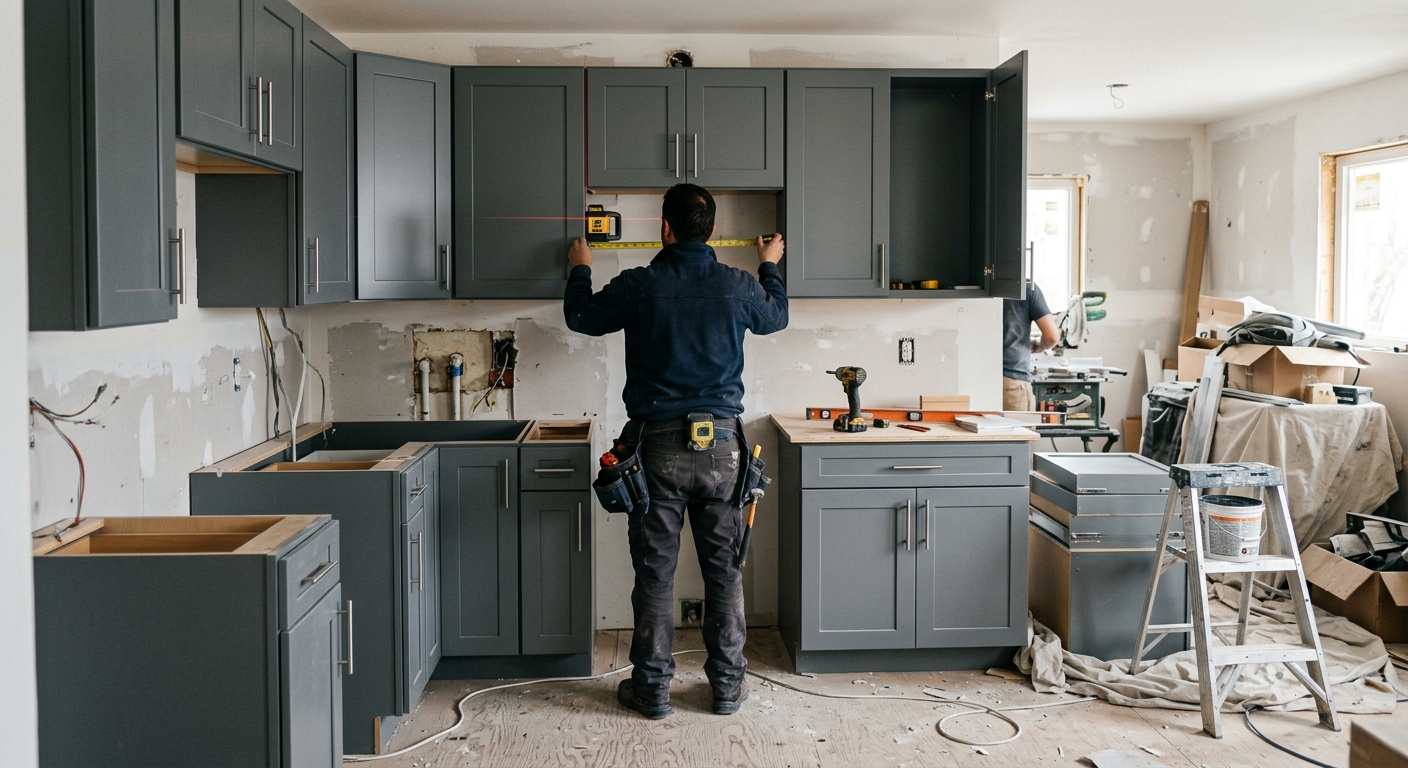
Kitchen renovation costs in Wilson — 2026
For Wilson homeowners, understanding kitchen renovation pricing is the baseline for a project that doesn’t spiral. Wilson sits within the broader Lehigh Valley market, and with a homeownership rate of 62.3% and a median household income of $80,565 (U.S. Census Bureau, ACS 2024), most remodels here are planned by people living in their homes, not investors flipping rentals. Budgeting must reflect that—kitchen renovations are typically the largest single home improvement most Wilson owners will fund themselves.
Older construction in nearby Bethlehem and Easton—the majority built before 1940—means Wilson kitchens often require more than just a fresh coat of paint. Outdated galley layouts, lack of outlets, and tight work triangles are common, so projects frequently include changing the footprint or opening walls. If your house predates 1980 (as most do here), expect more surprises inside those walls and a higher chance you’ll need major layout or mechanical changes.
The biggest pitfall is pricing one scope (say, simple cabinet replacement) and then asking for features that belong to a much higher tier (like moving the sink or tearing down a wall). Local costs for kitchen renovation break down across service classes like this:
| Scope |
What's included |
Duration |
Price range |
| Full gut remodel, same layout |
cabinets, counters, appliances, flooring, lighting, fixtures |
6–10 weeks |
$30,000–$120,000 |
| Gut plus layout change |
all of the above plus moved plumbing, electrical, walls |
10–16 weeks |
$65,000–$120,000 |
| Cabinet replacement (stock to semi-custom) |
remove and install cabinets, hardware, patching |
1–3 weeks |
$7,000–$30,000 |
| Cabinet refacing |
new doors and drawer fronts, veneer, hardware |
3–6 days |
$7,000–$20,000 |
| Countertop replacement only |
template, fabricate, install, reconnect sink |
1–3 weeks |
$4,000–$16,000 |
| Kitchen flooring only |
remove existing, install new flooring |
3–6 days |
$5,000–$20,000 |
Estimates for a typical Wilson kitchen. Cabinet grade and whether the layout changes move these figures more than square footage.
Where the money actually goes
Most Wilson homeowners overestimate what they’ll put into features like appliances and underestimate cabinetry and installation. In reality, cabinetry is your largest check. Even semi-custom units from a big-box box can run more than an upgraded fridge, and custom pieces only go up from there. Labour and installation follow close behind, with older homes demanding skilled trades to adjust for out-of-plumb walls or add electrical circuits—especially common in Northampton County’s older stock.
Appliances are a wide range: you can spend nearly as much or as little as you want. Mid-tier works fine, but a $12,000 fridge in a kitchen with stock cabinets is a poor allocation. On the other hand, cutting corners on cabinets or skipping a contingency fund backfires fast in homes built before 1980, where rot, wiring issues, or odd framing frequently appear.
Soft costs—permits, design fees, delivery, and jobsite disposal—rarely show up in early budgets but are part of every legitimate project in Wilson, especially with required permits if you’re running new circuits or moving walls. For a full gut remodel at $65,000 (the area’s typical), here’s where that money actually lands:
| Category |
Share of budget |
Notes |
| Cabinetry |
25–35% |
the largest line and the longest lead time |
| Labour and installation |
20–30% |
rises sharply if the layout changes |
| Countertops |
8–15% |
material choice drives the swing |
| Appliances |
10–20% |
widest range of any category |
| Flooring |
5–10% |
durable surfaces save future repairs |
| Lighting and electrical |
5–10% |
higher in older homes needing circuits |
| Plumbing and fixtures |
4–8% |
especially high with relocated sinks |
| Permits, design, disposal |
3–6% |
usually forgotten in early budgets |
| Contingency |
10–15% |
not optional in a pre-1980 house |
Where does an extra thousand count? Cabinet upgrades or electrical fixes. Where is it wasted? Appliances beyond what the cabinetry and layout can support.
Cabinets: reface, stock, semi-custom or custom
The cabinet decision drives every kitchen budget in Wilson. Refacing, which keeps your existing cabinets but puts on new doors, veneer, and hardware, is a real budget-saver—but it’s only viable when your cabinet boxes are solid, plumb, and you like the current layout. It cannot fix storage issues or allow for any layout change, but in Wilson—where many homes have sturdy original cabinetry—it’s an option worth considering if the bones are good.
Stock cabinets are sized in set increments, ideal when your kitchen lines up neatly with standard dimensions. The compromise: gaps and filler strips wherever your walls refuse to play along. Semi-custom lets you choose dimensions and finishes, so it fits older homes in Wilson and nearby Bethlehem and Easton, where kitchen walls are rarely square and layouts are anything but standard. Full custom is for when every inch needs to be used or you want something entirely unique—and it comes with the price and timeline to match.
Construction quality is independent of price tier. Plywood boxes outlast particleboard, dovetail drawer joints hold up better than stapled or nailed ones. Soft-close, full-extension hardware is now the minimum for most decent lines. Frameless cabinets (European style) maximize interior space but rely on box strength, while face-frame cabinets suit traditional aesthetics and provide a bit more forgiveness with doors.
| Option |
Cost |
Best when |
Limitation |
| Painting existing cabinets |
$1,200–$3,500 |
boxes and doors sound, tight budget |
no layout or style change |
| Refacing |
$7,000–$20,000 |
boxes square and layout works |
storage unchanged |
| Stock cabinets |
$7,000–$30,000 |
standard dimensions fit |
filler strips, limited finishes |
| Semi-custom |
$20,000–$30,000 |
non-standard walls or finishes |
6–12 week lead time |
| Full custom |
$20,000–$30,000 |
unusual layout or high-end design |
longest lead, highest cost |
In Wilson’s older homes, semi-custom is the default, even for those who planned for off-the-shelf.
Layout changes and the cost cliff
The biggest budget cliff in any Wilson kitchen project comes with layout changes. Keeping the plumbing and wiring in place means your renovation stays in a lower price class: surfaces, cabinets, counters, and appliances can all refresh the space without tearing into floors or walls. Move the sink or stove? Costs jump—not linearly but in large increments—because it requires opening walls and floors, bringing in multiple trades, and triggering permits and inspections.
Relocating a sink means you need to maintain proper drain slope; in slab foundations, or if there’s a finished ceiling below, this can mean opening up more floor/wall area than anticipated. Electrical is similar: adding a new circuit for a relocated range or microwave means checking if your main panel has capacity. Older houses in Wilson may need a subpanel or significant upgrades. If you knock down a wall, the crucial first step is determining if it’s load-bearing—a structural change requires an engineer’s stamp and a municipal permit as in Bethlehem, plus drawn plans for review.
Range hood relocation requires running new ductwork through an exterior wall or roof. Any new exterior penetration complicates cost, and in pre-1940 layouts, vent runs are rarely simple.
If the existing kitchen works (even if it’s dated), keep utilities in place to control costs. Moving a sink or range typically adds $20,000–$40,000 to a project that would otherwise hit $30,000–$65,000. Before chasing a “dream kitchen”, determine if the current plan is unlivable or only unfashionable—because the price gap is substantial, and Wilson’s homes built before 1980 tend to harbor the surprises that drive change orders.
Resale value and kitchen spending
A remodeled kitchen always helps a Wilson house sell faster, but it doesn’t reliably return all that you put in. Middle-of-the-road projects recover a greater share than high-end ones. For owners planning to sell soon, the smart play is a cosmetic update: refaced cabinets, resilient counters, new lighting, and neutral palettes. Skip rearranging walls or plumbing—buyers rarely pay extra for what they can’t see.
Renovating to sell is entirely different from renovating to live in for decades. If you’re staying, spend on cabinets, counters, or workflow upgrades that make daily life easier. If you’re selling, focus on durability and broad appeal. In Wilson, the median household income is $80,565. Spend well above this area’s typical kitchen budget, and you risk over-improving. The upper end of a full-scale gut renovation $120,000 is unlikely to be recouped if your neighborhood’s home values don’t support it, especially with most homes built before 1980 where buyers expect tasteful, not extravagant, kitchens.
Major kitchen updates do help homes move faster in Wilson and throughout Northampton County, but over-improving returns pennies on the dollar and complicates resale. Only put big money into luxury features if you plan to stay and use them.
Planning appliances before cabinets
The timing of appliance selection is everything. In Wilson, as everywhere, cabinets are built around your chosen appliances—so if you pick your appliances after the cabinet order goes in, there’s a real risk they won’t fit or will need expensive onsite modifications. Even a standard refrigerator versus counter-depth changes your upper cabinet and panel spacing. A slide-in range needs countertop overlap; a freestanding range may leave a gap against the wall. For ranges, gas and induction options each require advance planning: induction may mean running a dedicated 240V circuit if your home’s electrical panel can support it.
Dishwashers come in standard and panel-ready versions—the latter blends into the cabinetry but must be spec’d before build. Range hood venting is especially important in Wilson’s older homes; ducting to the exterior is better for removing cooking odors but can mean opening walls or ceiling soffits for new runs. Recirculating hoods are easier, but don’t handle smoke, moisture, or grease nearly as well.
Professional-grade appliances do deliver on control and durability for heavy use but mostly add aesthetic value—don’t break your budget chasing them if it means downgrading cabinets or electrical safety. Lead times for specialty appliances can be longer than cabinets, so always confirm availability before final cabinet measurement in any Wilson kitchen project.
What requires a permit in a kitchen renovation
In Wilson and the rest of Northampton County, whether you need a permit for kitchen work depends on the scope—and getting this wrong can cause trouble later, especially at resale. Simple cosmetic work (painting, new hardware, refacing, swapping counters with no plumbing moves) typically does not require a permit. But as soon as you move or add electrical circuits (for outlets, appliances, or lighting), run new plumbing, remove a wall, or change structural elements, a permit is needed. In Bethlehem, any kitchen renovation involving structural changes or new electrical circuits requires a building permit, and layout changes trigger plan review.
Municipal code inspectors—rather than outside agencies—perform electrical inspections in Bethlehem and other townships. This means your project’s schedule and signoff depend on their calendar, which can get tight in the busy season.
All contractors working on projects over $500 for Wilson homeowners must hold a valid Home Improvement Contractor (HIC) registration from the Pennsylvania Office of Attorney General (verify at hic.attorneygeneral.gov). If your contractor has employees, workers’ compensation insurance must be current and can be verified through WCAIS (wcais.pa.gov).
Kitchen work done without proper permits can derail sales, force last-minute corrections, and make insurance claims tricky. Always confirm with your locality’s code office before starting work—even if your neighbor skipped a permit. It’s not worth the risk when the cost of a permit is a small fraction of a $30,000–$120,000 project.
Frequently asked questions — kitchen renovation in Wilson
How much more does moving the sink and range cost?
Moving the sink and range in a Wilson kitchen typically bumps the project into a whole new cost category. Where a basic gut remodel using the existing layout may be in the $30,000–$65,000 range, adding layout changes with new plumbing and electrical can raise the price to $65,000–$120,000. The main driver is the labor: rerouting drain lines (which need proper slope, especially difficult in pre-1980 Wilson homes), running new water lines, upgrading electrical for modern ranges, and repairing all affected surfaces. There’s also the need for permit review and possible engineering if walls come out. It’s rarely just “move the pipe”—it’s open more floor, add inspections, and possibly upgrade your panel. Most homeowners are shocked by how quickly this change multiplies both cost and project duration.
Can I live in the house during a kitchen renovation?
Yes, most Wilson homeowners stay in the house during a kitchen renovation, but expect plenty of disruption. For anything beyond simple cabinet refacing or countertop replacement, you’ll lose access to the space entirely for at least several weeks—sometimes longer if the layout or major mechanicals are changing. A project in the $30,000–$65,000 bracket (full gut, same layout) typically involves six to ten weeks of dust, noise, and crews in and out. Setting up a temporary kitchen in another room and planning for take-out or simple meals is essential. Houses in Wilson, especially pre-1980s, can have surprises behind the walls leading to more mess and extra days with water or power shut off. If you have young kids or pets, be ready for frequent detours and limited access to major parts of the home during the messiest phases.
Are Wilson kitchens typically small galley layouts?
Many Wilson kitchens, like those in nearby Bethlehem and Easton, are smaller and originally built as galley or closed-in layouts—especially in homes constructed before 1980. Given that over 86% of local homes were built before that year (U.S. Census Bureau, ACS 2024), it’s common to encounter narrow kitchens where storage and flow are limited. That’s why layout changes, such as opening up walls or reconfiguring the footprint, are frequent in full renovations. If your kitchen is a tight galley, even a basic upgrade like cabinet replacement $7,000–$30,000 can feel transformative, but moving toward an open plan with an island will drive costs sharply upward, especially when plumbing or structural changes are involved.
What happens if previous work was unpermitted?
Unpermitted work in a Wilson home can create headaches at sale, during inspections, or after an insurance claim. For kitchen renovations, which often involve electricity, plumbing, or wall changes, lack of permits can mean a flagged listing, forced retroactive inspections, or requirements to open up finishes to prove work was safe and code-compliant. Fixing this after the fact is always more expensive—sometimes requiring a full re-do that lands in the $30,000–$65,000 band just to get signed off. Pennsylvania’s Home Improvement Consumer Protection Act includes specific language about contracts and permissions; it’s there to protect both homeowner and buyer. If you suspect old work wasn’t permitted, have it reviewed before you start your project to avoid compounding the problem.
Do I need to change my kitchen layout?
Not always—most Wilson kitchens can be significantly improved without changing the existing layout. Layout changes (especially moving the sink, range, or walls) drive the project from the entry level $30,000 tier up to $65,000–$120,000. If your workflow is comfortable, and the kitchen functions well—even if it’s dated—you might get the “new kitchen” feeling by updating cabinets, counters, and lighting. But in older Wilson homes with truly cramped or dysfunctional layouts (like many built before 1980), changing the plan may be the only way to get storage, modern appliances, and open sightlines. It comes down to how much of the budget you’re willing to allocate to hidden mechanicals and construction, not just visible finishes.
What are cabinet lead times in Wilson right now?
In Wilson and Northampton County, lead times can catch homeowners off guard. Stock cabinets ordered from national suppliers may be available in three to four weeks, but semi-custom options—common here due to so many pre-1980 homes with non-standard dimensions—take six to twelve weeks from final measurement to delivery. Full custom work is usually at the high end of that range if not longer, especially with local finish-trade labor in tight supply in this market. Plan to decide on your cabinets (and all final dimensions) before demolition, and factor in appliances, which can sometimes exceed cabinet lead times. For a smooth project in the $7,000–$30,000 range (stock/semi-custom), locking in your design early is crucial.
What does a full gut kitchen remodel cost in Wilson?
For a full gut remodel in Wilson—removing everything down to the studs and starting fresh—budget between $30,000–$120,000, with most projects landing near $65,000. That price assumes new cabinets, counters, flooring, lighting, appliances, paint, and possibly upgraded electrical and plumbing if the home is older (which, in Wilson, most are). Layout changes, hidden surprises in wiring or framing, and material choices all shift the cost up or down. Compared to surrounding areas, Wilson’s tight finish-trade labor pool and older housing stock add to the timeline and price. Always ask for a detailed, written estimate broken out by labor, materials, and contingencies before signing a contract.
Should I renovate before selling or let the buyer do it?
This is a common dilemma for Wilson homeowners. Unless your kitchen is truly unusable, most listing agents advise against a high-end overhaul before listing. Buyers in Wilson look for updated, clean, and functional spaces—major layout changes or luxury brands rarely add enough value to repay your investment. A cosmetic refresh, like painting or refacing cabinets $7,000–$20,000, updating lighting, and new counters, can make the house show well and stand out among area listings. If you go all the way to a gut remodel, especially anywhere near $120,000, you’re unlikely to recoup more than a portion of that spend—especially given the local median income. Save the big projects for homes you intend to enjoy long-term.
What countertop material is best for a family kitchen?
In Wilson’s family homes, durability and maintenance are priorities. Most local families choose quartz or well-sealed granite in the $4,000–$16,000 band because they resist stains, scratches, and heat, but require less attention than marble or butcher block. Laminate is budget-friendly and easy to clean, though less durable. Solid surface options bridge the gap but can burn or chip. Quartz resists almost everything, comes in many colors, and doesn’t need sealing—making it ideal if you have kids or are hard on surfaces. In older Wilson homes, proper installation and templating are vital; out-of-square walls make stone installs tricky, so working with experienced local fabricators matters. Ultimately, pay for practical durability before exotic looks if you want value.