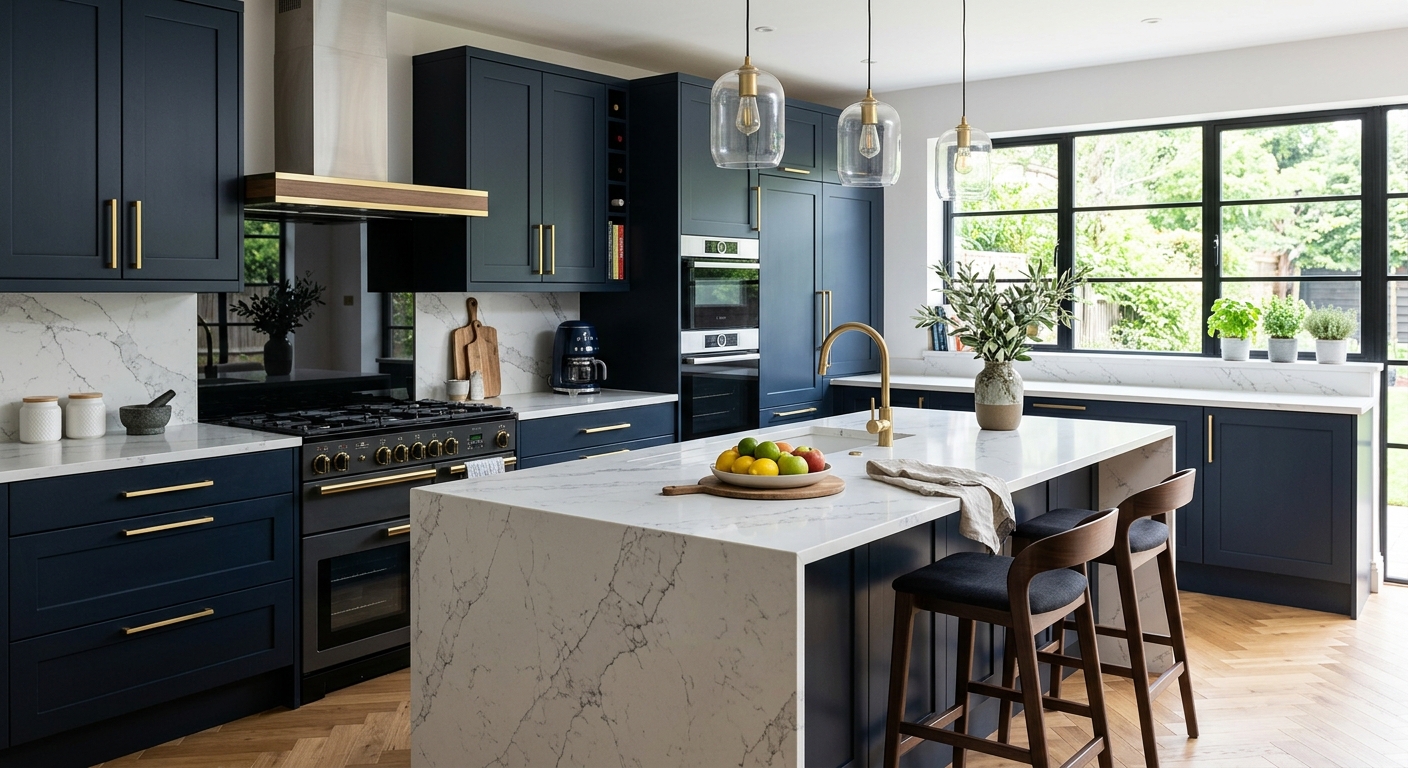
Washington kitchen renovation prices by scope — 2026
Washington, Lehigh County lies in a market where kitchen budgets follow homeownership trends and the value owners place on their homes. With a homeownership rate of 92.7% and a median household income of $87,719 (U.S. Census Bureau, ACS 2024), homeowners here often see a kitchen renovation as a sound investment rather than just an upgrade. Most tract homes in this area sprang up during the post‑1960 boom in Upper and Lower Macungie, meaning many kitchens now approaching renewal were built between the 1970s and 1990s—long after the tiny galley kitchens of older homes, but before modern circuit counts or cabinet options became standard. If yours is from this era, the bones are likely good, but you’re probably looking at worn finishes, aging cabinets, and fixtures well past their time.
The biggest risk to your budget is pricing for a simple cabinet swap or countertop update, then adding electrical work, a new appliance suite, or layout changes mid-project. Choose your scope honestly before bidding.
| Scope |
What's included |
Duration |
Price range |
| Full gut remodel, same layout |
cabinets, counters, appliances, flooring, lighting, fixtures |
6–10 weeks |
$31,000–$123,500 |
| Gut plus layout change |
all of the above plus moved plumbing, electrical, walls |
10–16 weeks |
$67,000–$123,500 |
| Cabinet replacement (stock to semi-custom) |
remove and install cabinets, hardware, patching |
1–3 weeks |
$7,200–$31,000 |
| Cabinet refacing |
new doors and drawer fronts, veneer, hardware |
3–6 days |
$7,200–$20,500 |
| Countertop replacement only |
template, fabricate, install, reconnect sink |
1–3 weeks |
$4,100–$16,500 |
| Kitchen flooring only |
remove existing, install new flooring |
3–6 days |
$5,100–$20,500 |
Estimates for a typical Washington kitchen. Cabinet grade and whether the layout changes move these figures more than square footage.
Why the electrical line grew
The most frequent reason for a kitchen renovation budget jump in Lehigh County happens when the electrical inspector walks through and sees old wiring exposed. Today’s code, per the Pennsylvania Uniform Construction Code (UCC), expects dedicated 20-amp small-appliance circuits, GFCI outlets anywhere above a countertop, outlets every four feet, and separate dedicated circuits for the microwave, dishwasher, and garbage disposal. An electric range asks for a 240-volt line, and often the panel needs enough capacity to add what your new kitchen demands.
In parts of Washington built before the mid-1980s, more than half the homes date pre-1980 (U.S. Census Bureau, ACS 2024). You may find two-wire ungrounded circuits, just one or two lines running the whole kitchen, and occasionally aluminium branch wiring. A good chunk of homes from the 1970s and 1980s still do not have enough circuits for new kitchens with multiple counter appliances, or they lack GFCI and arc-fault protection. Once walls are open, today’s code does not allow you to put it back the way it was. Instead, a full rewire is expected for the area touched by the remodel, and the panel must handle the load. This can come as an $8,000 surprise on a project quoted for a “simple” kitchen update.
For a mid-range kitchen in Washington, plan for electrical work to run $4,100–$16,500, especially if new circuits or a panel upgrade are needed. Ignoring this is not optional: inspectors require it before finishing the job, and lenders spot it at resale.
What requires a permit in a kitchen renovation
In Washington and the rest of Lehigh County, the dividing line for permits is clear: cosmetic changes like painting, swapping hardware, cabinet refacing, or even replacing a countertop (if you leave the sink and appliances where they are) do not usually require a permit. But once you relocate plumbing lines, add or move electrical circuits, move gas piping, or make any structural change, you’ll need a permit—especially in Allentown, where the city’s Bureau of Building Standards handles code enforcement, and most Lehigh townships run their own code offices. If the remodel involves layout changes or new mechanicals, expect building department plan review before work starts.
Inspections for electrical work in Allentown are done by the city’s code office. In township areas, it’s common for third‑party inspection agencies to step in, so a municipal official will not always be the one showing up to check outlets and circuits—that often catches homeowners off guard.
Anyone signing a home improvement contract in Pennsylvania for more than $500 must have a valid Home Improvement Contractor (HIC) registration, issued by the Pennsylvania Office of Attorney General. You can check that at hic.attorneygeneral.gov. Every employer must have workers’ compensation coverage—check at WCAIS (wcais.pa.gov). A written contract is required, and you have three business days to cancel it by law.
Unpermitted work can cause real pain during resale if a home inspector or buyer’s lender finds out. Fines, delays, and forced “rip and replace” are not uncommon, so play it safe: if you’re moving anything but finishes, get it permitted.
Choosing a countertop for a Washington kitchen
Your selection of countertop material will matter every day you cook, clean, and use your kitchen. In Washington, it’s not just about looks—think about heat, scratches, stains, daily use, and the possibility of future repairs. Quartz is engineered, non-porous and avoids stains, but it can discolor or crack with sustained heat near the cooktop. Granite is natural, withstands knife marks and heat, but needs sealing every year or two. Laminate is the unsung hero—today’s options are much improved from the 1980s, resisting stains and handling daily knocks. A good match for rentals or utility spaces, laminate is not a step down if you’re being practical.
Butcher block feels warm and is easy on dishware, but it stains and scratches, and needs regular oiling or it will darken and crack. Solid surface (like Corian) can be sanded and repaired using common abrasives, so scratches and burns aren’t terminal. Seams are less visible than with stone.
Fabrication impacts price more than homeowners realize. Fancy edge profiles cost extra, as do sink cutouts or tricky seam placements. For stone and solid surface, a specialist comes to template before cutting—you want this for a tight fit, not rough measurements.
In a typical Washington project, laminate is a practical choice in a secondary kitchen or for families watching dollars elsewhere. Rushing into granite or quartz isn’t always smart—think about how you’ll really use the space and demand to see repairs on sample pieces before you decide.
Allocating a kitchen budget
Most Washington kitchen budgets change shape the moment homeowners see the real numbers. Cabinetry is almost always the single biggest share, usually outpacing every other category by a wide margin due to material and lead time. Next comes labor and installation, especially if the kitchen layout is being altered. Counters, appliances, flooring, lighting, and fixtures follow, but soft costs like permits, design, delivery, and disposal routinely get forgotten at planning time.
What most owners skip—but shouldn’t—is a contingency line: even in post‑1960 homes, there’s a real chance of finding water damage or outdated wiring hidden behind cabinets. Set aside a hard 10–15% for surprises, especially in Washington, where more than half the housing stock is pre‑1980 (U.S. Census Bureau, ACS 2024).
Where does one more thousand dollars help? It buys a noticeable jump in countertop material, or soft-close drawer hardware (you’ll use those every day). On the flip side, a pro-grade range in an otherwise mid-range kitchen seldom raises long-term value. Chasing built-in wine coolers or statement lighting is smart only when the rest of the space is sorted.
For a full kitchen remodel in Washington, expect these shares of a typical $67,000 budget:
| Category |
Share of budget |
Notes |
| Cabinetry |
25–35% |
the largest line and the longest lead time |
| Labour and installation |
20–30% |
rises sharply if the layout changes |
| Countertops |
8–15% |
material choice drives the swing |
| Appliances |
10–20% |
widest range of any category |
| Flooring |
5–10% |
|
| Lighting and electrical |
5–10% |
higher in older homes needing circuits |
| Plumbing and fixtures |
4–8% |
|
| Permits, design, disposal |
3–6% |
usually forgotten in early budgets |
| Contingency |
10–15% |
not optional in a pre-1980 house |
Appliance choices and the decisions they force
Deciding on appliances first is not just smart; in Washington kitchens, it’s borderline mandatory if you want a tight, error-free fit. Cabinets are designed around the dimensions of your fridge, range, and dishwasher. If you pick a refrigerator after cabinets are ordered, plan for a fridge that sticks out or a cabinet run that needs a last-minute field fix. Counter-depth fridges sit nearly flush, but lose interior volume, while standard ones need deeper cabinets or a visible overhang.
Ranges come as freestanding (backsplash included) or slide-in for a seamless top—each with different cabinet and counter requirements. Gas versus induction or electric is a big fork in the road: an induction cooktop often needs a dedicated, higher-capacity 240V line that older kitchens lack. Panel-ready dishwashers disappear behind cabinet doors but demand custom fronts, usually ordered with your cabinets.
For ventilation, a ducted hood is best for actual cooking—you send grease and moisture outside. Recirculating (“ventless”) hoods filter only odors and smoke; they are a compromise and sometimes used if a vent run is infeasible.
Professional-grade appliances offer robust hardware and sometimes elevated design, but the real-life gains come down to aesthetics unless you are cooking at volume. Lead times for premium brands can easily outstrip those for cabinets—plan months ahead for anything special order.
The biggest line item in your Washington kitchen
In Washington, the cabinet decision sets the ceiling and floor for nearly every other line in your kitchen budget. There are four main routes, each with strengths and pitfalls.
Refacing keeps your existing cabinet boxes but swaps in new doors, drawer fronts, and matching veneer. This works well if your boxes are solid, square, and you’re happy with the current layout. You won’t get new storage or different shapes this way, but it can take years off the kitchen for a third of the cost of new cabinets.
Stock cabinets offer the best price, but come in fixed increments—widths in 3-inch steps, heights that may or may not fit your ceiling. When the walls aren’t standard (common in Upper and Lower Macungie homes from the ‘70s and ‘80s), you’ll see filler strips or awkward transitions. Semi-custom lets you tweak dimensions and finish choices, closing up gaps and matching variances in the room. Full custom can follow any wall, any style—at a steep premium and with a longer wait, sometimes 12 weeks or more.
Box construction matters more than the price tag. Plywood builds are sturdier and hold up to moisture better than particleboard; dovetail drawers outlast staples ten to one. Full-extension, soft-close hardware, and whether cabinets are frameless (more interior space, sleeker) or face-frame shape day-to-day use as much as looks.
Given the post‑1960 housing stock and the odd angles you’ll find here, most Washington kitchens end up choosing semi-custom—often not because they planned to, but because it’s the only way to get a tight, coherent fit.
| Option |
Cost |
Best when |
Limitation |
| Painting existing cabinets |
$1,200–$3,500 |
boxes and doors sound, tight budget |
no layout or style change |
| Refacing |
$7,200–$20,500 |
boxes square and layout works |
storage unchanged |
| Stock cabinets |
$7,200–$31,000 |
standard dimensions fit |
filler strips, limited finishes |
| Semi-custom |
$20,500–$31,000 |
non-standard walls or finishes |
6–12 week lead time |
| Full custom |
$20,500–$31,000 |
unusual layout or high-end design |
longest lead, highest cost |
Frequently asked questions — kitchen renovation in Washington
Why are kitchen quotes in Washington so far apart?
The wide range in kitchen quotes for Washington, Lehigh County mainly comes from differences in scope, materials, and local labor markets. Some contractors price for full gut renovation with layout changes, which can reach $123,500, while others estimate for basic cabinet replacement, starting around $7,200. In a market with both mid-century homes in need of rewiring and 1980s tract homes with dated finishes, a quote may or may not include new electrical, plumbing moves, or high-end materials. Labor availability in Lehigh County is tighter than rural Carbon or Schuylkill, but not as tight as Philadelphia, and this impacts pricing for skilled trades. If a bid seems exceptionally low, it often omits necessary code upgrades or contingency work. Always clarify what’s actually included—this avoids surprises when the first wall comes down.
Is lead paint a concern in Washington kitchen renovations?
Yes, lead paint remains a concern in Washington and most of Lehigh County since more than half the homes were built before 1980 (U.S. Census Bureau, ACS 2024). For any kitchen renovation in a pre-1978 house, federal law requires all contractors to follow EPA Lead Renovation, Repair and Painting (RRP) Rule practices. Certified contractors—searchable at certifiedrenovatorsearch.epa.gov—must use specific containment and cleanup methods. If your kitchen falls in a building with possible lead paint, disturbing even a few square feet can trigger these requirements. It’s not a place to save money by hiring unqualified crews, especially as non-compliance can create health hazards and become a flag at resale. Lead-safe work will be priced into most quotes, especially for gut remodels ranging from $31,000–$123,500.
Which upgrades are not worth the money?
In Washington, not every kitchen upgrade pays you back in function or resale. Built-in wine coolers, pot fillers, elaborate in-cabinet lighting systems, or top-tier professional appliances can eat up thousands from your budget without a real jump in daily comfort or home value. In fact, splurging on pro-grade appliances in a non-custom layout—where cabinets are stock or refaced—rarely impresses later buyers. If your home has aging electrical, spending $4,100–$16,500 on a safe, code-compliant rewire delivers far more long-term peace of mind than a name-brand fridge. Where it’s smart to invest: soft-close hardware, stone or sturdy counters, and durable, easy-to-clean flooring. Spend on what you touch every day; skip what looks good in a showroom, unless the entire project is top to bottom custom.
What is the difference between stock and semi-custom cabinets?
Stock cabinets are built in fixed sizes and finishes—think 12”, 15”, 18” wide increments and a handful of color options. Semi-custom cabinets, common in Washington’s post‑1960 tract homes with less-than-perfect wall runs, are partially made-to-order: you can specify increments to fit odd walls, customize finishes, and sometimes add storage features not available off-the-shelf. The price difference is significant. Stock fits straightforward kitchens and is easier to install, but gaps and mismatched finishes can look out of place in older or remodeled spaces. Semi-custom allows a tailored fit and better integration with other materials. Typically, stock cabinets run $7,200–$31,000, while semi-custom starts higher—about $20,500—but is often unavoidable in Lehigh County’s older, less standard homes.
Can I cancel a renovation contract in Pennsylvania?
In Pennsylvania, including Washington and all of Lehigh County, homeowners have a legal right to cancel most home improvement contracts within three business days of signing. This right comes from the Home Improvement Consumer Protection Act (HICPA), which requires contractors to give you written notice—make sure this clause is in your contract. The rule applies to contracts over $500, which covers nearly all real renovation work (including projects as small as a $7,200 cabinet refacing). This cooling-off period gives you time to rethink the commitment, compare financing, or clear up any misunderstandings before the contractor schedules materials or labor. After the three days, cancellation is possible only if both parties agree or according to contract terms, and deposits may not be fully refundable.
How much does a kitchen renovation cost in Washington?
A kitchen renovation in Washington runs the full spectrum depending on what you want done. A straightforward cabinet replacement with no layout changes typically costs between $7,200–$31,000. A full gut remodel with new finishes and appliances sits around a typical $67,000. Factoring in layout changes—moving plumbing, adding circuits, or knocking open a wall—can push the total into the $67,000–$123,500 range. Choices about cabinetry (stock or semi-custom), countertop material, and whether you upgrade electrical and flooring all impact the final total. Washington’s high homeownership rate and the number of aging tract homes keep the demand steady, pushing some labor lines higher than in neighboring rural counties.
Why is there a gap after cabinets are installed?
In Washington and the rest of Lehigh County, many kitchens were built in housing booms—meaning walls are not always square or level. Stock cabinets are built in fixed sizes, so installers often use filler strips to close irregular gaps or hide plumb issues, especially in post‑1960 homes that have shifted or settled. If a cabinet run ends with a gap, it’s usually because the wall is not perfectly straight or the cabinet size did not match the opening exactly. Semi-custom or custom cabinets (which cost from $20,500–$31,000) are sized to the room and often eliminate these spaces. If you see a gap now, talk to your installer about caulking, scribing a filler piece, or whether semi-custom would be the tighter fit next time.
Can I renovate a kitchen in stages?
Staging a kitchen renovation is common in Washington, especially if your budget or schedule won’t allow for a single large project. Many owners start with cabinet refacing or replacement (from $7,200–$31,000), then tackle countertops, appliances, and flooring later. However, planning is essential: if you know you’ll want a new sink or move the range down the line, run wiring and plumbing changes early—even if some upgrades follow. Phased work can spread cost, but may increase labor if crews return for multiple trips. For anything touching electrical or plumbing, make sure code-required upgrades happen on the first phase, so later finishes aren’t torn out and redone. Talk with your contractor about how to permit and schedule staged work in Washington’s permit system.
How should renovation payments be scheduled?
In Pennsylvania, including Washington, reputable contractors do not require full payment upfront. The industry norm is a schedule tied to job milestones such as demolition, cabinet installation, countertop templating, and final punch list. You may pay a deposit (often 10–33% of the total), then progress payments as work is completed. In a $31,000–$123,500 kitchen remodel, for instance, expect to pay some up front to secure materials, then further draws as cabinets and counters are delivered and installed. Pennsylvania law requires a written contract for any job over $500 and prohibits practices like waiving your homeowner’s insurance deductible. Always confirm your payment schedule in writing; never pay more than the value of work done and materials delivered at each stage.