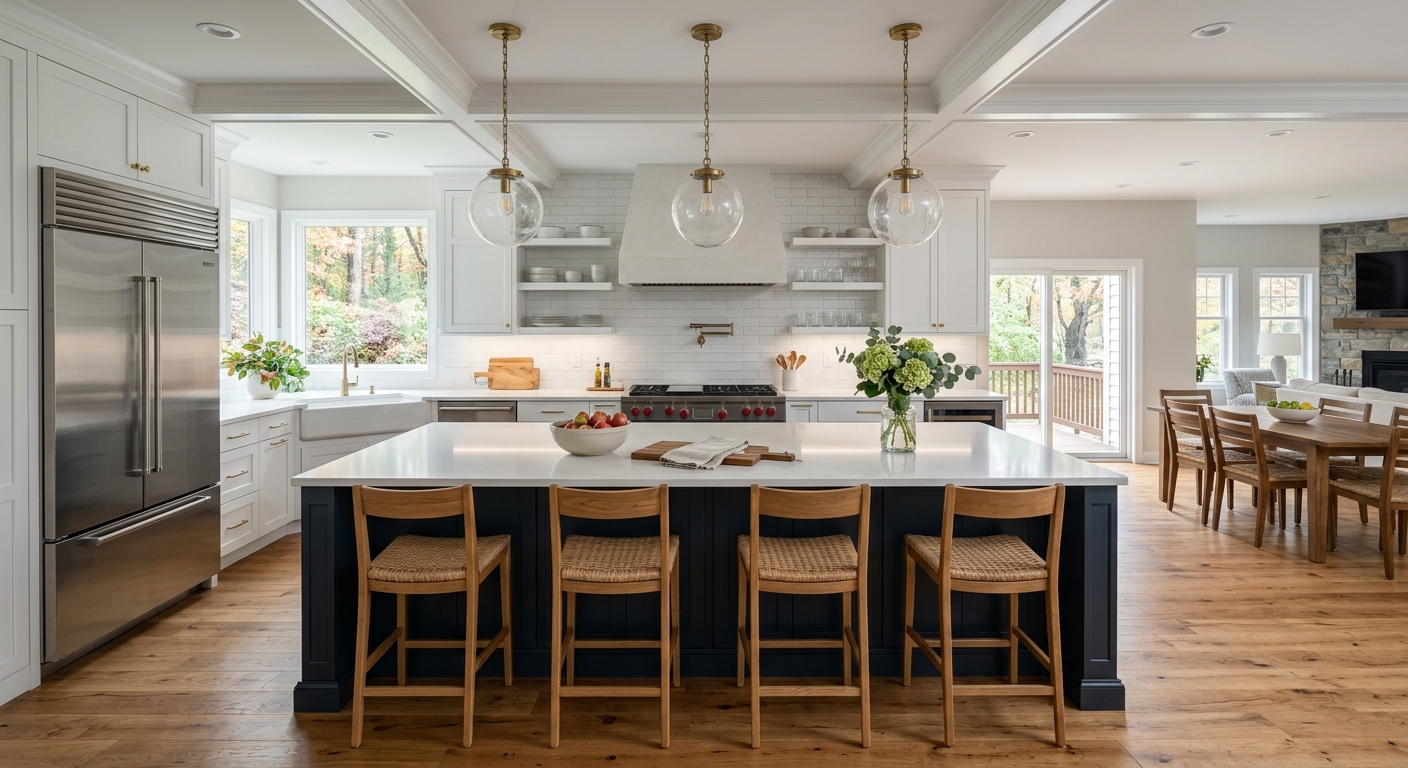
What a kitchen remodel costs in Delaware
Delaware’s kitchen renovation market draws heavily from Pike County, Pennsylvania, where the population is made up mostly of homeowners (88.5%) with a median household income of $76,518 (U.S. Census Bureau, ACS 2024). These numbers mean most clients are owner-occupiers interested in building long-term value, not flip-and-go landlords. Kitchen remodels around Delaware typically target homes from the 1980s to the early 2000s, since the region’s neighborhoods grew fastest then—a builder-grade kitchen in these homes is usually worn, but the basic layout is functional for today’s family. So, most jobs are either “pull and replace” renovations or full gut remodels that update wiring, cabinets, and finishes but leave the original layout intact.
Where budgets go off the rails is when a project starts as a surface update and then snowballs: soft-close drawers become pull-out organizers, or someone decides to move the sink at the last minute. The single biggest driver of cost is scope creep—if you price a job as just “cabinets” but wind up hiring for new electrical, plumbing, and relocation work, totals climb fast and you’ll blow past even the top end of typical figures.
| Scope |
What's included |
Duration |
Price range |
| Full gut remodel, same layout |
cabinets, counters, appliances, flooring, lighting, fixtures |
6–10 weeks |
$29,500–$118,500 |
| Gut plus layout change |
all of the above plus moved plumbing, electrical, walls |
10–16 weeks |
$64,000–$118,500 |
| Cabinet replacement (stock to semi-custom) |
remove and install cabinets, hardware, patching |
1–3 weeks |
$6,900–$29,500 |
| Cabinet refacing |
new doors and drawer fronts, veneer, hardware |
3–6 days |
$6,900–$19,500 |
| Countertop replacement only |
template, fabricate, install, reconnect sink |
1–3 weeks |
$3,900–$16,000 |
| Kitchen flooring only |
remove existing, install new flooring |
3–6 days |
$4,900–$19,500 |
Estimates for a typical Delaware kitchen. Cabinet grade and whether the layout changes move these figures more than square footage.
Defining your scope before you get quotes
Most confusion in kitchen renovations comes from using the same words—like “remodel”—to describe jobs that cost five times differently. In Delaware and Pike County, the smart move is to pick your scope before you call anyone: contractors can’t give you a reasonable number if you haven't settled what you actually want done.
- Cosmetic refresh: The lowest tier. Fresh paint on the walls and cabinets, new hardware, updated light fixtures, swapping out backsplash tile. Fast, affordable, and leaves the cabinet boxes and kitchen footprint untouched. No plumbing or electrical moved.
- Pull and replace: Also known as “simple renovation.” New cabinets and countertops go in, but everything stays in the exact spot. Appliances may be swapped for new ones, but plumbing, gas, and electric are not moved. Minimal mess and disruption, very predictable timeline.
- Gut, same layout: Take everything down to the studs—cabinets, counters, drywall, sometimes subfloor—but rebuild in the same arrangement. Plumbing and electrical are updated in place to code. This tier is common in Pike County’s 1980s-2000s housing, where the layout works but finishes are shot.
- Layout change: Moving walls, relocating the sink or range, or tearing out bulkheads. This is where costs jump steeply. Moving utilities triggers permits and inspections, rework of existing wiring and plumbing, and sometimes involves engineering for structure.
The leap in price and timeline between tier three and four is significant—layout changes require more planning, different trades, and more permit scrutiny. Decide your tier realistically up front: most reputable contractors in Pike County won’t quote a one-hour walk-through on an undefined scope, because their number will be meaningless or wrong.
How a Delaware kitchen budget breaks down
The most surprising thing for homeowners in Delaware is how much of a kitchen budget goes straight to cabinetry. Expect that line to eat a quarter to a third of everything you spend, followed by labor costs (especially if you’re moving anything around). Counters and appliances follow, then flooring, lights, plumbing, and fixtures—a pecking order homeowners rarely predict at the start.
Two areas are often ignored at first, but you’ll thank yourself for including them. First, a contingency: in Pike County, a good chunk of homes were built before 1980, and opening old walls or floors reveals plumbing and wiring surprises. Second, soft costs: permit fees (which apply if moving plumbing or electrical lines in townships like Dingman), upfront design, delivery, and debris disposal. If you miss these on your spreadsheet, you’ll see them in surprise change orders or at the end, anyway.
If you have an extra thousand dollars to hedge, spend it on cabinetry features or lighting upgrades—those are useful and by far the best long-horizon value. Extra on “statement” appliances while using basic cabinets? Usually a poor allocation. For a full gut renovation at $64,000, here’s how dollars divide in Delaware right now:
| Category |
Share of budget |
Notes |
| Cabinetry |
25–35% |
the largest line and the longest lead time |
| Labour and installation |
20–30% |
rises sharply if the layout changes |
| Countertops |
8–15% |
material choice drives the swing |
| Appliances |
10–20% |
widest range of any category |
| Flooring |
5–10% |
|
| Lighting and electrical |
5–10% |
higher in older homes needing circuits |
| Plumbing and fixtures |
4–8% |
|
| Permits, design, disposal |
3–6% |
usually forgotten in early budgets |
| Contingency |
10–15% |
not optional in a pre-1980 house |
Appliance choices and the decisions they force
Appliance selections are never just about style—they shape the rest of your project. In Pike County and Delaware-area renovations, cabinets are measured and built to fit around appliance sizes. Picking appliances late guarantees headaches: if your builder orders cabinets before you choose a fridge or range, you risk an expensive miss or forced filler panels.
Refrigerators come standard or counter-depth: counter-depth units are shallower and taller, giving you a flush look with cabinetry, but they hold less. If you swap a deep fridge for counter-depth without resizing cabinets, you get odd gaps. Slide-in ranges (where the cooktop overlaps the counter) need cutouts and tight tolerances, while freestanding ranges drop into the opening with more wiggle room. Gas versus induction is a real fork—going induction can mean a dedicated 40-amp electrical circuit if your kitchen was wired before heavy-duty appliances were common. “Panel-ready” dishwashers blend with cabinets, requiring careful preplanning. Range hoods matter: ducted to the outside is code-preferred for venting, especially with gas, while recirculating hoods only filter and push air back—those are a compromise, usually when ducting isn’t an option.
Professional-grade appliances are only worth the price if you care about power, fit, and finish—otherwise, you’re mainly paying for the look. Also note: certain brands now have cabinet-matching lead times—waiting 10–12 weeks for delivery is not unusual, so set appliance selections first in your timeline.
Comparing kitchen renovation bids in Delaware
The main reason kitchen renovation bids in Delaware are hard to compare is "allowances." An allowance is a placeholder dollar amount for items (like tile or fixtures) not yet chosen. Two bids might both total $64,000, but if one includes a $800 tile allowance and the other a $2,000 allowance, there is a real gap—one of you is in for a change order when selections are made.
So, the first thing when comparing bids: read the allowance lines line by line. After that, compare cabinet and material specifics—always look for brand and construction details, not just vague promises. For counters, see the thickness, edge finish, and seam location. Make sure the contract spells out how surprises (hidden wiring, mold, or water damage) will be priced, and whether change orders need your written signoff before extra charges accrue. Payments should be milestone-based—deposit, mid-demo, after cabinets, after inspection—never heavy upfront.
Pennsylvania’s Home Improvement Consumer Protection Act applies over $500: you must have a written contract, and you have a three-day right of cancellation. Make sure your contractor holds Home Improvement Contractor (HIC) registration, and that workers’ comp is current—verify at hic.attorneygeneral.gov and WCAIS.
| Line item |
What to look for |
Red flag if… |
| Allowances |
realistic amounts, itemised |
round numbers with no basis |
| Cabinetry |
brand, line, box construction |
'quality cabinets' |
| Countertops |
material, thickness, edge, seams |
material name only |
| Electrical |
circuits to be added, GFCI scope |
'as needed' |
| Unforeseen conditions |
how they are priced and approved |
not addressed |
| Change orders |
written approval before work |
verbal |
| Payment |
milestone-based, modest deposit |
front-loaded |
| Lien waivers |
from subs at each payment |
not offered |
Cabinets: reface, stock, semi-custom or custom
Cabinets shape the budget and look of every Delaware kitchen renovation—nothing else comes close in cost or impact. Here’s how to weigh the main options (and cut straight past sales lingo):
- Refacing replaces doors, drawer fronts, and applies a veneer skin to visible box faces. This works beautifully if your boxes are solid, square, and you don’t want to rearrange anything. No extra storage, but a totally new look for less than replacement.
- Stock cabinets are ready-made in set widths, requiring fillers or panels when your room sizes do not play along—common in Pike County’s 1980s–2000s subdivision homes, where builder kitchens weren’t designed for custom cabinetry. Less design flexibility but much faster delivery and lower cost.
- Semi-custom fills the gap: you get more sizing, finish, and feature choices, and the cabinets can be adjusted for out-of-square walls or non-standard ceiling heights—a common issue here. Semi-custom is often the only fit for homes with past renovations or awkward dimensions.
- Full custom is for the rare case where nothing off-the-shelf will do—historic homes with odd corners or a dream design with specialty storage. Expect both the highest price and the longest wait.
For build quality, you want plywood box construction and dovetail drawer joints, regardless of price tier. Particleboard boxes and stapled or pin-nailed drawers may look fine at install, but won’t survive 20 years. Frameless cabinets (no face frame) give you more storage, but installation is fussier—face-frame is more forgiving in older homes.
| Option |
Cost |
Best when |
Limitation |
| Painting existing cabinets |
$1,200–$3,500 |
boxes and doors sound, tight budget |
no layout or style change |
| Refacing |
$6,900–$19,500 |
boxes square and layout works |
storage unchanged |
| Stock cabinets |
$6,900–$29,500 |
standard dimensions fit |
filler strips, limited finishes |
| Semi-custom |
$19,500–$29,500 |
non-standard walls or finishes |
6–12 week lead time |
| Full custom |
$19,500–$29,500 |
unusual layout or high-end design |
longest lead, highest cost |
What requires a permit in a kitchen renovation
In Pike County townships—serving much of Delaware—a kitchen remodel typically does not require a permit just to reface cabinets, swap countertops, or install new hardware. But the line is clear: as soon as you move or add plumbing or electrical, or alter any walls, you trigger the need for a permit. For example, in Dingman Township, any kitchen renovation with changes to plumbing or electrical systems requires one. Changing the kitchen layout, moving the sink or range, or installing new circuits crosses the threshold nearly everywhere in the area.
Inspections are handled by municipality code offices—Milford Borough and surrounding townships each maintain their own. If your township does not manage code enforcement, Pennsylvania’s Department of Labor & Industry steps in. For permits granted, inspectors will expect to see that all required work complies with the Pennsylvania Uniform Construction Code (UCC), which applies everywhere in Pike County. For plumbing, electrical, or HVAC, licensure is handled by each municipality—there are no statewide trade licenses.
Your contractor must hold Home Improvement Contractor (HIC) registration from the Pennsylvania Office of Attorney General for any job over $500, and workers’ compensation coverage is mandatory for employers—check both at hic.attorneygeneral.gov and WCAIS. Unpermitted work almost always causes trouble if you sell your home; buyers’ agents in Delaware and Pike County look for closed permits on major renovations, and missing paperwork can block sales or lower offers.
Frequently asked questions — kitchen renovation in Delaware
What is a change order and how should it work?
In Delaware and across Pennsylvania, a change order is a formal written document recording any change to the renovation contract after work has started—whether scope, cost, or timeline. For example, if you want to upgrade to a better countertop after your contractor has ordered the initial materials, that triggers a change order. Every reputable contractor should require your written approval for any change order, making clear the extra cost (say, $3,900–$16,000 for a new counter if you go up a material tier), what’s being changed, and the new completion date. Avoid verbal agreements. A proper change order protects everyone: it prevents unexpected bills, keeps your project on track, and stands up if there is ever a dispute. Pennsylvania’s Home Improvement Consumer Protection Act gives you the right to a clear contract with all amendments documented—you’re well within your rights to insist that every change goes through this process.
What is the cheapest way to update a Delaware kitchen?
The cheapest way to refresh a Delaware kitchen is a cosmetic remodel: stick to painting cabinet boxes and doors, swapping out old hardware, updating lighting, and maybe a new backsplash. If you paint cabinets and add some new pulls, you can see a big transformation for as little as $1,200–$3,500. You avoid permit costs because you’re not moving plumbing or electrical, which is important in Pike County where permits are triggered by that kind of work in many townships. Skipping demolition also means less labor and less mess. You won’t change the storage or the layout, but for many 1990s kitchens in the area, this is enough to modernize the look and feel without a major outlay or disruption.
Why is there a gap after cabinets are installed?
Gaps after cabinet installation—often seen where cabinets meet the walls or ceiling—are common in Delaware-area homes, especially in Pike County’s 1980s–2000s subdivisions. Houses settle, walls are rarely perfectly plumb, and stock cabinets are made in standard sizes, so installers use fillers to cover the differences. In some cases, these gaps are intentional for expansion or appliance clearances. Semi-custom or custom cabinets can be made to tighter tolerances, but for most stock or refaced jobs (in the $6,900–$29,500 range), some filler or scribe pieces are part of a professional install. If you see significant or uneven gaps, it’s worth discussing with your contractor—they can usually be trimmed or capped for a clean finish as part of the punch-out phase.
Which upgrades are not worth the money?
In most Delaware and Pike County kitchens, the least valuable upgrades are ultra high-end appliances and smart gadgets unless the rest of your finishes match. For example, a built-in, Wi-Fi-connected double oven in a kitchen with stock cabinets won’t recoup its cost, especially since appliances can eat up 10–20% of your project budget. “Exotic” luxury counters (like rare marble) in a basic kitchen typically won’t get you your money back either. Spend instead on cabinetry and lighting, which boost both daily function and resale value. Anything hidden behind the wall—better wiring, sturdy boxes, or proper venting—will always be noticed by the next buyer’s inspector, even if not by your guests.
Is induction worth it over gas?
Switching to induction in Delaware or Pike County kitchens is often worth it for speed, safety, and efficiency—induction heats pans quickly and the cooktop itself remains cooler. The catch is that older homes (especially pre-2000s builds common here) may need an upgraded electrical circuit, which can add to your cost. If you’re doing a gut remodel in the $29,500–$118,500 range, adding an induction circuit at the same time is easiest and cheapest. If you cook with a wok or want traditional flame control, gas may still be your preference. For most kitchens, induction is a good trade-off, just make sure your electrical is up to spec before committing.
Is lead paint a concern in Delaware kitchen renovations?
Lead paint is primarily a concern in Pike County homes built before 1978, which is roughly half the stock in Delaware and the county according to U.S. Census data. If your kitchen was built or remodeled after 1980, it’s unlikely to contain lead, and standard renovation practices apply. For pre-1978 homes, federal EPA Lead RRP Rules govern work—contractors must use lead-safe practices and be certified, and you can verify this at certifiedrenovatorsearch.epa.gov. If you’re gutting a kitchen ($29,500–$118,500), insist on a contractor who can document their compliance. Not only is this safer for your family, but failing to use lead-safe methods can also stall a home sale later if disclosures aren’t complete.
How do I verify a kitchen contractor in Pennsylvania?
In Pike County and all of Pennsylvania, kitchen contractors are required to hold Home Improvement Contractor (HIC) registration for any job over $500. You can verify a contractor’s status and history at hic.attorneygeneral.gov. Also, confirm they have current workers’ compensation coverage, even if they claim to be a “one-man shop”—you can check this via the WCAIS system (wcais.pa.gov). These registrations are your proof that a contractor is operating legally and that you have consumer protection under Pennsylvania’s Home Improvement Consumer Protection Act, which requires a written contract and gives you a 3-day cancellation right. Don’t hire anyone unwilling to produce these credentials.
How much do new kitchen cabinets cost in Delaware?
The price of new kitchen cabinets in Delaware (and Pike County neighborhoods) spans a wide range, mostly depending on whether you choose stock, semi-custom, or custom options. For most kitchens, expect installed costs between $6,900–$29,500. Stock cabinets are the most affordable, but may need filler strips to fit the space. Semi-custom brings more sizes and finish flexibility and typically lands in the upper part of the band, while full custom design—increasingly rare except in unique or historic homes—can hit the top end. Most subdivision homes from the 1980s–2000s end up with semi-custom for best fit and durability. Always look for plywood boxes and solid hardware, regardless of cost.
How much more does moving the sink and range cost?
Moving the sink or range in a Delaware kitchen is a major cost driver because it triggers new plumbing, electrical, and likely permit requirements under Pike County township rules. Instead of a “gut, same layout” remodel ($29,500–$118,500), shifting the layout can add $10,000–$30,000 to your overall cost, pushing most jobs closer to the high end of the spectrum. The added expense includes demolition required to access and re-route pipes and wires, new wall or floor patches, code inspection fees, and time. Unless your current layout is truly dysfunctional, keeping plumbing and electrical in place saves the most money and cuts weeks off your schedule.