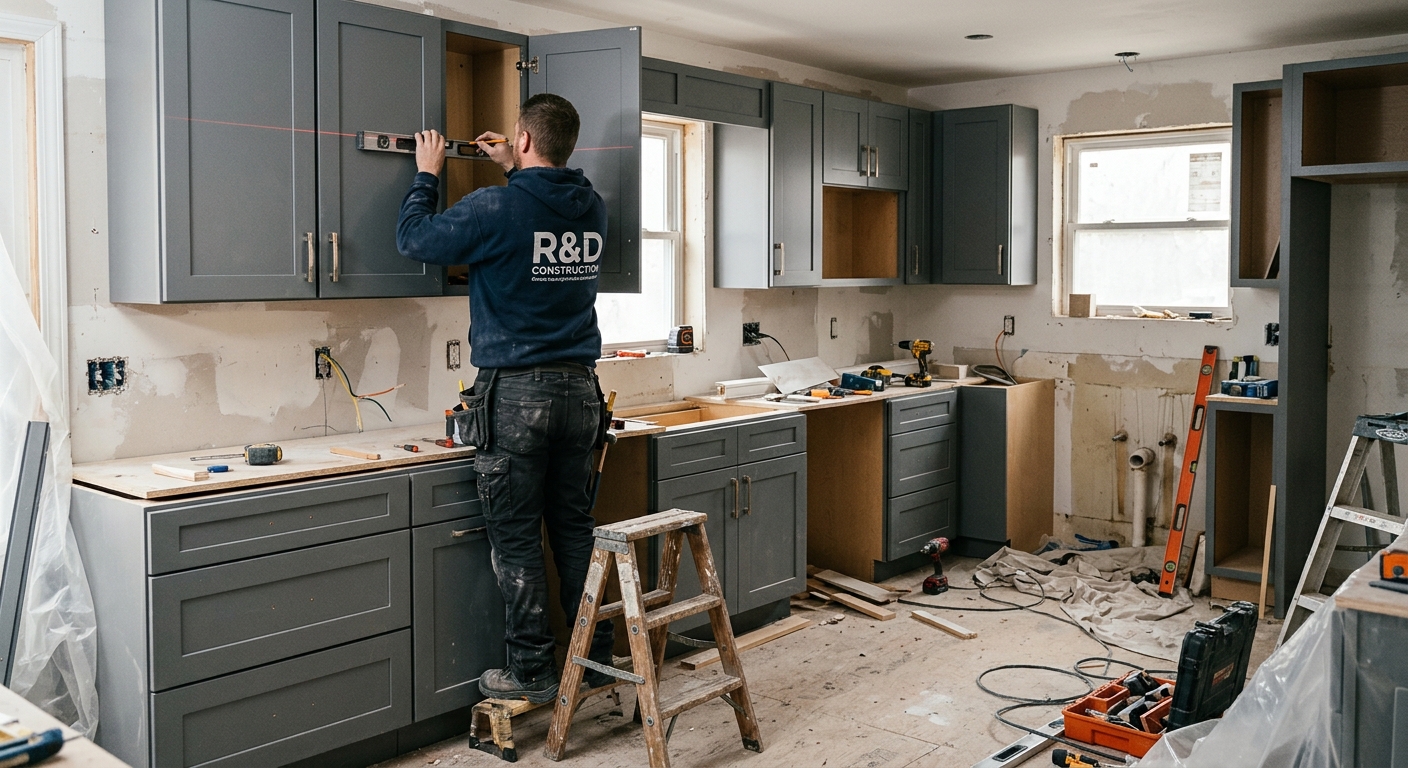
Phoenixville kitchen renovation prices by scope — 2026
Phoenixville homeowners see a wide range in kitchen renovation costs, with budgets closely tied to home value and long-term plans. With a median household income of $91,593 and a homeownership rate of 50.2% (U.S. Census Bureau, ACS 2024), every dollar tends to be scrutinized. Many houses here were built between the 1960s and 1980s, and most kitchens at this age need more than just new paint—they either have a cramped galley layout from the 1950s or a slightly more open-but-dated 1990s footprint, each with its own set of renovation needs.
The leading cause of blown budgets in Phoenixville is shopping for cosmetic refresh pricing, then wanting layout changes that require new plumbing, rewiring, and wall work. It’s a fivefold difference in cost from one end of the scale to the other, depending on scope.
| Scope |
What's included |
Duration |
Price range |
| Full gut remodel, same layout |
cabinets, counters, appliances, flooring, lighting, fixtures |
6–10 weeks |
$33,000–$132,000 |
| Gut plus layout change |
all of the above plus moved plumbing, electrical, walls |
10–16 weeks |
$71,500–$132,000 |
| Cabinet replacement (stock to semi-custom) |
remove and install cabinets, hardware, patching |
1–3 weeks |
$7,700–$33,000 |
| Cabinet refacing |
new doors and drawer fronts, veneer, hardware |
3–6 days |
$7,700–$22,000 |
| Countertop replacement only |
template, fabricate, install, reconnect sink |
1–3 weeks |
$4,400–$17,500 |
| Kitchen flooring only |
remove existing, install new flooring |
3–6 days |
$5,500–$22,000 |
Estimates for a typical Phoenixville kitchen. Cabinet grade and whether the layout changes move these figures more than square footage.
Permits and inspections for a Phoenixville kitchen
Phoenixville follows the Pennsylvania Uniform Construction Code (UCC), enforced by local municipalities. In practice, permits are triggered by the nature of the work. Cosmetic updates like painting, hardware, backsplash replacement, counter swaps (without plumbing changes), or straightforward cabinet refacing usually do not require a permit in Phoenixville or West Chester. But as soon as you move a wall, add a new electrical circuit, relocate plumbing, or make structural changes—even just venting a new range hood through a wall—a building permit is generally required. For projects altering structure or utilities, expect a plan review process, especially where walls or plumbing are redirected.
Electrical inspections in Phoenixville and nearby West Goshen are typically performed by third-party agencies such as United Inspection Agency, rather than the local code office, which can add coordination time. This is often overlooked until the inspector shows up. For projects involving mechanical, electrical, or plumbing system changes, anticipate at least rough-in and final inspections.
Contractors must be registered as Home Improvement Contractors (HIC) through the Pennsylvania Office of Attorney General for jobs over $500. This is public record—verify registration at hic.attorneygeneral.gov. All employers must have workers' compensation coverage, which you can check at Pennsylvania’s WCAIS system. Failure to pull required permits can complicate resale—the issue can surface when a buyer’s title company or home inspector spots an undocumented renovation, meaning you might end up retrofitting or reopening walls at your expense.
What's behind the walls in a Phoenixville kitchen
With 57.3% of Phoenixville homes built before 1980 (U.S. Census Bureau, ACS 2024), it’s common to find surprises during kitchen demolition. Out-of-plumb walls and out-of-level floors often require extensive shimming and adjustments to make new cabinets fit. Electrically, undersized or ungrounded wiring shows up regularly—a full kitchen rewire typically lands in the $6,000–$18,000 range depending on circuit complexity. Galvanized water supply lines or cast iron drains also appear in these older homes—replacing a main kitchen run might add $2,000–$5,000. No insulation at exterior walls is another routine find, which is worth addressing during demo, adding a modest bump, often $800–$2,200 for typical wall areas.
Previous unpermitted work is a real concern. Unmarked, hidden junction boxes or non-code plumbing splices are headaches now but can mean even more at resale. For homes built before 1978, the EPA Lead Renovation, Repair and Painting Rule (RRP) applies. Certified contractors are required to test for lead before disturbing painted surfaces, and may need lead-safe work practices—a factor in both scheduling and cost. If the home has resilient flooring or old adhesives, asbestos is a possibility, but testing must always come before disturbance.
In the area’s newer suburban stock, especially late 1980s or 1990s builds, the issue is often builder-grade materials at end of life—particleboard cabinet boxes sagging, minimal electrical circuit counts, and laminate countertops all needing replacement in the same decade.
Circuits, GFCI and code compliance
Bringing kitchen electrical up to code is where budgets in Phoenixville most often get blown open, especially in homes built before 1980. Today, the Pennsylvania Uniform Construction Code (UCC) requires dedicated 20-amp small-appliance branch circuits, GFCI protection at all countertop outlets, and receptacles spaced so no point on the counter is more than 24 inches from a plug. There must also be dedicated circuits for the dishwasher, garbage disposal, and a microwave, plus 240-volt service for an electric range if used.
But walk into a 1960s or 1970s Phoenixville kitchen and you’ll frequently find two-wire, ungrounded outlets with no GFCI, a single circuit shared between fridge, lights, toaster, and coffee maker, and sometimes panels that are entirely full or use outdated fuse blocks. Opening the walls triggers code compliance, and inspectors will require a full update—not just patchwork fixes. Aluminum wiring does show up in a few 1965–1972 builds and, if present, brings its own complications and expense. Even in homes from the 1990s, it’s common to find kitchens with only one or two general-purpose circuits, which isn’t code-compliant today.
Expect a kitchen rewire—from panel to last outlet, with AFCI/GFCI breakers and all new circuits—to add $6,000–$18,000 to a project, varying by panel location, wall access, and appliance load-out.
Cosmetic, replacement, gut, or layout change?
In Phoenixville, “kitchen remodel” could mean anything from replacing the wallpaper to relocating walls and plumbing, but the right scope saves both time and money. There are four main tiers:
- Cosmetic refresh: paint, hardware swaps, new lighting, a backsplash—no cabinets, counters, appliances, or layout change. Fastest and cheapest, but all the old bones remain.
- Pull and replace: new cabinets and countertops in the same footprint, but no changes to electricity or plumbing. The look transforms, but the function, flow, and storage are what you had with the old kitchen.
- Gut, same layout: everything out to the studs, update insulation, wiring, and plumbing in the same places, but nothing moves. Code-compliant and the best chance to fix hidden problems.
- Layout change: walls, plumbing, or electric get moved—whether it's an open plan or just shifting the sink to a better location. This is where costs climb sharply because moving services triggers permits, engineering, and much more labor coordination.
Most projects in 1960s–1980s Phoenixville homes fall between pull-and-replace and layout-change, since outdated kitchen footprints and service lines are so common. The cost jump is real: jump tiers before you call anyone, as a contractor can’t give honest numbers if the scope isn’t clear. The cliff is especially steep between “gut, same layout” (starting at $33,000) and “layout change” (starting at $71,500). Deciding honestly where your needs fall is the best way to avoid disappointment—or unexpected six-figure quotes.
Choosing cabinetry
Cabinet choice drives more of your kitchen budget than any other decision. In Phoenixville’s older homes with odd wall dimensions, you have four main options:
Refacing keeps your existing cabinet boxes and replaces only the doors, drawer fronts, and visible structure with new veneer and hardware. This is the least disruptive option—if your current boxes are square, sturdy, and the right layout. It costs a fraction of full replacement but cannot add storage or fix a bad layout. It’s a solid choice in homes where the base cabinets are real plywood or hardwood, common before 1980.
Stock cabinets come in fixed increments, so older rooms with walls out of square require filler strips and don’t always look “built-in.” Semi-custom cabinets allow both dimensional tweaks and finish options, slotting in perfectly when the house is a little out-of-true—a typical situation in Phoenixville’s 1960s–1980s era houses. Custom cabinets fit any space but come with a price and lead time to match.
For any purchase, prioritize solid plywood over particleboard boxes, dovetail drawer construction, and full-extension soft-close hardware. Frameless (European-style) cabinets give more storage, but face-frame is traditional and a bit more forgiving in imperfect rooms.
| Option |
Cost |
Best when |
Limitation |
| Painting existing cabinets |
$1,200–$3,500 |
boxes and doors sound, tight budget |
no layout or style change |
| Refacing |
$7,700–$22,000 |
boxes square and layout works |
storage unchanged |
| Stock cabinets |
$7,700–$33,000 |
standard dimensions fit |
filler strips, limited finishes |
| Semi-custom |
$22,000–$33,000 |
non-standard walls or finishes |
6–12 week lead time |
| Full custom |
$22,000–$33,000 |
unusual layout or high-end design |
longest lead, highest cost |
Living through a kitchen renovation
Renovating your Phoenixville kitchen means weeks without your main cooking space. Plan a temporary “kitchen”—most homeowners park a fridge and microwave in the dining room, with a kettle and coffee maker on a folding table. Washing up shifts to the laundry or bathroom sink, and paper plates become your best friend. Even a straightforward pull-and-replace takes a minimum of 1–3 weeks; a gut or layout change stretches to two months or longer.
Expect dust: plastic sheeting (zip walls) will keep most of it contained, but fine debris escapes into the rest of the house. If anyone in your family has allergies, take containment seriously and run air purifiers. The crew will need a spot for their dumpster and material deliveries—a driveway or curb cut is typical, so consider parking changes. Pets can be a hazard with doors constantly propped open, and deliveries coming and going. Some families move out during the demolition week; it’s dusty, noisy, and all water and power to the kitchen are off.
Add up what you’ll spend eating out or ordering meals—over eight weeks, this extra cost can outpace the flooring allowance. It’s real money, and the only thing worse than not planning for it is being forced to eat every meal out because the sink is gone and there’s no safe way to cook.
Frequently asked questions — kitchen renovation in Phoenixville
How much more does moving the sink and range cost?
Moving the sink or range in your Phoenixville kitchen is what pushes a project across the main cost cliff. While leaving everything in place allows for a remodel starting at $33,000, moving plumbing and electrical—especially through old framing and possibly concrete—bumps you into the “layout change” range, which starts at $71,500 and can climb to $132,000 when structural or HVAC relocations are included. The cost reflects permits, trades coordination, and possible need for engineered plans. If your kitchen is in a 1960s–1980s house, expect to touch a lot of old wiring and plumbing when relocating these fixtures. For many Phoenixville homeowners, the big question is whether the new layout is worth double the price of a pull-and-replace.
What is an allowance in a renovation quote?
An allowance in a Phoenixville kitchen renovation quote is a placeholder budget for items not yet chosen, like tile, flooring, appliances, or lighting. Contractors include an estimated dollar amount—say, $5,500 for flooring—so you have a target, but the actual choice and cost might be higher or lower. Anything you pick above the allowance is an extra cost. For local homeowners, allowances are a way to keep the project moving before all selections are finalized, but beware: it’s easy to go over your initial contract if product selections exceed allowances, especially with supply chain hiccups in this market. Make sure you know if your quote’s allowance matches what you actually want, not just the lowest line in the showroom.
What is the cheapest way to update a Phoenixville kitchen?
If your cabinet boxes and doors are solid, the absolute cheapest way to update a Phoenixville kitchen is to paint or reface the cabinets, replace the countertop, swap in a new sink and faucet, and add modern hardware. Painting cabinets can run as low as $1,200–$3,500, and a stock countertop starts at $4,400. Skip tile, leave the footprint alone, and consider DIY backsplash or lighting. Most cosmetic refreshes require no permit. In a market where a full gut remodel might run $33,000 at minimum, starting small can keep your kitchen feeling fresh for a fraction of that cost—and doesn’t lock you out of a bigger renovation down the road.
Which upgrades are not worth the money?
In Phoenixville, heated floors, wine fridges, built-in desk nooks, or ultra-premium imported cabinetry rarely deliver a full return unless you’re in the very top local price bracket. Most houses here were built in the 1960s–1980s, and buyers focus on durable materials, modern fixtures, and up-to-date code compliance—not luxury bells and whistles. Spending $7,700–$22,000 on cabinet upgrades that eliminate needed storage or pushing your countertop cost above $17,500 without addressing layout problems is almost never wise. Focus on what makes the space more useful, such as better lighting or an improved work triangle, rather than expensive extras.
How long does a kitchen renovation take in Phoenixville?
The timeline for a Phoenixville kitchen renovation varies by scope. A cosmetic project (painting, minor updates) can be done in a week. Replacing cabinets and counters in place is typically 1–3 weeks. A full gut and rewire, retaining the layout, usually takes 6–10 weeks. If you’re moving plumbing, adding circuits, or knocking down walls in these older homes, allow for 10–16 weeks. That’s partly because Chester County’s labor pool is tight in finish trades, and inspections—sometimes by third-party agencies—add time. It’s very common to be without a working kitchen for 6–10 weeks on a gut remodel, so budget time for meal plans as well as money.
Is lead paint a concern in Phoenixville kitchen renovations?
Yes—if your Phoenixville home was built before 1978, then federal EPA Lead RRP Rule applies. This means certified contractors must test for the presence of lead paint before starting demolition or sanding. If found, lead-safe practices are required and must be part of the cost structure. Most homes in Phoenixville fall into the pre-1980 era, so it’s a routine part of the planning and bidding process here. For a typical lead-safe kitchen reno, you’ll pay more for labor, containment, and careful cleanup, which usually adds several hundred to a few thousand dollars depending on scope. Always ask your contractor for EPA RRP certification—they must display it by law.
Should I choose plywood or particleboard cabinet boxes?
For Phoenixville kitchens, plywood cabinet boxes are almost always worth the small premium over particleboard, especially in older homes where floors and walls are less than perfect. Plywood boxes are more forgiving during installation and don’t swell up from the leaks and humidity you’ll eventually get. In 1960s–1980s homes, many original cabinets were plywood, and you can see how well they’ve held up compared to the particleboard replacements installed in the 1990s. The upgrade often adds $1,200–$3,000 to a semi-custom cabinet package, but that buys durability and easier modifications down the road.
How much does a kitchen renovation cost in Phoenixville?
A Phoenixville kitchen renovation in 2026 runs from $33,000–$132,000 for a full gut remodel, depending on whether you change the layout or move services. Most pull-and-replace projects—new cabinets, counters, and flooring, but no major moves—fall in the $22,000–$71,500 bracket. Simple updates, like countertops or cabinet refacing, can be as low as $4,400–$22,000. The biggest price drivers are layout changes, material selection, and what’s found behind the walls in these mostly pre-1980 homes. It’s not uncommon for the final bill to be double the starting allowance if the initial scope isn’t nailed down.
Does replacing cabinets require a permit?
In Phoenixville and nearby West Chester or Tredyffrin, replacing cabinets “in place” (meaning, not moving plumbing, walls, or electrical circuits) usually does not require a permit. Cabinet refacing—just changing doors and hardware—also proceeds without one. But if you move the location of a sink, alter circuits, or need drywall and patching beyond straightforward replacement, expect to pull a permit. If any part of your kitchen reno creeps into “gut remodel with layout change”—like knocking down a wall—you absolutely need a permit, and you’ll likely go through plan review as well. The price to bring plumbing and electrical to code as a result can add $6,000–$18,000 to the project.