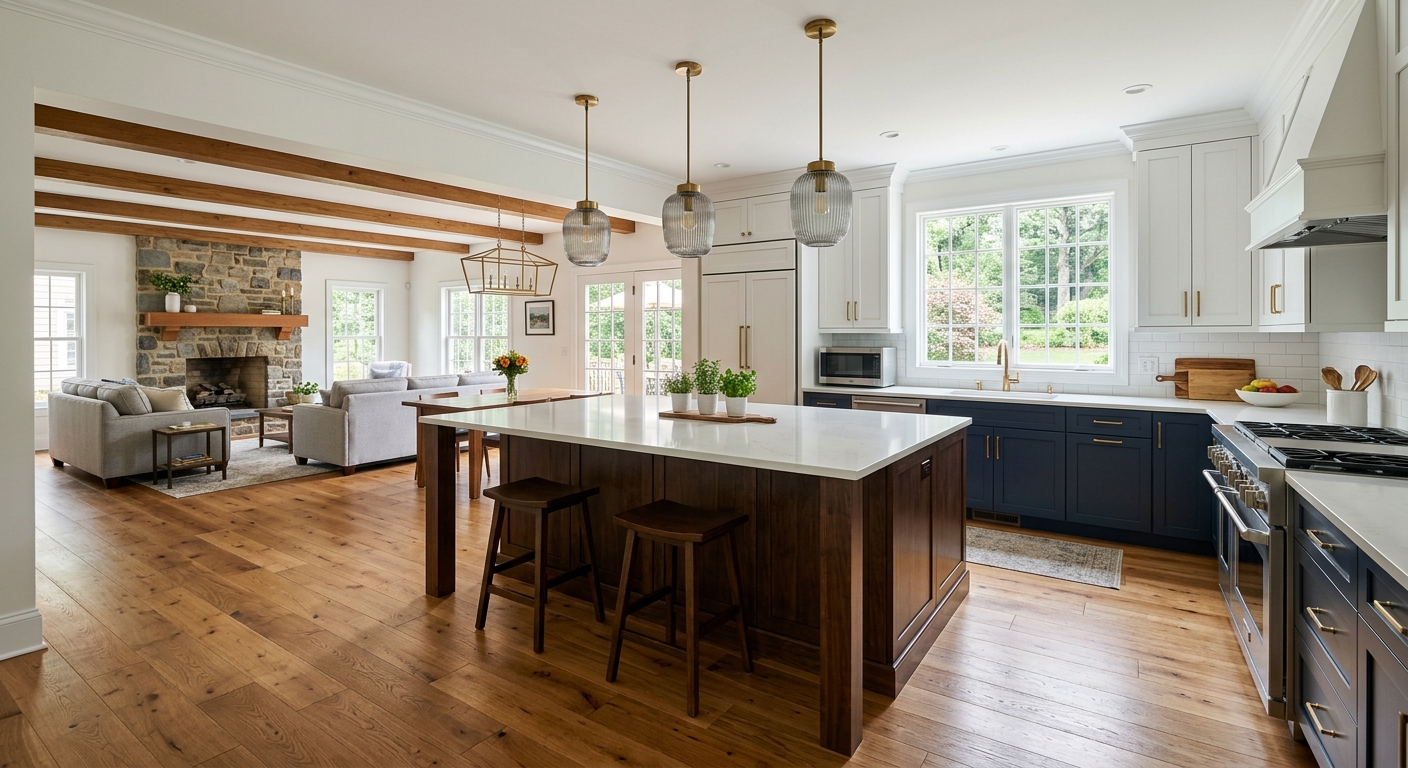
Kitchen renovation costs in Allentown — 2026
Allentown homeowners thinking about a kitchen renovation in 2026 are facing some of the widest price ranges in the state. With a median household income of $52,449 and a homeownership rate of just 42.3% (U.S. Census Bureau, ACS 2024), most owner-occupied kitchens are kept in service until a major replacement is clearly needed—and renters are far less likely to invest. The renovation market is directly shaped by Allentown’s housing stock: many homes, especially in Upper and Lower Macungie, were built post‑1960 and are hitting the age where full kitchen replacement is needed. In these tract homes, layouts are usually functional but dated; in older city housing, galley layouts from the 1950s and before often mean awkward workflows and tiny prep areas that homeowners want to rework entirely.
The single biggest reason projects run over budget is mismatching scope and finish: pricing “pull and replace” and then picking finishes or add-ons from a custom-tier, without realizing each upgrade drags costs upward. Below are the true bracketed costs you should expect for each scope. These figures include both labor and solid, code-compliant materials using 2026 Lehigh County pricing.
| Scope |
What's included |
Duration |
Price range |
| Full gut remodel, same layout |
cabinets, counters, appliances, flooring, lighting, fixtures |
6–10 weeks |
$29,500–$118,500 |
| Gut plus layout change |
all of the above plus moved plumbing, electrical, walls |
10–16 weeks |
$64,500–$118,500 |
| Cabinet replacement (stock to semi-custom) |
remove and install cabinets, hardware, patching |
1–3 weeks |
$6,900–$29,500 |
| Cabinet refacing |
new doors and drawer fronts, veneer, hardware |
3–6 days |
$6,900–$20,000 |
| Countertop replacement only |
template, fabricate, install, reconnect sink |
1–3 weeks |
$4,000–$16,000 |
| Kitchen flooring only |
remove existing, install new flooring |
3–6 days |
$4,900–$20,000 |
Estimates for a typical Allentown kitchen. Cabinet grade and whether the layout changes move these figures more than square footage.
Practical survival during the work
No matter the budget, every Allentown kitchen renovation means weeks without a real kitchen. Planning a temporary setup takes the sting out. Most folks move their fridge to the dining room or garage, then set up a folding table with a microwave, coffee maker, and electric kettle. If you have a laundry sink, that’s a luxury for washing dishes; otherwise, use the bathroom sink—plus plenty of paper plates and plastic utensils.
Construction dust is a surprise for most. Good contractors seal entries with plastic sheeting and temporary zip walls, but dust still finds its way. Plan to box up or cover anything important in adjacent rooms. Outside, expect a dumpster on your driveway or street and a pile of cabinets or flooring waiting their turn—your garage or side yard is often staging central.
Pets can slip out when workers carry debris, and if you have indoor cats or a nervous dog, talk to your contractor first about keeping them secure. Demolition week is loud, dirty, and involves the door being open far more than usual. Some families choose to move out for this stretch, but most tolerate it at home if there’s another bathroom and an eating corner somewhere.
One honest reality: eating out for 6–8 weeks adds up in Allentown. For many, that extra cost is larger than new kitchen flooring. Don’t overlook it when planning your budget.
Cosmetic, replacement, gut, or layout change?
In Allentown, “kitchen remodel” can mean anything from paint and new pulls to moving walls and rerouting every pipe. To avoid sticker shock, start by deciding which of these four tiers describes your goal:
- Cosmetic refresh: New paint, cabinet hardware, backsplash, or lighting, with all cabinets in place and no electric or plumbing moved. Expensive look for little cost, but no layout or storage gains.
- Pull and replace: Cabinets, counters, and floors come out and are replaced, but everything (sink, stove) stays where it is. Electrical and plumbing upgrades may be included, but no relocation.
- Gut, same layout: Everything out to the studs or subfloor. Wiring, outlets, and plumbing are updated but rebuilt where they were. Mold or rot is handled, and insulation improvements happen. Cabinets, counters, and appliances all new.
- Layout change: Walls move, or the kitchen is opened up to a dining or living room. Sink and appliances may change locations—this triggers electrical and plumbing permits, needs engineering, and usually costs much more.
The cliff in cost, time, and permits is between gutting within the same layout and moving elements. Moving a sink across the room or opening a load-bearing wall changes your contractor pool and puts you in a totally different price band: $64,500–$118,500 for Allentown, rather than a “reasonable” gut job.
Deciding which tier fits your house and goals is the most important prep step. Contractors can’t give a real number—or even a useful range—without this. Set expectations first, then vet your bidders.
Permits and inspections for a Allentown kitchen
In Allentown and most of Lehigh County, kitchen projects trigger permits and inspections depending on the scope. Painting your cabinets, changing hardware, or even cabinet refacing and installing new counters normally proceed without a permit. The line is crossed when you move or add plumbing lines, introduce new electrical circuits, or touch gas piping—all of which require a building permit in Allentown. Sometimes a new range hood vented to the exterior also requires mechanical permits.
Full kitchen remodels in Allentown with plumbing or layout work undergo building department plan review before a permit is issued. This can add weeks to your timeline but protects resale value and safety. Electrical inspections in Allentown are performed by the City of Allentown Bureau of Building Standards, while surrounding Lehigh County townships usually rely on third-party agencies to inspect after critical phases.
Contractors working on projects over $500 must have Home Improvement Contractor (HIC) registration with the Pennsylvania Office of Attorney General—proven at hic.attorneygeneral.gov. All contractors with employees must carry workers’ compensation, and you can verify their compliance via WCAIS (wcais.pa.gov).
Skipping required permits risks fines, insurance headaches, and dealing with problems at resale when the new owner’s lender or home inspector spots nonpermitted work. Except for true cosmetic projects, always check what your scope requires before you commit.
Does a kitchen renovation pay back in Allentown?
Renovating your kitchen in Allentown will make your house more attractive and can help it sell, especially if nearby homes of similar age have been updated. But a kitchen update does not guarantee dollar-for-dollar return, even in a hot market—and high-end jobs are least likely to pay themselves back. In neighborhoods where most kitchens are original to the post‑1960 build, a thoughtful renovation can move your house to the top of buyers’ lists, but it rarely justifies costs at the very top of the price band.
The decision splits: if you plan to stay in the house for five years or more, renovate for your own comfort and ignore resale. Pick the layout, cabinets, and appliances best for your routines. But if you’re likely to sell soon, keep finishes neutral, layouts the same, and target a mid-tier budget—think $29,500–$64,500 instead of high six figures. This avoids over-improving past neighborhood values, especially given Allentown’s median household income of $52,449 (U.S. Census Bureau, ACS 2024). Spending $100,000 on a kitchen in a $250,000 house will not add $100,000 to your sale price.
In short: if you plan to sell, update to the standard for your part of Allentown. If you will stay, ignore “return” and build what works for you.
What a kitchen quote should specify
No two kitchen quotes in Allentown are truly comparable until you dig into the fine print—and the biggest reason is allowances. An allowance is a placeholder dollar amount for items you have not yet picked: for example, a $2,000 countertop allowance means your price will adjust up or down as you pick the slab. Some bidders lowball allowances to show you an attractive bottom-line, while others are realistic from the start. Two bids can look identical but end up thousands apart once true kitchen choices are made.
Your written proposal should spell out cabinet brand and line, not just “quality wood.” Countertop quotes should specify material (granite, quartz, laminate), edge profile, thickness, and whether seams will be visible. Make sure you see the process for “unforeseen conditions” (for example, discovering subfloor rot), approval and documentation for change orders, and a payment schedule based on work milestones—never pay more up front than materials already ordered. Lien waivers should come from subcontractors at each payment so no surprise claims appear later.
In Pennsylvania, work over $500 requires a written contract under the Home Improvement Consumer Protection Act (HICPA), with a three business-day right of cancellation. Do not move ahead on a handshake or verbal changes.
| Line item |
What to look for |
Red flag if… |
| Allowances |
realistic amounts, itemised |
round numbers with no basis |
| Cabinetry |
brand, line, box construction |
'quality cabinets' |
| Countertops |
material, thickness, edge, seams |
material name only |
| Electrical |
circuits to be added, GFCI scope |
'as needed' |
| Unforeseen conditions |
how they are priced and approved |
not addressed |
| Change orders |
written approval before work |
verbal |
| Payment |
milestone-based, modest deposit |
front-loaded |
| Lien waivers |
from subs at each payment |
not offered |
Choosing cabinetry
This is the one decision that steers the whole budget in Allentown. You have four honest options:
- Refacing: Leaves the cabinet boxes and layout as they are, giving you new doors, drawer fronts, and a fresh veneer. It only makes sense if your boxes are solid, square, and already laid out sensibly. You can’t add more storage, but it’s an effective, sharp-looking option in a sturdy kitchen for $6,900–$20,000.
- Stock cabinets: These are factory-built in set widths and heights. They are fast to get and cheaper. But in older or non-standard kitchens, especially outside of the post‑1960 tract homes of Upper and Lower Macungie, you’ll need filler strips or end up with awkward gaps.
- Semi-custom cabinets: Closes the gap for most Lehigh County homes. Offers a range of dimensions and finishes—so you get better fit and a more tailored look. Many mid-tier Allentown kitchens go this route by necessity, not just preference, as existing walls aren’t perfectly square or sized for stock.
- Custom cabinets: For unique layouts, old homes, or high-end finishes, this gets you exactly what you want. Expect higher lead times and the top end of the price band.
Box construction beats price tier every time: plywood beats particleboard, dovetail drawers beat stapled, and full-extension, soft-close hardware is worth it on any project. Frameless (Euro-style) delivers more usable interior space, but face-frame is common and sturdy. If most walls or corners aren’t standard, your bid will tilt semi-custom or custom whether you planned it or not.
| Option |
Cost |
Best when |
Limitation |
| Painting existing cabinets |
$1,200–$3,500 |
boxes and doors sound, tight budget |
no layout or style change |
| Refacing |
$6,900–$20,000 |
boxes square and layout works |
storage unchanged |
| Stock cabinets |
$6,900–$29,500 |
standard dimensions fit |
filler strips, limited finishes |
| Semi-custom |
$20,000–$29,500 |
non-standard walls or finishes |
6–12 week lead time |
| Full custom |
$20,000–$29,500 |
unusual layout or high-end design |
longest lead, highest cost |
Frequently asked questions — kitchen renovation in Allentown
Why are kitchen quotes in Allentown so far apart?
Allentown has a very saturated remodeling market, and many homes—especially in the post‑1960 tracts around Upper and Lower Macungie—are now in serious need of updates. The result: huge differences in project approach and price. Some contractors price out stock cabinets and off-the-rack finishes, while others assume semi-custom or even custom work due to non-standard dimensions common here. Labor is also tighter (and costlier) than in rural counties, pushing up prices in busy seasons. Also, watch allowance lines: one quote may use a low placeholder (say, $3,000 for counters) while another is realistic ($8,900). Until you read the breakdown, two bids can look aligned but lead to thousands in overruns once materials are chosen.
Do I need to change my kitchen layout?
If your house is in one of Allentown's post‑1960 neighborhoods, layouts usually work—the classic U- or L-shape with reliable traffic flow—so a gut renovation without layout changes fits most budgets. It's the pre‑1960 city homes with narrow galleys or tight corners that draw owners to knock down a wall or move the sink. But here’s the truth: jumping from “gut, same layout” ($29,500–$118,500) to “layout change” ($64,500–$118,500) is a massive price and permitting step. If your current layout fundamentally works, you’ll save tens of thousands by leaving services where they are. Change only for a real functional problem or if you plan to stay long term.
How do I set up a temporary kitchen?
Most Allentown renovations are lived through, not moved out for. Roll your fridge to the dining room or garage, put a microwave and coffee maker on a folding table, and keep essentials nearby. If you have a laundry sink, perfect—that covers dishes. Otherwise, it's the bathroom sink and lots of paper plates. Plan meals that need only a microwave, air fryer, or barbecue. Remember, eating out for 6–8 weeks—at area prices—can easily match or exceed the cost of mid-grade flooring ($4,900–$20,000). Good contractors seal with plastic sheeting, but dust gets everywhere; keep valuables boxed up nearby. The key is anticipating inconvenience so you’re not caught off-guard mid-demo.
Should I order cabinets before demolition?
In Lehigh County, especially Allentown, never order cabinets before demolition unless your contractor takes full responsibility for measurements after walls are open and the room is verified. Post‑1960 tract homes are fairly predictable, but older houses—common in city neighborhoods—often reveal surprises. Out-of-plumb walls, hidden soffits, or missed pipes can throw factory dimensions off. Cabinets can take several weeks to arrive, so your contractor will typically demo, remeasure, and then place the final order to ensure fit. If you want to minimize your kitchen-out time, work with a pro who can move quickly between demo and order—or consider refacing, which keeps the old boxes and is done in days for $6,900–$20,000.
Is lead paint a concern in Allentown kitchen renovations?
Yes, it is a legitimate concern for Allentown and Lehigh County homes built before 1978—which is a large percentage given the area’s housing data (U.S. Census Bureau, ACS 2024). The federal EPA Lead RRP Rule applies, which means any contractor disturbing painted surfaces in older kitchens must have special certifications and follow dust containment protocols. This protects your household—particularly kids and pets—from lead dust during demolition and sanding. Make sure to ask your contractor about their training and check their firm at certifiedrenovatorsearch.epa.gov. Costs for EPA-compliant prep can push the lower end of renovation bands up by several hundred dollars.
Which upgrades are not worth the money?
In Allentown, spending at the very top of the finish spectrum—imported tile, expensive oversized ranges, or fully custom cabinets for a tract home—rarely delivers on resale. Most buyers here are working within the market’s median income ($52,449), so mid-range cabinetry and durable counters return more than ultra-premium. Specialty features like pot fillers or tech-integrated appliances also see little use in daily life and aren’t sought after at resale. If your budget is tight, focus on cabinets and counters; skip the expensive tile backsplashes or wine fridges. A solid “pull and replace” with mid-grade cabinets can cost as little as $20,000 and be the best investment for both daily use and resale.
What happens if previous work was unpermitted?
Allentown’s code office, and those in Lehigh County’s other municipalities, can flag unpermitted kitchen work during resale or refinance. This can stall sales or require expensive after-the-fact remediation—sometimes opening walls to prove everything was done to code. Insurance claims can fail if uninspected work is tied to a problem like an electrical fire or leak. For any job over $500, Pennsylvania requires a written HIC contract with the scope clearly listed (Home Improvement Consumer Protection Act). Whenever you move plumbing, electrical, or structural components, always ensure permits are pulled, or you may inherit a compliance headache at closing. Cosmetic work (cabinet painting or refacing) remains the low-risk, no-permit path.
How much does a kitchen renovation cost in Allentown?
In 2026, a full gut remodel of a standard Allentown kitchen—keeping the layout—starts at $29,500 and can climb to $118,500. The typical replacement falls close to $64,500, but costs swing higher with premium finishes or structural changes. Just ordering new semi-custom cabinets, installed, runs $20,000–$29,500. Cheapest projects—countertop-only or refacing—can still reach $4,000–$20,000. Most overruns are caused by picking finishes out of your original price tier or deciding mid-stream to move walls or appliances. Allentown’s busy contractor market keeps labor tight, so don’t expect outlier bargains unless you’re doing most of the work yourself.
What is the difference between stock and semi-custom cabinets?
Stock cabinets are made in standard sizes, finishes, and door styles—what you see is what you get. They fit perfectly in newer Allentown tract homes built to standard dimensions, and they’re the quickest to install. If your walls are non-standard—a common headache in older city homes—stock cabinets need filler strips and sometimes look shoehorned in. Semi-custom cabinets bridge the gap, letting you pick dimensions, some details, and a wider array of finishes. This can help you work around quirky wall lengths, sloped ceilings, or unusual plumbing locations. In 2026, expect to pay $6,900–$29,500 for stock and $20,000–$29,500 for semi-custom installed. For perfectly tailored cabinets, custom is a separate tier—but semi-custom is the sweet spot for most Allentown renovations.