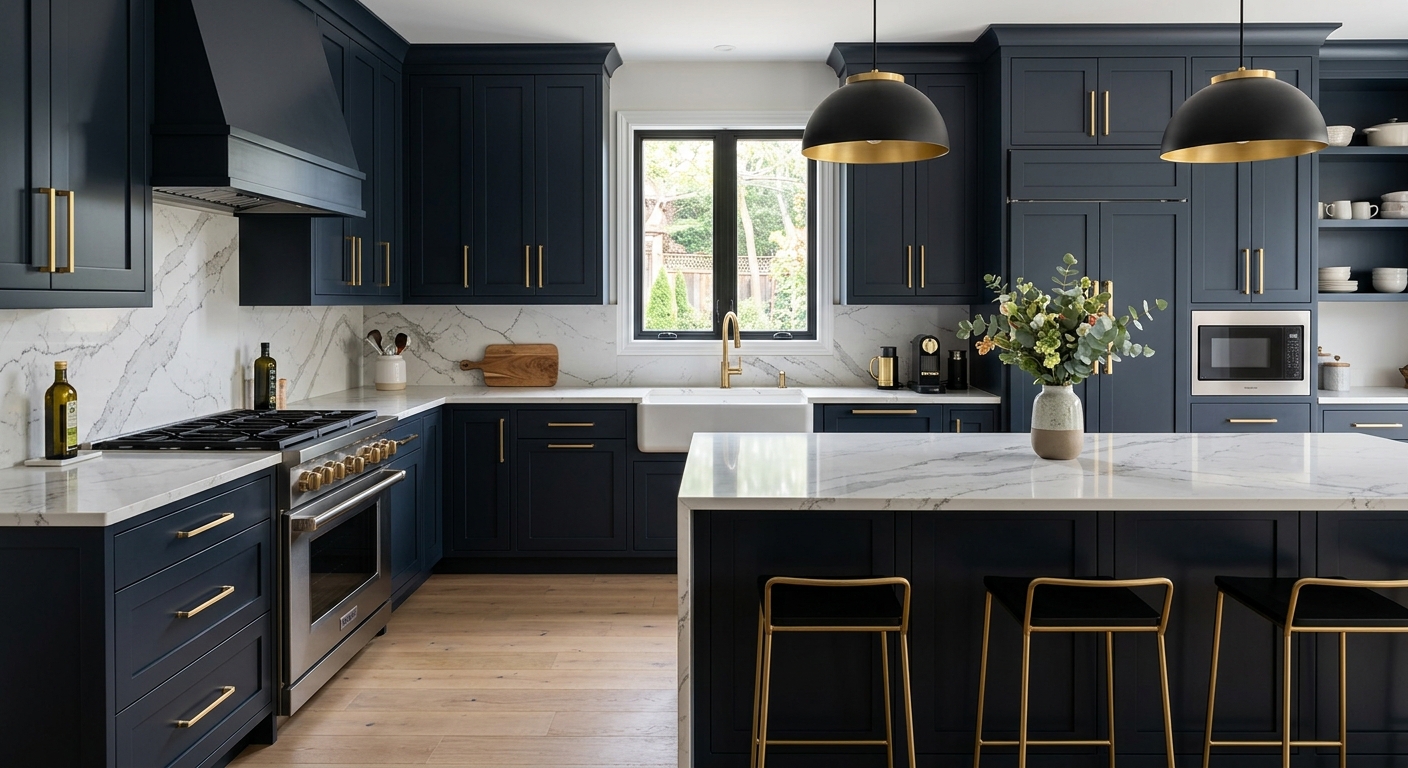
What a kitchen remodel costs in Middletown
Middletown stands out for its high homeownership rate (75.5%) and healthy median household income ($108,052), making full-scale kitchen renovations a common investment among owner-occupants rather than landlords. The bulk of local housing comes from post-1960s suburban tracts, and many kitchens still have original galley layouts, which are usually smaller and more compartmentalized than newer open concepts. As a result, most renovation projects here start as “gut-and-replace” jobs—stripping everything down to the studs, sometimes moving walls to join the kitchen with dining or living spaces.
The single mistake that blows most kitchen budgets is confusing scope. Homeowners often price out a modest pull-and-replace (keep the layout, new cabinets and finishes), then begin specifying for a full reconfiguration—moving the sink, adding circuits, knocking down walls—without updating their expectations. The gap isn’t just cost, but also time, complexity, and permit requirements.
| Scope | What's included | Duration | Price range |
|---|
| Full gut remodel, same layout |
cabinets, counters, appliances, flooring, lighting, fixtures |
6–10 weeks |
$33,500–$133,000 |
| Gut plus layout change |
all of the above plus moved plumbing, electrical, walls |
10–16 weeks |
$72,000–$133,000 |
| Cabinet replacement (stock to semi-custom) |
remove and install cabinets, hardware, patching |
1–3 weeks |
$7,800–$33,500 |
| Cabinet refacing |
new doors and drawer fronts, veneer, hardware |
3–6 days |
$7,800–$22,000 |
| Countertop replacement only |
template, fabricate, install, reconnect sink |
1–3 weeks |
$4,400–$18,000 |
| Kitchen flooring only |
remove existing, install new flooring |
3–6 days |
$5,500–$22,000 |
Estimates for a typical Middletown kitchen. Cabinet grade and whether the layout changes move these figures more than square footage.
What a kitchen quote should specify
The detail in your kitchen quote makes all the difference in comparing bids. The biggest trap is the “allowance”—a placeholder dollar amount for an item not yet selected, such as tile or lighting. If Contractor A carries an allowance that actually buys the tile you want and Contractor B lists a token amount, two quotes with the same total can be thousands of dollars apart in the real end price. Always compare allowance lines before you look at the bottom line.
The quote should name the cabinet brand, line, and box construction—not just “quality cabinets.” For countertops, look for details: material, thickness, edge profile, and how seams are handled. If unforeseen conditions (like hidden water damage) come up, your contract should spell out how this is priced and approved. Change orders—any scope or price change—should require your written sign-off before additional work starts. Payments should be tied to milestones (like cabinets delivered) rather than calendar dates, and it’s best practice for your contractor to provide lien waivers from trades as you make payments.
Under Pennsylvania’s Home Improvement Consumer Protection Act, any contract over $500 must be written, and you have a three business-day right to cancel—protecting homeowners in Middletown from pressure or rushed decisions.
| Line item | What to look for | Red flag if… |
|---|
| Allowances |
realistic amounts, itemised |
round numbers with no basis |
| Cabinetry |
brand, line, box construction |
'quality cabinets' |
| Countertops |
material, thickness, edge, seams |
material name only |
| Electrical |
circuits to be added, GFCI scope |
'as needed' |
| Unforeseen conditions |
how they are priced and approved |
not addressed |
| Change orders |
written approval before work |
verbal |
| Payment |
milestone-based, modest deposit |
front-loaded |
| Lien waivers |
from subs at each payment |
not offered |
The biggest line item in your Middletown kitchen
The cabinet decision sets the cost baseline for any Middletown kitchen project. You have four main options: painting the cabinets, refacing, stock/semi-custom, and full custom. Refacing (replacing doors, drawer fronts, and veneering boxes) is the lowest effort-to-impact route if your boxes are solid, square, and you’re happy with the current storage and layout—no added drawers or rearranged cabinets are possible with this approach.
Stock cabinets come in fixed sizes and finishes; they’re lowest priced, but you’ll notice extra filler strips or dead zones where your post-1960s galley kitchen wasn’t built to standard widths. Semi-custom cabinets allow you to dial in widths, depths, and finishes to make the most of a non-standard space—very typical in Middletown’s older housing, where walls may run off by an inch or more. Full custom can solve almost anything, at a price and with the longest lead time.
Cabinet quality cuts across these price tiers: plywood boxes and dovetail drawers outlast particleboard and stapled joinery, and soft-close hardware is no longer luxury-only. Frameless construction buys you a sleek look and better interior access, face-frame is more traditional and forgiving of wall irregularities common in older Bucks County homes.
| Option | Cost | Best when | Limitation |
|---|
| Painting existing cabinets |
$1,200–$3,500 |
boxes and doors sound, tight budget |
no layout or style change |
| Refacing |
$7,800–$22,000 |
boxes square and layout works |
storage unchanged |
| Stock cabinets |
$7,800–$33,500 |
standard dimensions fit |
filler strips, limited finishes |
| Semi-custom |
$22,000–$33,500 |
non-standard walls or finishes |
6–12 week lead time |
| Full custom |
$22,000–$33,500 |
unusual layout or high-end design |
longest lead, highest cost |
Four kinds of kitchen project, four budgets
In Middletown, homeowners mean wildly different things when they say “kitchen remodel”—and the price swings fivefold depending on what you want:
- Cosmetic refresh: Paint, lighting, backsplash, hardware. No cabinets or layout changes. Think weekend DIYers or prepping a house to rent out.
- Pull and replace: New cabinets and countertops in the same footprint. All plumbing and major electrical stay put. A fast, tight-scope project if you like your layout but want it looking (and functioning) new.
- Gut, same layout: Tear out down to the studs, new cabinets/drawers, upgraded wiring and plumbing, but fixtures land where they started. Best for that tired 1970s galley that’s ready for a modern surface and safer utilities.
- Layout change: Knocking down a wall, moving the sink or range, reconfiguring the entire flow. This is where price and complexity spike, because you trigger permits, need new branch circuits and potentially walls, and the project runs longer.
The biggest jump is from gut-same-layout to moving the core infrastructure. Relocating even one fixture or breaking a wall means hiring a licensed plumber or electrician, extra design work, more inspections, and waiting on permits. Decide which tier you want—honestly—before calling contractors, because until you’ve set the “scope,” nobody can give you a reliable number and any bid will just be a guess.
What requires a permit in a kitchen renovation
In Middletown Township, a kitchen facelift—painting, hardware swaps, cabinetry refacing, or direct countertop replacement—does not typically require a permit as long as you aren’t changing the layout or running new plumbing or circuits. Most full kitchen renovations, though, do trigger permits: any time you move electrical circuits, relocate plumbing fixtures, take down or add walls, or run gas for a new appliance, you are squarely in permit territory. Plan reviews are not a standard part of the process unless you’re in Bensalem Township, but it’s always best to check with your municipal code office on what your job requires.
Electrical inspections in some Bucks County municipalities are done by a third-party agency—this surprises many homeowners used to city inspectors. If you’re hiring a contractor for any kitchen work over $500, make sure they’re registered with the Pennsylvania Office of Attorney General as a Home Improvement Contractor (HIC) and are carrying valid workers' compensation, which you can verify through the WCAIS system. Skipping these steps can bite you hard at resale: an unpermitted kitchen update is a red flag on disclosure forms and can stall or derail a closing.
Allocating a kitchen budget
A full kitchen gut remodel in Middletown almost always sees cabinetry claim the largest portion—often 25–35% of the budget—especially when the project leans toward semi-custom to fit non-standard post-1960s layouts. Labor and installation typically come next (20–30%), reflecting the time it takes skilled trades to work with older framing and utilities. Countertops, appliances, flooring, lighting, and fixtures fill in the rest, but two critical lines get missed early: a contingency (what you may discover inside the walls) and soft costs (permits, design fees, delivery, disposal).
Your money works hardest in cabinetry and labor—fixing a crooked floor or uneven walls is worth professional skill and durable materials. Cheapest upgrades with little impact: premium appliances in a kitchen with builder-grade cabinets, or ultra-high priced fixtures if plumbing is untouched. For a typical Middletown renovation in the $33,500–$133,000 range, here’s what the breakdown looks like:
| Category | Share of budget | Notes |
|---|
| Cabinetry |
25–35% |
the largest line and the longest lead time |
| Labour and installation |
20–30% |
rises sharply if the layout changes |
| Countertops |
8–15% |
material choice drives the swing |
| Appliances |
10–20% |
widest range of any category |
| Flooring |
5–10% |
|
| Lighting and electrical |
5–10% |
higher in older homes needing circuits |
| Plumbing and fixtures |
4–8% |
|
| Permits, design, disposal |
3–6% |
usually forgotten in early budgets |
| Contingency |
10–15% |
not optional in a pre-1980 house |
General contractor, kitchen firm, or manage it yourself?
The way you approach your Middletown kitchen job—who manages, who contracts, and who schedules—shapes the final cost and your stress way more than most product choices. Design-build kitchen firms—where design, cabinetry, and installation all come from a single contractor—cost the most, but you get a cohesive process and one throat to choke if something is wrong. A general contractor coordinates trades (carpentry, plumbing, electrical, flooring) while you or a designer specify the finishes and layout. This is middle ground for both cost and homeowner effort.
Owner-management is just what it sounds like: you directly contract each trade, schedule deliveries, and run down punch lists. It is the only path to the lowest price, but the learning curve is steep and every delay or surprise lands on your shoulders. In Bucks County, with finish-trade labor always tight, juggling schedules and vetting pros is more work than people think—especially if you have another job or the project involves new circuits or plumbing (which almost always means you need a permitted, inspected job).
If your scope triggers permits, and especially if you’re renovating an older kitchen in one of Middletown’s many post-1960s homes, managing it yourself rarely saves as much as you hope and often costs more in callbacks or delays.
Frequently asked questions — kitchen renovation in Middletown
Do I need to change my kitchen layout?
In Middletown, many kitchens are original galley or L-shaped layouts from post-1960s subdivisions. If you’re finding your kitchen cramped, closed off, or hard to entertain in, a layout change can open up the space and add function. However, not every project needs this level of overhaul. Simply replacing cabinets and updating finishes in the existing footprint can bring huge improvement on a budget of $33,500–$133,000, especially if you’re satisfied with the basic flow. Remember, moving the sink or tearing down walls in Middletown triggers permits and drives costs sharply upward. Most owners start with the question: “Does this layout fit our life—or would a simple refresh get the job done?”
Does a kitchen renovation increase home value in Middletown?
Given Middletown’s high percentage of owner-occupied, single-family homes, an updated kitchen can be a strong investment. Kitchens are one of the most scrutinized features during resale. A full gut remodel in the $33,500–$133,000 range does not guarantee a dollar-for-dollar return, but in older homes with tired layouts or finishes, it helps the home compete in the Bucks County market. Moderately priced upgrades—quality cabinets, durable counters—tend to add more value than high-cost, ultra-custom features. The best returns are seen when old, worn, cramped spaces are modernized to suit the needs of today’s buyers.
What is a change order and how should it work?
In any sizeable Middletown kitchen renovation, a change order is a formal agreement to alter the original contract—whether for added work, different materials, or necessary corrections. For example, if hidden water damage is found behind a wall, both you and your contractor need to agree in writing to the added scope and price before work goes further. Never rely on a handshake or verbal approval; Pennsylvania’s Home Improvement Consumer Protection Act expects written documentation. A properly priced change order—let’s say adding a few feet of new cabinets at $7,800–$33,500 range—protects both sides. Make sure your contractor requires your written sign-off before starting extra work.
Can I cancel a renovation contract in Pennsylvania?
Yes, under the Pennsylvania Home Improvement Consumer Protection Act, any signed contract for home improvement work over $500—common for any kitchen project in Middletown—comes with a three business-day right of cancellation. You don’t have to provide a reason. This is a critical protection if you feel pressured, realize you made a hasty decision, or simply change your mind. If your contractor does not include this right in the paperwork, consider it a warning sign. If you signed up for a countertop project at $4,400–$18,000, you still have the right to walk away in that window.
How does Middletown's housing stock affect cabinet fit?
Much of Middletown’s housing was built after 1960, meaning you’re often dealing with kitchens that have small or non-standard layouts—especially those old galley kitchens in Lower Bucks. Walls and dimensions rarely line up to “stock” cabinet sizes, so filling the space attractively can push you toward semi-custom or custom options, which are pricier but fit better. Budget for cabinet replacement in the $7,800–$33,500 range if you want a good fit and finish. Trying to force standard cabinets into a quirky space often means awkward gaps or wasted storage, making semi-custom a sensible upgrade for this area.
How much does a kitchen renovation cost in Middletown?
For a typical owner-occupied home in Middletown, full gut renovations usually fall between $33,500–$133,000, with most clients spending around $72,000. These numbers include everything—cabinets, counters, flooring, appliances, labor, electrical, and permits. If you don’t move walls or fixtures, and stick to a pull-and-replace approach, your project may fall near the lower end. Cosmetic updates, like painting cabinets or swapping counters, land even lower: expect a countertop-only job to fall in the $4,400–$18,000 range. The big swings come from layout changes, finish choices, and structural work.
Is laminate countertop a bad choice?
Not necessarily—for many Middletown kitchens, laminate remains a smart, budget-friendly option. It costs far less than stone, falls within $4,400–$18,000 for a full replacement, is easy to clean, and can be installed quickly, especially in smaller, post-1960s layouts. The drawbacks: lower resale appeal, less heat and scratch resistance, and the seams are usually visible. If your cabinets and layout are dated and you plan further upgrades later, laminate buys you time without blowing the budget. In higher-end homes or when selling soon, buyers will often expect granite or quartz—but for many, laminate is a practical, sensible pick.
Should I order cabinets before demolition?
In most Middletown projects, it’s smart to have your cabinet order placed before demolition, but not necessarily delivered. Older homes can have wall inconsistencies that only become obvious once everything is torn out. Ordering once you’ve confirmed all site measurements reduces errors, and a trusted contractor will typically build a buffer between demolition and delivery to avoid delays. Keeping your cabinet replacement budget in the $7,800–$33,500 range means careful planning; rushing an order or trying to save a week on the schedule by cutting corners almost always costs more in mistakes and frustration.
What is a realistic contingency for a Middletown kitchen?
For any pre-1980 Middletown home, a contingency line in your kitchen project budget isn’t just smart—it’s essential. Expect the unexpected, especially with plumbing and electrical buried in old walls or floors. Most experienced contractors recommend budgeting 10–15% of the total cost (so for a $72,000 gut remodel, around $7,200–$10,800). This covers surprises like hidden water damage, outdated wiring, or uneven floors. Using this buffer means you’re ready for whatever Bucks County’s older housing throws at you, without halting the job or sabotaging your finish choices.