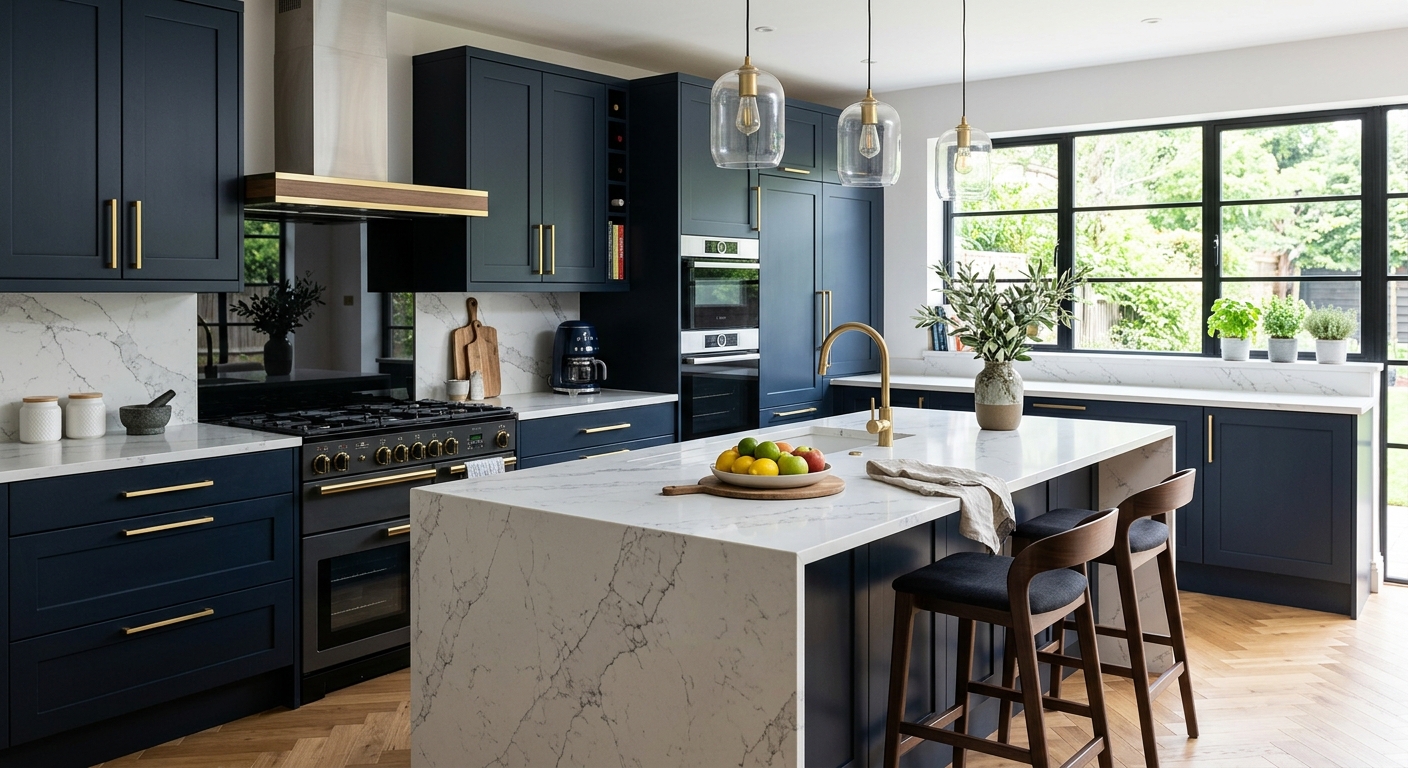
McKeesport kitchen renovation prices by scope — 2026
In McKeesport, with a median household income of $31,635 and a homeownership rate under 50% (U.S. Census Bureau, ACS 2024), the decision to tackle a kitchen renovation is both practical and consequential. Many kitchens here were built before 1980—a full 89.9% of local homes—which means renovation is often a question of gutting small, closed-off rooms built for another era rather than refreshing a recent open-plan. That underlying structure shapes both price and timeline. Most blown renovation budgets come from starting with a basic price list, then choosing changes that belong to a much higher cost tier—especially moving out of a “surface-level” upgrade into new layout territory.
Below is what you can expect to spend on typical kitchen projects in McKeesport in 2026. Always factor in that moving plumbing, electrical, or walls is a much bigger leap than simply replacing what’s already there. Labor rates in Allegheny County’s core are firm, and costs reflect not just materials, but the continuous demand for finish trades around the Pittsburgh area.
| Scope |
What's included |
Duration |
Price range |
| Full gut remodel, same layout |
cabinets, counters, appliances, flooring, lighting, fixtures |
6–10 weeks |
$28,000–$113,000 |
| Gut plus layout change |
all of the above plus moved plumbing, electrical, walls |
10–16 weeks |
$61,000–$113,000 |
| Cabinet replacement (stock to semi-custom) |
remove and install cabinets, hardware, patching |
1–3 weeks |
$6,600–$28,000 |
| Cabinet refacing |
new doors and drawer fronts, veneer, hardware |
3–6 days |
$6,600–$19,000 |
| Countertop replacement only |
template, fabricate, install, reconnect sink |
1–3 weeks |
$3,800–$15,000 |
| Kitchen flooring only |
remove existing, install new flooring |
3–6 days |
$4,700–$19,000 |
Estimates for a typical McKeesport kitchen. Cabinet grade and whether the layout changes move these figures more than square footage.
Choosing cabinetry
Cabinets are typically the largest single expense in a McKeesport kitchen job. The choice between refacing, stock, semi-custom or full custom is what drives your total cost and, realistically, your satisfaction. Refacing replaces doors, drawer fronts, and adds a fresh veneer while keeping the existing cabinet boxes. This is the least disruptive route, but only makes sense if your layout suits you and the boxes are solid and square. You cannot change configuration or add more storage with refacing, so it is for those happy with working inside their existing footprint.
Stock cabinets work for standard room sizes but require filler strips and won’t always suit the non-standard dimensions common in pre-1940 Allegheny County homes—exactly what’s found all over McKeesport. Semi-custom allows for some size and finish adjustments, and usually makes installation easier (and tidier) in these older, wonkier rooms. Full custom is for those tackling unusual layouts, luxury remodels, or require a perfect built-in fit, but comes with the longest lead time and highest price tag.
Beyond the base price, construction quality matters. Plywood boxes last longer than particleboard and resist sagging under weight—especially important in humid or heavily used kitchens. Dovetail drawers are sturdier than stapled, and soft-close full-extension hardware goes further for usability than any door style. Frameless (European) cabinets maximize space inside, but face-frame is more forgiving during installation, a real consideration in out-of-plumb McKeesport walls.
| Option |
Cost |
Best when |
Limitation |
| Painting existing cabinets |
$1,200–$3,500 |
boxes and doors sound, tight budget |
no layout or style change |
| Refacing |
$6,600–$19,000 |
boxes square and layout works |
storage unchanged |
| Stock cabinets |
$6,600–$28,000 |
standard dimensions fit |
filler strips, limited finishes |
| Semi-custom |
$19,000–$28,000 |
non-standard walls or finishes |
6–12 week lead time |
| Full custom |
$19,000–$28,000 |
unusual layout or high-end design |
longest lead, highest cost |
When a McKeesport kitchen needs walls moved
The cost cliff in a McKeesport kitchen comes the moment you ask to move walls, plumbing, or electrical. Leaving everything in its current place keeps the job in one cost tier. But the minute you move a sink, break through a wall, or call for a relocated range, the complexity—and the cost—can escalate fast. It’s not about how far things move, but that they move at all.
Relocating drain lines is often the show-stopper. Drains need slope, so moving a sink across a slab or above a finished ceiling below may mean opening more floors and walls than you expect. Adding new outlets or lighting means checking if your existing panel can carry another circuit. Removing any wall means figuring out if it is load-bearing, which triggers the need for engineering and, in Allegheny County, a permit—especially in Pittsburgh and its boroughs. Relocating a range hood calls for a new vent in an exterior wall, which is a separate line item in both labor and inspection.
This all adds up: the leap from a same-layout gut remodel at $28,000–$113,000 to a new-layout job at $61,000–$113,000 is for these complications. Before going down this path, weigh if the existing kitchen is unworkable or merely dated. Many families in older McKeesport homes want open space, but you should know up front what every wall move does to your budget.
Permits and inspections for a McKeesport kitchen
In most boroughs around McKeesport, routine cosmetic work like painting, swapping hardware, refacing cabinets, or replacing countertops in-place does not require a building permit. However, once you start moving plumbing, electrical lines, or altering any wall—especially load-bearing ones—a permit is typically required. In Pittsburgh itself, structural wall changes or major plumbing and electrical relocations always trigger building permits and sometimes plan review by the City of Pittsburgh Department of Permits, Licenses, and Inspections. Elsewhere in Allegheny County, borough code offices handle reviews.
Many homeowners are surprised that electrical inspections, particularly in Pittsburgh, are carried out either by the city or by third-party inspection agencies—something to clarify with your contractor before starting. In the county’s boroughs, check with the local code office; do not assume it’s the same everywhere.
Your contractor must have Home Improvement Contractor (HIC) registration from the Pennsylvania Office of Attorney General for any job over $500 (verify at hic.attorneygeneral.gov). Employers are also required to carry workers’ compensation insurance, verifiable through WCAIS. For projects that cross the permit line, you will need a written contract under the Home Improvement Consumer Protection Act, which also gives you a three business-day right of cancellation.
Skipping permits and inspections risks causing major problems at resale. Unpermitted work is a red flag for buyers and can stop a closing cold in Allegheny County. Do the paperwork right the first time.
General contractor, kitchen firm, or manage it yourself?
There are essentially three ways to run a kitchen renovation project in McKeesport, each with a clear tradeoff between cost and homeowner effort. A one-stop kitchen firm delivers design, materials, and installation under a single contract. You’ll pay the highest price, but you get the least stress and a very predictable timeline—often worth it for busy professionals or anyone unfamiliar with construction. A general contractor (GC) runs the job, hires and schedules the trades, and oversees permits, while you or your designer supply the plans and make product choices. This lands in the mid-range for cost and hassle.
Owner-managed projects—where you hire each trade, coordinate material deliveries, line up inspections, and schedule who does what when—cost the least but put all the headaches and risk on your shoulders. In Allegheny County, where demand for finish trades is tight, a self-managed job can lead to delays and blown timelines if you aren’t experienced or don’t have trade contacts. If your renovation triggers permits, has multiple trades, or you have a day job, managing it yourself in McKeesport is not wise. The labor market here is too busy to risk no-shows and blown inspection windows.
If you prioritize lowest price above all and have months to give, managing every step yourself can work—but for most, a GC or kitchen firm is what keeps the project both on-schedule and on the right side of code and inspection.
Where the money actually goes
For a kitchen gut or major update in McKeesport in the $28,000–$113,000 range, the biggest slice by far is cabinetry—typically 25% to 35% of the whole budget. Next is labor and installation, which climbs fast if the layout changes or if old construction throws up surprises (and it often does, given the age of most local homes). Countertops, appliances, flooring, lighting/electrical, and plumbing make up most of the rest.
Yet the two lines owners forget are the most important: contingency—what covers surprises behind the walls in a pre-1980 house—and soft costs like permits, design fees, delivery, and disposal. Skipping these means scrambling for cash late in construction. Every budget should set aside at least 10% for contingency in McKeesport.
If you have an extra thousand dollars to spend, it goes furthest toward better-quality hardware, full-extension drawers, or safe and practical lighting—not a fancy refrigerator paired with bargain cabinets. Swapping stock cabinets for semi-custom in an old house often prevents a lifetime of crooked doors and stuck drawers. Conversely, marble counters or commercial-grade appliances rarely pay off unless the rest of the kitchen matches.
| Category |
Share of budget |
Notes |
| Cabinetry |
25–35% |
the largest line and the longest lead time |
| Labour and installation |
20–30% |
rises sharply if the layout changes |
| Countertops |
8–15% |
material choice drives the swing |
| Appliances |
10–20% |
widest range of any category |
| Flooring |
5–10% |
|
| Lighting and electrical |
5–10% |
higher in older homes needing circuits |
| Plumbing and fixtures |
4–8% |
|
| Permits, design, disposal |
3–6% |
usually forgotten in early budgets |
| Contingency |
10–15% |
not optional in a pre-1980 house |
Does a kitchen renovation pay back in McKeesport?
A kitchen renovation in McKeesport will usually help a house sell faster, but rarely returns every dollar spent. The sweet spot for return on investment is found at the mid-range—not the high end—since buyers in this area are careful about value and often work within a lower median household income, at $31,635 (U.S. Census Bureau, ACS 2024). A new kitchen removes a major objection for buyers, while a tired one can slow a sale or force a price drop—but overspending, especially on a “dream kitchen” with high-end materials or luxury appliances, almost never comes back at resale.
Renovating to live in is not the same as renovating to sell. To sell: neutral finishes, quality but not luxury, improve lighting, update counters and hardware, and never move plumbing or walls unless the layout is truly dysfunctional. If you plan to stay, spend where it counts for you, but don’t expect neighbors to value your taste or investment the same way.
With most local homes built before 1980, new kitchens do stand out—but only up to the point the local market supports. Know the ceiling for your block, or you risk a $90,000 project in a $110,000 resale neighborhood, and that’s money not coming back.
Frequently asked questions — kitchen renovation in McKeesport
How far ahead should I book a contractor in McKeesport?
Trade availability in McKeesport, and more broadly in Allegheny County, is tight—especially for finish work like cabinetry and counters. Demand is steady all year, driven by the saturated Pittsburgh metro market. For a full kitchen remodel (in the $28,000–$113,000 band), you should expect to book three to six months in advance for a reputable general contractor or kitchen firm, and even longer if you want specific materials or the area’s best installers. Materials themselves—especially semi-custom or custom cabinets—add more lead time. If you have a firm deadline, like hosting an event, add another month of buffer. Waiting until after you've chosen cabinets and appliances before locking in a contractor is a common mistake that can stretch a timeline unnecessarily here.
Is induction worth it over gas?
In southwestern Pennsylvania, including McKeesport, more homes have gas service than many other regions, so replacing an existing gas range is straightforward. Induction offers precise, fast cooking and a cool cooktop but costs more upfront, both for the appliance and sometimes for electrical upgrades—often needing a dedicated 240V circuit. Those requiring electrical upgrades will find costs climbing into the mid bands (a range of $3,800–$15,000 for only a counter/floor update, more for major electrical work). For serious cooks or families with safety or clean-air concerns, induction is often well worth it. For the average budget, though, a quality gas or standard electric range will serve perfectly unless you’re already planning a full electrical rework as part of your renovation.
How much does a kitchen renovation cost in McKeesport?
The cost can swing widely based on scope, but for a full gut renovation sticking to the same layout, figure on $28,000–$113,000—with most McKeesport jobs landing around $61,000. If you’re just replacing cabinets (not touching plumbing or electrical), expect $6,600–$28,000. Refacing comes in lower if the setup works as-is. Swapping a counter or flooring only comes in the $3,800–$19,000 range. Every move upward in scope—like changing the layout or upgrading all systems—drives the cost to the next category. Always budget at least a 10% contingency, especially in pre-1980 houses.
Can I live in the house during a kitchen renovation?
Many McKeesport residents stay put during their kitchen project, but expect real disruption. For projects in the mid to upper bands (say, $28,000–$113,000), water and cooking will be offline for days or weeks at a time. Contractors will partition the space, but dust, noise, and daily access issues are real—especially in older homes with smaller footprints and only one real kitchen. If you have a second kitchen, laundry sink, or outdoor cooking setup, it’s easier to cope. For gut jobs or where walls move, staying elsewhere for a few weeks is wise if you have young kids, pets, or work from home. Shorter projects like counter or flooring swaps (in the $3,800–$19,000 ranges) are easier to live through.
Can I renovate a kitchen in stages?
Yes, you can break a McKeesport kitchen project into several smaller jobs—like new floor now, cabinets or counters later, and appliances last. This can help with cash flow, with components running $3,800–$28,000 each depending on the part. The main downside is cost efficiency: trades charge more piecemeal, and you’ll experience the mess several times instead of all at once. If you know you’ll want a full remodel in a year or two, it’s better to wait and tackle everything at once. That said, stage work is common in McKeesport homes, especially for owners who plan to stay and want to spread the financial hit.
What should I expect in a pre-1980 McKeesport kitchen?
Older McKeesport kitchens—most built before 1980—often mean small rooms, patchwork wiring, limited circuits, and outdated plumbing. Gut jobs (in the $28,000–$113,000 band) here will expose hidden problems like ungrounded outlets, outdated knob-and-tube wiring, undersized water lines, or wall framing not on standard centers. Lead paint is likely in pre-1978 homes, which requires compliance with EPA’s Lead RRP Rule during demolition. Expect plaster rather than drywall and oddball framing dimensions, which makes semi-custom cabinetry the norm. Plan for unknowns—always hold a healthy contingency, since what you can’t see will absolutely affect your budget.
Who inspects kitchen electrical work in McKeesport?
Electrical inspections within Pittsburgh are handled under city permitting authority; in McKeesport and other boroughs, it depends on the local code office, and sometimes an approved third-party inspection agency is used. This flexibility can catch homeowners off guard. Your contractor should know McKeesport's current practice. If your kitchen project adds or moves any electrical, even just circuits for new appliances (which pushes you into permit territory—typical range: $28,000–$113,000 for full gut remodels), expect a formal inspection before walls can be closed. Electrical shortcuts are the main reason deals fall apart at resale in Allegheny County.
Why are kitchen quotes in McKeesport so far apart?
The spread comes from scope creep and the realities of Allegheny County’s contractor market. Some quotes might cover all trades, permits, haul-away, design, and high-end materials—others might assume you’re handling part of the work or choosing stock finishes. One contractor might be using skilled finish labor with a backlog (common in the Pittsburgh core), while another may be cutting corners on hardware or panel upgrades. For cab replacement, you’ll see $6,600–$28,000 quotes—so make sure you compare apples to apples: level of finish, hardware, what’s excluded, and contingency allocation all matter.
Can I over-improve for my McKeesport neighbourhood?
Yes, and it happens more often than you’d think. With McKeesport’s median income at $31,635 (U.S. Census Bureau, ACS 2024), a kitchen project that pushes far into the top price bands—say, $90,000–$113,000—won’t recoup the difference above what local buyers will pay for a whole updated house. The safest bet for resale is to choose cabinets, counters, and layouts that are clean, functional, and updated—without going luxury unless you plan to stay long-term. Renovate with the upper end of local sale prices in mind, not what you see on TV or in higher-cost neighborhoods.