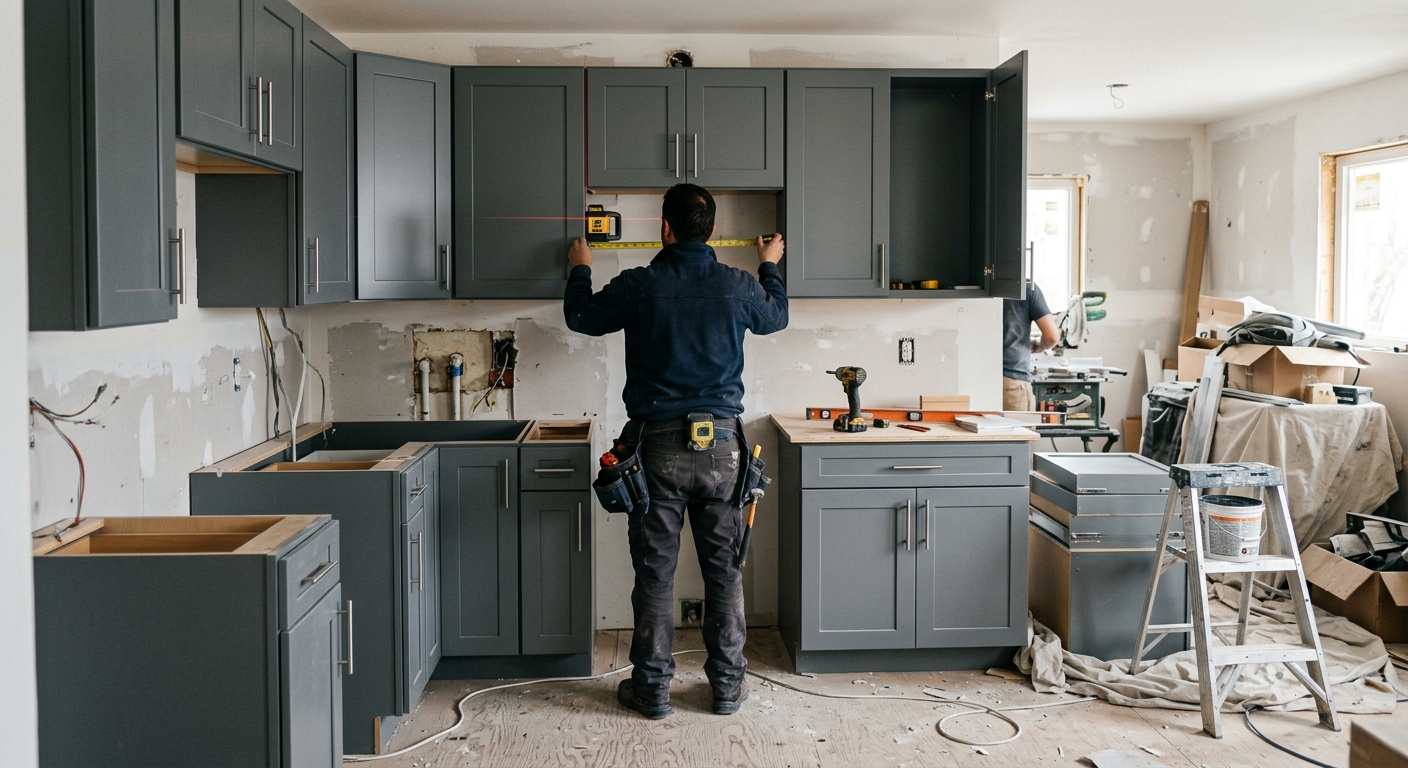
What a kitchen remodel costs in Bangor
Bangor homeowners considering a kitchen renovation are working with homes where 62.3% are owner-occupied and the median household income is $51,578 (U.S. Census Bureau, ACS 2024). That means most projects here are motivated by long-term use and improving livability, not flipping or high-end investment. The vast majority of homes—94.8%—were built before 1980, so it’s common to encounter layouts designed for how families lived decades ago. You’ll see more 1950s and 60s galleys needing walls moved or electrical rerouted than late-1990s open kitchens that just want new surfaces.
Most blown budgets happen when homeowners hear the price for a cabinet-only job, then chase the look of a full gut or add in a layout change. Decide now: is this a pull-and-replace, or are you moving the sink and stove? Swapping cabinets alone is much less disruptive—both to your wallet and your plans—than reconfiguring the entire room.
| Scope |
What's included |
Duration |
Price range |
| Full gut remodel, same layout |
cabinets, counters, appliances, flooring, lighting, fixtures |
6–10 weeks |
$29,000–$115,000 |
| Gut plus layout change |
all of the above plus moved plumbing, electrical, walls |
10–16 weeks |
$62,500–$115,000 |
| Cabinet replacement (stock to semi-custom) |
remove and install cabinets, hardware, patching |
1–3 weeks |
$6,700–$29,000 |
| Cabinet refacing |
new doors and drawer fronts, veneer, hardware |
3–6 days |
$6,700–$19,000 |
| Countertop replacement only |
template, fabricate, install, reconnect sink |
1–3 weeks |
$3,800–$15,500 |
| Kitchen flooring only |
remove existing, install new flooring |
3–6 days |
$4,800–$19,000 |
Estimates for a typical Bangor kitchen. Cabinet grade and whether the layout changes move these figures more than square footage.
Surprises in an older Bangor home
In Bangor and the rest of Northampton County, it’s not unusual to see kitchen walls opened for the first time since Eisenhower was president. Since nearly 95% of homes here were built before 1980 (U.S. Census Bureau, ACS 2024), the odds are good you’ll encounter a surprise or two once demolition begins. Cabinets might stand out of plumb by an inch from worn floors, making installation a test of patience and careful shimming, adding several hours or even days of labor. Electrical surprises are common—old ungrounded or undersized wiring typically means pulling new circuits, which runs $2,000–$4,000 more in rewiring if you’re already opening up walls.
Plumbing can be another budget creep: galvanized supply lines or old cast iron drains will need replacement once exposed, adding $1,000–$3,000 depending on access. No insulation in the exterior walls? Adding spray foam or batt can add $500–$1,500. Previous unpermitted work, like odd plumbing reroutes behind cabinets, isn’t rare and can force you into further repairs. If your home is pre-1978—a real possibility here—federal law requires lead-safe work practices during renovation. Reputable crews will test for lead paint before disturbing painted surfaces. Asbestos in old floor tiles or adhesives gets handled the same way: test first, don’t just demo and hope for the best.
In newer homes, issues shift to builder-grade shortcuts—cabinet boxes that give out all at once in their third decade, laminate counters swelling at seams, or circuit counts too low for today’s code. Whether old or simply outdated, budget at least a 10% contingency for Bangor’s hidden issues.
Four kinds of kitchen project, four budgets
Homeowners in Bangor ask for a "kitchen remodel," but that phrase can mean four entirely different things—each with its own price band and level of disruption. Start by getting clear on which tier you’re really looking for:
- Cosmetic refresh: New paint, hardware swap, simple backsplash, maybe some new lighting. Cabinets and layout stay right where they are. This is what landlords and handy owners do to give a tired kitchen a shot in the arm for $3,000–$8,000.
- Pull and replace: Cabinets and counters are swapped for new, but plumbing and electrical stay put. No walls are opened unless there’s a major issue behind them. Expect a project in the $6,700–$29,000 range here. It’s the most common Bangor upgrade due to so many midcentury layouts.
- Gut, same layout: Everything is taken down to the studs: new electrical, plumbing, insulation, ventilation. No walls are moved, but you’re getting a modern kitchen behind historic shell. Figure $29,000–$115,000, depending on finishes and appliance selection.
- Layout change: Walls are moved, plumbing is relocated, and everything is fair game. This is the most expensive and disruptive—if you’re moving the range or sink, expect permits, plan reviews, and skilled subtrades. The jump from “gut, same layout” to “move things around” is not small: costs start at $62,500 and stretch to $115,000.
The hardest truth is that moving a sink or wall means you’ve crossed into the high-price tier with little chance of a shortcut. Decide which tier fits your needs before calling contractors—nobody can give you a meaningful price without a clear scope on these terms.
Choosing a countertop for a Bangor kitchen
Countertop decisions for Bangor kitchens should start with maintenance, durability, and repair—not just color swatches. Quartz is a standout for busy homes: it’s non-porous and shrugs off stains, but doesn’t like hot pans (thermal shock can crack it). Granite, natural and unique, must be sealed every year or two to repel stains, but shrugs off heat better than quartz. Laminate counters have outperformed their reputation for decades and are often the right pick in a modest kitchen or rental—they resist stains, wipe up easily, and replacing the top later is straightforward at $3,800–$8,000.
Butcher block delivers warmth and repairability but demands constant care: regular oiling and quick cleanups. Solid surface (like Corian) can be seamlessly repaired after a gouge or burn, making it an option for cooks who are hard on their counters. Seam placement matters—most Bangor kitchens are compact, so a good fabricator will template in person rather than measuring from a drawing to get you the cleanest run.
Price depends on edge profile (complex shapes cost more), number of sink cutouts, and if the installer needs to make on-site tweaks for out-of-square walls (common in pre-1940 homes here). Don’t dismiss laminate; for many Bangor homes, it’s not a compromise, just a practical choice where water, sharp knives, and coffee stains are daily facts of life.
Living through a kitchen renovation
Most Bangor homeowners know to expect dust, but few understand how disruptive a full kitchen project really is. The first step is setting up a temporary kitchen: move your fridge to the dining room, set up a microwave and kettle on a folding table, and be prepared to use a laundry or bathroom sink for dishes. Stock up on paper plates—the food budget almost always jumps. Eating out for eight weeks can cost as much or more than new flooring ($4,800–$19,000), so build that into your plan.
Expect significant dust, especially in older homes where plaster and demoed tile release more debris. Good contractors use plastic sheeting and zip walls to contain mess, but some dust still escapes. Figure out where the crew will stage materials and place their dumpster—driveways in Bangor can be tight, and street permits may be needed. Pets are another consideration: with doors open and paths through the house, it’s safer to keep animals elsewhere during demolition or painting. Leaving for the first week isn’t a bad idea if you’re especially sensitive to noise or disruption.
Finally, talk with your contractor about daily cleanup expectations and access hours up front. You’ll appreciate clarity when the crew is there at 7 a.m. and the smell of demo sticks around for days.
What requires a permit in a kitchen renovation
In Bangor and across Northampton County, whether your kitchen project needs a permit comes down to what you’re changing. Cosmetic work—repainting, cabinet refacing, and swapping a countertop in place—rarely requires any permit. But if your project involves moving or adding electrical circuits, plumbing lines, or making structural changes, permits are standard across the region. For instance, in Bethlehem, building permits and plan review are required for kitchen remodels that move walls or add electrical circuits.
In contrast, simply replacing cabinets without altering the kitchen’s basic layout is often done without a permit in Easton. Still, if you’re adding a new range hood duct, bumping out a wall, or moving a sink, expect to apply for permits and schedule inspections—especially if you’re in one of the larger townships with a dedicated code office.
Electrical inspections in certain nearby municipalities, like Bethlehem, are handled by the municipal code inspectors themselves, not outsourced to third parties. Contractor registration is required for projects over $500: everyone working in your home should have current Home Improvement Contractor (HIC) registration from the Pennsylvania Office of Attorney General, which you can verify at hic.attorneygeneral.gov. For workers' compensation, checks are done via WCAIS at wcais.pa.gov. Unpermitted work is the detail that catches homeowners at resale—lenders and buyers can and do ask for evidence of permitted, inspected work for new kitchens.
Cabinets are the critical path
For Bangor kitchen remodels, the speed of the entire job usually comes down to cabinetry. Here’s why: Once you approve a design, cabinets are ordered—lead times typically run three to eight weeks, sometimes more if you want painted or semi-custom options. Demolition and rough work (for electric and plumbing) often take a week or two, but cabinets must be on site and ready before most other work continues.
The sequence goes: design and measurement, cabinet order (wait), demolition, rough-ins and inspections, cabinet installation, then and only then can the countertop fabricator come to template the tops. They can’t work from the plan alone—cabinets must be perfectly in place for measuring. This means there’s always a dead period after cabinets are set: at least a week, often longer, for the countertop to be templated, fabricated, and installed. After counters arrive, final electrical, backsplash, trim, and flooring follow quickly—barring surprises.
Contractors covering Bangor work across the Lehigh Valley, where fewer dedicated remodelers than nearby Allentown means you may wait longer for finish trades. The most common timeline miss is a cabinet order made after demolition, not before, leaving you weeks without a kitchen. Always order cabinets—and verify the lead time—before anything comes out. Organizing delivery and inspection ahead saves headaches down the line.
Frequently asked questions — kitchen renovation in Bangor
Should I order cabinets before demolition?
Cabinets for a Bangor kitchen should always be ordered before demolition starts. Most homes in town have layouts built before modern cabinet dimensions became standard, and lead times for delivery routinely run three to eight weeks—sometimes longer if you’re after a painted or upgraded finish. Starting demo first means you could be living in a construction zone for months, especially if the cabinets arrive late or damaged. Coordinating storage or arranging delivery as close as possible to install date keeps your project moving smoothly. You can do the tear-out in the week before cabinet arrival, but waiting to order is a classic reason kitchen remodels in Northampton County unexpectedly stretch from 4 to 12 weeks. A standard cabinet replacement here runs $6,700–$29,000; don’t extend that pain by delaying your order.
How should renovation payments be scheduled?
In Pennsylvania, including Bangor, state law requires a written contract for renovations over $500, with clear payment terms. Most reputable contractors set up progress payments: a deposit at contract (often 20–30%), another payment when materials such as cabinets are delivered or install begins, and the remainder at completion or after punch-list items are addressed. Never pay more than one-third up front—state rules are designed to protect you. For a typical full kitchen gut remodel in Bangor, you’d see a schedule with each payment tied to milestones within the scope of $29,000–$115,000. Don’t pay in full until you’re satisfied with the work and your final inspection (if required by your township) is complete. Clarify this before work starts. Lopsided payment requests or unclear terms are red flags.
What flooring works best in a kitchen?
Kitchens in Bangor see a mix of vinyl plank, tile, and wood flooring depending on the age and style of the home. For the older housing stock here, prefinished hardwood or quality luxury vinyl plank (LVP) functions well—they’re durable, easy to clean, and forgiving of imperfect subfloors typical in pre-1980 homes. Tile is ideal near sink zones but can feel cold except in newer builds. Sheet vinyl still holds up in rentals and gets overlooked for its practicality. Expect to spend $4,800–$19,000 for a professionally installed kitchen floor in Bangor. Check that the installer preps for level and moisture, since uneven old floors are a recurring issue here. Choose flooring that won’t swell if the fridge leaks and is simple to patch if needed.
Who inspects kitchen electrical work in Bangor?
Electrical inspections in Bangor are handled at the municipal level, similar to Bethlehem, where the City Bureau of Code Enforcement has its own inspectors. So if your renovation involves new circuits, rewiring, or moving outlets, the electrical work will be inspected by the local code office—not a third-party agency. This matters: municipal inspectors will expect work to follow the Pennsylvania Uniform Construction Code. Make sure your contractor is familiar with the documentation and scheduling process. For a remodel involving new wiring—a typical case in homes built before 1980—you’re adding both direct costs (permitting, hourly rate) and time to the process. For example, full gut remodels, which almost always need inspection, are in the $29,000–$115,000 range for Bangor.
What is a realistic contingency for a Bangor kitchen?
For Bangor homes, especially those built before 1980 (which is nearly all of them per local data), a 10–20% contingency built into your kitchen project is smart planning. Unforeseen issues come up routinely—think unexpected wiring, out-of-level floors, plumbing lines in the wrong place, or hidden water damage. If your initial budget for a cabinet replacement or midtier renovation is $19,000, adding $1,900–$3,800 as a reserve helps you avoid panic when—inevitably—something is uncovered. Older construction in Bangor lacks documentation, so even the best contractors can’t estimate perfectly without some margin for surprises. No one likes spending extra, but it’s better than cutting corners or halting work half-finished.
What adds the most resale value in a kitchen?
In Bangor, a quality kitchen remodel that respects the age and bones of the house adds the most value—think pull-and-replace jobs with updated cabinets, modern counters, and efficient lighting. The local market, with its high rate of older homes (94.8% pre-1980), favors updates that fix functional flow and upgrade key surfaces without unnecessary luxury. Buyers respond best to kitchens that are bright, easy to clean, and feel move-in ready, which can mean a new cabinet and counter package in the $6,700–$29,000 range. Full layout changes rarely recoup their added expense unless the old plan was truly dysfunctional. Neutral finishes, quality hardware, and attention to lighting pay off more than top-end appliances.
How much does a kitchen renovation cost in Bangor?
Kitchen renovation in Bangor covers a wide range, but most homeowners should plan based on the full gut remodel range of $29,000–$115,000, with a midrange project typically around $62,500. Simpler cabinet replacements or refacing jobs range from $6,700–$29,000. The older housing stock—almost all built before 1980—sometimes pushes costs higher, as unexpected repairs or code requirements pop up after demolition. Costs are also higher if you want a layout change, since moving the sink, electrical, or knocking down a wall puts you at the top of the band. The main driver of your cost is scope—decide early whether you need a layout change or can work within the current footprint.
How does Bangor's housing stock affect cabinet fit?
Bangor’s housing stock, with 94.8% built before 1980, makes kitchen cabinet installation trickier than in newer subdivisions. Older homes often have out-of-square rooms, uneven floors, and odd soffit heights, so off-the-shelf cabinets don’t always drop in. Skilled installers often need to shim, scribe, or custom-cut cabinets to fit—sometimes stretching the install from two days to more than a week. This extra labor is reflected in the price, so a cabinet replacement here can run $6,700–$29,000 depending on how much retrofitting is needed. During planning, have your contractor measure carefully—including wall plumb and floor level—to avoid late surprises and rushed fixes.
Do I need to change my kitchen layout?
Most Bangor kitchens can benefit from a layout shift if you’re living with a tight 1950s galley or an awkward workspace enforced by old wall construction—but you rarely need to move walls. Typically, new cabinets and counters in the same footprint—costing $6,700–$29,000—deliver a dramatic upgrade without the hassle and expense of gutting or moving plumbing. However, if you’re tripping over the fridge or lacking counter space for a real cook’s kitchen, a redesign may be justified. Remember, altering the layout triggers permits, plan review, and sharply higher budgets. Get a few designs to compare before making the call; sometimes, adjusting the storage or lighting gives 90% of the benefit without a five-figure upcharge.