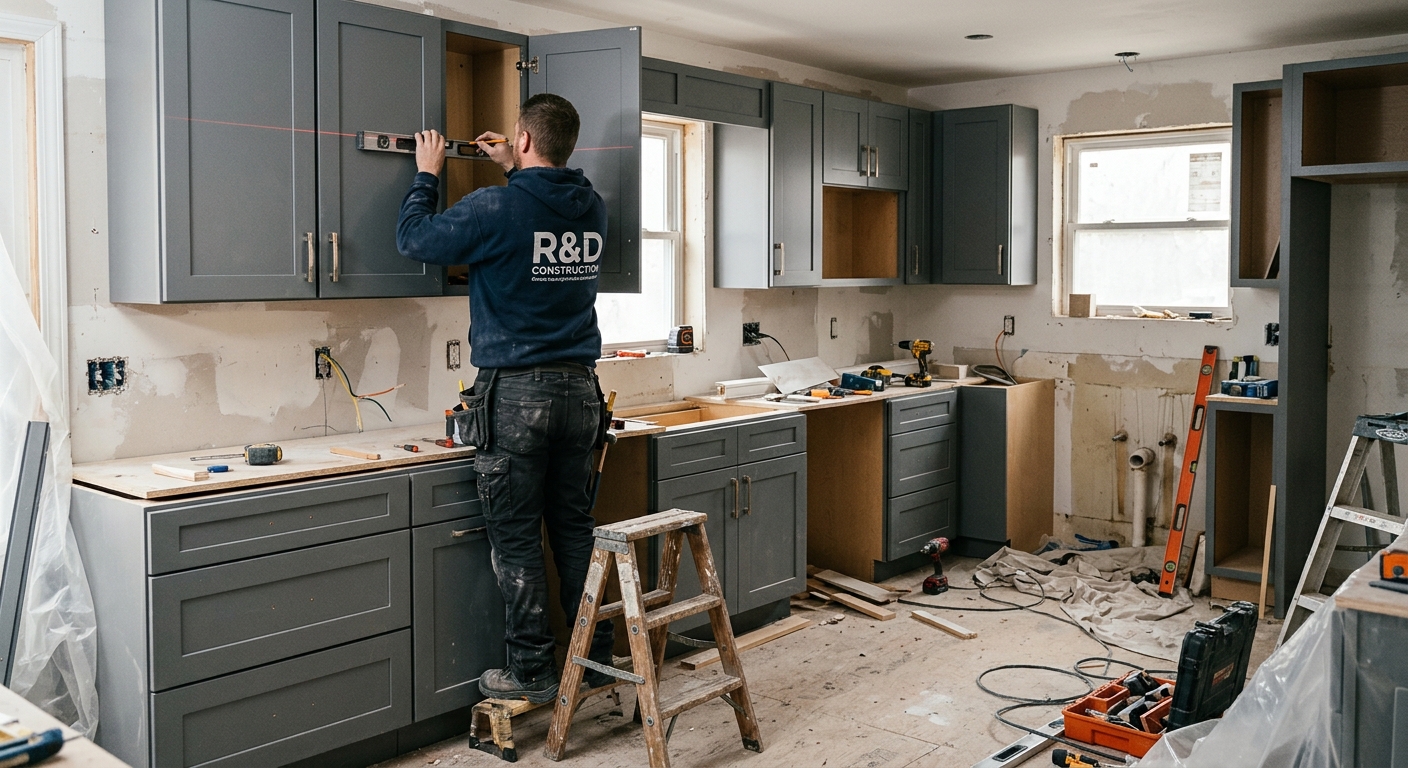
What a kitchen remodel costs in East Marlborough
Kitchen renovation projects in East Marlborough are shaped by a high homeownership rate and substantial median incomes, with many owners willing to invest in long-term improvements. With a 91.4% homeownership rate and a median household income of $144,515 (U.S. Census Bureau, ACS 2024), owners here tend to budget for kitchens that match both neighborhood standards and home values. A significant number of homes in the borough and surrounding towns are from the 1960s through 1980s, meaning projects often involve modernizing outdated layouts instead of simply replacing finishes. If your goal is to open a closed galley or move plumbing fixtures, expect costs at the higher end of the range. In contrast, late-80s homes often only need surface updates, saving thousands.
Most blown budgets in East Marlborough start with pricing a basic replacement and then adding scope: moving a wall, upgrading all appliances, or specifying custom everything. The numbers below give East Marlborough homeowners a clear look at what can be done within each band. The table focuses on typical durations and what’s realistically included — not national averages, but what gets built in Chester County today.
| Scope |
What's included |
Duration |
Price range |
| Full gut remodel, same layout |
cabinets, counters, appliances, flooring, lighting, fixtures |
6–10 weeks |
$36,500–$145,000 |
| Gut plus layout change |
all of the above plus moved plumbing, electrical, walls |
10–16 weeks |
$78,500–$145,000 |
| Cabinet replacement (stock to semi-custom) |
remove and install cabinets, hardware, patching |
1–3 weeks |
$8,500–$36,500 |
| Cabinet refacing |
new doors and drawer fronts, veneer, hardware |
3–6 days |
$8,500–$24,000 |
| Countertop replacement only |
template, fabricate, install, reconnect sink |
1–3 weeks |
$4,800–$19,500 |
| Kitchen flooring only |
remove existing, install new flooring |
3–6 days |
$6,000–$24,000 |
Estimates for a typical East Marlborough kitchen. Cabinet grade and whether the layout changes move these figures more than square footage.
What moving the sink really costs
The biggest budget leap in an East Marlborough kitchen remodel comes when you move utilities — especially the sink or range — away from their current location. Keeping plumbing and electrical in their existing places keeps you in the $36,500–$145,000 basic gut band; as soon as you move them, you enter the much steeper $78,500–$145,000 category that covers both gut and layout changes. The added dollars do not scale proportionally with distance. Moving a sink just four feet can require reworking drain lines, which must stay sloped and often run under slab floors or above finished ceilings, making even short moves surprisingly expensive.
Electrical relocations bring their own costs — new circuits mean you’ll need to check for main panel capacity, and in older East Marlborough homes, panels are often maxed out. Range hoods that get relocated need new vent penetrations, not just ductwork. If you remove or move a wall, you must determine if it’s load-bearing, requiring an engineer and a permit. In West Chester, permits are triggered any time you relocate a wall or install new electrical circuits as part of a kitchen renovation.
My best advice: be very honest about whether the layout is unworkable or just dated. Many Chester County owners regret spending tens of thousands on mechanical moves that gave them a little more counter space. Unless you truly need the change, keeping everything where it is will save you tens of thousands compared to moving utilities.
Code requirements for East Marlborough kitchens
Most kitchen upgrades in East Marlborough that are limited to cosmetic work — like painting, refacing cabinets, or swapping out a countertop without moving the sink — typically do not require a permit. However, as soon as you plan to run new electrical circuits, move plumbing, or alter a wall structure, a permit process is triggered under the Pennsylvania Uniform Construction Code (UCC), enforced by your local municipality or possibly the PA Department of Labor & Industry if the township has opted out. In West Chester Borough, plan review is required for remodels that alter structural elements or mechanical, electrical, and plumbing systems.
Electrical inspections are often conducted by third-party agencies such as United Inspection Agency, not the township directly, which is a surprise for many owners. This means scheduling and passing inspections aligns with their availability, not just your contractor’s.
For projects over $500, your contractor must carry Home Improvement Contractor registration, which you can verify at hic.attorneygeneral.gov, and they must maintain workers’ compensation insurance — check this through the WCAIS system. If your home was built before 1978, only hire contractors certified under the EPA Lead RRP Rule if paint disturbance is involved.
Unpermitted work can complicate resale in Chester County; buyers and their agents will look for evidence of proper permits when renovations are apparent, and insurance claims may be denied if unpermitted or uncertified electrical work leads to damage.
Three ways to organise the project
The way you organize your kitchen renovation in East Marlborough shapes your experience more than your tile or counter choice. The design-build route means a single firm handles layout, cabinetry, construction, and coordination — this is by far the easiest route for the homeowner, with the highest cost, but a single point of accountability. You work with one contract and timeline, and typically see far fewer surprises, but pay a premium.
The second option is hiring a general contractor: you (or a hired designer) plan the kitchen and select materials, while the GC pulls permits and manages trades. This is a middle road for both budget and stress. You retain some control over selections and costs but must be available for timely decisions to keep things moving.
The least expensive, and by far the most demanding, is owner-managed renovation: you hire all the trades, sequence the work, handle permits, and resolve any scheduling failures. In Chester County, where kitchen-trade labor is expensive and tightly scheduled due to contractor density, this route can become a full-time job. Anyone with a demanding job or limited renovation experience should not self-manage a project involving layout changes or new utility work.
Comparing kitchen renovation bids in East Marlborough
Comparing kitchen bids in East Marlborough homeowners often find that two proposals with similar bottom lines can differ by tens of thousands once the work starts — and the culprit is usually the allowances. Allowances are essentially placeholder budgets for items you haven’t selected yet, like tile, lighting, or appliances. One contractor might carry a $2,000 tile allowance, while another lists $500, making totals misleading until selections are made.
Always scrutinize the allowances section before comparing totals. The details also matter: insist on a named cabinet brand and series, specific countertop materials and thickness, written protocols for handling unforeseen site conditions, and a change order process requiring your written approval. Payment schedules should be milestone-based, not just by date, with reasonable deposits — and lien waivers from subcontractors at each payment stage protect you from future claims.
Pennsylvania’s Home Improvement Consumer Protection Act requires a written contract for work over $500 and grants you a 3-business-day right of cancellation. Insist on these protections before work begins.
| Line item |
What to look for |
Red flag if… |
| Allowances |
realistic amounts, itemised |
round numbers with no basis |
| Cabinetry |
brand, line, box construction |
'quality cabinets' |
| Countertops |
material, thickness, edge, seams |
material name only |
| Electrical |
circuits to be added, GFCI scope |
'as needed' |
| Unforeseen conditions |
how they are priced and approved |
not addressed |
| Change orders |
written approval before work |
verbal |
| Payment |
milestone-based, modest deposit |
front-loaded |
| Lien waivers |
from subs at each payment |
not offered |
Countertop materials compared
Countertop selection in East Marlborough kitchens should be driven less by looks and more by how the counter will handle everyday abuse. Quartz counters are engineered and non-porous — they handle stains and spills beautifully, but can discolor if you set a hot pan directly on them. Granite offers the appeal of natural stone and is heat-tolerant, but does require sealing every year or two to avoid stains. Laminate, often dismissed, deserves real consideration: it stands up well to knocks and, in rentals or modest kitchens, is a sensible choice at a fraction of the price, with modern visuals far ahead of what you may remember from old installations.
Butcher block brings warmth and a forgiving work surface, but demands regular oiling and is susceptible to both cuts and standing water. Solid surface counters (like Corian) are less trendy but can be refinished to remove scratches and are seamless for integral sinks.
Fabrication and installation cost swings come from your choices: complex edge profiles, multiple cutouts for sinks/cooktops, and where seams fall (the more inconspicuous, the pricier the job). Installing stone or quartz always starts with a physical template, not just a tape measure — that template determines precise fabrication and sets your real project schedule.
Where the money actually goes
In a typical full kitchen gut remodel in East Marlborough — cost band $36,500–$145,000 — cabinetry is consistently the single largest budget item, often accounting for nearly a third of total spend. Labor follows closely, especially if your project involves moving walls or utilities in these older 1960s–1980s homes. Countertops, appliances, and flooring typically absorb the next biggest shares, with lighting, plumbing fixtures, and minor items rounding out the construction costs.
Two lines that seldom appear in early budgets but always matter here: a contingency fund (for surprises inside your walls, especially in pre-1980 houses) and the soft costs — permits, design, delivery, and disposal. These add up quickly and are rarely optional.
If you’re deciding where to invest an extra thousand dollars, it will show in longer-lasting cabinetry or better lighting — not a fancier faucet or a pro-grade range unless your cabinets and counters are already high-quality. In this market, spending $7,300–$14,500 more on true custom cabinets makes a visible impact; spending the same on a signature appliance in a kitchen with basic cabinets is money wasted.
| Category |
Share of budget |
Notes |
| Cabinetry |
25–35% |
the largest line and the longest lead time |
| Labour and installation |
20–30% |
rises sharply if the layout changes |
| Countertops |
8–15% |
material choice drives the swing |
| Appliances |
10–20% |
widest range of any category |
| Flooring |
5–10% |
|
| Lighting and electrical |
5–10% |
higher in older homes needing circuits |
| Plumbing and fixtures |
4–8% |
|
| Permits, design, disposal |
3–6% |
usually forgotten in early budgets |
| Contingency |
10–15% |
not optional in a pre-1980 house |
Frequently asked questions — kitchen renovation in East Marlborough
Is a cosmetic refresh enough or do I need a gut remodel?
In East Marlborough, a cosmetic kitchen refresh — cabinet painting or refacing, new counters or hardware — is often enough if your existing layout works and the cabinets are structurally sound. Many homeowners in the area, especially with 1980s homes, choose this route because it keeps the project well below the $36,500 entry point for a full gut remodel. However, if your kitchen is from the 1960s or earlier and still has the original footprint (narrow doors, boxed-in galleys), a gut remodel may be the only way to get the layout, storage, lighting, and code-required updates you truly want. The decision is usually less about appearance and more about function: if it’s hard to entertain, cook, or use the space daily, a deeper renovation is usually justified. Test your cabinets — if boxes are solid and there’s enough lighting, a refresh saves tens of thousands.
What flooring works best in a kitchen?
For East Marlborough kitchens, flooring needs to balance moisture resistance, durability, and style. Tile remains the most bombproof for spills and pets, but it’s cold on winter mornings — many Chester County homes now specify luxury vinyl plank (LVP) because it resists water, can mimic hardwood or tile, and is easier underfoot. Engineered hardwood is common in open-plan layouts and holds up better than solid wood to humidity swings and spills, though dropping a pan can dent it. Budget runs from $6,000–$24,000 depending on material and kitchen size. For modest budgets, sheet vinyl is still a sensible option and can look credible in a well-kept rental or smaller home. The bottom line: moisture and slip resistance matter most, but don’t pick the hardest surface if you stand for hours cooking.
How should renovation payments be scheduled?
In Pennsylvania and specifically for East Marlborough projects, payments for kitchen renovations should always be tied to clear, project milestones, not to calendar dates. For a gut remodel in the $36,500–$145,000 range, a standard payment schedule would look like a modest deposit at contract signing (often 10%), with additional draws released only as defined stages are completed — after demolition, upon cabinet delivery and install, after counters are in, and then at final punch list. This protects both homeowner and contractor, ensuring you aren’t exposed for more than the work completed. Lump-sum, front-loaded, or “weekly” schedules heavily favor the contractor and put your money at risk. Always insist on an itemized schedule in your written contract and keep a hold-back for final acceptance (usually 5–10%).
Should I order cabinets before demolition?
For East Marlborough kitchens, do not place a cabinet order until the contractor has done site verification, demolition is scheduled, and critical dimensions have been confirmed — especially in pre-1980 homes, where walls often aren’t square and previous work can leave surprises. Cabinet lead times can run six to twelve weeks in Chester County, and receiving them too early risks damage or loss of manufacturer coverage. However, waiting until demo is fully finished risks pushing your timeline by weeks. The right approach is to confirm final measurements after mechanical rough-ins are planned but before teardown starts, with your contractor’s direct involvement. This helps you stay on schedule for a gut remodel (at $36,500–$145,000) without storing expensive inventory onsite unnecessarily.
Should I renovate before selling or let the buyer do it?
In East Marlborough, renovation before sale depends on your home’s baseline: if the kitchen is outdated but functional and you’re in a seller’s market, you may get a faster sale and a strong price by just updating surfaces for well below $24,000. If the kitchen truly needs a gut remodel to bring it in line with other homes in the area, buyers here — especially at the median income and homeownership rate — may expect a move-in-ready kitchen and discount hard for outdated layouts. That said, investing in a high-end gut or layout change remodel rarely returns dollar-for-dollar at closing, and you may be better off pricing aggressively and letting new owners choose their layout. Cosmetic improvements generally get the best return if done thoughtfully and cost-effectively.
Does replacing cabinets require a permit?
In East Marlborough townships, simply replacing cabinets in the same location, without changing plumbing, electrical, or walls, does not typically require a permit. In West Chester and Tredyffrin, cabinet door refacing with no layout or utility changes is also permit-exempt. However, if you touch electrical or move plumbing fixtures as part of the cabinet replacement, or knock down a wall, you will trigger permitting requirements under the Pennsylvania Uniform Construction Code. For a straightforward cabinet swap in the standard $8,500–$36,500 Chester County range, you usually proceed without municipal review, but always verify with your local code office early.
Do older East Marlborough homes need electrical upgrades for a kitchen?
Many homes built in and before the 1980s in East Marlborough do require electrical upgrades for a full kitchen remodel. These houses often have limited panel capacity, fewer circuits, and outlets that don't meet modern code — adding appliances or reconfiguring layouts nearly always means adding new circuits, GFCI protection, and tamper-resistant outlets. In West Chester, permits are required for new circuits. For any significant remodel (in the $36,500–$145,000 bracket), a qualified electrician will typically assess your main panel and service size; upgrades might be necessary to handle today’s appliances and code requirements. Skipping this step isn’t recommended, as unprotected circuits can be both a code and insurance issue at resale.
How much do new kitchen cabinets cost in East Marlborough?
For homeowners in East Marlborough, replacing kitchen cabinets with stock to semi-custom units runs from $8,500–$36,500, with typical installs around $24,000. This band covers removal, disposal, new cabinet boxes, doors, and basic finishing carpentry. If you step into custom cabinetry or demand intricate details, the price can rise close to the upper end of the range. Lead times are also a factor — better cabinets take longer. Most Chester County projects fall in the mid to high end of this range, reflecting both the area’s labor rates and owner expectations. If your current cabinets are sturdy, refacing (new doors and veneer) can be a worthwhile alternative, usually saving a few thousand.
What does a full gut kitchen remodel cost in East Marlborough?
A full gut kitchen remodel in East Marlborough costs between $36,500–$145,000, with most typical jobs closing near $78,500. The wide range reflects choices: keeping your existing layout can keep costs at the lower end, while moving walls, adding high-end appliances, or splurging on stone and custom cabinetry quickly moves you up the band. Chester County’s labor market, with its high contractor density and tight finish-trade labor pool, drives prices above what you’ll see in much of central Pennsylvania. If you’re eyeing a full gut for a 1960s–1980s home, consider whether you truly need layout changes — those alone can double the electrical, plumbing, and finish costs. Always plan for a contingency, especially for older homes, as surprises are routine once walls come down.