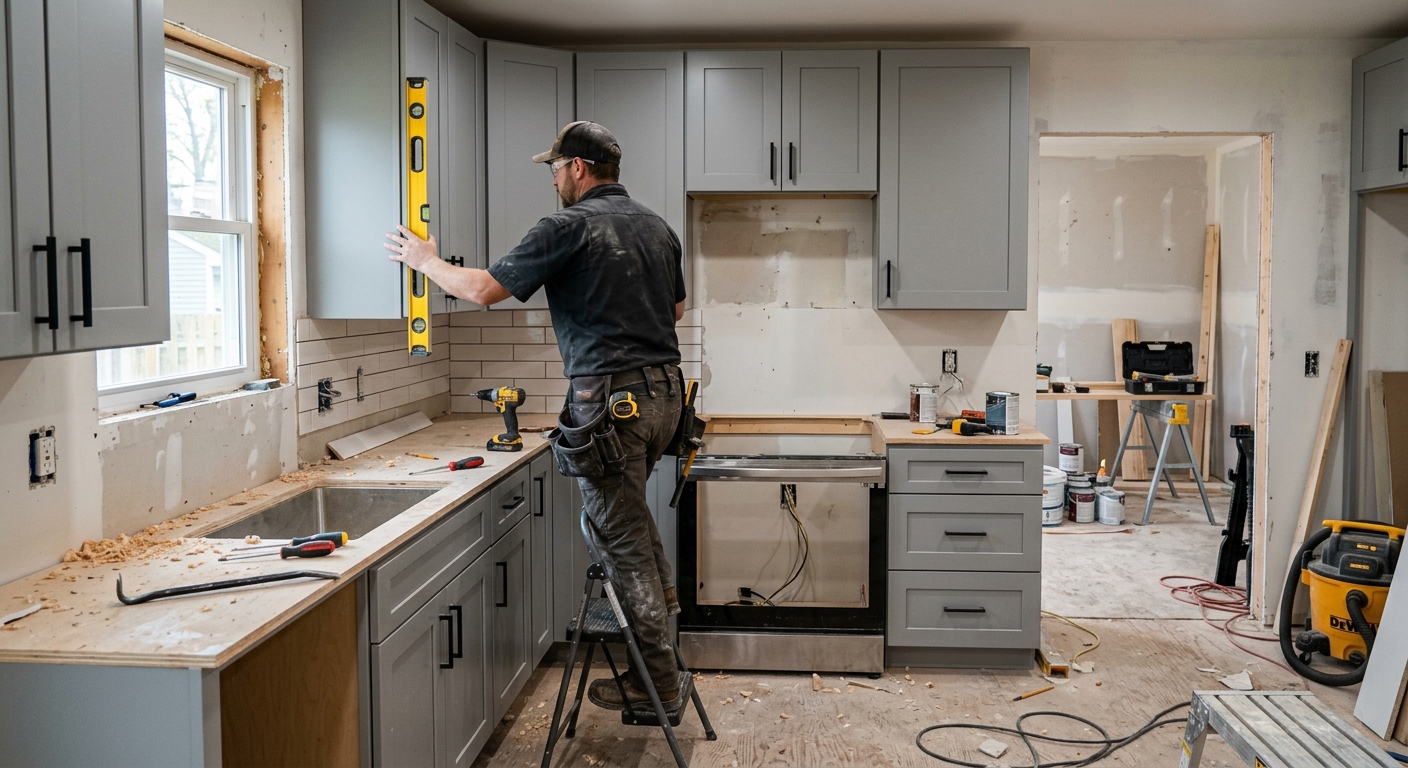
Kitchen renovation costs in Harrison — 2026
The cost to renovate a kitchen in Harrison spans a wide range, shaped by both your goals and the character of homes here. With a median household income of $61,879 and a homeownership rate of 73.9% (U.S. Census Bureau, ACS 2024), kitchen renovation is common—especially for owners looking to modernize old, compartmentalized layouts. Homes in and around Pittsburgh skew older: over 85% were built before 1980, so it's normal for gut renovations to reconfigure chopped-up kitchens into more open and functional spaces. In newer housing, finishes and fixtures tend to age out together, but less often require tearing down walls.
The biggest budget surprises happen when owners plan upgrades based on one scope but end up getting sold on a higher one. For example, you might start thinking about cabinet refacing but end up gutting and moving walls. Scope defines cost here more than anything: cosmetic changes are far less expensive than full gut remodels, and moving infrastructure like plumbing is a big jump.
| Scope |
What's included |
Duration |
Price range |
| Full gut remodel, same layout |
cabinets, counters, appliances, flooring, lighting, fixtures |
6–10 weeks |
$28,000–$113,000 |
| Gut plus layout change |
all of the above plus moved plumbing, electrical, walls |
10–16 weeks |
$61,000–$113,000 |
| Cabinet replacement (stock to semi-custom) |
remove and install cabinets, hardware, patching |
1–3 weeks |
$6,600–$28,000 |
| Cabinet refacing |
new doors and drawer fronts, veneer, hardware |
3–6 days |
$6,600–$19,000 |
| Countertop replacement only |
template, fabricate, install, reconnect sink |
1–3 weeks |
$3,800–$15,000 |
| Kitchen flooring only |
remove existing, install new flooring |
3–6 days |
$4,700–$19,000 |
Estimates for a typical Harrison kitchen. Cabinet grade and whether the layout changes move these figures more than square footage.
Surprises in an older Harrison home
If your house in Harrison was built before 1980—and chances are high, given that 85.5% of homes fit this (U.S. Census Bureau, ACS 2024)—expect a few unwelcome kitchen surprises once demolition starts. Out-of-plumb and out-of-level walls are routine in these older homes, making every new cabinet install a hands-on shimming job and sometimes requiring carpentry to get things square. Electric wiring is often ungrounded or undersized compared to today’s codes, so rewiring a kitchen typically adds $4,000–$8,500, depending on circuit count and access. Plumbing surprises include galvanized water lines and cast iron drains—both prone to corrosion and replacement cost around $2,500–$7,000 if exposed during renovation. An exterior wall without insulation is common pre-1970, adding cost if you’re gutting down to studs.
Previous unpermitted remodels are surprisingly common. Good contractors flag and correct these, but if left, they can hold up sales or insurance claims later. Lead paint is present in most homes built before 1978; under the EPA Lead RRP Rule, certified renovators test before disturbance and follow abatement protocols if lead is found. Suspect vinyl/asbestos tile in kitchens from the 1950s and 60s, but full abatement is rare unless the original is disturbed.
If you’re in one of Harrison's newer subdivisions, you’re more likely to run into builder-grade particleboard cabinets at end of life, limited circuits that won’t handle modern appliances, or laminate counters all reaching replacement age together. While not as dramatic as plumbing surprises, these still mean a kitchen update is likely warranted.
Choosing cabinetry
Cabinetry accounts for the largest single line on almost every Harrison kitchen quote. It’s also where owner decisions drive the biggest gap between planned and actual budget. Refacing swaps in new doors, drawer fronts, and veneer panels while keeping the existing cabinet boxes—so it’s dramatically less expensive than full replacement at $6,600–$19,000, but only worth considering if the boxes are sturdy, truly square, and you’re happy with the current layout.
Stock cabinets come in the smallest range of sizes and require filler strips to make up differences when the kitchen dimensions aren’t standard (common in Harrison’s pre-1940 homes). You get what you pay for: fewer finishes, simpler construction. Semi-custom lines let you adjust sizes, depths, and finishes—better for older homes where nothing is square. Custom cabinets are for rethinking layouts or high-end kitchens, let you fit any dimension or creative storage, and carry the longest wait.
Construction quality is just as important as price. Plywood cabinet boxes hold up longer than particleboard in Harrison’s humid, fluctuating seasons. Dovetail drawer joints, full-extension slides, and soft-close hardware make a big difference for daily use, while frameless cabinets (European style) maximize storage but demand precision installation. Face-frame cabinets are more forgiving for uneven walls—again, an edge for our older homes.
| Option |
Cost |
Best when |
Limitation |
| Painting existing cabinets |
$1,200–$3,500 |
boxes and doors sound, tight budget |
no layout or style change |
| Refacing |
$6,600–$19,000 |
boxes square and layout works |
storage unchanged |
| Stock cabinets |
$6,600–$28,000 |
standard dimensions fit |
filler strips, limited finishes |
| Semi-custom |
$19,000–$28,000 |
non-standard walls or finishes |
6–12 week lead time |
| Full custom |
$19,000–$28,000 |
unusual layout or high-end design |
longest lead, highest cost |
Cosmetic, replacement, gut, or layout change?
It’s easy for “kitchen remodel” to mean anything from a new backsplash and paint to tearing out every wall—and price differences run fivefold. Here’s how to think about the tiers in Harrison:
- Cosmetic refresh: Paint cabinets, new pulls, swap lights, tile a backsplash. No cabinet or layout change—quick and modestly priced, but doesn’t change storage or flow.
- Pull and replace: Install new cabinets and counters, but keep everything in the same spot. Plumbing and wiring stay where they are. This is common in Harrison homes already laid out adequately, avoiding permit triggers and heavy trades.
- Gut, same layout: Strip to studs, update everything underground (wiring, plumbing, insulation), but rebuild in the same footprint. This is the default for older houses where wiring is iffy and walls are uneven—it fixes hidden problems but costs more than you might hope.
- Layout change: Move the sink, stove, dishwasher, or knock down a wall. This triggers a building permit and often plan review in Pittsburgh. You’ll pay for engineering, inspections, and substantially more labor, as new plumbing and wiring are routed and must pass code.
The real price “cliff” is between gutting in place and moving layout—going from $28,000–$113,000 to $61,000–$113,000 is typical. Before calling for quotes, decide which tier you’re really aiming for. No contractor can give a firm price until you know if walls or services are moving. It will keep you from getting sold on scope you might not need.
The real timeline for a Harrison kitchen
The single biggest source of frustration in Harrison kitchen renovations is how the schedule actually unfolds versus what people expect. Our market is busy, trades are stretched thin, and cabinet lead times often run 6–12 weeks—especially if you’re going with anything semi-custom to fit non-standard older homes.
Sequencing is everything. Design and field measurement comes first—never skip this step, especially when walls may not be square. Once final specs are locked, you order cabinets before any demolition starts. This way, materials are on site when you’re ready, not stalled in a warehouse. After demolition, rough-in work for new wiring and plumbing is done, then inspected. Only then are cabinets set.
Here’s where most owners are caught by surprise: countertops can’t be templated until all cabinets are 100% installed and checked for level. The template visit happens, and then fabrication (for quartz, granite, solid surface, etc.) takes 1–2 weeks. That’s “dead” time—expect kitchen use to be limited during this wait. Once counters are in, the plumber returns to hook up sinks and appliances, then flooring, tile, and final trim close out the job.
In a dense, high-demand market like Allegheny County, you’ll save weeks of frustration by locking down specs and ordering cabinets as soon as you’ve finalized your plan—not after demolition. It’s a step few people know to push for, but it sets the whole job up for success.
Quartz, granite, laminate or butcher block
Countertop materials in Harrison kitchens are about more than just looks—they drive function, cost, and maintenance for decades. Quartz—engineered stone—is popular for being non-porous, stain resistant, and low maintenance, but set a hot pan down and you can scorch it. Granite brings natural beauty, is highly heat resistant, but does need sealing once a year to stay stain free and resist mildew, especially in corners near sinks.
Laminate has come a long way—modern patterns mimic stone well, and the cost is a fraction of natural or engineered stone. It resists stains and is easy to keep clean but scratches and chips if you’re not careful, and seams can swell if water seeps in. For many rental properties or modest kitchens in Harrison, though, it's a completely reasonable and budget-friendly choice.
Butcher block offers a warm, classic look but is high maintenance: it will scorch, burn, stain from red wine or beets, and needs regular oiling. It is repairable if scratched or gouged, just as solid surface (such as Corian) can be sanded out for major blemishes.
Cost isn’t just about the material. Intricate edge profiles, extra sink cutouts, and difficult seam placements all add labor and dollars. Fabricators measure on site with templates, never just off drawings; this is why countertop lead time always comes after cabinets go in, and why the templating step is mandatory. Plan on $3,800–$15,000 for a quality install in a typical Harrison kitchen, depending on material and complexity.
What requires a permit in a kitchen renovation
Allegheny County’s permit requirements for kitchen work are straightforward, but many Harrison homeowners are caught unaware at resale. Cosmetic changes—painting, new hardware, even countertop replacement on existing cabinets—usually don’t require permits. The line is crossed (especially in Pittsburgh and many boroughs) when you move or add electrical circuits, plumbing, or alter structural walls; any of these trigger a building permit. If you’re knocking out a wall or re-routing the sink, you’ll likely need plan review and official sign-off before the job starts and final inspection when done.
Electrical inspections in Pittsburgh are handled by the city’s permitting authority. In some nearby suburbs, approved third-party agencies do inspections, which can catch homeowners off guard late in the process. For work over $500, Pennsylvania law requires that every contractor hold a Home Improvement Contractor (HIC) registration, listed with the Office of Attorney General, and that all employers carry valid workers’ compensation insurance (verifiable at WCAIS). Always ask contractors for these—both are non-negotiable and protect you legally.
Unpermitted work may seem faster and cheaper, but it usually comes back to bite you. At resale, municipal code departments can demand documentation or even require reopening walls. Spend the money on permits where required; it’s worth it for your investment and peace of mind.
Frequently asked questions — kitchen renovation in Harrison
How much more does moving the sink and range cost?
Relocating a sink or range in a Harrison kitchen is the tipping point between a standard “pull and replace” and a full layout change. This means not just plumbing or gas rerouting, but new electrical and possibly structure/permit requirements. Expect this to add at least $15,000–$40,000 to your overall cost, because you’re now opening walls or floors, hiring licensed trades, and scheduling additional inspections. Many older Harrison homes have plaster walls and out-of-date wiring, so opening things up can reveal even more to update. If your current kitchen functions okay, moving major pieces is usually the one upgrade you cut if you want to control costs.
What is the cheapest way to update a Harrison kitchen?
If you’re focused on spending as little as possible, consider a refresh: painting cabinets, changing hardware, replacing a faucet or light, or updating the backsplash. Most of these upgrades can be done for less than $3,500 total, especially if existing cabinets are sound. In Harrison, where many homes have original cabinetry that’s structurally fine (even if dinged up), you’ll get the biggest visual impact for the least money this way. Painting, for example, won’t change storage or fix flow, but it makes a tired space feel much fresher without requiring permits or full teardown.
How do I verify a kitchen contractor in Pennsylvania?
In Pennsylvania, every contractor doing home improvements over $500 must be registered as a Home Improvement Contractor (HIC) through the Pennsylvania Office of Attorney General. You can look up their registration number at hic.attorneygeneral.gov. For added protection, confirm the contractor’s workers’ compensation insurance through the WCAIS system. In Harrison, these checks matter: saturated demand means some fly-by-night operators chase jobs who may lack proper coverage or registration. Never sign a contract or hand over a deposit until you have confirmation of both. This applies whether your job is a $8,500 countertop swap or a full remodel.
What flooring works best in a kitchen?
In Harrison, kitchens experience freeze-thaw cycles and occasional tracked-in grit from clay soils. Luxury vinyl plank and porcelain tile are both top options—they handle moisture, heavy use, and are easy to clean without warping after dishwasher leaks or winter boots. Hardwood can work but requires extra upkeep and is less forgiving if plumbing fails. Flooring replacement runs from $4,700–$19,000 for a typical kitchen depending on material and prep, so choose durability and repairability over trend—especially in an older home where floors may not be level.
Does a kitchen renovation increase home value in Harrison?
Renovating a kitchen in Harrison often creates strong resale value, especially in homes built before 1980. Local buyers expect updated kitchens, and most realtors in the area confirm they are a focal point at showings. A full gut remodel in Harrison typically runs $28,000–$113,000; you likely won’t recoup every dollar spent at resale, but you’ll find a better buyer pool and faster sale time for a renovated space. Minor cosmetic upgrades in a dated kitchen can also help position your home above the competition, but avoid overspending in smaller or mid-range houses.
Should I order cabinets before demolition?
Yes, especially in Harrison, where lead times for semi-custom or custom cabinets can run six weeks or more. Because so many homes here have odd wall dimensions and unlevel floors, you’ll need on-site measurement to finalize sizes—and ordering before demolition keeps your project moving. If you wait until after demo to order, you’ll likely be kitchen-less for weeks as you wait for fabrication. This holds even for a midrange cabinet package (typically $19,000 for semi-custom): plans and ordering set the whole project timeline.
What does a quartz countertop cost in Harrison?
For a standard kitchen in Harrison, a professionally measured, fabricated, and installed quartz countertop will cost between $3,800–$15,000. The price is driven mostly by edge detail, the number of cutouts (for sinks, cooktops, etc.), and total square footage. Quartz is non-porous and low-maintenance, making it popular in busy households. Be aware that you’ll need cabinets fully installed and leveled before templating can occur, which adds a week or more to the project sequence compared to laminate or butcher block.
How should renovation payments be scheduled?
You should never pay a Harrison kitchen contractor in full up front. A typical schedule is a deposit upon contract signing (often 10–25%), a second payment when cabinets or major materials are delivered, a progress payment at mid-point (usually after cabinets or countertops are installed), and the remainder at completion and final walk-through. For example, on a $28,000 remodel, this evens out risk on both sides and keeps everyone motivated through complex stages. Always make payments based on milestones, not just dates.
How does Harrison's housing stock affect cabinet fit?
The high percentage of pre-1940 and pre-1980 homes in Harrison means walls and floors are rarely square, and kitchen dimensions often don’t fit standard cabinet sizes. Stock cabinets—which work fine in newer or suburban homes—will often leave awkward gaps or force filler panels in older houses here. That’s why semi-custom or custom cabinets, despite costing more (often $19,000–$28,000), are the more practical option if you want a properly finished, seamless look. Renovation plans must always account for this local reality—measuring twice and confirming specs before any order is placed.