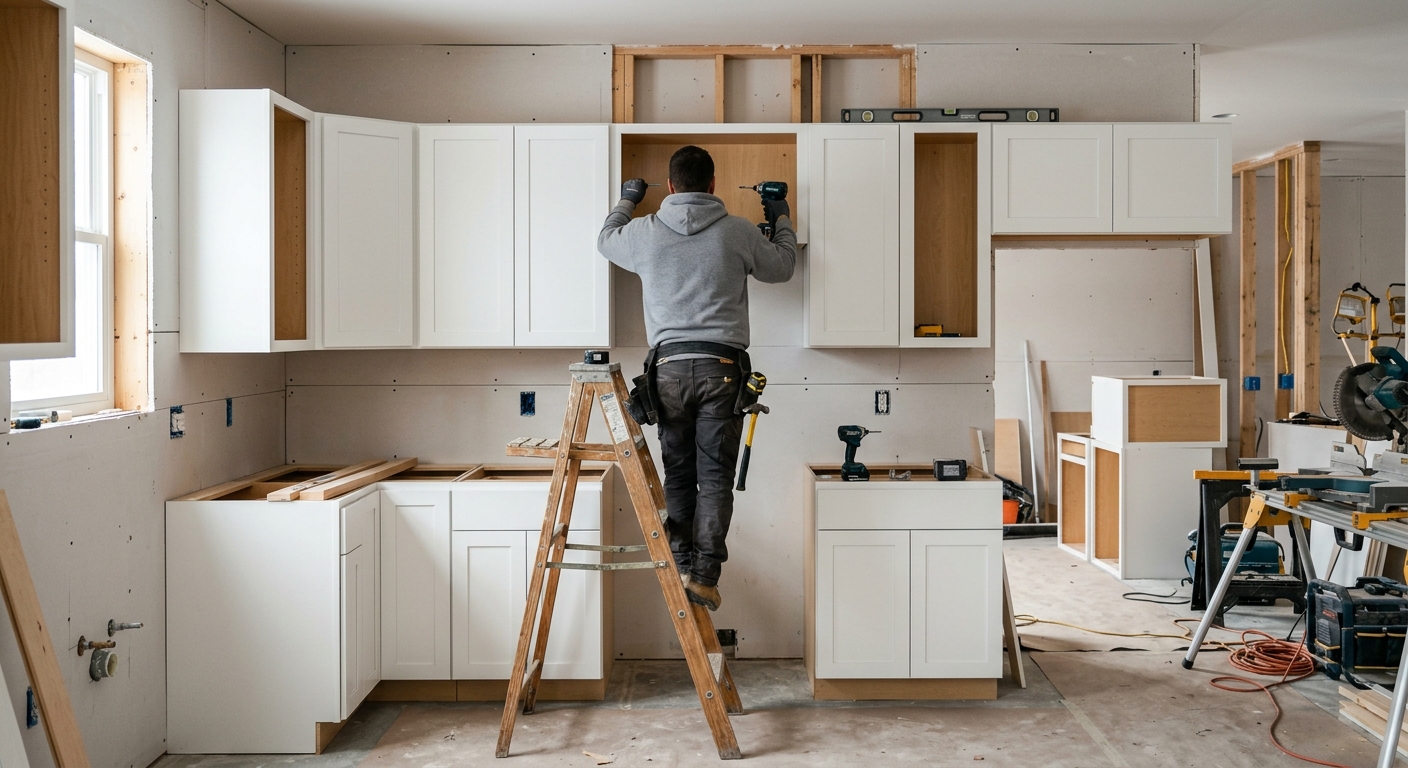
Fairview kitchen renovation prices by scope — 2026
In Fairview, where the median household income is $100,013 and the homeownership rate sits at 90.8% (U.S. Census Bureau, ACS 2024), most homeowners approach kitchen projects as investments. Renovation budgets in Fairview track higher than average, matching the suburban Erie County market, but are driven more by what’s behind the walls than square footage or finishes. Much of this area’s housing dates from before 1950, so kitchens can require substantial work: expect to find legacy wiring and irregular wall framing in these older homes. Those built since the 1990s tend to have layouts that adapt more easily, often requiring just finish work instead of structural changes.
The single most common source of blown budgets is failing to align the initial scope with desired changes. Homeowners may price a simple kitchen refresh, then start specifying layout changes, more expensive cabinets, or broad appliance upgrades—each moving the project into a higher cost category.
| Scope |
What's included |
Duration |
Price range |
| Full gut remodel, same layout |
cabinets, counters, appliances, flooring, lighting, fixtures |
6–10 weeks |
$32,000–$129,000 |
| Gut plus layout change |
all of the above plus moved plumbing, electrical, walls |
10–16 weeks |
$70,000–$129,000 |
| Cabinet replacement (stock to semi-custom) |
remove and install cabinets, hardware, patching |
1–3 weeks |
$7,500–$32,000 |
| Cabinet refacing |
new doors and drawer fronts, veneer, hardware |
3–6 days |
$7,500–$21,500 |
| Countertop replacement only |
template, fabricate, install, reconnect sink |
1–3 weeks |
$4,300–$17,000 |
| Kitchen flooring only |
remove existing, install new flooring |
3–6 days |
$5,400–$21,500 |
Estimates for a typical Fairview kitchen. Cabinet grade and whether the layout changes move these figures more than square footage.
Layout changes and the cost cliff
In Fairview, changing the kitchen’s footprint is the single biggest jump you’ll see in a renovation budget. If you keep all plumbing and electrical where they are, your project can remain in a manageable cost band. Move the sink, range, or major appliances and you’re immediately into the next category, with the cost increase for relocating utilities rarely proportional to how far something moves.
For example, relocating a drain line means working around the realities of slope. If your kitchen sits on a slab or above finished living space, running new drains involves more than just opening walls — the slope must work, access matters, and things escalate quickly. New appliance locations often require dedicated circuits, raising questions about your electrical panel’s capacity. If you want to remove or relocate a wall, you first need to know if it's load-bearing; in Erie County, that triggers an engineer’s review and an official permit. Moving a range hood or installing a new vent means creating a fresh exterior penetration, not always straightforward in homes with stone or thick siding.
For a full gut remodel with the layout unchanged, you’re typically looking at $32,000–$129,000. The second you move walls or major lines, that figure jumps to $70,000–$129,000. Most of that delta is for work you’ll never see—rerouting, structural work, unforeseen repairs. If your layout is merely dated or slightly inconvenient, not fundamentally unworkable, think carefully; the money spent relocating a sink four feet or adding an island’s worth of plumbing is rarely recouped. The gains are only worth it when the kitchen truly can’t function as is.
Surprises in an older Fairview home
With 66.4% of homes in Fairview built before 1980 (U.S. Census Bureau, ACS 2024), surprises behind the walls are the rule, not the exception. Demolition in older Erie County homes often reveals walls out of plumb or floors that have settled over the decades, making it a shimming exercise to install cabinets—this can add $800–$2,000 just for leveling and prep. Wiring is another common surprise: it’s not unusual to find ungrounded or even cloth-insulated wiring that won’t pass inspection, meaning a few thousand more for safe upgrades. Galvanized supply lines and cast iron drains often show up, both prone to corrosion and slower flow, running costs from $1,000–$3,500 if they need to be replaced back to the main.
If you see no insulation in the exterior wall behind cabinetry, that’s another several hundred dollars to cut in and fix—and worth doing, given Erie County’s heavy winter and 6,200 heating degree days. Previous unpermitted work can hold up progress while you sort out corrections with local authorities. For pre-1978 homes, the federal EPA Lead RRP Rule applies—so before disturbing painted surfaces, certified testing and proper precautions are required. Asbestos risk can arise in old sheet flooring and pipe wraps but needs to be verified by specific testing before disturbance. In contrast, newer suburban Fairview homes often confront a wave of builder-grade shortcuts—particleboard cabinet boxes at the end of their life, circuits just barely up to current code, and laminate counters all due for replacement at the same time.
Cabinets are the critical path
For Fairview kitchen renovations, nothing impacts schedule more than cabinet lead time. Many homeowners underestimate what’s involved—or what gets held up if cabinets aren’t ready. The sequence runs like this: first, detailed measurements and design. Next, cabinets are ordered, which starts you on a real timeline; in Erie County, lead times for stock to semi-custom cabinets run five to nine weeks, especially with the labor pool centered in Erie and Millcreek.
Only after cabinets are on the way does demolition make sense—demolishing beforehand can leave you with a bare, unusable kitchen for longer than you expected, especially if surprises come up. Once the job is opened, rough-in electrical and plumbing can proceed and be inspected, but everything waits on cabinets. Once cabinets arrive and are installed, only then can the countertop fabricator come to template—countertops can’t be measured off blueprints, they rely on the actual installed boxes. That’s an unavoidable dead period: after cabinet install, expect at least a week before countertops even begin fabrication, with two to three weeks typical from template to completed install.
Only after counters are in does the rest—backsplash tile, appliances, flooring, and final trim—wrap up. The reality for Fairview is that market demand means you compete with Erie-area volume for both scheduling and deliveries, so ordering cabinetry before any demolition is the smartest move you can make to stay on schedule and minimize disruption.
How a Fairview kitchen budget breaks down
Seeing an actual kitchen renovation budget by category can reorder priorities quickly. In Fairview, cabinetry typically absorbs the largest line item by far—most homeowners set aside 25–35% of project funds here, which means $8,000–$45,000 even in a mid-tier job. Labor is next, comprising 20–30% because older Erie County homes need more skilled work correcting framing and wiring. Countertops, appliances, flooring, lighting, and fixtures make up the next group, their share rising or falling based on the choices you make in finishes and brands.
Two categories are often omitted at first: a contingency—absolutely necessary for pre-1980 Fairview homes given the odds of finding legacy plumbing or wiring—and soft costs, such as permits, design fees, delivery, and disposal. Budget at least 10% for surprises and 3–6% to cover documentation and logistics. If faced with trade-offs, spending an extra thousand dollars here goes furthest in cabinetry quality, panel-ready appliances (to clean up the look), and proper leveling. The least value is gained by splurging on high-end appliances without supporting features elsewhere—versus, say, investing in solid counters over stock cabinets, the latter is usually a mistake.
| Category |
Share of budget |
Notes |
| Cabinetry |
25–35% |
the largest line and the longest lead time |
| Labour and installation |
20–30% |
rises sharply if the layout changes |
| Countertops |
8–15% |
material choice drives the swing |
| Appliances |
10–20% |
widest range of any category |
| Flooring |
5–10% |
|
| Lighting and electrical |
5–10% |
higher in older homes needing circuits |
| Plumbing and fixtures |
4–8% |
|
| Permits, design, disposal |
3–6% |
usually forgotten in early budgets |
| Contingency |
10–15% |
not optional in a pre-1980 house |
Why appliance selection comes first
In Fairview, homeowners often get tripped up by picking appliances after they order their cabinets—it’s the fastest way to end up with a range that does not fit or a fridge that crowds a doorway. All cabinetry measurements hinge on your appliance selections. For example, counter-depth refrigerators look seamless but leave you with shallower cabinet runs; standard-depth fridges stick out unless you design cabinets deeper or build a niche. Slide-in ranges sit flush and require a gap on both sides, while freestanding models don’t—critical for cabinetry planning. Decide on gas versus induction early, because electric upgrades are not trivial in Erie County’s older homes: moving from gas to induction may require panel upgrades, new circuits, or even a new service line.
Panel-ready dishwashers and refrigerators give a custom look, but they’re only possible if planned ahead. For range hoods, ducted exhaust is always better, especially in a region with as much cooking in winter as Fairview sees. Recirculating hoods are a compromise, not a solution—they filter some odors but leave moisture. Professional-grade appliances come with real upsides for passionate cooks: better burners, heavier construction, more accurate ovens. That said, in most suburban kitchens, the premium is largely aesthetic.
Finally, appliance lead times have become unpredictable, sometimes longer than cabinetry. Pick and order appliances first—even basic models—so your renovation flows smoothly.
What requires a permit in a kitchen renovation
In Fairview, permits are required for anything beyond cosmetic kitchen work. Painting, swapping hardware, cabinet refacing, or simple countertop replacement usually cannot trigger a permit. The line is firm when you add or relocate electrical circuits, move plumbing, take out or open up walls, or perform any structural changes. In these cases, expect to document the work for code enforcement, which in Erie County is handled by the City of Erie Department of Codes and Permits where applicable, or other designated authorities in each township.
Electrical work—new circuits, outlets, or panel upgrades—always requires a permit and inspection at township or city level in this region. Moving or adding plumbing also requires one. Venting a new range hood may be considered mechanical work and will be reviewed if it involves new ducting. For older homes, work disturbing painted surfaces in pre-1978 properties invokes the EPA Lead RRP Rule; certified contractors are required, and documentation must be maintained.
Pennsylvania state law requires registration of any contractor taking on contracts over $500—verify their Home Improvement Contractor (HIC) registration at hic.attorneygeneral.gov. Every employer in Pennsylvania must carry workers’ compensation, which you can check in the WCAIS system (wcais.pa.gov). If work is done without permits or by unregistered crews, it will be flagged during any future home sale—banks and realtors know to ask.
Frequently asked questions — kitchen renovation in Fairview
How long does a kitchen renovation take in Fairview?
The timeline for a kitchen renovation in Fairview depends on the project’s scope and the age of your home. A straightforward cabinet and countertop update might take as little as three weeks, while a full gut remodel with a layout change often requires 10–16 weeks. In older Fairview homes—two-thirds of the housing stock is pre-1980—unexpected delays are common due to the need for electrical and plumbing upgrades or fixing uneven floors and walls. Coordinating with the core of kitchen labor based in Erie and Millcreek also impacts schedules, often stretching out the tail end of the project. Plan for lead times on cabinets and a dead period while countertops are templated and fabricated. For a full gut remodel with layout change, expect $70,000–$129,000 and a patient approach, especially if you want it done right.
Is lead paint a concern in Fairview kitchen renovations?
Yes, lead paint is a concern in many Fairview homes given that 66.4% were built before 1980 (U.S. Census Bureau, ACS 2024). Any renovation that disturbs painted surfaces in homes built before 1978 falls under the federal EPA Lead RRP Rule. This means certified contractors must test for lead and follow specific containment and cleanup procedures. If your renovation involves demolition or sanding, expect this to add several hundred dollars in cost and possibly a few days to the schedule, but it’s not optional if you want to do the job legally and safely. Don’t let anyone talk you out of it—your health and any future resale depend on compliance. Even a countertop replacement can trigger the rule if base cabinets are painted. For context, even projects like cabinet refacing ($7,500–$21,500) may involve lead paint precautions.
Does a kitchen renovation increase home value in Fairview?
Most Fairview homeowners see some increase in resale value after a quality kitchen renovation, but dollar-for-dollar recovery depends on scope and finish level. Because Fairview has a high homeownership rate (90.8%) and most homes are single-family, buyers expect more than builder-basic materials. Renovations in the middle of the price band—think cabinet replacement and updated counters rather than a full-scale layout change—usually offer the best return since they modernize the space without over-improving for the market. Spending at the high end ($129,000) rarely translates to a matching bump in appraised value, so weigh those choices carefully. What helps most is correcting functional or code problems: fixing layout bottlenecks, adding outlets, proper ventilation, and making the kitchen feel move-in ready for another family.
What does a full gut kitchen remodel cost in Fairview?
A full gut kitchen remodel in Fairview with the same layout typically costs $32,000–$129,000, with most projects landing around the $70,000 mark. The wide range reflects both the cost of materials and, most importantly for this market, the condition of what’s behind the walls. Older homes in Fairview frequently reveal wiring or plumbing that needs complete replacement, or a floor that must be leveled before new cabinets go in—all of which pushes costs up quickly. Layout changes or moving appliances/fixtures into new locations can send the price to the top of the band. If your kitchen’s footprint works, keeping everything in place keeps costs under much better control.
Who inspects kitchen electrical work in Fairview?
In Fairview and the wider Erie County area, kitchen electrical work—like adding circuits, outlets, or upgrading panels—must be inspected by the municipal authority where your home sits. For Fairview Township, this falls under the local enforcement of the Pennsylvania Uniform Construction Code, with inspections managed either directly by township officers or, in some cases, through the City of Erie Department of Codes and Permits if jurisdiction is shared. This inspection is not optional: electrical work is the main item buyers and real estate agents flag during resale. Expect permit and inspection fees as a line item, which usually runs about 3–6% of the total project cost—for example, $2,000–$4,000 on a major remodel.
How much do new kitchen cabinets cost in Fairview?
New kitchen cabinets in Fairview typically run from $7,500–$32,000 when replacing stock or semi-custom lines. The price depends on cabinet construction (plywood boxes cost more but last longer than particleboard), finish quality, interior accessories, and whether existing walls and floors need major leveling or repair before installation. In older Erie County homes, expect a chunk of the cabinetry budget to go toward shimming and prepping uneven substrates, especially if you’re trying to achieve a high-end fit and finish. In the typical Fairview kitchen, most families budget around $21,500 for new cabinets, which balances durability and appearance without tipping into true custom territory.
Should I choose plywood or particleboard cabinet boxes?
In Fairview, plywood cabinet boxes are the better investment if you have the choice and the budget. They handle the seasonal swings in humidity caused by Lake Erie winters and resist sagging or damage when cabinets need to be shimmed onto less-than-perfect walls—which is common, given Erie County’s pre-1950 housing. Particleboard cabinets are cheaper and work okay in newer, flatter homes, but in older kitchens prone to moisture and movement, they may swell or delaminate over time. Upgrading from base particleboard to plywood may add $1,000–$2,000 total—less than 10% of the overall cabinet cost for most jobs in the $7,500–$32,000 price band. If you must cut costs, compromise on doors or drawer types, not the cabinet box itself in older Fairview homes.
How should renovation payments be scheduled?
Pennsylvania’s Home Improvement Consumer Protection Act requires a written contract for any job over $500, and that contract should spell out a schedule of payments tied to actual progress. In Fairview, standard practice is to pay a deposit (often 20–33%) to secure labor and materials, a second draw when cabinets are ordered or work begins, a third when rough-in is complete, and the remainder upon substantial completion. Never pay the entire sum upfront. For a cabinet replacement in the $7,500–$32,000 band, expect to commit a third to start and the rest as the project hits major milestones. Hold the final payment until you can confirm punch-list items are resolved. If your contractor won’t agree to these terms, find another.
Do I need to change my kitchen layout?
Not always. In Fairview, many kitchens benefit from modernizing finishes and updating fixtures without moving walls or major plumbing runs. Most budgets get wrecked when a homeowner decides mid-project to relocate the sink or add an island with plumbing—pushing a project from the $32,000–$129,000 range well into the next tier. Unless your layout is truly dysfunctional—like a door that blocks the fridge or no countertop space near the range—sticking to the existing footprint is the best value. Focus upgrades on storage, lighting, and surfaces. In homes built in the 1950s or earlier, the compact galley style can sometimes warrant a rethink, but always weigh the cost of structural and utility work versus how much function you really stand to gain.